Image source: wikiart.org
Introduction
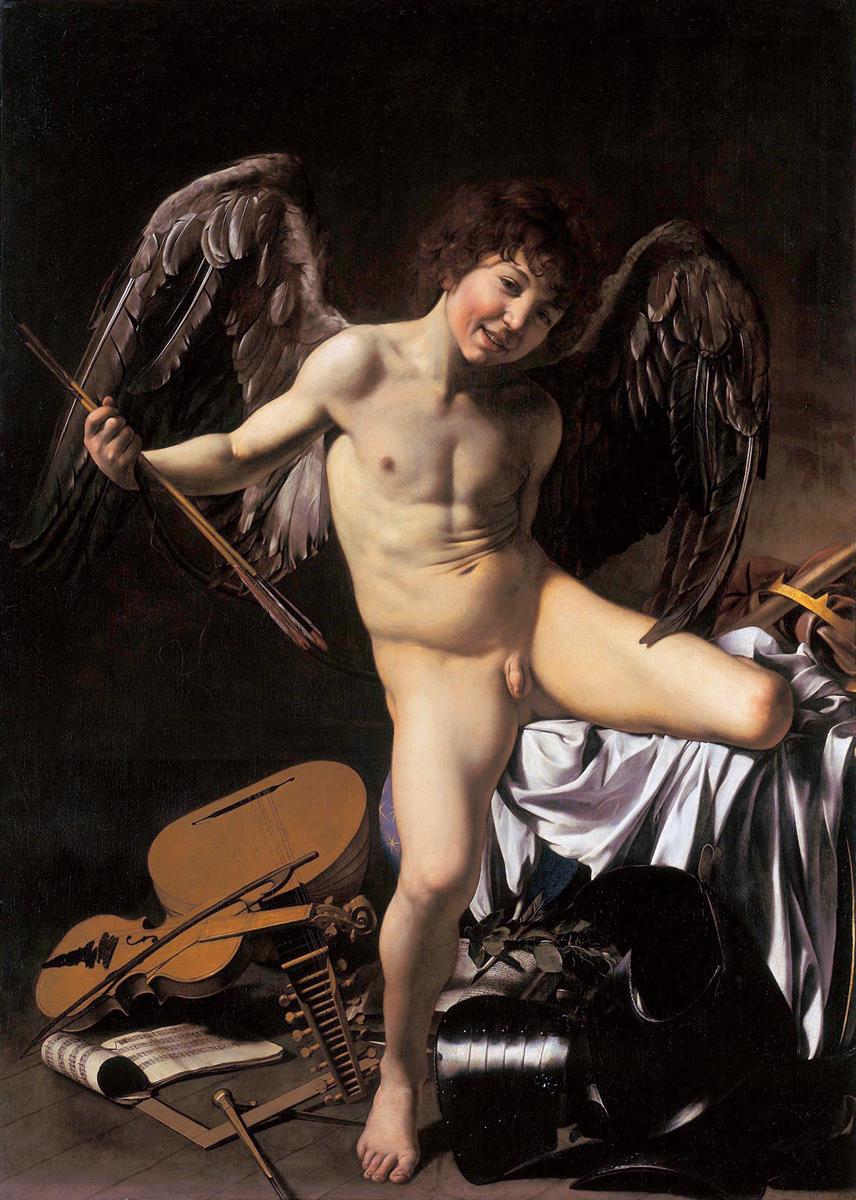
Caravaggio’s “Amor Victorious” (1602) is a paradox wrapped in a grin. A mischievous Cupid—wings spread, bow in hand, body unabashedly nude—perches on a rumpled mattress amid the fallen trophies of human ambition: music, geometry, poetry, armor, and power. He leans forward with an almost theatrical wink, as if letting us in on a joke that culture keeps trying to forget—that love, with its unruly arrow and soft footfall, conquers everything. In Caravaggio’s hands the classical theme becomes neither allegorical wallpaper nor a courtly compliment. It is a startlingly physical manifesto, staged in a shallow, tenebrist space where objects gleam with tactile truth and a boy-god claims dominion simply by being alive.
Historical Context
Painted during Caravaggio’s Roman ascent, “Amor Victorious” was likely commissioned by the banker Marchese Vincenzo Giustiniani, a sophisticated collector who appreciated both classical learning and radical naturalism. Rome circa 1600 was negotiating the Counter-Reformation demand for clarity with the aristocratic taste for myth. Caravaggio answered by treating myth through the same lens he brought to saints and cardsharps: direct observation under a purposeful beam of light. His Cupid carries ancient symbolism yet looks like a boy pulled from a Roman street—hair tousled, grin lopsided, wings modeled after real feathers rather than idealized plumage. This marriage of the antique idea and the contemporary body is the painting’s core innovation.
Subject and Allegory Brought to Earth
The Latin motto “Amor Vincit Omnia” (Love conquers all) traditionally invited artists to parade emblems of music, war, scholarship, and rule—each humbled by Cupid. Caravaggio retains the emblems but refuses rhetorical distance. The youth dominates the picture not with abstractions but with radiant flesh and a gaze that meets ours. Around him lie a lute and violin with broken strings, a theorbo, sheet music half unrolled, a compass and square for geometry, a laurel crown for poetry, and a piece of black armor glinting like an unused threat. The message is classical, but the delivery is up-close and earthy: life’s passions and projects find their measure in love’s disruptive presence.
Composition and the Architecture of Triumph
The entire composition tilts toward Cupid. His body forms a robust diagonal from wingtip to planted foot, balanced by the counter-diagonal of the draped sheet and the splayed instruments below. Caravaggio compresses the space so that the foreground objects feel within reach; the back wall disappears into darkness, making Cupid’s pale skin the visual anchor. The boy’s right elbow props the bow as if it were a casual toy, while his left leg crosses audaciously over the bed, knee thrust forward to claim the center. Nothing crowds him; everything points to him. The viewer’s eye travels a loop from Cupid’s smile to the bow, down his torso to the foot, across the silver cloth to the armor and instruments, and back up the curve of the wing—an orbit that repeatedly confirms his sovereignty.
Chiaroscuro and the Behavior of Light
Light enters like a verdict from above left, igniting Cupid’s torso, the satin fabric, and the polished surfaces of wood and steel. Caravaggio’s tenebrism is precise rather than theatrical. The darkness around the figure is not a mere backdrop; it functions as air that throws the lit forms forward, sharpening edges where truth matters most: the crisp ribcage, the taut forearm, the crisp seam of an armored cuisse. On Cupid’s wing the painter feathers light, letting barbs catch glints while the shafts sink to brown—an effect that makes plumage convincing without fuss. The bow casts a delicate shadow across the boy’s abdomen, proof that this radiance obeys physics even as it declares meaning.
The Body as Argument
Caravaggio’s Cupid is not porcelain; he is a teenager on the cusp between child and youth, with a gawky charm that refuses idealization. A faint farmer’s tan at hip and thigh, callused toes, and a playful asymmetry in the smile root the god in the human. Muscles are modeled with translucent layers that keep warmth beneath cool highlights; skin gathers into small folds where the torso bends, and the navel sits not as a dot but as a shallow hollow. This credible body is the painting’s thesis: love’s power is located in incarnate life, not in a remote allegory. It conquers not by decree but by delight—by the magnet of living presence that topples systems simply by reordering attention.
Gesture, Gaze, and Controlled Provocation
The pose carries both swagger and invitation. Cupid leans into our space with shoulders back, left knee forward, right hand loosely gripping the bow in a way that flaunts capability without menace. The head tilts and the mouth opens into a teasing grin that collapses mythic distance. He is aware of looking and being looked at; this complicity is Caravaggio’s wit. Viewers accustomed to marble Eros find themselves addressed by someone who can reach for an arrow at any second—or set the weapon aside and laugh. The ambiguity keeps the scene buoyant: love disarms and arms simultaneously.
The Fallen Trophies: Music, Knowledge, and Power
The still-life array at Cupid’s feet is a Caravaggist inventory that doubles as a philosophy of culture. The lute’s snapped string and cracked soundboard signal music’s susceptibility to passion; melody is born of tension and easily undone by it. The theorbo’s long neck angles like a ladder toward the bed—a visual bridge from disciplined art to embodied play. The compass and square lie open and idle: reason and geometry can measure the world, but love remeasures the measurers. The laurel crown rests unused; fame bows to a grin. Most striking is the black armor, its curved plates shining dully as if recently set down. War is no match for this barefoot sovereign. Yet Caravaggio does not mock these pursuits. He paints them with respect, as goods that find right order under Cupid rather than ruin.
Color and the Emotional Climate
The palette is restrained but strategic. Cupid’s warm flesh and brown-black wings dominate against the near-black ground, while the white-silver drapery throws cold light that heightens his warmth. Ochres and golden woods of the instruments add a mellow register; the armor drinks light in glossy blacks; the small violet-blue of the mattress cover peeks with nocturnal coolness. Caravaggio avoids sugary hues, keeping the mood adult. Love here is not pastel sentiment but a force with weight and temperature, staged in a room whose colors whisper continuity with his religious canvases.
Fabric, Feathers, Wood, and Steel: Tactility as Persuasion
Caravaggio’s textures argue as persuasively as his composition. The satin sheet puckers into luminous ridges; its highlights describe every fold like cartography. Wing feathers are painted with a patient mix of browns, greys, and pearly tips that catch the beam without metallic glitter. The lute’s varnish reflects a soft glow, contrasting with the rawer wood of the theorbo. The armor’s curved plates show tiny dings under a slick finish, testimony to a human past now paused. Such tactile truth dissolves doubt about what we see and allows the mind to receive the allegory under the spell of credible things.
Eroticism, Innocence, and the Baroque Edge
The figure’s nudity, frank and frontal, has long stirred debate. Caravaggio steers a narrow channel between erotic charge and classical decorum. The boy’s sexuality is acknowledged but not exploited; desire is treated as a gravitational fact rather than a smirk. His grin plays on the viewer’s self-awareness: do we approach as connoisseurs of allegory or as humans susceptible to beauty? The Baroque delight in engaging the viewer is present, but Caravaggio controls it with moral poise. Cupid’s power is not to titillate; it is to reorder priorities. The painting’s heat serves its thesis.
The Stage Without a Story
Unlike Caravaggio’s narrative masterpieces, “Amor Victorious” has no before or after. The scene is a state of affairs, a proposition visually proved. The shallow stage—stone tiles barely visible at lower left—puts us in a studio-like chamber that could be anywhere. The absence of setting universalizes the claim: wherever culture lays out its instruments, love will sit among them and smile. By subtracting context, Caravaggio converts allegory into presence.
Classical Echoes and Anti-Idealism
Renaissance and Mannerist artists often rendered Cupid as porcelain smooth, with tiny wings and a contrived pose. Caravaggio reverses the trend. His Cupid is oversized for the mythic child, wings broad and mottled like those of a real raptor, and the body carries the quirks of a living model. This anti-idealism is not disrespect for antiquity; it is fidelity to the antique insight that a god may appear unannounced in the ordinary. The result is a paradox the ancients would recognize: the divine carves its signature into the human, not away from it.
Patronage, Display, and the Shock of Candor
Giustiniani’s circle prized pictures that provoked and delighted in equal measure. “Amor Victorious” would have commanded attention in a gallery—its startling nudity, its technical bravura, and its insolent humor all calibrated for conversation. The painting reveals Caravaggio’s instinct for patron psychology: he gives collectors allegory they can explain to guests while delivering the visual jolt that makes gatherings memorable. The work’s fame in Rome attests to how cannily he balanced erudition and immediacy.
Morality Under the Smile
For all its playfulness, the painting carries a sober undercurrent. Love conquers—yes—but it conquers us as much as our institutions. The scattered objects register a gentle critique of vanity, not a nihilistic dismissal. Music without love becomes noise; geometry without love becomes sterile; war without love becomes monstrous. The armor’s emptiness is chilling precisely because it is beautiful. Caravaggio’s Cupid is not destructive but corrective, and his grin implies responsibility: what will you pick up again after acknowledging my rule, and how will you use it?
Technique and Paint Handling
Caravaggio builds the figure with thin, translucent veils of pigment that allow warmth to breathe under cooler highlights—visible on the clavicles, abdomen, and knee. Edges are handled with exquisite discipline: sharp where light cuts (bow, armor rim, sheet crests), softened where form turns (hip, shoulder, downy feathers at the wing’s edge). The instruments’ inlays and frets are suggested with economical strokes, never fussy but always legible. Micro-accents—pinpoint glints on the bow’s tip, a wet shine along the lute’s varnish—act like musical grace notes. The surface reads as inevitable rather than labored, a hallmark of Caravaggio’s maturity.
Dialogue with Caravaggio’s Oeuvre
“Amor Victorious” shares DNA with the painter’s early musicians and still lifes—urban youths posing with instruments, fruit that looks ripe enough to bruise, surfaces rendered with unsentimental care. It also converses with his sacred dramas: the same directional light that singles out saints now exalts a pagan boy; the same shallow stage that thrusts martyrs into our space now belongs to Cupid. The coherence is thematic: whether in a chapel or a collector’s palace, Caravaggio paints forces that command human attention—grace, mortality, desire—and he paints them as events occurring here and now.
Reception, Copies, and Influence
The canvas quickly gained fame; copies proliferated, and the image of a naturalistic Cupid entered the Baroque vocabulary. Later artists borrowed the idea of allegory grounded in the studio’s real light and real flesh. Even critics who frowned at the frankness could not deny the work’s authority. Modern viewers, accustomed to photography, find in it a startling contemporaneity: a person, not a type, standing in a room, daring us to admit that our carefully tuned pursuits—art, war, science—tilt toward love’s gravity.
How to Look
Begin with Cupid’s smile and track the line of the bow to the glowing abdomen, then down to the planted foot. Cross the silver cloth to the armor and instruments; note the broken lute string, the rolled sheet music, the compass’s open legs. Climb back through the wing where light feathers into shadow, and return to the face. Repeat this orbit and the painting’s thesis solidifies: every object is a satellite; the body is the sun. The longer you look, the more the grin seems less taunt than invitation—to reorder your own table of priorities.
Conclusion
“Amor Victorious” is Caravaggio’s audacious claim that love’s empire is not abstract. It is as concrete as skin warmed by light, as persuasive as feathers catching glints, as undeniable as a broken string at a dancer’s feet. By collapsing classical allegory into a studio encounter, he renders an ancient motto newly urgent. The god of desire is not a myth in books; he is a presence amid our instruments, smiling as he rearranges them. Four centuries on, the picture remains disarming because it speaks in the grammar of things we recognize—bodies, tools, fabric—and because it trusts that what conquers truly does not need a crown. It only needs to be seen.