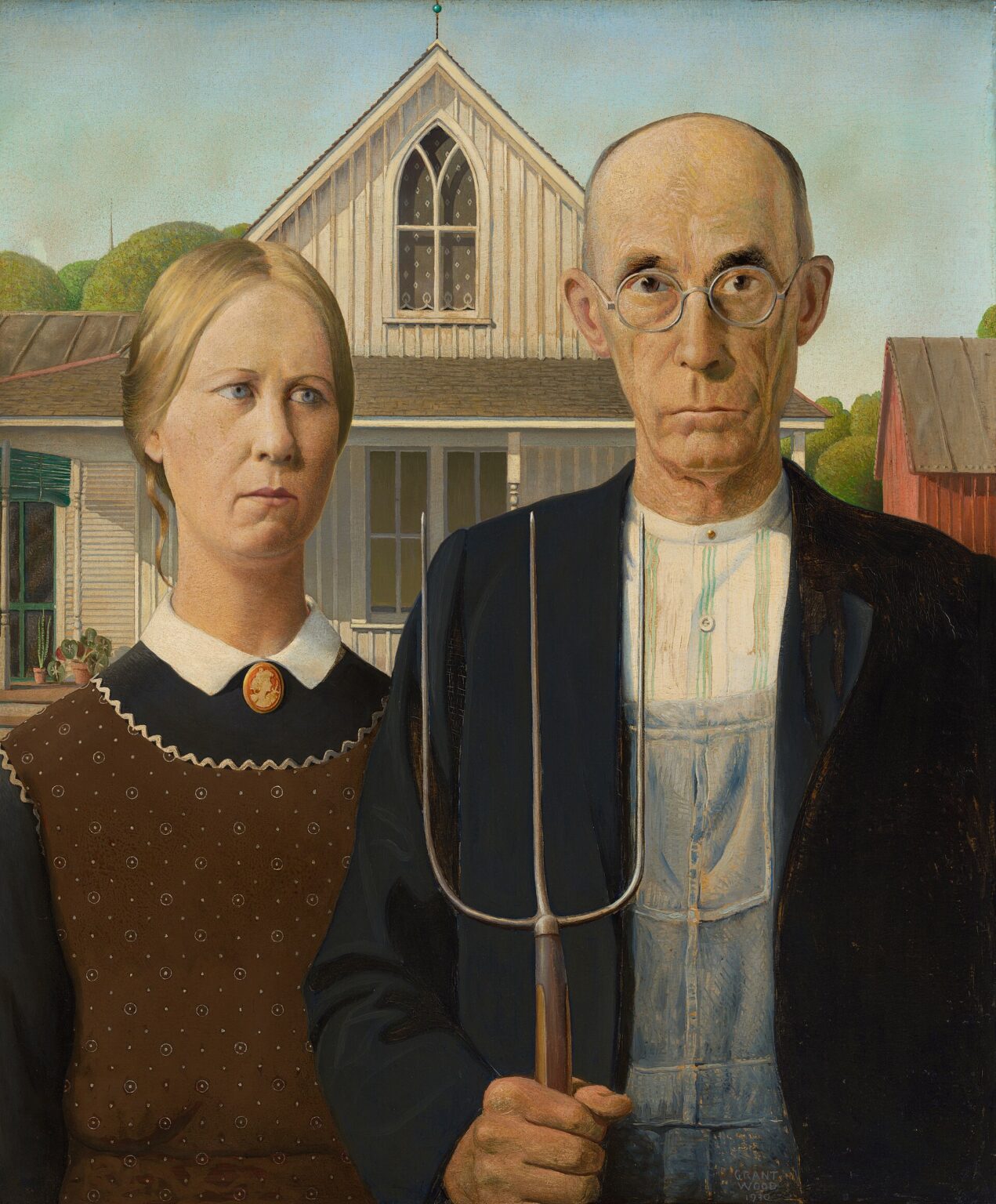
Image source: wikimedia.org
Introduction
Grant Wood’s American Gothic is one of the most recognized paintings in the history of American art. Created in 1930, it has become far more than a portrait of two rural figures standing in front of a white farmhouse. It is now a cultural symbol, a visual shorthand for the American Midwest, and a work that continues to provoke debate about identity, tradition, class, morality, and national character. Few paintings have entered public consciousness so completely. Even people who know little about art often recognize the stern man, the serious woman, and the sharply pointed Gothic window behind them.
Part of the painting’s lasting power comes from its simplicity. At first glance, American Gothic appears straightforward. Two figures are posed before a house, rendered with clean detail and an almost severe orderliness. Yet this clarity is precisely what makes the painting so open to interpretation. Is it a tribute to hardworking rural Americans, or is it a subtle satire of small-town values? Is it affectionate, ironic, respectful, critical, or all of these at once? Wood never locked the painting into one single meaning, and that ambiguity has helped it survive changing tastes and changing cultural climates.
The work emerged during a crucial moment in American history. Painted at the beginning of the Great Depression, it appeared when questions about what counted as truly “American” had become especially urgent. Modern cities were growing, industry had transformed daily life, and many artists were looking toward Europe for stylistic inspiration. At the same time, there was a strong desire to define a distinctly national visual language. Wood answered that desire by turning toward the rural Midwest, not as a vague idealized fantasy, but as a carefully observed world of architecture, clothing, faces, and habits. In doing so, he created an image that feels specific to Iowa and universal to the United States.
Historical Context and the America of 1930
To understand American Gothic, it helps to place it within the social atmosphere of 1930. America was entering economic collapse after the stock market crash of 1929. The optimism of the previous decade was giving way to anxiety, uncertainty, and a reevaluation of national values. In such a moment, images of endurance, labor, self-restraint, and tradition could carry enormous emotional weight. Rural America, whether accurately or romantically imagined, became a site onto which many people projected ideas of stability and authenticity.
Grant Wood was part of a broader movement often associated with Regionalism, a current in American art that emphasized local subjects, recognizable places, and national identity rooted in everyday life rather than imported European models. Regionalist artists often focused on the land, the people who worked it, and the visual character of American regions. Wood, who was deeply connected to Iowa, became one of the central figures of this movement. Yet American Gothic is more complicated than a simple Regionalist manifesto. It is local, but not narrow. It is accessible, but not simplistic. It is realistic, but also highly constructed.
The painting reflects a period when Americans were asking what kind of nation they were. The rural Midwest, in this context, could stand for endurance, plainness, morality, and continuity. At the same time, urban audiences often viewed rural communities with a mix of nostalgia, condescension, fascination, and humor. American Gothic sits directly within that tension. It gives viewers a highly disciplined and memorable image of Midwestern life, but it never tells them exactly how to feel about it.
The Subject and Its Immediate Visual Impact
The composition of American Gothic is unforgettable because it is so direct. Two figures stand shoulder to shoulder in the foreground. The man, holding a pitchfork, faces the viewer with a stern, tight expression. Beside him stands a woman, slightly turned away, her gaze directed to the side rather than outward. Behind them rises a white house with a distinctive Gothic-style window in the upper story. Trees and carefully trimmed plants soften the background, but the dominant impression is one of order, rigidity, and restraint.
This frontal arrangement gives the painting a confrontational quality. The figures are very close to the picture plane, leaving little space between themselves and the viewer. They do not welcome us into the scene in any warm or narrative way. Instead, they present themselves almost like emblems. Their stillness feels formal, posed, and deliberate. This gives the painting a strange tension. These are clearly human beings, yet they also seem larger than themselves, as if they represent a type, an era, or a way of life.
The emotional tone of the painting is shaped by facial expression and posture. The man’s face is long, narrow, and severe. His lips are pressed together, his eyes alert and unsmiling. The woman appears more inward, less confrontational, but not relaxed. Her expression is subdued and difficult to read. Together they create a mood that is serious, disciplined, and slightly uneasy. There is no overt tenderness between them, no anecdotal action, no dramatic gesture. Everything is controlled.
That control is essential to the painting’s power. Nothing in American Gothic feels accidental. The figures, the house, the pitchfork, the clothing, and even the direction of the gazes have been arranged to create an image of striking visual unity. It is not a casual snapshot of country life. It is a carefully built icon.
Composition and Structure
One of the reasons American Gothic is so effective is its strong compositional design. Wood organizes the painting with remarkable precision. Vertical lines dominate the image. The man’s body is upright and narrow, the pitchfork rises vertically, and the house behind them reinforces the same structural firmness. These repeated verticals create a visual rhythm that suggests discipline, uprightness, and moral rigidity.
The most famous echo in the painting is the relationship between the pitchfork and the Gothic window. The pitchfork’s three prongs find a formal counterpart in the pointed divisions of the window above. This repetition links the man, his labor, and the house into one tightly ordered system. The figures do not merely stand in front of the house. They seem to belong to it, shaped by the same values of structure, endurance, and plainness that the building itself expresses.
Wood also uses balance in a subtle way. The two figures are close together but not symmetrical in expression or orientation. The man looks directly forward, while the woman looks away. This small difference prevents the composition from becoming static in a dull sense. Instead, it introduces psychological complexity. Their relationship is near, but not unified in an easy emotional way. They share space and identity, yet remain distinct in mood.
The surface clarity of the painting reinforces the structure. Edges are crisp, forms are legible, and details are carefully defined. Wood avoids painterly looseness. There is very little visual ambiguity in the rendering itself. This precision gives the image an almost sculptural stillness. The figures appear fixed in place, as if time has paused around them.
The Meaning of the House and the Gothic Window
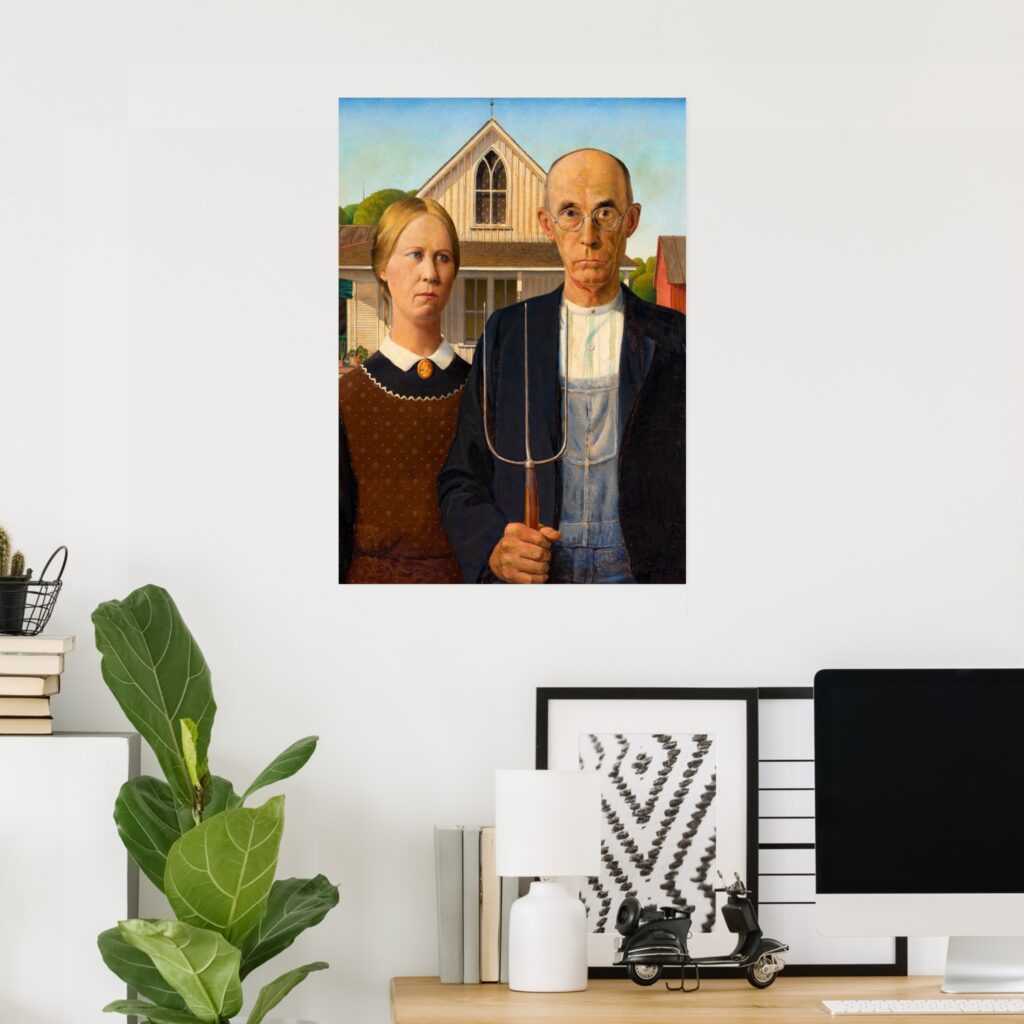
The title American Gothic comes not from the figures, but from the architectural feature behind them. The house includes a pointed upper window in the Carpenter Gothic style, a rural American adaptation of Gothic Revival architecture. This detail is crucial because it gives the painting both its name and much of its symbolic charge. The window transforms the house from a generic rural dwelling into something culturally specific and visually memorable.
The Gothic window introduces a note of aspiration. It suggests that even in a modest rural setting, there is a desire for beauty, order, and inherited style. The house is not grand, but it carries traces of older architectural ideals. That matters because American Gothic is partly about how Americans shape identity through objects, homes, and appearances. The window implies that culture and taste are not confined to cities or elite spaces. They appear here in local, practical, adapted form.
At the same time, the house contributes to the painting’s ambiguity. Its decorative Gothic feature feels slightly formal and slightly odd within the plain rural setting. This can be read either as a touching sign of aspiration or as a subtle sign of stiffness and pretension. Wood leaves room for both readings. The house is well kept, but it is not romanticized into warmth. It is neat, closed, and almost severe, much like the figures before it.
The house also functions as an extension of the people. It is a visual statement about their values, or at least about how they wish to be seen. The clean white siding, the upright geometry, and the carefully maintained appearance suggest discipline, respectability, and pride. This is not a home presented as cozy or intimate. It is presented as an exterior identity, a public face.
The Figures and Their Psychological Complexity
Much of the fascination of American Gothic comes from the relationship between the two figures. They are often assumed to be husband and wife, but Grant Wood described them as a father and daughter. That distinction changes the painting in subtle ways. A married couple might imply partnership, domestic continuity, or mutual dependence. A father and daughter suggest generational order, family authority, and inherited values. Yet the painting never becomes purely narrative. It does not tell a story so much as stage a relationship.
The man embodies severity. His expression, posture, and grip on the pitchfork all suggest vigilance and restraint. He appears hardworking, guarded, and perhaps unyielding. His role as bearer of the pitchfork identifies him with labor and rural life, but the tool also feels symbolic. It is not simply an agricultural implement. It becomes a sign of character, discipline, and even authority.
The woman is more enigmatic. She does not meet the viewer’s gaze. Instead, she looks slightly away, creating psychological distance. Her profile, clothing, and downcast seriousness suggest modesty and decorum, yet her inwardness also invites speculation. Is she dutiful, resigned, skeptical, shy, or quietly self-contained? Wood gives her less overt power than the man, but perhaps more mystery.
Together, they form a pair defined by tension rather than intimacy. They do not interact through gesture or glance. Their closeness is physical, but emotionally reserved. This restraint is central to the painting’s tone. It evokes a world where feelings are controlled, social roles are fixed, and identity is shaped by duty rather than self-expression.
Clothing, Detail, and Symbolic Precision
Wood’s treatment of clothing is one of the most striking features of the painting. The man’s overalls and jacket identify him with labor and rural practicality, while the woman’s apron and dress evoke domestic order and modest femininity. These garments are not loosely suggested. They are rendered with exacting attention, which gives them a symbolic weight beyond mere costume.
The detailing of the apron, the brooch at the woman’s collar, and the stitching of the clothing all contribute to the sense that this is a world built on care, repetition, and visible propriety. The people define themselves not through luxury, but through correctness. Their clothes are not fashionable in an urban sense, yet they are presented with dignity and deliberateness.
The pitchfork is the most famous object in the painting, and it deserves close attention. Its sharp vertical form echoes both the man’s face and the Gothic window. In formal terms, it binds the whole image together. Symbolically, it stands for work, rural identity, and a kind of hard-edged moral seriousness. It gives the man a severity that might otherwise remain merely facial. The tool reinforces his role as an embodiment of labor and order.
Wood’s precision with objects creates a world in which every detail matters. This is one reason the painting resists simple interpretation. Because the details are so specific, the image feels grounded in reality. Because they are so carefully arranged, the image also feels symbolic. The painting exists between portrait and emblem, document and construction.
Style and Technique
Grant Wood’s style in American Gothic combines realism with stylization. The painting is naturalistic enough to make the figures and architecture immediately recognizable, but it does not aim for photographic spontaneity. Instead, Wood simplifies, sharpens, and organizes forms in ways that heighten their symbolic presence.
Faces are elongated and cleanly modeled. Surfaces are smooth. Light is even and controlled. There is little atmospheric softness or emotional drama in the handling of paint. This gives the picture a polished clarity that can feel almost hard. It lacks the loose brushwork associated with Impressionism and the fragmentation associated with avant-garde modernism. Wood instead chooses a deliberately legible style that feels rooted in older traditions of portraiture and Northern European precision.
This technical control contributes to the painting’s unsettling effect. Because everything is so clear, the image can feel more intense rather than more natural. The viewer notices the tight mouth, the angular features, the rigid posture, the repeated shapes. Precision becomes a way of intensifying psychology. The stillness becomes almost eerie.
Wood’s technique also helps explain why the painting has been so widely reproduced. It reads immediately, even at small scale. Its major forms are clear, its contrasts are strong, and its defining symbols are easy to identify. Yet that accessibility does not weaken the painting. Instead, it makes it unusually durable. It can function as both mass-cultural image and serious work of art.
Respect, Irony, and the Problem of Interpretation
The greatest debate surrounding American Gothic concerns tone. Does the painting honor rural Americans, or does it gently mock them? This question has followed the work for decades, and part of its genius lies in the fact that it supports both readings.
On one hand, the painting can be seen as a tribute. The figures are presented with dignity, seriousness, and monumental presence. They are not caricatured in any crude sense. The meticulous attention to their clothing, home, and bearing suggests care rather than contempt. In a moment of national instability, such figures could be interpreted as symbols of endurance and moral steadiness.
On the other hand, the painting contains elements of exaggeration and stiffness that suggest irony. The severe expressions, the exaggerated uprightness, and the almost overdetermined matching of pitchfork and window can feel slightly too perfect, slightly too rigid. There is a theatrical quality to the seriousness, as if Wood is aware of the gap between appearance and lived reality.
This uncertainty has allowed different generations to claim the painting in different ways. Some viewers read it as conservative and nostalgic. Others see it as a subtle critique of narrowness, repression, or self-presentation. Still others understand it as a work that registers the complexity of American identity without choosing a side. That last reading may be the most convincing. American Gothic is powerful because it does not reduce its subjects to either heroes or fools. It captures the tension between admiration and distance, belonging and observation.
American Identity and the Myth of the Midwest
Over time, American Gothic has come to represent much more than the people or place it depicts. It has become a central image in the mythology of the American Midwest. The painting suggests qualities often associated with that region: hard work, reserve, practicality, thrift, religious seriousness, and attachment to tradition. Whether these qualities are being celebrated or questioned, they are unmistakably present.
The painting also helped define a visual language of Americanness. Instead of grand historical scenes or mythological subjects, Wood offers ordinary people in ordinary surroundings. Yet he gives them a formal gravity usually reserved for more elevated themes. This move was deeply important in American art. It suggested that national identity could be found not in borrowed European grandeur, but in local life, regional architecture, and familiar faces.
At the same time, the painting reveals how national identity is always partly constructed. The figures are not simply observed. They are posed, framed, and transformed into symbols. In this sense, American Gothic does not merely reflect America. It helps invent an idea of America. It takes one regional image and elevates it into a national one.
That process of transformation explains why the painting continues to matter. Even viewers far removed from Iowa or rural life can recognize in it broader questions about self-presentation, tradition, family, and the relationship between individuals and the ideals imposed upon them. The painting is American not only because of its setting, but because of its engagement with national myths.
Cultural Legacy and Endless Reinvention
Few paintings have had the afterlife of American Gothic. It has been parodied, quoted, adapted, and reimagined countless times in popular culture. The central pose has been reused with celebrities, politicians, fictional characters, couples, families, and social groups of every kind. This endless reinvention proves just how fully the image has entered public memory.
Yet parody has not diminished the original work. In some ways, it has confirmed its strength. For an artwork to become endlessly adaptable, it must possess extraordinary structural clarity. American Gothic offers exactly that. The pose, the pitchfork, the expressions, and the house create a template that remains recognizable even when altered.
Its cultural afterlife also reveals something about the original painting itself. Because the work is already slightly stylized and slightly ambiguous, it lends itself naturally to reinterpretation. It is serious, but not so solemn that it cannot be played with. It is iconic, but not closed. Each parody depends on the viewer’s recognition of the original tension between dignity and rigidity, sincerity and performance.
This is why American Gothic has never faded into mere textbook importance. It remains alive because it can still be used to think about identity, society, and image-making. It belongs both to museum culture and to everyday visual culture, which is a rare achievement.
Conclusion
American Gothic endures because it compresses so much meaning into such a controlled and seemingly simple image. Grant Wood transformed a rural American scene into a national icon by combining precise observation with formal discipline and interpretive ambiguity. The painting gives viewers two figures, a house, and a pitchfork, but from those elements it opens a much larger meditation on America itself.
Its continuing relevance lies in its refusal to settle into one meaning. It can be read as homage, satire, portrait, symbol, or cultural mirror. It speaks to the Great Depression era that produced it, but it also speaks to later generations who continue to argue about tradition, identity, respectability, and the myths a nation tells about itself. The painting is rooted in one place and one moment, yet it has become timeless.
Grant Wood’s achievement was not simply to paint rural America. It was to create an image so exact, so memorable, and so psychologically charged that it could stand for competing ideas at once. American Gothic remains one of the defining works of American art because it captures the tension between the local and the national, the real and the symbolic, the sincere and the ironic. That tension is what keeps the painting alive, and what ensures that viewers continue to return to it with fresh eyes.