Image source: wikiart.org
Introduction to Rubens’ “Altarpiece of St. Ildefonso (Right Panel)”
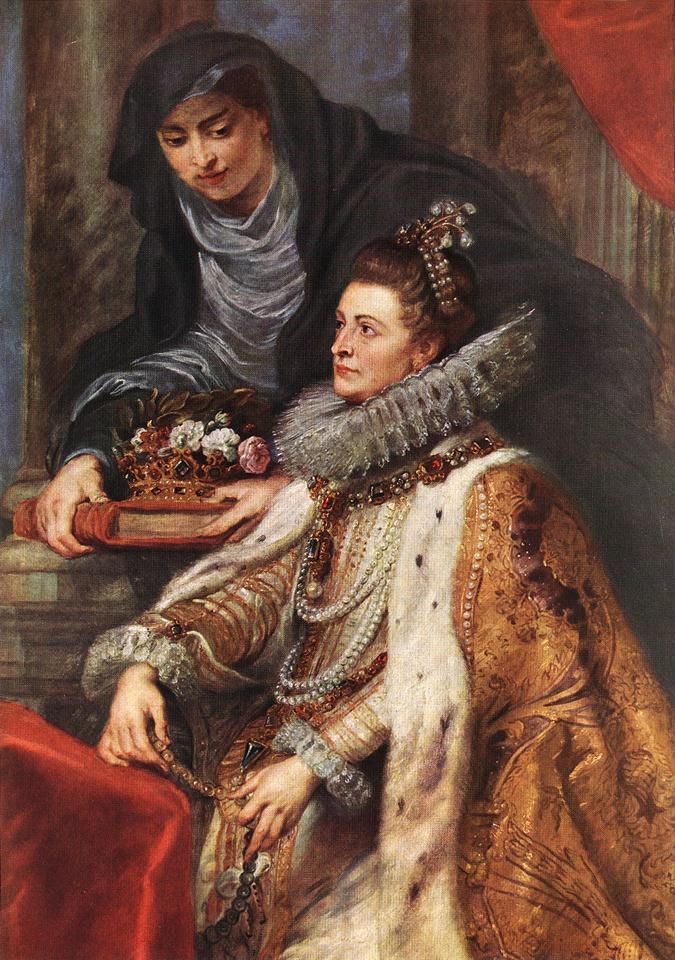
Peter Paul Rubens’ “Altarpiece of St. Ildefonso (right panel),” painted in 1639, is a refined late Baroque portrait that mixes courtly splendor with quiet devotion. This panel belongs to a larger triptych designed for the Brotherhood of St. Ildefonso in Antwerp and focuses on a richly dressed noblewoman—traditionally identified as Isabella Clara Eugenia, sovereign of the Spanish Netherlands—attended by a veiled companion who offers her a crown of flowers. The scene fuses political authority, personal piety, and Marian symbolism, encapsulating Rubens’ ability to turn religious commissions into psychologically layered portraits.
The right panel is not merely a side-piece to the central image; it is a fully realized work in which costume, gesture, and setting all contribute to a sophisticated statement about power and humility. The sitter appears as a ruler draped in ermine and gold, but her expression and accessories underscore her role as a devout protector of the Church.
Historical Context and the St. Ildefonso Altarpiece
The “Altarpiece of St. Ildefonso” was commissioned for the church of St. James in Antwerp, a city where Rubens spent most of his career. The Brotherhood of St. Ildefonso, dedicated to the Marian theologian bishop of Toledo, sought a grand altarpiece celebrating the Virgin’s privileges and the confraternity’s noble patrons. Rubens created a triptych: a central panel with the Virgin and St. Ildefonso and two flanking panels portraying the archducal patrons in devotional attitudes.
The right panel, painted near the end of Rubens’ life, reflects both the religious and political realities of the Spanish Netherlands. Isabella Clara Eugenia, daughter of Philip II of Spain and widow of Archduke Albert, ruled as governor and remained a crucial supporter of Catholic reform in the region. Depicting her as donor alongside St. Ildefonso anchored the brotherhood’s devotion in the authority of the ruling house and linked local piety to Habsburg power.
By 1639 Rubens was an aging yet celebrated master. He had served as diplomat as well as painter, negotiating for peace during the Thirty Years’ War. In this late work he combines his deep understanding of courtly protocol with an increasingly tender, introspective style. The right panel becomes a meditation on a ruler at the end of her life, balancing worldly honors with spiritual preparation.
Composition: Two Figures in Intimate Dialogue
The composition of the right panel is remarkably focused. Two figures dominate: the seated noblewoman draped in luxurious robes, and the standing veiled attendant who leans in from behind a column, offering a tray bearing a crown made of flowers and jewels. The closeness of the two women, their bodies nearly touching, creates a sense of personal conversation within a grand ceremonial setting.
The seated figure occupies the lower right half of the canvas. Her body turns slightly toward the viewer while her head faces the attendant in profile. This pose allows Rubens to display the full richness of her costume and regalia while still suggesting attentive engagement with the offering. Her right hand rests lightly on an unseen armrest; her left hand holds a rosary that drapes over a red fabric, linking her physical presence to devotional practice.
The attendant stands behind and above her, framed by a grey column and dark drapery. Cloaked in a sober, dark garment and white head covering, she contrasts sharply with the golden, fur-trimmed splendor of the seated woman. Her gesture—hands forward, supporting the tray—leans diagonally into the composition, guiding the viewer’s eye from her face to the floral crown and then down to the donor herself.
The tight grouping of the figures, combined with the shallow architectural background and hints of red curtain at the right, gives the scene an intimate, almost domestic feel, despite the regal context. Rubens uses this intimacy to suggest that the exchange between the two women has deep spiritual meaning, not just ceremonial formality.
Costume, Regalia, and the Language of Power
One of the most striking features of the right panel of the “Altarpiece of St. Ildefonso” is the opulence of the main sitter’s garments. Rubens meticulously renders an ermine-lined robe embroidered with gold patterns, which cascades across her lap and down the side of the chair. The fur lining, with its delicate dark spots, and the intricate brocade signal royal or archducal status. This is not a generic aristocrat but a sovereign accustomed to formal ceremonial dress.
Around her neck, the sitter wears an extravagant ruff, built up of fine lace that creates a radiant halo-like frame for her face. Long strands of pearls and gemstones drape across her chest, forming complex loops and clusters. Rubens paints each jewel with small touches of color and highlight, mimicking the play of light on polished surfaces. These adornments emphasize the patron’s wealth and political stature, while pearls in particular allude to purity and Marian devotion.
The coronet in her elaborately arranged hair, along with jeweled hairpins, further asserts her rank. Yet the jewels do not overpower her; they form a stately architecture that echoes the columns behind her and the feathery lace at her throat. Rubens knows that clothing in court portraiture is a language of power, and he allows it to speak clearly.
At the same time, the sitter’s right hand gently holds a rosary—the intimate instrument of personal prayer. The beads glint softly against the red fabric. This rosary, quietly prominent in the lower part of the painting, balances the worldly shine of the jewels, suggesting that the true measure of the ruler lies as much in devotion as in rank.
The Veiled Companion and the Crown of Flowers
The standing woman in dark clothing plays a crucial symbolic role. She has often been interpreted as a nun or female attendant, perhaps representing Isabella’s later life when she took the habit of the Poor Clares. Dressed in a simple dark cloak and white veil, she embodies humility and religious renunciation, in direct contrast to the luxurious attire of the seated sovereign.
In her hands she bears a wooden tray on which rests a crown composed of flowers, leaves, and precious stones—a wreath that fuses natural beauty with crafted splendor. The crown’s floral form evokes crowns of virtue or heavenly reward, while its jeweled elements hint at earthly honors. By having the veiled figure present this object to the seated woman, Rubens may be suggesting that Isabella offers her temporal crown to Mary or to God, receiving in exchange the crown of spiritual merit.
The attendant’s expression is gentle and contemplative. She inclines her head slightly, as if explaining or encouraging the transition from worldly power to spiritual dedication. Her presence adds a narrative dimension: the painting becomes not just a portrait, but a scene of counsel and offering, a visual echo of religious vows and acts of patronage.
Setting and Architectural Symbolism
The background architecture of the right panel subtly reinforces its themes. Behind the two women stands a classical column, rendered in cool stone tones that contrast with the warmth of the fabrics. The column suggests stability, tradition, and the enduring structure of Church and state. Its vertical line frames the figures and visually supports the weight of the crown and jewels.
A partially open door is visible behind the attendant. This door can be read symbolically as a threshold between different states: court and convent, earthly life and spiritual retreat, temporal rule and eternal salvation. The way the attendant stands in front of it reinforces her role as mediator or guide across that threshold.
To the right, a swath of red curtain descends in heavy folds, echoing the rich red textile beneath the sitter’s hand. In Baroque painting, red drapery often evokes both luxury and sacrifice—royal stage and altar cloth. Here it may hint at the altarpiece setting and the sacrificial dimension of renouncing worldly power for religious dedication.
Light, Color, and Rubens’ Mature Palette
The lighting in this panel is soft yet focused. A gentle, golden light falls from the left, illuminating the faces of both women and the textures of their clothing. The sitter’s pearls and gold embroidery catch small, bright highlights, while the attendant’s dark cloak absorbs light, creating depth and emphasizing her modesty.
Rubens’ palette in this late work combines warm golds, creams, and reds with cooler greys and blacks. The interplay of warm and cool tones guides the viewer’s eye: warm hues emphasize the principal figure and the crown, while cool shadows in the background recede. The flesh tones, particularly in the face and hands of the donor, are delicately modeled with rosy undertones, lending her a sense of living presence and advanced age without harshness.
This restrained yet rich color scheme is typical of Rubens’ last decade, when his painting grew more atmospheric and less dependent on high-contrast drama. Instead of the explosive diagonals of his earlier altarpieces, the “Altarpiece of St. Ildefonso (right panel)” offers a balanced, almost contemplative harmony of tones, appropriate to a subject that blends ceremony with introspection.
Psychological Insight and Characterization
One of Rubens’ great strengths as a portraitist is his ability to convey character. In this panel, the sitter’s face is that of an older woman—cheeks softening, eyes slightly heavy—but her expression is alert and resolute. She looks forward with a calm, steady gaze, suggesting a lifetime of experience in governance and diplomacy. There is a trace of weariness, but also of dignity and acceptance.
The slight smile at the corner of her mouth and the relaxed posture of her hand on the rosary communicate an inner serenity. She is neither stiffly formal nor overly sentimental. Instead, Rubens presents her as a sovereign who has found equilibrium between duty and devotion.
The attendant’s face, in contrast, is younger and shaded by a hood. Her eyes are lowered, her mouth gently closed. She exudes quiet supportiveness rather than assertive authority. Together, the two women form a psychological pairing: a worldly ruler preparing for spiritual transition, and a religious figure guiding and affirming that path.
Rubens’ sensitivity to expression allows viewers to feel that they are witnessing a private moment of decision and reflection, not merely observing a display of costume.
Devotional Function within the Altarpiece
While the right panel can be appreciated as an independent portrait, its full meaning emerges in relation to the entire “Altarpiece of St. Ildefonso.” In the context of the triptych, the donor figures on the side panels kneel or sit in adoration of the Virgin and St. Ildefonso in the central scene. Their lavish dress and jewelry declare their status as earthly rulers and patrons, but their gestures and proximity to devotional objects highlight their subordinate, worshipful role.
The crown of flowers in this panel likely echoes Marian imagery in the central portion, where the Virgin may be crowned or honored. By presenting the sovereign with a floral crown rather than a purely golden one, Rubens suggests that true sovereignty lies in humility and union with the Virgin’s virtues. The rosary, the attendant’s quasi-monastic clothing, and the architectural setting of columns and doorways all reinforce the idea that political power should be oriented toward spiritual ends.
For members of the Brotherhood of St. Ildefonso and parishioners of St. James, the panel would have functioned as a visual model. It depicted their rulers not just as distant monarchs but as fellow worshippers who placed themselves under Mary’s protection and intercession. That message would have been particularly poignant during a period marked by war and religious tension.
Rubens’ Late Style and Legacy in Portraiture
Painted only a year before his death, the “Altarpiece of St. Ildefonso (right panel)” showcases Rubens’ mature style at its most refined. The brushwork is confident yet not ostentatious; details such as lace, fur, and jewelry are suggested with quick, precise strokes rather than painstaking linear description. The overall effect is one of shimmering richness rather than photographic accuracy.
This ability to evoke texture and weight with economical means influenced generations of later painters, including Van Dyck and the portraitists of the eighteenth century. Rubens’ blend of grandeur and psychological insight in this panel anticipates the great state portraits of European courts, where rulers are shown both in their regalia and as individuals with particular temperaments.
At the same time, the panel testifies to Rubens’ deep Catholic faith and his conviction that art could encourage piety as well as display power. By merging donor portrait, Marian symbolism, and subtle narrative, he created an image that continues to invite contemplation not only of historical personalities but of the relationship between worldly responsibility and spiritual aspiration.
Conclusion
The “Altarpiece of St. Ildefonso (right panel)” by Peter Paul Rubens is a rich, layered work that rewards close study. On the surface, it is a sumptuous portrait of a royal patron in full regalia, attended by a modest companion and surrounded by luxurious fabrics and jewels. Beneath that surface, however, lies a complex allegory of devotion, renunciation, and the transition from temporal rule to spiritual preparation.
Through careful composition, textured color, expressive faces, and symbolic objects such as the floral crown and rosary, Rubens presents the sitter as both powerful sovereign and humble devotee. The panel’s combination of courtly grandeur and intimate psychological insight exemplifies Rubens’ late Baroque mastery and underscores his role as both painter of princes and painter of souls.