Image source: wikiart.org
A Stage-Built Image of Empire
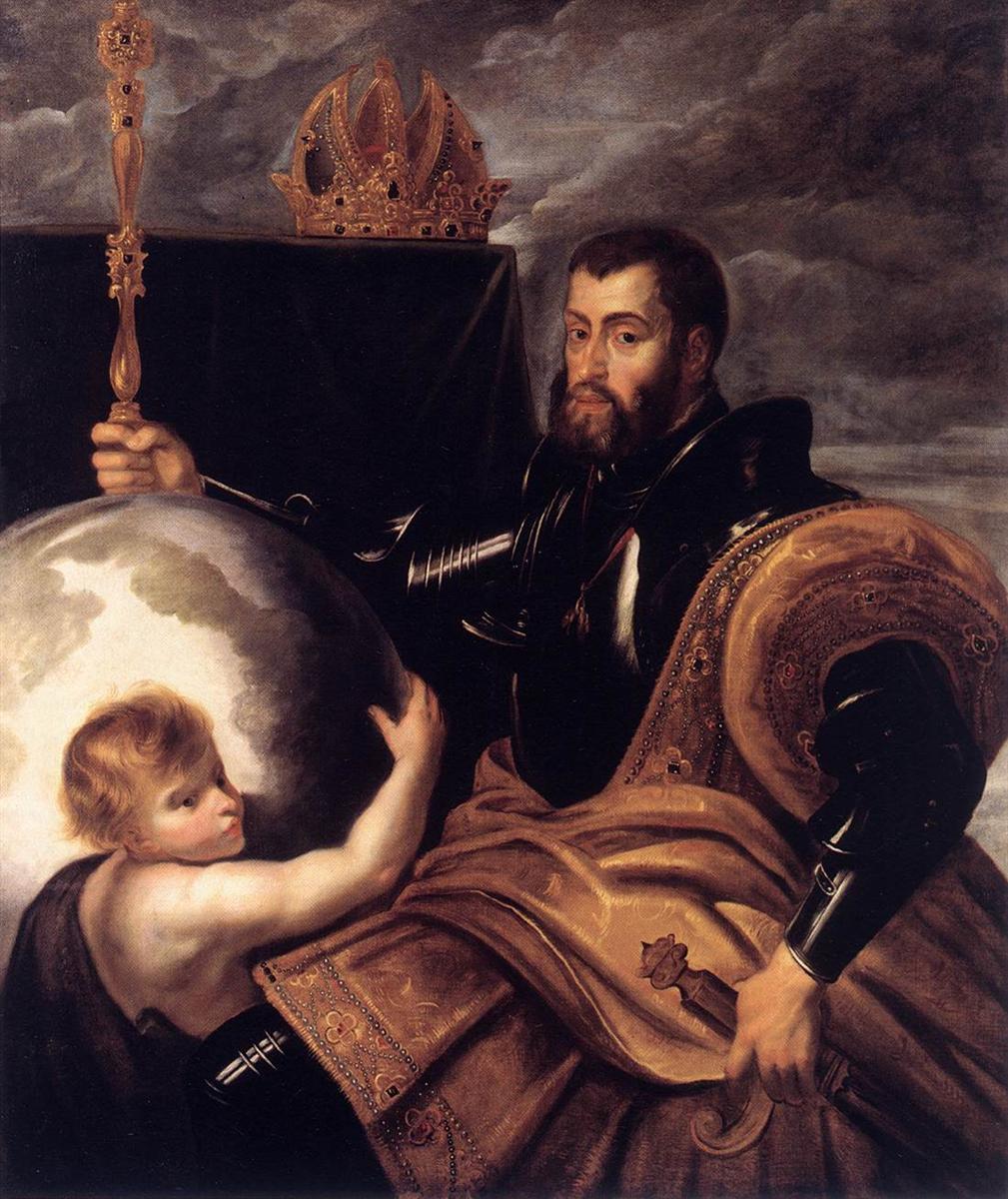
Peter Paul Rubens’s “Allegory on Emperor Charles as Ruler of Vast Realms” (1604) distills imperial ideology into a compact, legible theater of symbols. The emperor appears half-length in black, mirror-polished armor, turned slightly toward us, his left hand resting on a sword hilt while his right arm lifts a jeweled scepter. A monumental globe presses into the foreground, embraced by a fair-haired child. Above a dark curtain rests the arched imperial crown, its red and green jewels glinting against a sky sewn with thunderclouds. With a handful of elements—scepter, crown, armor, globe, and the small attendant—Rubens composes a complete political sentence: Charles rules by right (regalia), by force (arms), over the whole world (globe), with Providence and posterity at his side (the child figure), even amid history’s storms (the brooding sky).
Painted in the early years of Rubens’s Italian period, the picture is both a tribute to the Habsburg legend of Charles V and a virtuoso exercise in giving abstract power a breathing presence. Rather than scattering allegories across a wide stage, Rubens brings them close and sets them into convincing touch with the emperor’s body. The result is a portrait that reads first as a person—and then as a comprehensive emblem of dominion.
Context: Charles V as Enduring Model
By 1604, Charles V had been dead for nearly half a century. Yet throughout the Habsburg world he remained the gold standard for imperial propaganda—conqueror at Mühlberg, defender of the faith, and master of territories that stitched Europe to the newly charted Americas. Courts in Spain and in the Holy Roman Empire continued to commission images that renewed his myth as a model for ruling descendants. Rubens, moving through Mantua and Spain, was steeped in that visual tradition. His composition answers Titianic prototypes of the emperor in armor while compressing the pageantry into an intimate allegory. It functions like a portable monument: the sovereign ideals of the dynasty reduced to essential, shining tokens.
The Globe: Dominion Held in the Hands
The painting’s true protagonist is the globe, large enough to eclipse much of the lower canvas. Rubens refuses cartographic fuss; continents melt into a cloudy, pearly surface suggesting both land and atmosphere. That ambiguity serves the allegory, shifting meaning from map to idea—“the orb of the world.” The emperor’s armored forearm rises behind it like a steel meridian, while the child clings to it as if to a planet that requires both care and strength. A glancing highlight rides the sphere near the child’s hands: a small dawn on a world held steady by imperial authority. In earlier Renaissance imagery the orb often sits as a small royal apple atop a scepter. Rubens magnifies it to a real, heavy planet the ruler must balance, an update suitable to the Habsburg aspiration to globe-spanning order.
The Child: Genius, Atlas, or Future?
Who is the boy? Rubens leaves the identity productively open. He can be read as a personified Genius of Empire, a putto-like assistant who cooperates in the governance of the world; as a modernized Atlas, shouldering cosmic weight with tender strength; or as an emblem of posterity—the future generation that benefits from the emperor’s discipline. The child’s compact musculature and rosy light contrast with the black sheen of Charles’s armor, dramatizing a partnership between innocence and authority. He looks toward the emperor, not toward the viewer, as if awaiting instruction. That gaze helps knit the figures into a single, efficient government: command issued, help supplied, world steadied.
Armor and Mantle: Ethics of Splendor
Rubens paints the armor as if it were moral philosophy in metal. Broad planes of black steel catch white sparks of reflected light, the curves of the vambrace and breastplate modeled with restrained brilliance. A sumptuous ocher mantle, embroidered with red and green scrollwork, drapes over the right shoulder and cascades across the lap. The mantle’s gold warmth answers the cool severity of the armor, tempering martial readiness with magnificence proper to a Christian emperor. The sword hilt, controlled rather than brandished, underlines a theme carried through many Rubens portraits of rulers: strength available, but governed; violence not as appetite but as tool of justice.
The Scepter and the Crown: Regalia in Conversation
The scepter stands upright—an axis that organizes the painting. It rises from the emperor’s hand like a column of legitimacy, topped with a small finial that catches a cometic highlight. Behind it, perched on a velvet-covered stand, the imperial crown insists on the continuity of office beyond any one person. Rubens places the crown slightly above and behind the emperor’s head so the viewer reads it as both near and beyond him: a charge he bears, not a trinket he flaunts. The triangulation among globe, scepter, and crown forms a tight geometry of rule: governance of the world (orb), by lawful authority (scepter), under the sanction of empire (crown).
Composition: A Half-Length Monument
The composition is as economical as a coin relief. The emperor occupies the right side; the globe and child claim the left; the regalia and curtain crown the upper band. The diagonal of the scepter balances the globe’s roundness; the oblique of the mantle answers the angle of the child’s embrace. A nearly square black field of curtain interrupts the vaporous sky, giving the crown a hard, ceremonial stage and keeping the design from dissolving into atmospheric blur. Though the painting is half-length, it feels monumental because Rubens scales the symbols to the figure’s size. There is no wasted space; every inch contributes to the communication of sovereignty.
Light and Weather: Providence in the Air
The sky churns with thick, smoky clouds, a weather of history. Yet the light on faces, metal, and fabric is clear and humane. Rubens orchestrates a subtle, moral chiaroscuro: darkness attends the world, but authority—temperate, luminous—orders it. Highlights are placed strategically: a cool flash along the breastplate’s ridge; a warmer glisten on the mantle’s embroidered edge; a milky gleam along the globe; a precise star on the scepter’s top. The picture breathes with these nodes of light, and the viewer senses that political order is a kind of illumination that does not erase the storm but navigates within it.
Color: Black, Gold, Flesh, and the Stone of the World
The palette is simple and sovereign. Black armor and curtain define gravity; golden cloth and jewelry deliver magnificence; flesh tones of emperor and child add living warmth; the globe’s gray-white surface acts as the painting’s moon, a cool counterweight to the mantle’s sun. Rubens threads small reds and greens through ornament and crown to animate the gold without cheap sparkle. Because he limits the basic color families, each hue reads with heraldic force. Even the sky—a smoldering mixture of slate and bruised violet—serves the central chromatic drama rather than distracting from it.
The Emperor’s Face: Presence Over Pageant
Rubens’s psychological acuity anchors the allegory. Charles’s expression is steady and inward, neither theatrical nor remote. The beard frames a mouth that holds the faint pressure of responsibility; the eyes meet the viewer without challenge. The face is built with cool transitions, the kind Rubens learned from Venetian models: moist lower eyelid, soft shadow under cheekbone, a single careful highlight at the brow. The portrait refuses flattery and avoids severity; it gives us a ruler thinking. That interiority grounds the symbols in character. The world can be trusted to a mind that appears composed.
The Curtain and the Stagecraft of Power
State images often rely on drapery as stagecraft. The black hanging here is not merely backdrop; it functions as a portable throne room. It squares the crown, sets off the profile of the scepter, and introduces a geometric reserve that disciplines the swirling sky. In a single black plane Rubens compresses the institutions of court—the canopy, dais, and velvet textiles—into a legible sign that saves space while intensifying symbolic focus. The painting could hang in any palace and conjure ceremony by its own devices.
Rubens’s Technique: Glazes, Sparks, and the Breath of Surfaces
Up close the surface reveals a technical intelligence equal to the iconography. Rubens builds the armor with layered dark glazes so that highlights sit atop depth rather than on an opaque black. The mantle receives broader, buttery strokes, with thin red or green accents scumbled into gold to simulate woven threads catching the light. Flesh is handled with pearl grays and warm pinks, and the child’s cheek carries a radiant bloom that casts a faint reflection onto the globe. The crown’s jewels are not laboriously counted; they are suggested by a few crisp, colored touches, letting the eye finish the craft. Everywhere, the painting trusts the viewer’s imagination—Rubens’s hallmark economy of means.
Allegory That Stays Legible
Baroque allegory often risks opacity; here, clarity reigns. The painting reads at once, even across a room. Yet it also rewards nearness: the child’s tiny dagger hilt, the fringe at the mantle’s edge, the soft reflection of armor on the globe’s surface. Because the symbols are integrated with the bodies—scepter in hand, crown at shoulder height, globe held and hugged—the scene never feels pasted together. Meaning is enacted, not merely displayed.
Political Use and Audience
A picture like this would have circulated among Habsburg allies and governors, a visual memorandum of imperial ideals. Unlike a battlefield panorama, it communicates beyond the specifics of campaign or treaty. Any viewer in the orbit of Habsburg power could read the message: lawful rule shelters the world, and Charles remains the dynasty’s measure. In a court culture that prized ceremony, the painting doubled as a stand-in for imperial presence—an image that could bless a chamber with authority.
Dialogue With Other Rubens Images of Charles
Rubens painted Charles in armor without allegorical extras and produced a full-length equestrian type in the Habsburg vein. This allegory sits between those modes, combining lifelike presence with emblematic argument. Compared with the sober half-length “Charles V in Armour,” it is more theatrical but also more condensed; compared with later, larger triumphs, it is intimate enough to feel like a consultation rather than a parade. That variety demonstrates Rubens’s flexibility: he could tune the same sovereign to different registers depending on the room, the patron, and the intended effect.
The Moral Temperature of the Image
What keeps the painting fresh is its ethical pitch. The emperor’s power is neither vaunted nor excused; it is shown as a responsibility that requires vigilance and restraint. The child’s embrace humanizes the world, and the sword kept at rest implies peace as the monarch’s preference. Even the storm clouds feel more like the weather of history than like divine threats. In a time that often painted victory with loud color and trumpeting symbols, Rubens offers a quieter triumph: composure.
Why the Allegory Matters Now
Contemporary viewers, skeptical of grand claims, can still engage this picture because it dramatizes governance as balance. The world is heavy but held; symbols are glittering but disciplined; the face is serious but humane. We can read the painting as propaganda and as a meditation on leadership at once. Rubens shows how images create political myths without abandoning the human being inside the myth.
Conclusion: Empire Made Persuasive
“Allegory on Emperor Charles as Ruler of Vast Realms” demonstrates Rubens’s gift for turning abstraction into palpable experience. He fuses globe, crown, scepter, and armor with living flesh and gives them credible weight and reflective light. In doing so he offers not only a Habsburg catechism but also a lesson in pictorial ethics: power looks most convincing when it appears steady, luminous, and responsible. The painting condenses a continent of meaning into one room—an eloquent emblem that still speaks in the clear grammar of hand, metal, cloth, and the rounded stone of the world.