Image source: wikiart.org
A Young Conqueror Forged in Half-Light
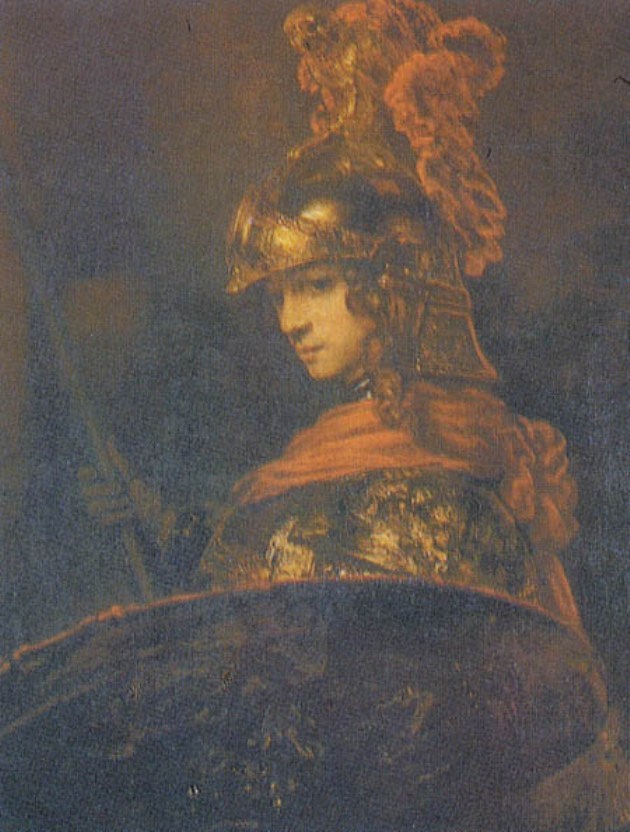
Rembrandt’s “Alexander the Great” offers not a parade or a battlefield but a moment of inwardness. The figure turns in profile beneath a crested helmet, shoulders mantled, a staff or spear receding into the gloom and a vast shield advancing toward us like a dark planet. The pose is quiet and withheld, the expression meditative. Power, in this image, is not noisy. It gathers itself in silence and shadow, negotiating resolve before action. From the first glance the painting proposes a different kind of heroic picture—one in which character, rather than spectacle, carries the weight of history.
The Composition’s Triangle of Authority
The design is anchored by a firm triangular scaffold. At the apex glows the helmet’s plume; one side of the triangle descends along the profile of the face and down to the shield’s rim; the other falls through the scarf at the shoulder toward the lower right. This geometry stabilizes the figure without freezing it. An internal S-curve slips from the faint spear at upper left, through the helmet’s glints, across the cheek and mouth, and out along the shield’s broad arc. The eye follows this path almost unconsciously, passing from the instruments of command to the seat of judgment and finally to the apparatus of defense. The hero’s body becomes a diagram of authority arranged in planes of light.
Chiaroscuro as Crown and Discipline
Light functions as regalia. It gathers where it matters—on the helm, the cheekbone, a knot in the scarf—and leaves the rest in temperate dusk. Instead of a theatrical spotlight, Rembrandt gives a slow, intelligent illumination that moves across metal like thought across a plan. The helmet flashes with small points of brilliance, each bright note balanced by neighboring half-tones that keep the glow persuasive rather than ostentatious. The face is treated more gently than the armor; it receives a calmer light, as if to say that judgment must be steadier than glory. The darkness is not a void but a medium, a dense air in which metal breathes and fabric thickens.
A Palette Tempered to Command
The color world is restrained and durable: bronzed ochres for the helm and breastplate, deep wine for the cloak, olive and slate for the atmosphere, aubergine and tarry browns for the shield. Within this economy Rembrandt finds abundance. Warmth pulses up through the scarf and into the lower planes of the helmet; cooler tones settle in the background so the figure can advance. The shield’s near-black panel is not a dead zone; close looking finds bruised blues and iron violets that catch fugitive reflections. This palette refuses pageantry in favor of focus. It trains the eye to read value relationships the way a general reads terrain.
Surface, Touch, and the Physics of Armor
Rembrandt’s handling turns paint into a credible physics of metal, leather, and feather. The helmet’s curved plates are built with dense, oily glazes, then articulated by tiny, loaded touches that pucker into rivets and edges. The plume is a mass of feathery swipes and drag marks that break into air at the tips, translating softness by the speed of the brush. The breastplate carries thicker passages of pigment, gloved and pressed so that highlights sit on their crests like hammered gilding. The shield’s wide plane is smoother and darker, its lustre subdued; it receives light rather than broadcasting it, a reservoir for reflections that tempers the painting’s blaze. Facture here is not garnish; it is how the picture persuades the body of the viewer that the hero’s equipment has weight and temperature.
The Shield as Planet and Ethical Argument
The shield occupies nearly a quarter of the surface, thrust forward like a world in eclipse. Its presence shifts the painting’s rhetoric from unilateral aggression to a more complex grammar of power. Defense is monumental and unavoidable; offense is a slender vertical, implied by the staff at the far left. This reversal—making protection tangible and attack conceptual—lends the figure a modern dignity. He is armed, but his first principle is not violence. The shield’s scale also deepens space by contrast: as it advances, the figure’s thought seems to retreat into privacy, creating a theater where action and contemplation negotiate a truce.
Profile, Youth, and the Psychology of Command
The face is youthful, almost delicate. Curls slip from beneath the rim; the jaw is not yet heavy; the mouth is closed in a line of concentration. Rembrandt avoids swagger. The lowered gaze resists the traditional heroic stare and replaces it with a look of measured attention. This profile is aristocratic without arrogance—an Alexander who knows that conquest, to endure, must be governed by discipline. The image vibrates in the interval between promise and experience: a young man already habituated to the weight of decision.
From Tronie to History: A Studio Practice Made Moral
Seventeenth-century Dutch painters often made “tronies,” character studies in fanciful dress used to test light and expression. Rembrandt mined that tradition but refused to stop at costume. He uses the same intimacy and immediacy—a sitter close to the picture plane, materials described with relish—yet tightens the psychological screws until the study becomes an “exemplum,” something to think with. The helmet does not simply denote antiquity; it suggests the habit of preparedness. The scarf’s warm loop does not merely decorate; it softens the soldier with humanity. The painting evolves from an exercise into an argument about how power should look.
A Theater of Edges
Edges carry the narrative. The serrated shine along the visor establishes the authority of metal; the soft edge where scarf meets breastplate releases warmth into the anatomy; the shield’s rim is crispest where it passes the face, then falls into blur as it arcs into shadow. This choreography of clarity and softness tells a story of focus. The mind is where distinctions sharpen; the periphery remains elastic and negotiable. Even the background participates, its vaporous transitions offering the eye rest where decision is not yet required.
Gesture Without Gesture
There is no flourish, no raised sword, no arm extended in command. The figure’s right hand, if present, is lost to the dark; the left only ghosts the spear. The hero gathers rather than spends. The only active movement is the turning of the head away from us—a withdrawal that increases authority by denying exhibition. This is the pause between counsel and order, between plan and trumpet. The image trusts the viewer to understand that such pauses are where history is actually shaped.
Armor as Allegory of Character
The helmet is a portable architecture around a mind. It shines because attention is directed there. The breastplate displays a weathered brilliance, as if plans and blows have already glanced off it. The plume is a controlled flame, spirited but tethered. Taken together, the pieces imply a hierarchy: protection of thought, resilience of heart, vitality of spirit. None of the elements is gaudy, because none of the virtues is performed for an audience. They are means, not theater.
Dialogue with Antique Models
A strict profile inevitably recalls ancient coins and medals, where rulers presented themselves as pure silhouette and emblem. Rembrandt absorbs that memory but rehumanizes it. Unlike the engraved certainty of bronze, this profile flickers with life: the nostril breathes, the eyelid’s shadow adjusts, the mouth warms at its corners. The painting thus negotiates between legend and person. Alexander as symbol inhabits the same surface as the young man susceptible to doubts and hopes. That dual habitation is the picture’s true subject.
The Background as Moral Space
The darkness that surrounds the figure is not merely negative space. It is the arena of the unknown—terrain not yet conquered, contingencies not yet resolved, night before departure. Within that moral space the glints on metal behave as decisions, each one a small island of certainty surrounded by possibility. The painting’s atmosphere therefore functions as a philosophy of action. It suggests that clarity is episodic and must be cultivated, that brightness is hard won rather than given.
Temporal Tension and the Breath Before History
The painting captures a very specific temporal register: the breath before issuance of command. Nothing in the image implies haste. The lowered gaze collects possibilities; the head’s slight turn slows the body’s appetite for motion. Viewers sense that the next instant could tilt toward speech or silence, advance or delay. That ambiguity sustains the image in memory long after the glitter has dimmed. It feels true to lived experience, in which crucial choices often arrive in quiet.
Masculinity Without Bombast
This Alexander is not loud. Strength appears as composure; bravery reads as readiness to think; leadership takes the form of listening inward. The softness at the edge of the mouth does not contradict courage; it refines it. The painting proposes a model of masculinity that retains vividness without slipping into ornament or brutality. It enlarges rather than narrows the idea of a conqueror, making room for patience, prudence, and self-command.
The Viewer’s Position and the Ethics of Looking
The hero does not look out; he does not recruit us with eye contact. We stand slightly below and in front, as if admitted to the tent yet kept at a respectful distance. That vantage grants us the privilege of witness while keeping the autonomy of the figure intact. The painting thereby trains our looking. It asks us to receive rather than demand, to observe attentively rather than consume. Such ethics of viewership align with the image’s broader morality of power.
Interiority as the True Subject
Strip away the helmet, shield, staff, and scarf, and the heart of the picture remains: a person thinking. The heavy apparatus of warfare turns out to be a frame for that fragile, decisive activity. Rembrandt’s genius is to make this interiority visible without betraying its privacy. He gives it as a climate rather than as a diagram. We do not see thoughts; we feel the air in which they form, warmed by the body and cooled by the surrounding dusk.
Echoes Within Rembrandt’s Oeuvre
Rembrandt repeatedly explored figures on the cusp of action or revelation—apostles paused over a text, soldiers in lamplight, young men in studio dress illuminated by moving reflections. This painting belongs to that family. It shares with them a commitment to the drama of cognition, a preference for the moment ideas take shape. It also shares a tactile allegiance to the world: metal must look hammered, cloth must fall with weight, air must have color. The material and the mental enter a pact, each guaranteeing the other’s reality.
Influence Forward and Resonance Now
Later painters learned from works like this that the heroic could be intimate. The image anticipates the nineteenth-century fascination with the psychology of leaders and foreshadows modern portrait photography’s ability to compress narrative into a single, telling posture. Its relevance today is plain. In public life saturated with performance, the painting honors deliberation. In cultures tempted by speed, it celebrates a poised second that refuses to be rushed. Viewers find in it an image of leadership at once demanding and humane.
A Conqueror Measured by Restraint
Everything in the painting—geometry, palette, handling, and pose—conspires to articulate a single thesis: that greatness is inseparable from self-possession. The helmet gleams but does not boast. The plume rises but does not flare out of control. The shield looms but does not threaten. The face rests in disciplined quiet. We leave the picture with the sense that victory begins not with charge or shout but with an inward assent to responsibility. In Rembrandt’s hands, Alexander conquers first the impulse to display and then the world that lies beyond the tent flap.