Image source: wikiart.org
Introduction to “Alexander and Roxana”
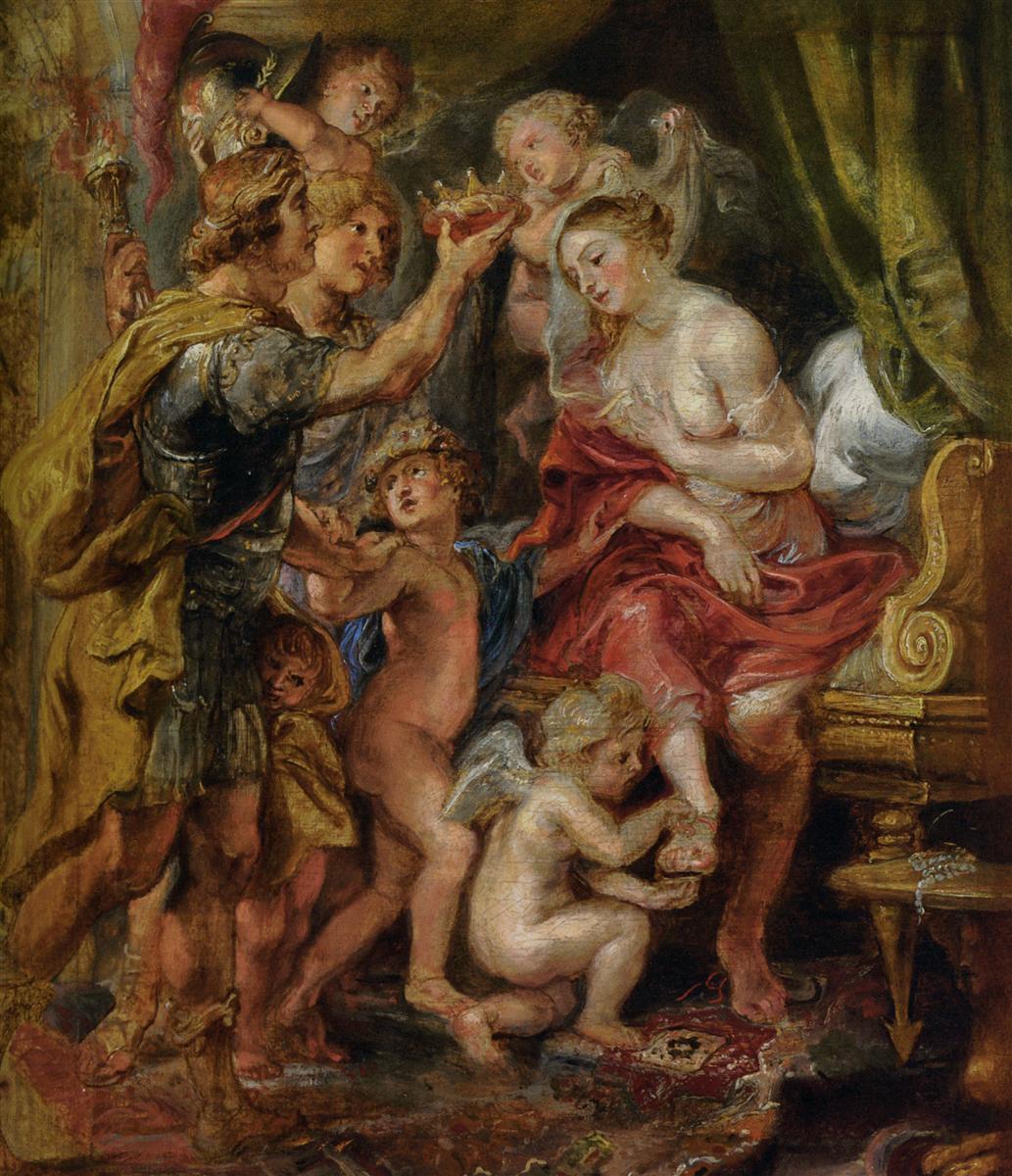
“Alexander and Roxana” by Peter Paul Rubens is a dazzling Baroque celebration of love, power, and sensuality. In this intimate yet richly theatrical scene, the legendary conqueror Alexander the Great approaches his new bride Roxana, offering her a crown while playful cupids flutter around them. The painting is compact in size but overflowing with movement and color. Every inch glows with Rubens’s trademark vitality: swirling draperies, rosy flesh, gleaming armor, and the lively gestures of winged children.
Rather than presenting Alexander on the battlefield, Rubens shows him at the threshold of a private world. The atmosphere is not one of conquest but of seduction and ceremonial union. Roxana, partially undressed and seated on a gilded bed or throne, becomes the radiant center of the composition, while Alexander is drawn toward her in reverent admiration. Around them, putti act as ministers of love, tying sandals, bearing torches, and holding the bridal crown. The scene evokes both a historical wedding in distant Bactria and a timeless allegory of marital harmony.
The Historical and Literary Background
The story of Alexander and Roxana comes primarily from ancient writers such as Plutarch and Curtius Rufus. Roxana was the daughter of a Bactrian noble whom Alexander encountered during his campaigns in Central Asia. Captivated by her beauty, he chose to marry her, a decision with both romantic and political dimensions. The union symbolized the merging of Macedonian and Eastern elites and formed part of Alexander’s broader policy of fusion between Greeks and conquered peoples.
Rubens, a learned reader of classical texts, would have known these accounts. In the Renaissance and Baroque periods, the marriage was often used as a theme for tapestries, frescoes, and paintings decorating palaces, particularly in rooms dedicated to weddings or dynastic alliances. It presented Alexander not only as a brilliant general but also as an ideal lover and husband who could control his passions within the bounds of legitimate union.
In Rubens’s interpretation, the emphasis is on the moment when Alexander approaches Roxana for the first time as his bride. The presence of cupids and the intimate bedroom setting make the scene both mythic and human. The historical Bactrian palace becomes a stage for Baroque allegory, where classical history, erotic charm, and moral overtones of lawful love coexist.
Composition and the Staging of Intimacy
The composition of “Alexander and Roxana” is a masterclass in Baroque staging. The figures are tightly grouped in a vertical format, filling the entire field with movement. On the left, Alexander, clad in armor and a yellow cloak, strides forward. On the right, Roxana occupies a golden seat, wrapped in a red drapery that slips away to reveal her pale torso and shoulder. Between and around them swarm several putti, as well as a female attendant behind Alexander.
Rubens builds the scene around a diagonal that runs from the lower right corner, where a cupid kneels to remove Roxana’s sandal, up through the bride’s reclining figure and into the raised hands offering the crown. This diagonal leads the viewer’s gaze from foot to head, from earthly touch to ceremonial honor. At the top, additional cherubs hover, holding Alexander’s helmet and perhaps a veil, completing the sense that the entire celestial world participates in this union.
The space is shallow, almost theatrical. Heavy curtains frame the right side, suggesting a canopy bed or ceremonial alcove. The floor is strewn with a patterned carpet that pushes forward into the viewer’s space, so that we seem to stand almost within the chamber. Despite the crowded arrangement, Rubens controls the eye’s movement through clear focal points: Roxana’s luminous body, Alexander’s outstretched arm, the glowing crown, and the tender actions of the children.
Alexander the Conqueror as Bridegroom
Rubens presents Alexander as a young, handsome warrior whose physical vigor is tempered by chivalrous restraint. He wears a breastplate and short military tunic, but his helmet is removed and held aloft by a cupid, signaling that this is not a moment of war. A yellow cloak wraps around his shoulders, its folds echoing the rich draperies on Roxana’s side and linking the two visually.
Alexander’s body is in forward motion, yet his upper torso leans slightly back as he raises the crown. His gesture is one of offering, not seizure. The expression on his face, turned toward Roxana, is earnest and slightly astonished, as if he is overwhelmed by her beauty. This blend of martial strength and emotional vulnerability underscores the transformation of the conqueror into the lover. The man who subdued cities now bends to honor a single woman.
The crown he holds is not simply jewelry. It symbolizes both royal dignity and marital commitment. By offering it to Roxana, Alexander recognizes her as queen and partner, integrating her into his empire. For Rubens’s patrons, the image of such a powerful ruler humbly crowning his bride would have carried flattering messages about the importance of dynastic marriages and the civilizing influence of lawful love.
Roxana as Radiant Bride
Roxana is the visual and emotional center of the painting. Seated on a gilded piece of furniture that resembles both throne and bed, she is enveloped in a red drapery that cascades across her lap and down to the floor. Her upper body is mostly bare, her skin rendered with pearly highlights that contrast with the warm fabrics around her. A transparent veil falls behind her head and over her shoulder, signifying modesty even as her exposed flesh suggests erotic allure.
Her pose is subtly ambivalent. She leans slightly away, her head turned down and to the side, as if shy or modest. One hand rests on her chest, fingertips touching her skin in a gesture that can be read as both bashful and emotionally moved. The other hand drapes across her lap, relaxed but not fully open. She seems aware of her role as desired bride yet not entirely at ease with the attention.
This combination of modesty and sensuality is typical of Baroque depictions of brides. Rubens portrays Roxana as both subject and object of desire. She is not simply a passive figure; her expression suggests inner life, perhaps a mixture of anticipation, nervousness, and acceptance. The viewer senses that a major change in her destiny is taking place at this very moment.
The Role of the Putti
The numerous putti, or winged children, are more than charming accessories. They orchestrate the action and clarify the allegory of love. One kneels at Roxana’s feet, gently removing her sandal. This act symbolizes preparation for entering the marriage bed and may also allude to themes of humility and service within love. Another child standing near the center wears a small crown and looks up at the couple, as if rehearsing the role of future offspring or the blessings of progeny that marriage promises.
Higher up, a cupid holds Alexander’s helmet, removing the last trace of battle from the scene. Another bears a flaming torch, the classical emblem of Hymen, god of marriage, whose light signals the union’s legitimacy and passion. A chubby child at the top center assists in presenting the crown to Roxana, merging divine playfulness with solemn ceremony.
These putti transform what could be a cold political arrangement into a scene saturated with affection and joy. They embody the playful side of erotic desire, but they also work diligently, tying, lifting, and offering. Love, in Rubens’s vision, is both delightful and industrious, actively weaving bonds between the couple.
Color, Light, and Sensual Atmosphere
Rubens’s color palette in “Alexander and Roxana” is warm and sumptuous. Golden yellows, deep reds, and amber browns dominate, with touches of cool blue and silver to offset them. The light appears to come from the left, where Alexander stands, and it flows across the figures, catching on metallic surfaces, silky fabrics, and soft skin.
Roxana’s pale flesh is the brightest area, drawing attention to her as the focus of desire. Her red drapery echoes the crimson carpet below and the pinkish skin of the infants, creating a network of warm tones that unify the composition. Alexander’s armor reflects the light with silvery highlights, emphasizing his heroic status without overshadowing the bride.
The brushwork is lively and somewhat loose, especially in the background and fabrics. This painterly handling enhances the sense of movement and spontaneity. Highlights are often laid on with thick, almost creamy strokes, especially on the edges of drapery and on the putti’s limbs. The resulting surface vibrates with energy, mirroring the emotional excitement of the occasion.
Erotic Love and Moral Order
Like many of Rubens’s works, “Alexander and Roxana” balances explicit sensuality with a strong moral framework. Roxana’s near nudity, the tactile presence of the putti, and the intimate setting all emphasize physical attraction. Yet the painting does not depict a stolen or illicit moment. The presence of the marriage torch, the crown, and the ceremonial actions of the attendants make it clear that this is a lawful, socially sanctioned union.
In Baroque culture, such images served to legitimize erotic love within marriage. They suggested that passion, far from being sinful, could be ennobled when contained within the proper institution. Alexander’s respectful stance and Roxana’s modest gestures reinforce this message. Desire is powerful but disciplined, guided by honor and ritual.
This moral dimension would have been particularly relevant if the painting or its design formed part of a decorative scheme celebrating a contemporary aristocratic wedding. The ancient story becomes a flattering mirror for modern viewers, hinting that their own alliances, too, merge love and political significance.
Allegory of Political Alliance
Beyond personal romance, the marriage of Alexander and Roxana symbolizes the union of different cultures and territories. By choosing a bride from Bactria, Alexander sought to integrate local elites into his expanding empire. Rubens, who frequently worked for European courts engaged in diplomatic marriages, would have recognized the allegorical potential of this episode.
The painting thus hints at broader ideas of concord and empire. Alexander’s act of crowning Roxana visually equates marital union with political elevation. She is not simply absorbed into his world; she is elevated alongside him. The presence of the helmet held aloft, unused, suggests that peace and alliance can achieve what war alone cannot. In this light, the lovers become personifications of Lands or Peoples united under a single rule.
For seventeenth century viewers, especially those in courts where marriages stitched together complex dynastic networks, this message was both flattering and instructive. The painting implicitly celebrates rulers who, like Alexander, use marriage as a means to harmonize diverse regions and secure lasting peace.
Rubens’s Inventive Adaptation of Classical Sources
Rubens often adapted classical themes in ways that showcased his understanding of both ancient art and contemporary tastes. While ancient texts mention Alexander’s admiration of Roxana when he first saw her, they do not describe a scene exactly like this, with putti and staged crowning. Rubens combines elements from classical bridal iconography, Renaissance marriage imagery, and his own imagination.
For example, the removal of the sandal has echoes in classical descriptions of Venus and in various marriage rituals. The use of a canopy and heavy drapery recalls mythological paintings of Venus and Mars or of hymeneal festivities. By weaving these motifs together, Rubens elevates the historical narrative into a hybrid of history painting and allegory, fully suited to Baroque decorative programs.
His flexible approach shows that he was not interested in archaeological reconstruction but in emotional truth and symbolic richness. “Alexander and Roxana” becomes a prototype for many later images of princely weddings, where historical specificity matters less than the overall message of love, honor, and political harmony.
Emotional Tone and Viewer Experience
Despite its crowded composition and complex symbolism, the painting communicates a very immediate emotional tone. The viewer is drawn into the lively bustle of cupids and the shy yet eager interaction between the bride and groom. It feels as if the ceremony is unfolding before our eyes, with gestures mid motion and draperies still settling.
The expressions of the children, in particular, invite empathy and delight. Some laugh, some concentrate on their tasks, others gaze upward with wonder. Their spontaneity balances the formality of the crown and torch, making the scene feel human rather than rigidly ceremonial.
For modern viewers, the painting continues to fascinate because it presents legendary figures in a surprisingly intimate light. Alexander, whom we often imagine in armor on the battlefield, appears here almost like a young suitor. Roxana, though idealized, appears vulnerable and emotionally present. Rubens allows us to imagine the private feelings behind a public alliance, showing that even the most famous heroes experienced love, nervousness, and anticipation.
Conclusion
“Alexander and Roxana” is a small but richly layered masterpiece in Peter Paul Rubens’s exploration of classical history and Baroque allegory. Through dynamic composition, glowing color, and expressive gestures, he transforms an ancient royal marriage into a living scene of affection, ceremony, and political symbolism. The painting honors erotic desire while framing it within the moral and social order of marriage. It portrays Alexander as a hero who can both conquer and honor, and Roxana as a radiant bride whose beauty bridges cultures.
The swarm of putti, the gleaming crown, the removed helmet, and the intimate setting all work together to create a visual hymn to harmonious union. Centuries after its creation, the painting still speaks to viewers about the power of love to reshape even the mightiest of conquerors and to forge new bonds between distant worlds.