Image source: wikiart.org
Introduction: A Table Where History Turns
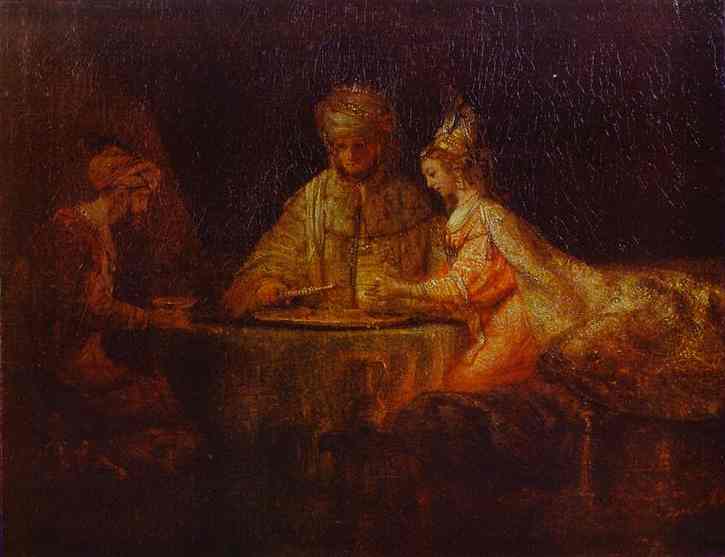
Rembrandt’s “Ahasuerus (Xerxes), Haman and Esther” (1660) stages a hinge of the Book of Esther as a small, ember-lit drama. Three figures gather at a round table. At the center sits the Persian king Ahasuerus, wrapped in pale golds, his authority concentrated in the weight of his robe and the gravity of his gaze. To his right, Esther leans forward in a cascade of warm rose and shimmering light, poised between deference and courage. To his left, Haman bends inward, his form submerged in shadow as if guilt had already begun to darken him. The scene is spare, intimate, and decisive: this is the banquet where Esther reveals the plot against her people and Haman’s downfall begins. Rembrandt compresses royal theater into a private exchange of hands and faces, turning scripture into human weather.
Historical Context: Late Rembrandt And The Art Of Concentration
The year 1660 belongs to Rembrandt’s late period, when surfaces thicken, palettes deepen, and narrative yields to psychology. After bankruptcy and shifting tastes in Amsterdam, he painted with uncompromising candor, removing ornament that did not serve feeling. The story of Esther, a Jewish heroine who risks her life to confront a king, had long resonated in Dutch culture; its themes of providence, courage, and perilous favor suited a Republic acquainted with political intrigue and religious tension. Rembrandt returns to the tale not as a pageant but as a meditation on authority and conscience. His small canvas positions viewers within whispering distance of power and danger.
The Story Distilled: A Banquet That Becomes Judgment
In the biblical account, Esther invites the king and his vizier Haman to a banquet. Only on the second night does she petition for her life and the life of her people, exposing Haman’s scheme to annihilate the Jews. Rembrandt’s painting fuses this sequence into a single, intensified moment. Esther’s body inclines toward the king, her hands gathered near a platter that doubles as a stage for decision. Ahasuerus, attentive yet contained, holds the center like a pivot of fate. Haman’s posture collapses inward, his face caught in the half-light of dawning realization. Nothing explodes, yet everything turns.
Composition: A Triangle Of Power And a Circle Of Fate
The composition is structured by a luminous triangle of heads—Esther, Ahasuerus, Haman—anchored upon the circular table. The triangle establishes hierarchy: the king at the apex, the two petitioners at the base, one rising into light, the other sinking into shade. The table’s roundness acts as a symbol and a compositional tool. Symbolically, it suggests completeness and inevitability, the closed circuit of providence within which human actors move. Visually, its edge directs the eye in a slow orbit that repeats the drama: from Esther’s courage to the king’s scrutiny to Haman’s dread and back again.
Light And Chiaroscuro: Judgment Written In Illumination
Rembrandt orchestrates the scene with a lamp-like light that rains softly from above and slightly to the right, privileging Esther and bleaching the king’s robe into quiet authority. Haman remains on the far side of that beam, his form half-dissolved, his presence admitted but not honored. This is late Rembrandt’s chiaroscuro at its moral peak: light is not spectacle but discrimination. It does not merely show; it evaluates. Esther’s truth gathers radiance; the king’s power receives enough light to act rightly; Haman’s malice retreats into dusk. The surrounding darkness—oily, warm, and active—presses the figures together while isolating the event from decorative distractions.
Color And Tonal Harmony: Embered Golds, Royal Browns, and Rose Courage
The palette is built from earths: umbers and raw siennas form the chamber air; the king’s garments glow with pale gold and muted citron; Esther’s robe carries a tender rose that flares toward salmon where the light catches; Haman’s attire sinks into wine-dark browns. These choices are not pretty; they are exact. Gold announces sovereignty without shouting; rose frames Esther as living warmth against a sober field; brown swallows the villain’s display into gravity. The coloristic restraint allows value to carry drama. Because nothing screams, the smallest light—a fleck on a bracelet, a thin strike along the platter—can speak decisively.
Gesture And Hands: The Argument Of Bodies
Rembrandt’s late paintings let hands do the eloquent work. The king’s right hand nears the platter with a stillness that feels judicial, a pause before sentence. Esther’s hands gather at the rim—one steadying, one offering—suggesting petition, respect, and courage at once. Haman’s hands, partly obscured, likely clutch the cup as if it could anchor him against the current of events. The triangular placement of hands mirrors the heads above and turns the table into a dial of intention: mercy, authority, and fear all present and legible.
Esther’s Presence: Modesty As Strength
Esther’s face, turned slightly downward, refuses theatricality. She does not plead; she speaks with composure. The light that favors her is not flashy but clarifying, reading the gentle plane of her cheek and the line of her brow with a tenderness that never tips into sentiment. Her robe’s pinks, uncommon in Rembrandt’s earthbound orchestra, become a visual theology: innocence fortified by resolve. A narrow white scarf or collar at her throat folds like a quiet accent of purity, yet the figure remains human, not emblem. This is the heroine as a person brave enough to tell the truth beside danger.
Ahasuerus: Authority Prepared To Listen
The king is neither tyrant nor cipher. Rembrandt paints him as a man weighted by office and awake to his choices. His turbaned head leans slightly toward Esther; eyes lower to the platter as if the decision might be found there; his robe’s pale breadth creates a calm center that tames the surrounding browns. The light that washes him is gentler than the one that claims Esther, a befitting modulation: he is the reflector of truth rather than its source in this moment. The crown, if present, is subsumed by fabric; sovereignty is felt in attention, not ornament.
Haman: The Shadow Of Self-Interest
Haman bends, self-contained, the posture of a man who hears his name in the wrong sentence. Rembrandt denies him the glamor of villainy; he becomes a study in contracted presence. The shadows that absorb him are not theatrical smoke but moral weather. His body tilts away from the light, away from the king, away from the woman whose courage exposes him. The diminution is subtle and devastating: a powerful minister suddenly smaller than the truth in the room.
The Tabletop Theatre: Plate, Cup, and Quiet Emblems
The table carries a few objects—plate, cup, perhaps a knife—rendered with the minimum needed to read their forms. Rembrandt has no interest in inventory. Instead, he uses these things to mark the space where decision incarnates. The circular plate becomes a stage on which hands nearly meet; the cup by Haman becomes a prop of false comfort; the linen’s edge glows to guide the eye. Everything is subordinated to the moral geometry of the scene, where light and pose do the telling.
Space And Background: A Chamber Of Consequence
There is little architecture. We sense a broad, dark enclosure, with remote attendants or furnishings barely implied at the edges. This austerity universalizes the moment. The banquet could be any room where power and truth must learn to talk. The breathing darkness is Rembrandt’s late chapel of air; it protects the figures from noise while allowing the atmosphere to register the pressure of events. The painting is small, but the room feels large enough to hold history’s pivot.
Surface And Brushwork: Paint That Carries Heat
Rembrandt’s handling is rich and varied. Across the king’s robe the paint is laid thickly, then softened with veils to mimic dense, lustrous fabric; Esther’s garment is modeled with smoother, warmer layers that let light soak in; Haman’s side receives rougher, more absorbed strokes, the brush dragging dry in places to let the ground breathe through. The background is scumbled, its texture catching stray glints like dust lit by a candle. This surface is not fussed; it is alive. The viewer sees not only a scene but the history of decisions by which the scene arrived.
Time Inside The Picture: A Pause Before Clarification
Rembrandt selects the split-second when everything is present but not yet declared. Esther has spoken or is about to; Ahasuerus is weighing; Haman begins to feel the floor tilt. That chosen second has the tension of breath drawn and held. It collects the narrative’s before and after—the quiet courage that brought Esther to this table and the reversal that will follow Haman to the gallows. By suspending the instant, Rembrandt lets viewers experience both suspense and inevitability, the twin rhythms of providence and free will.
Theology Without Emblems: Providence In Human Scale
No angel appears; no scroll writes itself on the wall. The painting refuses supernatural display in favor of providence enacted through character. Light does the theological work: it singles out truth, steadies authority, and diminishes pride. The result is a sacred drama that can be believed by secular eyes. Courage, attention, and justice, not marvels, carry the day.
Kinships Within Rembrandt’s Oeuvre: A Family Of Quiet Decisions
Place this canvas beside Rembrandt’s “Bathsheba,” “The Denial of Peter,” or “Saul and David,” and a pattern emerges. Late Rembrandt prefers the hinge before the door swings. He loves the moment when a face must accept its own meaning. In each of these works, light behaves ethically and paint records inward pressure. The Esther painting is among the most distilled of these—three figures, one table, the rest entrusted to air and tone.
Political Resonance In Seventeenth-Century Amsterdam
The Dutch Republic navigated alliances, religious pluralism, and the hazards of court favor. A narrative in which a minority’s survival depends on a ruler’s attention would have felt pointed. Rembrandt, living among Amsterdam’s Jewish community and drawing frequently on Hebrew scripture, paints the scene without caricature. The king is educable; the heroine is eloquent; the villain is small and self-defeating. The political lesson is clear and humane: justice begins when power listens well to the vulnerable.
The Viewer’s Place: Close Enough To Hear A Whisper
The painting seats us at the table’s edge. We share the lamplight with the protagonists; the round board opens toward us like a threshold. Our eye travels not as a spectator but as a fourth presence whose silence matters. That intimacy is essential to the work’s force. We are not looking at allegory from a gallery distance; we are nearly within reach of the king’s decision and of Esther’s courage. The image becomes a rehearsal for our own moments of speech in difficult rooms.
Modern Appeal: Leadership, Advocacy, And The Power Of Poise
Contemporary viewers read the scene as a case study in leadership and advocacy. Esther models persuasive courage—neither rage nor flattery, but steady truth. Ahasuerus models attention; his authority is exercised as listening before judgment. Haman, trapped by his own ambition, demonstrates how power collapses when it serves only the self. Managers, activists, and students recognize their lives in these roles. The painting’s quiet is practical instruction.
Why The Painting Endures
“Ahasuerus (Xerxes), Haman and Esther” endures because it distills a vast story into a room-sized truth: justice often depends on the courage of one and the attention of another. Rembrandt’s late mastery—earth harmonies, merciful light, eloquent hands, surfaces that keep the record of thought—serves that truth without vanity. The painting does not demand admiration; it rewards it. Stand before it and the scene begins to breathe, the table warms, the figures settle into a companionship of consequence. Few images stage moral clarity with such humility.