Image source: wikiart.org
Introduction
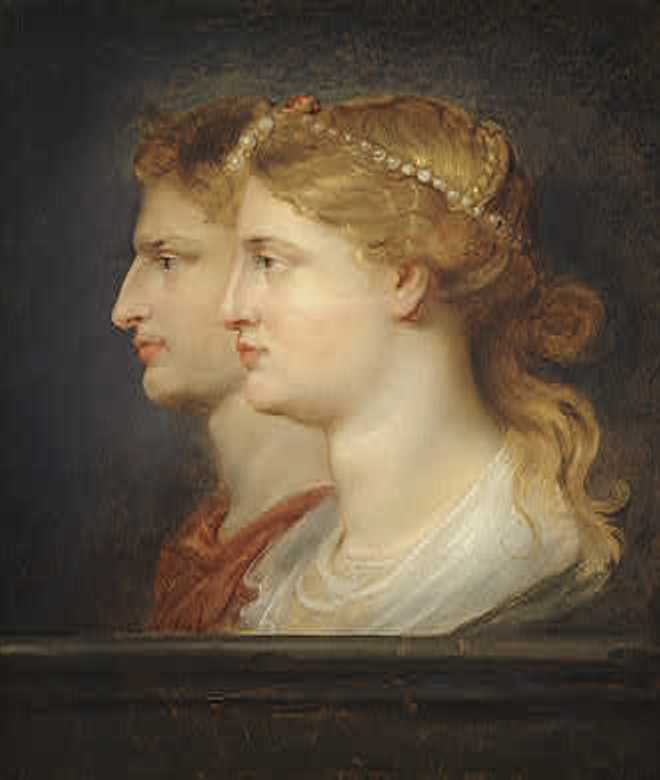
Peter Paul Rubens’s “Agrippina and Germanicus” presents two Roman heads in strict profile, aligned like medallions against a vaporous dark ground. The image is modest in scale yet monumental in effect. By compressing his composition to two contiguous silhouettes, Rubens fuses the clarity of antique coinage with the sensuous matter of Baroque paint. The result is at once archaeological and theatrical: an evocation of imperial Rome carried out with living warmth. Painted around 1614, when Rubens was newly established in Antwerp after years in Italy, the work demonstrates how deeply classical forms shaped his imagination and how deftly he could convert learned reference into persuasive character.
Historical Context
Between 1600 and 1608 Rubens worked in Italy, visiting Mantua, Rome, and Genoa, and absorbing a full education in antiquities, sculpture, epigraphy, and the numismatic collections that were fashionable among princes and scholars. Returning to Antwerp in 1608, he became the foremost painter of the Spanish Netherlands. The years around 1614 were a period of intense synthesis: he translated Roman models into altarpieces, mythologies, state portraits, and learned cabinet pictures. “Agrippina and Germanicus” belongs to this cabinet scale, the dimension of intimate study and connoisseurship. Such works circulated among humanist patrons who delighted in reenacting antiquity through pictures and objects. In this milieu, a double profile of a celebrated imperial couple would serve both as a moral exemplar and as a prompt for learned conversation.
The Historical Pair
Germanicus Julius Caesar and Agrippina the Elder were among the most admired figures of Julio-Claudian Rome. Germanicus, adoptive son of Tiberius and nephew of the emperor Augustus, embodied the ideal of the virtuous general—handsome, eloquent, victorious in Germania, beloved by the people. Agrippina, granddaughter of Augustus and wife of Germanicus, was famed for fertility, courage, and stoic dignity, especially after her husband’s untimely death in 19 CE. In later Roman texts they become emblems of marital concord and civic virtue. Their pairing therefore carries a specific moral charge: conjugal harmony, dynastic legitimacy, and the tragedy of political envy. By choosing this duo, Rubens taps into a reservoir of sentiments—admiration, sympathy, nostalgia for a golden age—that his learned audience would immediately recognize.
Sources And Classical Models
The picture’s format strongly recalls ancient coins and carved cameos. Imperial coins often aligned the emperor and his spouse in profile, with the female bust slightly in front, the male behind or vice versa, depending on the message. Rubens adopts this stacked arrangement, softening it with atmospheric paint and humane modeling. He may also have consulted gem engravings—onyx and sardonyx cameos—in which heads are layered in relief and crowned with pearled fillets. The pearled circlet braided into Agrippina’s hair reads like a painterly translation of gem carving, each highlight a tiny bead. Rubens is not copying a specific coin so much as reanimating a typology, turning stamped metal and carved stone into breathing flesh.
Composition And Design
The composition is a taut rectangle dominated by two contiguous ovals. Set in left-facing profile, Germanicus occupies the rear plane, his features cleanly cut, his hair trimmed to a soldier’s discipline. Agrippina, larger and closer to the picture plane, overlaps him by a fraction, her head level with his so the two profiles rhyme rather than compete. The dark surrounding field is not empty; it is inflected with thin veils of brown, slate, and olive that push the illuminated faces forward like reliefs in a niche. A shallow ledge at the bottom functions as a fictive plinth, further strengthening the sense that we are contemplating a sculpted double bust. Yet while the structural conceit is sculptural, all the effects—skin, hair, fabric—are quintessentially painterly.
The Psychology Of Profile
Profile has special rhetorical force. It offers neither the intimacy of a frontal gaze nor the play of three-quarter view; it is emblematic, judicial, and public. The profile makes a character into a type—lawgiver, matron, general—while still preserving individuality. In this painting the orientation to the left directs attention into a notional future; both figures look toward an unseen horizon. Their alignment suggests unity of purpose. Because neither returns the viewer’s look, the spectator is positioned as a witness rather than a participant, much as one regards a coin or a relief. The result is a dignified distance that suits the theme of Roman virtue.
Light And Color
Rubens builds the heads with cool, lamplit values rather than the sunlit warmth of his mythologies. A pale illumination falls from the upper left, striking cheekbones and bridge of nose, rimming the brow, and melting into soft half-tones at the jawline and neck. The palette is restricted but eloquent: flesh is composed from milky whites, cooled pinks, and gray-green shadows; hair gathers warm browns, golden ochres, and selective highlights; garments supply restrained accents—Germanicus in reduced Roman red, Agrippina in pearl and muted gold. The surrounding field is a deep, breathable dusk that never congeals to black. This economy of color elevates the work above portrait likeness into the sphere of exemplar; color becomes ethical atmosphere.
The Head Of Germanicus
Germanicus is drawn with chiseled concision. The forehead is broad, the nose straight, the lips firm, the chin compact. Rubens keeps the hair close to the skull in disciplined locks that read as both antique and soldierly. The neck column rises from a red mantle that hints at the general’s paludamentum, the cloak of command. There is no martial bravado; the profile communicates controlled energy and rectitude. Rubens avoids the slick uniformity of polished medals by structuring the flesh with small transitions and by allowing a fine, living moisture to breathe across the cheek and temple. The effect is a man made for public office who remains palpably human.
The Head Of Agrippina
Agrippina dominates the near plane with a luminous, steady presence. The nose is firm but less severe, the lips fuller, the chin rounded, the throat long and capacious. Rubens lavishes attention on hair and adornment: a soft chignon gathered behind the ear; loose tendrils catching light; a pearl comb and threaded beads that punctuate the curve of the skull. Around her shoulders he suggests a transparent veil over a pearly chemise, each stroke articulating different textures—silk, skin, and jewelry. The face is grave yet open, a Roman matron rather than a coquette. The slight parting of her lips and the forward weight of her head imply resolve restrained by decorum. Through these painterly choices Rubens conveys the reputation Agrippina earned in history: the courageous spouse and mother who endured exile and political malice.
Marital Concord And Dynastic Propaganda
The double profile communicates a political message as surely as any inscription. In imperial Rome, pairing the ruler with his consort visualized legitimacy and continuity; it promised fertility, heirs, and a harmonious household that mirrored civic order. Rubens revives that logic for a seventeenth-century audience. The picture acts as a portable altar to concordia, the Roman virtue of agreement and unity. Agrippina and Germanicus, placed head-to-head without overlap confusion or spatial anxiety, become a living emblem of shared destiny. The exact register of their chins and foreheads implies equality of stature within difference of role: the soldier behind, the matron before, two aspects of the same public good.
Materiality And Painterly Intelligence
Part of the painting’s charm is how it negotiates between object and image. On first glance, the stacked profiles read like an enlarged medal. Look longer and everything resolves into the language of oil paint: small loaded touches spark along the beads; broader planes of the cheek melt imperceptibly into shadow; transparent passages at the veil allow a brown ground to breathe through. Rubens’s brush deliberately varies pressure and viscosity to suggest different substances. Where medals generalize, he specifies. Shadows at the nostrils cool to a tender gray; the ridge of the nose catches a single unbroken stroke of light; the pearl diadem receives pinprick accents. Through this variety the picture keeps the ancient typology alive without sacrificing sensory conviction.
The Question Of Function
What purpose did such an image serve? In a well-appointed Antwerp study, it could accompany antique busts, casts, books, and coins, joining a dialogue between objects of learning. It may also have been conceived as a modello or cabinet picture that prefigured larger historical cycles, since Rubens later painted complex narratives involving Roman matrons and generals. In any case, the scale encourages an intimate, sustained gaze. Unlike a grand altarpiece, this painting asks for quiet attention, the kind of looking that turns connoisseurship into meditation.
Influence Of Italian Portraiture
Rubens’s double profile owes a debt to Italian precedents. Renaissance painters, from Piero della Francesca to Botticelli, revived the strict profile to evoke antique medals, often for dynastic propaganda. In Rome Rubens could observe papal medals, cameo collections, and reliefs; in Genoa he studied aristocratic portraiture that sharpened his taste for emblematic poses. Yet his version departs from Renaissance coolness by saturating edges with soft atmosphere and by letting breath and blood rise to the surface. Where quattrocento profiles sometimes feel like wax figures, Rubens’s couple looks warm, their skin animated by minute vibrations of tone. He keeps the antique dignity but lets life in.
Gender, Virtue, And Narrative Potential
Even within the constraints of profile, Rubens differentiates virtues. Germanicus’s lines are linear and spare; Agrippina’s are curvilinear and abundant. The man is defined by outline and plane, the woman by light and texture. This is not a retreat into stereotype; it is a pictorial grammar that assigns distinct strengths. In Roman historiography, Germanicus is the paragon who dies young, Agrippina the valiant widow who shepherds her children through peril. The painting contains that narrative latent within the arrangement: he recedes, she advances, not as dominance but as continuation. The image thus anticipates story without telling it.
Time, Memory, And Afterimage
Because the profiles are cropped at the base and nearly fill the frame, they carry a striking afterimage when one looks away—exactly the effect coins produce when pressed into the hand and then withdrawn. Rubens uses this perceptual property to extend the painting beyond itself. After closing one’s eyes, the twin outlines still float for a moment. In that interval of memory, the pair turns from depicted people into symbols. The painting thereby accomplishes what humanist collectors prized: it makes antiquity present in the mind’s theater.
Comparison With Rubens’s Other Heads
Within Rubens’s oeuvre, the painting converses with his studies of antique busts and with his portraits of contemporary sitters set in profile or three-quarter view. Compared to the turbulent physiognomies of his large altarpieces, these heads are serene, unburdened by dramatic narrative. Compared to his mythological nudes, they are restrained, their beauty moralized and channelled into outline. Yet the family resemblance is strong: the subtle modeling of cheek and eyelid, the wet gleam at the lower lip, the deft articulation of ear and hairline. The same hand that paints divine flesh in grand allegories here paints civic virtue in two calm faces.
The Moral Atmosphere
The painting exudes a temperate air. Nothing in it yields to courtly flattery or melodrama. The restraint itself is the message. Virtue, Rubens suggests, is not a matter of spectacle but of steady bearing. The profiles do not demand admiration; they earn it by composure. Even the pearls read not as luxury but as sobriety adorned, a Roman moderation that allows ornament without surrendering moral gravity. This climate of temperance would have appealed to northern humanists who saw in Rome’s best figures a mirror for their own ideals of household and city.
Light As Character
In the absence of narrative action, light becomes the agent of character. On Germanicus it sharpens the outline and cools the plane; on Agrippina it thickens and warms, rounding the cheek and gilding the hair. The difference is minute but meaningful. Where he reads as bronze given breath, she reads as alabaster suffused with blood. The shared light across both heads, however, knits them together, as if a single moral illumination informed their joined destiny. This subtle light-craft is the ultimate guarantee of unity in a composition that might otherwise fracture into two separate portraits.
Reception And Continuing Relevance
For viewers today, the painting works on two levels. It is a beautifully crafted object that rewards close looking—the kind of picture that teaches what paint can do within tight limits. It is also a portable moral image in the classical sense, a small theater of virtue that proposes steadiness, courage, and mutual regard as civic goods. In an age saturated with photographic immediacy, the choice of profile feels almost radical, asking the viewer to admire rather than to intrude. The painting’s calm resists haste and noise, which may be why it still feels modern: it offers an ethics of attention.
Conclusion
“Agrippina and Germanicus” is a lesson in how a small painting can carry grand meanings. Rubens condenses antiquarian learning, Roman moral exempla, and the pleasures of painterly craft into two stacked heads modeled by light. The antique coin and cameo become living flesh; the political emblem becomes marital concord; the cabinet picture becomes a quiet oration about public virtue. In the poised interval between stone and skin, emblem and portrait, past and present, Rubens finds his most compelling register: a classicism that breathes.
