Image source: wikiart.org
A Flight From Flames Into Destiny
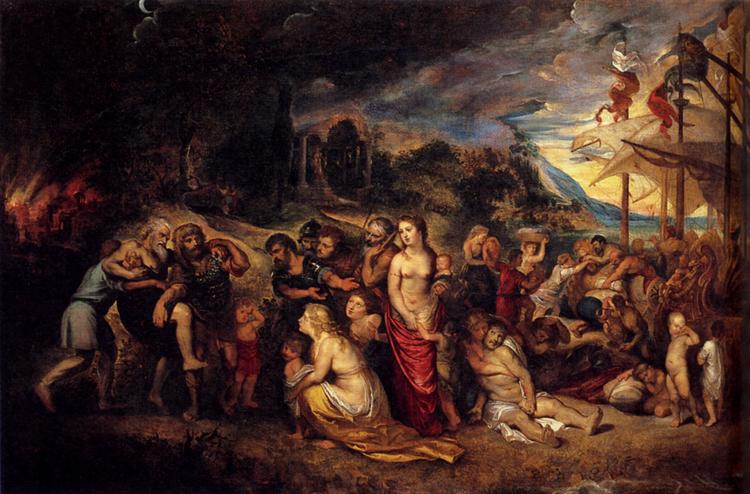
Peter Paul Rubens’s “Aeneas And His Family Departing From Troy” (1603) stages one of antiquity’s most consequential departures: the moment when Aeneas escapes a burning city to begin the long journey that will end in the founding myth of Rome. Painted early in Rubens’s Italian years, the canvas condenses epic poetry into a single, teeming panorama where heroism, grief, and providence share the same breath. Rubens refuses a tidy tableau. Instead, he orchestrates a crowded procession of bodies that seems to surge forward and outward, as if the entire civilization of Troy were trying to fit through one narrow exit in history. Fire licks the distant sky; ships ready their sails at the shore; between these terminals of destruction and hope, Aeneas and his companions become a moving bridge from past to future.
The Virgilian Moment Translated Into Paint
In Virgil’s epic, Aeneas bears his aged father Anchises on his shoulders, leads his young son Ascanius by the hand, and mourns the loss of his wife Creusa. Rubens braids these narrative threads into a visual knot. Anchises appears as the venerable weight of ancestry, a living reliquary of the household gods. Ascanius, small and urgent, stands for the promise of continuation. Women and children cluster nearby, embodying the populace that must be saved if the story is to have a future. This translation from verse to oil preserves Virgil’s moral: duty—pietas—moves the hero, not glory alone. The painting dramatizes that ethic by positioning Aeneas not as a solitary warrior but as the center of a family and a people whose survival depends on his steady forward motion.
A Composition Built From Two Horizons
Rubens divides the world into two horizons. At the far left, a scorched skyline blazes under a sickle of moon and smoke-stained clouds. At the far right, the sea opens, banners crack, and sailors hustle at the rigging. These horizons are joined by a low, diagonal ground where refugees advance, knotted together by gestures of carrying, consoling, and urging on. The diagonal is crucial: it tilts the entire human river toward the ships, gathering narrative pressure like water sluicing through a channel. The eye runs along this channel from terror to passage, from red-orange embers to sea-blue distance, and the painting’s emotional arc follows that visual path.
The Theater of Light and Weather
Light arrives in waves that mirror the story’s phases. The left glows infernally; the center, where Aeneas and his family move, is bathed in a warm, humane illumination that models flesh with a living softness; the right brightens into the cool, salt light of morning over water. Overhead, clouds churn with bruised violets and smoky grays, a meteorology of moral weather. Rubens uses chiaroscuro not as spectacle but as argument: darkness burns where the old order collapses; a tempered radiance surrounds the fragile convoy; clarity waits where destiny calls.
Aeneas as the Axis of Movement
Aeneas stands upright, muscular and controlled, the hinge between generations. His body turns in a subtle contrapposto—torso facing forward beneath the father’s weight, head angled toward the path he must choose, feet split between here and there. The heroic anatomy is not for show. It communicates competence and composure under burden. Aeneas’s forward leg sets the rhythm for everyone behind him; even the folds of the red mantle around his waist seem to fall in the key of onward. Rubens’s storytelling lives in these bodily decisions. No banner declares leadership; the human form itself does the announcing.
Anchises and the Gravity of Memory
The father’s presence is tender and grave. Anchises—white-bearded, wrapped, and heavy—rests on his son’s back like a living archive. In Virgil, he carries the Penates, the household gods; Rubens suggests that sacred cargo without over-insisting, letting age and dignity carry the significance. The old man’s face turns toward the burning city, as if he alone, having lived the fullness of Troy’s story, is allowed a last glance. The gesture becomes an ethics of looking: the young must face the future, the elder remembers. The two orientations meet in a physical embrace that feels both domestic and monumental.
Ascanius and the Pulse of Futurity
Beside Aeneas, the boy Ascanius looks out with alertness and fear mingled. His small steps attempt to match the adult stride; his hand reaches up in reflexive dependence. Rubens often used children to vivify the stakes of a narrative, and here the device is more than sentimental. Ascanius is not merely “the future” in allegory; he is a child trying to keep up, and the path he travels is rutted and crowded. That realism—the short leg, the slightly awkward angle of the shoulder—makes the myth immediate. The future is permitted to be human.
Women of Troy as the Chorus of Loss and Care
Across the central band, women cluster in postures of giving and grief: one kneels to comfort a child, another turns to help a companion rise, another looks back with a face that seems to hold two times at once. Draperies in gold and crimson wrap their bodies like moving flames, echoing the city’s fire while suggesting inner heat—courage and sorrow compressed into fabric. Rubens grants these figures a dignity equal to the hero’s. They are not background; they are the motive for the journey, the human cargo whose safety is the measure of Aeneas’s success.
The Language of Gesture
Narrative clarity in such a crowded canvas depends on gesture. Rubens assigns each figure a readable verb: lifting, guiding, consoling, pleading, pointing, bearing. Hands speak across the painting: a palm raised to shield eyes from smoke, fingers curled around a child’s shoulder, another hand extended toward the ship in wordless command to hasten. The gestures never exaggerate; they hover at the threshold where expression remains natural while still legible at a distance. This restraint intensifies the pathos. Panic is present but disciplined; the exodus moves because people help each other move.
Ships, Sails, and the Engineering of Escape
At the far right, ships prepare to receive the refugees. The masts create a comb of verticals, the taut lines of rigging sing against the sky, and the swelling sails echo the swelling of hope as the sea opens. Rubens positions an elevated platform or gangway where figures control the embarkation, their red garments and white banners brighter than anything on land. The stagecraft is exquisite: the scenes of boarding occur slightly above the horizon of the refugees, as if the future were literally a step up. The sea’s cool plane acts like a stabilizer to the canvas’s heat, promising a navigable surface after the chaos of streets.
Ruins and the Geography of Aftermath
Between fire and water, the middle distance shows stone arches and walls—remnants already receding into shadow. Rubens, attentive to archeological memory, places these ruins as a hinge between living figures and the abstract idea of a fallen city. They anchor the story without distracting from the human foreground. The message is gentle but firm: Troy will be memory and stone; the people must become flesh elsewhere.
Color as Historical Temperature
The chromatic tempo moves from embered reds and oranges at left, through warm flesh and gold in the center, to the cooler, airy blues at right. Rubens modulates these zones carefully so that no abrupt color break disturbs the procession. Aeneas’s red mantle becomes the bridge hue, a portable flame that travels from old city to new voyage. The painter’s understanding of color as time—warmth for what is burning, temperate light for what is living, cool clarity for what is to come—structures the entire painting’s emotional logic.
The Breath of the Gods Without Theatrics
Rubens hints at divine supervision without allowing it to swallow the human drama. A winged figure and high banners over the ships can be read as the breeze of providence, and the sky bears the restless signature of higher will, but the gods do not stage a coup over the picture. They remain modest presences, leaving the weight of choice and action to mortals. This decision honors the ethical core of the epic: destiny may assign a path, but humans must walk it.
Texture, Paint Handling, and the Feel of Emergency
The surface tells a story of urgency answered by control. In fire and smoke, Rubens lays pigment with quick, broken strokes that flicker like tongues of flame. Flesh, by contrast, is modeled with layered glazes that breathe. Metallic helmets and shield rims catch compact highlights; fabrics trend toward broad, juicy strokes that swing with the bodies they clothe. The alternation between brio and finish lets the scene feel both made in haste and crafted with authority, as if the painter’s own tempo matched the refugees’ need to move and the epic’s demand to endure.
The Ethics of Looking Back
Several figures cast their eyes toward the inferno. These backward glances are among the painting’s most eloquent motifs. They acknowledge what is lost without letting nostalgia paralyze the procession. Aeneas himself resolves the dilemma: his head tilts enough to be aware, but his stride never stalls. This choreography of attention—look, remember, move—becomes a moral lesson disguised as motion.
The Child’s Cry and the Civic Body
Near the left, a child reaches toward a departing relative, a small wail translated into upstretched arms. Such vignettes transform a heroic myth into a civic migration. Troy here is not a collection of marble halls but a body of citizens: infants, elders, mothers, artisans, guards. Rubens’s democracy of attention refuses to subordinate them to the hero as mere accessories. The painting’s grand theme—a people becoming a future—depends on these small, credible griefs.
A Bridge Between Two Worlds
The painting is both departure and inauguration. It closes the book on a city and opens another on a journey that will spawn empires, languages, and laws. Rubens compresses this bridge into the breadth of a single canvas, using the full grammar of Baroque painting—diagonals, chiaroscuro, color harmonies, and a crowd of expressive bodies—to make the crossing visible. The hero’s back bears family and memory; his feet negotiate mud and rock; his gaze scouts a horizon where ships wait. The myth becomes a physiology of history: muscles, lungs, hands, and oars enact destiny.
Rubens in Italy and the Synthesis of Traditions
Painted during the artist’s Italian residency, the canvas reveals how Rubens absorbed Venetian color and Roman authority while preserving a Flemish devotion to observed life. The sheen on draperies and flesh recalls Venetian splendor; the robust, classical anatomy echoes Roman sculpture and the Carracci reform; the vivid, human incident—children, anxious glances, the diversity of heads—remains rooted in Northern habits of describing the world as it truly looks. The synthesis yields a narrative language powerful enough to handle epic without losing intimacy.
Why This Painting Still Speaks
Modern viewers recognize the image not only as an episode from an ancient book but as a universal scene of displacement. Families carry elders and children away from fires and toward uncertain crossings; communities crowd onto ships with hope that seems both courageous and fragile. Rubens’s art refuses to romanticize; it dignifies. The painting offers no triumphal fanfare, only the promise that loyalty and courage can turn flight into foundation. That is why the canvas feels fresh: it understands that beginnings are often disguised as escapes.
Conclusion: Duty Embarked, History Under Sail
“Aeneas And His Family Departing From Troy” is an early declaration of Rubens’s capacity to translate civilization-scale stories into human movement and light. It binds fire to flesh, sorrow to duty, and private tenderness to public destiny. The city burns, the shore beckons, and amid the press of bodies a man steps forward carrying his father, guiding his son, and consenting to a future that will use his strength for more than himself. Rubens’s brush makes that consent visible. In a world pulled between loss and possibility, the painting steadies the eye on what endures: care for the old, protection of the young, and the hard, hopeful work of setting sail.