Image source: wikiart.org
Introduction to Rembrandt’s “Adoration of the Shepherds” (1646)
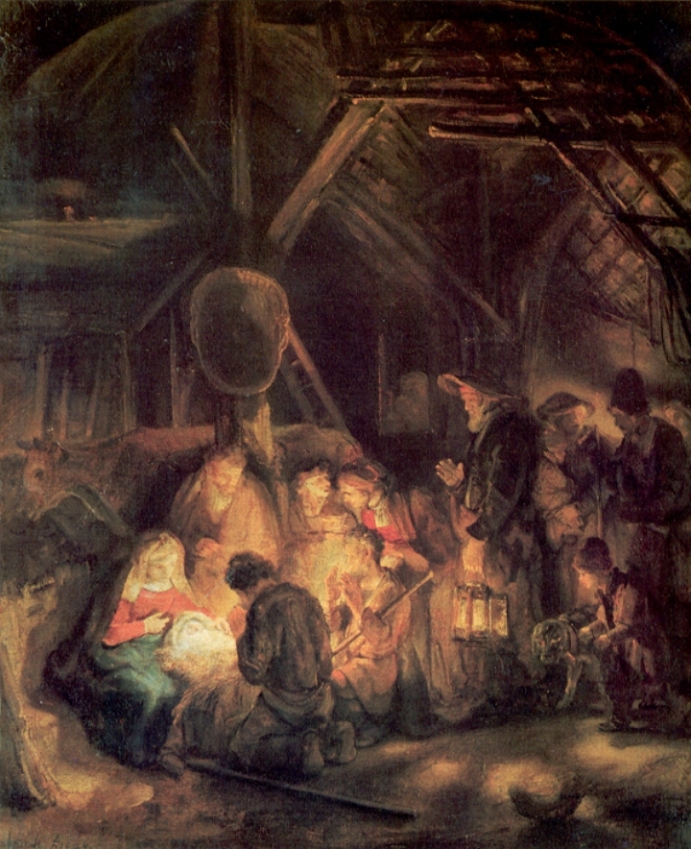
Rembrandt’s “Adoration of the Shepherds” from 1646 is a masterclass in how light can narrate a sacred story while honoring the textures of ordinary life. The painting gathers a crowd of shepherds, travelers, and villagers into a rough stable, where a newborn’s radiance becomes the only lamp anyone needs. Mary cradles the infant at left, Joseph bends protectively, and a procession of figures enters from the right, some with lanterns that dim beside the child’s glow. The architecture is improvised—beams, rafters, and ladders patched together into a shelter that feels both precarious and deeply human. Within this humble shell, Rembrandt composes a drama of sight and belief: people learn who the child is by seeing how the world looks in his light.
A Stable That Looks Lived In
The setting is not a tidy nativity theater. The roofline sags; planks overlap at odd angles; a hay basket hangs precariously from a beam; a broken ladder leans against a wall. This clutter is not negligence. Rembrandt wants viewers to feel the stable’s workaday truth—animals have been here, hands have mended things, drafts move through the roof. The roughness gives the holy event a credible habitat. When the shepherds kneel on straw and the child’s light climbs the boards, the miracle reads as something happening in the same world where people repair tools and sleep in their clothes.
Composition as Spiral of Approach
The composition organizes attention in a tightening spiral. From the dark rafters and vast roof, the eye drops to midground figures entering from the right, then coils inward around the kneeling shepherds toward the central cradle of light at Mary’s lap. That spiral is reinforced by arcs of bodies—standing, leaning, crouching—each closer to the glow than the last. The path of looking imitates the path of pilgrimage. Viewers reenact the shepherds’ approach, passing from night and curiosity into recognition.
Chiaroscuro as Theology in Paint
Few works demonstrate Rembrandt’s theological intelligence about light more clearly. The illumination comes not from a candle but from the child himself, whose pale body and swaddling ignite the tones around him. Skin, fabric, straw, and wool accept that light differently—Mary’s face blushes warmly; Joseph’s sleeve drinks it; a shepherd’s hat creates a crisp shadow across his brow; the backs of those still arriving register it only as a distant promise. Oil lamps continue to function in the scene, but their wan glow is humbled; it becomes a visual sermon about the insufficiency of manmade light to fully explain what has happened.
The Crowd as a Study in Human Response
Rembrandt’s shepherds represent a full register of human reaction. One kneels with hands clasped; another bows so low his hat almost touches the ground; a third peers intently as if verifying the news; an older man stands at the threshold with folded hands, hesitant to intrude yet unwilling to leave. A boy tugs at a companion’s sleeve; a dog noses forward; a figure with a lantern shades his eyes, newly aware that his tool is unnecessary. Because the faces are individualized and the poses are varied, the painting becomes a small encyclopedia of how people meet wonder: reverence, curiosity, doubt, joy, and a practical instinct to make room.
Mary, Joseph, and the Poise of Stillness
Mary’s stillness stabilizes the scene. Her head tilts with the quiet assurance of a woman who has held a child all day and knows how to keep him in a cocoon of calm. The red garment across her lap acts as a chromatic hearth, intensifying the child’s glow and anchoring the composition. Joseph, positioned slightly behind and to the side, leans forward in protective attention. His posture signals guardianship without dominance. The parents’ poise contrasts with the shepherds’ motion, establishing a polarity between domestic care and communal arrival that keeps the painting balanced.
Architecture as Metaphor for History
The barn’s colossal rafters create a cavern of time overhead. Their converging diagonals and rough carpentry suggest an edifice older than the night’s event—history itself bending over the child. In the upper left, a black pocket of space recedes into near-abstract darkness, like the unrecorded past. The beams, patched and re-patched, recall a people’s long endurance. Against that weight, the infant’s circle of light feels new and proportionately powerful. The structure does not imprison the miracle; it shelters it while silently acknowledging that something stronger than wood has arrived.
Color as Temperature and Narrative
Rembrandt keeps the palette limited—warm earths, straw yellows, umbers, and smoky blacks—then ignites it with concentrated areas of flame-like light around the child. Accents of red in Mary’s garment and a shepherd’s scarf hold the midground in conversation with the center. Greens are muted into brown, giving hay and clothing a lived-in patina. The chromatic decision prevents sentimentality. Nothing is candy-bright; everything carries the low, humane temperature of a winter night in a working barn where bodies gather against the cold.
Texture and the Tactile Imagination
The painting is a feast for touch. Look at the scumbled straw that receives light as if it were porous; the cracked boards that catch highlights on their edges; the matted wool of a cloak; the smooth lip of a lantern; the shined, oily grain of a staff handled for years. Rembrandt’s brush alternates between small fused strokes in faces and rough, dragged passages in wood and fabric. That alternation gives the image its credibility. Viewers believe the scene because their fingers remember it: straw prickles, wool warms, wood splinters, metal chills. The tactile realism anchors the spiritual content.
Sound, Scent, and the Multisensory Scene
Although paint is silent, Rembrandt implies a soundscape: the unison murmur of whispered prayers, the shuffle of boots on straw, a dog’s quiet pant, an infant’s sleeping breath, distant wind burrowing through roof gaps. Scent arises too: animals recently present, damp wood, wool warmed by rain, bread tucked in a satchel. These inferences occur because the visual world is so convincingly built that other senses feel invited. The multisensory persuasion strengthens the painting’s devotional power. The viewer is not just seeing the Nativity; they are standing in it.
The Lanterns and the Ethics of Light
Two figures bring lanterns whose flames become allegorical without ceasing to be useful. Their light illuminates hands and knees at the periphery, but compared with the child’s radiance it looks feeble and yellow. The carriers of these lanterns are the painting’s gentle theologians. One shades his eyes to adjust to the brighter source; the other holds the lantern low, almost embarrassed by its inadequacy. Rembrandt avoids scorn; the lanterns have their place. Yet by contrasting types of light, he suggests that revelation does not humiliate natural knowledge—it reorders it.
The Dog and the Honesty of Inclusion
The little dog nosing forward near the right margin is not a whimsical add-on. Dogs travel with shepherds, and their presence completes the social truth of the visitors. The animal responds to warmth and curiosity with the same instincts as the humans. Its inclusion lowers the painting’s grandeur to something more durable—an environment where creatures, not just characters, live. Rembrandt’s humility about what belongs in a sacred scene is part of his persuasiveness. The divine arrives without displacing the ordinary.
Youth, Age, and the Circulation of Wonder
Rembrandt organizes a cross-section of ages. A boy kneels close to the light, his face thrilled with discovery; young men lean forward with adventurous belief; older men hang back, weighing experience against novelty; a gray-bearded visitor clasps his hands in the fragile posture of one who recognizes grace by memory. By scattering ages across the composition, the painter dramatizes how wonder circulates in a community. The young rush in; the elders test and then consent; the middle convey news between.
Movement Without Frenzy
Despite the crowding, the picture breathes. Rembrandt achieves this by spacing figures in tiers and by letting dark areas of straw and floor act as rests between phrases of motion. Kneeling bodies echo one another without forming a clutter; standing figures create a vertical rhythm that leads the eye to the rafters and back down. The result is a scene full of movement but free of frenzy. That calm is intrinsic to the painting’s theology: peace on earth does not mean absence of activity; it means a new order in the midst of it.
The Infant as Source Rather Than Object
Rembrandt resists the temptation to make the child a display. The infant is small, swaddled, nearly swallowed by light. We see the glow more than the features, and that is the point. The child is not an object to be examined; he is a source whose identity registers in others. Faces around the cradle change because of him. This shift from object to source revises the viewer’s role. Instead of gawking at a baby, we read the meaning of his arrival in the transformed world he creates.
Echoes of Earlier Nativities and Rembrandt’s Innovations
Compared with earlier Netherlandish Nativities, which often bathe the scene in standardized gold, this painting prefers a lived light with edges and shadows. Rembrandt’s innovation lies in the way illumination behaves like moral knowledge. It reveals selectively, dignifies the poor with accurate detail, and binds strangers into a temporary community of sight. The painter’s interest in the shepherds as workers rather than props also sets the work apart. Tools and fabrics carry their own narratives, and the men retain the awkwardness of people who have just come in from the weather.
The Viewer’s Vantage and the Ethics of Witness
We stand just outside the kneeling circle, slightly to the right, at a distance where we could join without elbowing anyone aside. The vantage is ethical. It invites participation while preserving respect. We are not thrust upon the child; we are welcomed into a community that has made space for him. This placement matters because the painting, like the Gospel story, is about hospitality. The shepherds have hurried to share news; Mary and Joseph have accepted them; the viewer may come too, provided they come with the same courtesy.
Time, Memory, and the Future Inside the Barn
The painting holds an awareness of what will follow. Tools leaned against the wall, a staff on the floor, empty bowls—all are ready to be taken up again after the visit. The world will continue; the difference will be knowledge carried back to fields and hearths. Rembrandt’s stable is therefore a memory factory. The light stamping itself on faces will travel to other faces, and the viewer senses that tomorrow’s work will be done differently because of tonight.
Brushwork as Breath
Up close, the surface is a topography of breaths. Pigment thins and thickens according to need: thin glazes veil outer darkness; opaque lights pile up around the child; semi-opaque strokes knit together the middle tones of wool and straw. That modulation makes the air convective; it seems to move as figures breathe and kneel. The painter’s touch becomes part of the scene’s life, not a separate display of skill.
The Painting’s Contemporary Resonance
The “Adoration of the Shepherds” speaks clearly in any century. It honors laborers, values communities that make room for strangers, and imagines revelation as something that happens in the small hours among the poor. Its light invites people of different beliefs to agree on what awe looks like when it is honest: faces softened, hands emptied, bodies rearranged by kindness. In a world saturated with glare, the work demonstrates the power of a single, meaningful light to gather and govern attention without coercion.
Conclusion: A Human Circle Around a Luminous Center
Rembrandt’s 1646 “Adoration of the Shepherds” transforms a stable into a school of seeing. The rafters remember history; the straw accepts light like a sacrament; shepherds bring lanterns that learn their place; Mary and Joseph steady the center; a child radiates without performing. The painting’s greatness lies in how effortlessly it joins the sacred and the ordinary. It is not a competition between heaven and barn; it is a marriage. The glow that convinces the shepherds also warms their coats, and that is how the world changes: by light that respects what it touches. Standing before this canvas, we sense a modest but unshakeable hope—that compassion can become the organizing energy of a community, and that attentiveness is the natural posture of love.