Image source: wikiart.org
Introduction to Murillo’s “Adoration of the Shepherds”
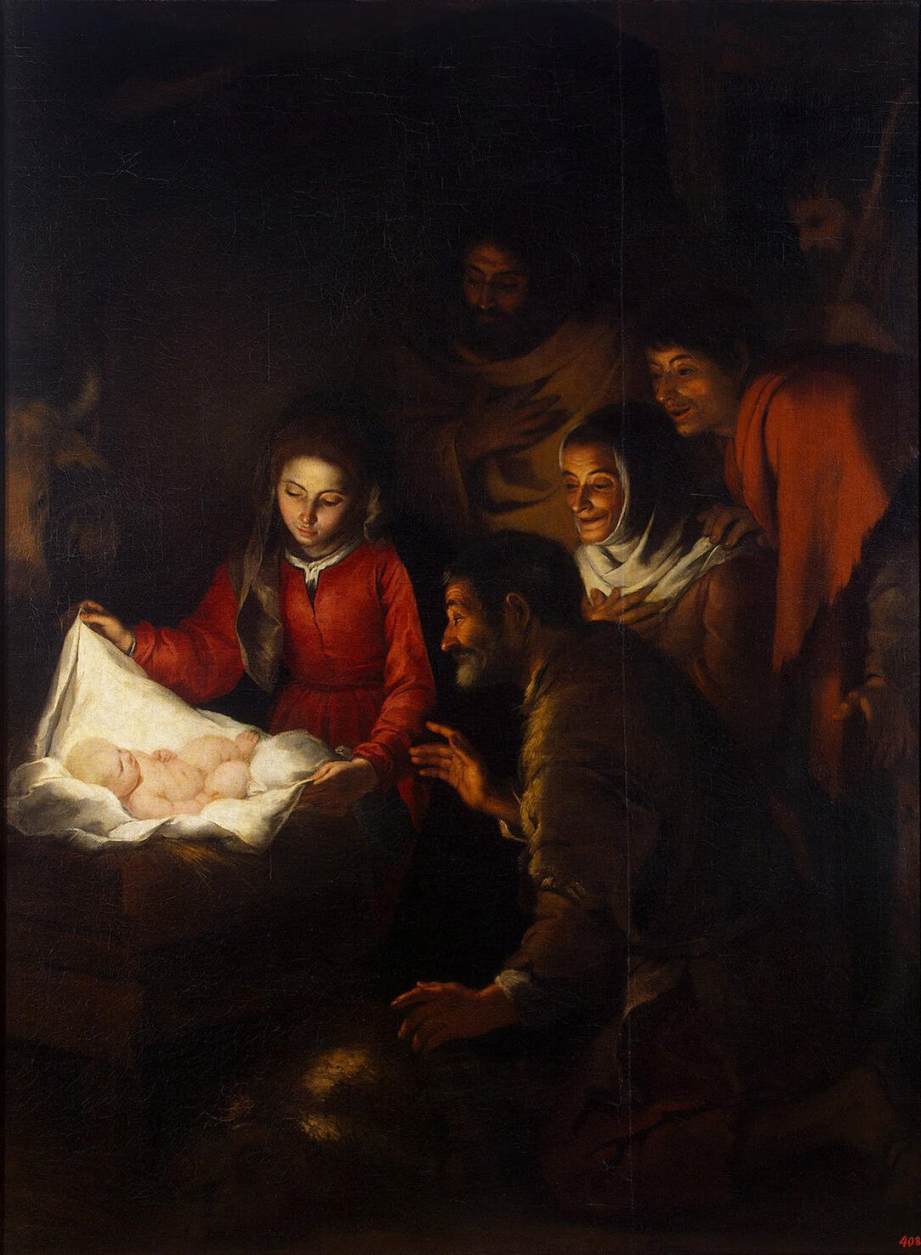
Bartolome Esteban Murillo’s “Adoration of the Shepherds,” painted around 1650, is a luminous meditation on the birth of Christ. The scene unfolds inside a dark stable, yet the atmosphere is filled with warm light and quiet awe. At the center lies the infant Jesus, wrapped in white cloth and placed on a manger. The light seems to emanate from his tiny body, bathing the faces of Mary and the gathered shepherds in a soft glow.
Murillo’s painting belongs to the great tradition of Nativity images, but it carries the unmistakable stamp of his personal style. The composition is intimate rather than grand. The figures are simple people whose emotions are tender and immediate. The use of light guides the viewer’s gaze and reinforces the spiritual message that the humble child is the true light of the world.
Composition and Focal Point
The entire composition revolves around the cradle of the newborn Christ. Placed in the lower left quadrant, the manger draws attention through the intense brightness of the white cloth and the delicate flesh tones of the baby. Mary stands slightly behind and to the side, holding up the cloth with both hands. Her red dress and calm posture form a vertical anchor that balances the horizontal spread of the cloth.
A semicircle of figures surrounds the mother and child. Two shepherds kneel in the foreground, one closest to Jesus with hands extended in reverent amazement, the other just behind him with a gentle smile. Behind Mary stand additional figures, including a woman with a white headscarf and a youth in red. Their faces lean forward, forming an arc that echoes the curve of Mary’s arms and the cradle.
The upper part of the painting is almost entirely in shadow. Only faint silhouettes of animals and structural elements of the stable are visible. This dark zone acts as a backdrop against which the illuminated group stands out. Murillo thus creates a strong contrast between the earthly poverty of the stable and the supernatural radiance at its heart.
Light as Symbol of Divine Presence
One of the most striking features of this painting is the way Murillo uses light. The primary source appears to be the infant Christ himself. His body is bathed in a brilliance that spills onto the sheet, which in turn reflects onto the faces and hands of the surrounding figures. There is no torch or lamp visible, reinforcing the idea that the child is the origin of this illumination.
This inner light has a spiritual meaning. It recalls the biblical phrase that Christ is the light shining in darkness. In Murillo’s image, the dark stable becomes a stage on which this metaphor becomes tangible. The surrounding gloom is not threatening; it simply makes the radiance of grace more evident. The shepherds, who have come from the fields at night, find themselves bathed in a new kind of light that transforms their simple barn into a place of revelation.
Murillo’s mastery of chiaroscuro is evident here. He softens the transitions between shadow and brightness, allowing faces to emerge gradually from the dark. This approach creates depth and gives each figure a sense of volume and presence. At the same time, it gently directs the viewer’s eye back toward the cradle whenever it strays.
The Figure of Mary
Mary is presented as a young and modest mother. She wears a red dress and a cloak that falls around her shoulders. Her long hair is partially covered by a veil. Her head is slightly bowed and her eyes are directed toward the child. The expression on her face combines tenderness, contemplation and quiet pride.
Murillo avoids idealization that would distance Mary from ordinary viewers. She is beautiful, but in a natural way. Her features are those of a real woman of Seville, perhaps modeled after local faces. Yet her calm dignity and the care with which she holds the cloth reveal her spiritual significance. She is both an ordinary mother and the Theotokos, the God bearer.
Her red garment carries symbolic weight. Red often signifies love and sacrifice. In the context of the Nativity, it can hint at the future Passion of Christ. Mary’s closeness to the child and her red clothing subtly connect birth and sacrifice, joy and future suffering. Murillo does this without any harshness, simply by integrating color symbolism into the tender domestic scene.
The Shepherds as Witnesses
The shepherds around the manger are key to the emotional impact of the painting. Unlike kings or soldiers, they are humble workers who have come directly from their fields. Murillo portrays them with rugged faces, worn clothes and rough hands. Their expressions, however, are filled with wonder, gratitude and affection.
The shepherd kneeling closest to the child leans forward, hands open in a gesture of awe and offering. His weathered face is lit from below, emphasizing his wrinkles and gray beard. There is a hint of a smile on his lips, as though he cannot contain his amazement at the sight of such innocence.
Behind him, a woman with a white scarf smiles warmly, pressing her hand to her chest. Next to her, a young man in a red cloak peers over her shoulder, eyes wide and shining. Another figure in the background holds his hand to his heart in silent devotion. Each face reflects a slightly different reaction to the same event: quiet adoration, joyful surprise, contemplative respect.
By giving the shepherds such individuality, Murillo invites viewers to see themselves in these witnesses. They represent the ordinary believer, called to recognize divinity in the most fragile of forms. Their poverty and simplicity are not barriers to faith; rather, they are the very conditions that prepare them to recognize the child as a gift.
The Intimacy of the Scene
Unlike some earlier Nativity paintings that include angels hovering above or distant cityscapes, Murillo keeps the setting close and enclosed. The stable walls are barely visible in the shadows, and the sky is absent. The focus is entirely on the human group gathered around the manger.
This restraint creates a remarkable intimacy. The viewer feels almost physically present, as if standing just beyond the circle of light. The closeness of the figures and their shared gaze on the child make the scene feel like a family gathering. The shepherds are not remote characters from a distant past; they are neighbors invited into the holy family’s personal space.
Murillo enhances this intimacy through body language. Hands overlap shoulders, heads lean together, eyes follow the same line. Even the baby, though asleep or quietly resting, seems connected to the group through the sheet that Mary holds. The fabric becomes a visual link between all the figures, echoing the spiritual bond created by the event itself.
Human Warmth and Spiritual Depth
One of Murillo’s great strengths is his ability to combine human warmth with theological depth. In “Adoration of the Shepherds,” the newborn Christ is presented as a real infant, with soft limbs and a slightly curled posture. The way the light caresses his skin makes him appear tangible and vulnerable.
At the same time, the light marks him as divine. His innocence becomes a sign of God’s humility. The shepherds’ reactions are human responses to a spiritual mystery. There is no abstract symbolism isolated from emotion. Instead, doctrine is woven into the fabric of an ordinary yet extraordinary encounter.
The painting therefore functions both as a devotional image and as a moving narrative. For believers, it is an invitation to prayer, to join the shepherds in kneeling before the child. For any viewer, religious or not, it offers a touching portrayal of shared wonder at new life.
Murillo’s Style and Influences
Painted around 1650, this work reflects Murillo’s mature style emerging in Seville. He had absorbed the lessons of Spanish masters like Zurbaran and Velazquez, as well as the influence of Italian and Flemish art that reached the city through trade.
The strong chiaroscuro and interior setting recall Caravaggesque compositions, where light and darkness provide theatrical emphasis. However, Murillo softens the harshness often found in Caravaggio’s scenes. His shadows are deep but not menacing, his light warm rather than cold. The overall tone is gentle, in keeping with his temperament and with the devotional aims of his patrons.
Murillo’s interest in everyday life also shapes the painting. The shepherds could easily belong to his series of genre scenes depicting poor people and street children. Their clothing, faces and gestures are observed from the real world, not invented from classical models. By integrating this realism into a sacred story, Murillo gives the Nativity a sense of immediacy that resonated strongly with viewers of his time and still moves audiences today.
The Role of Animals and Setting
Although secondary to the human figures, the animals and setting contribute to the atmosphere. In the upper left, just emerging from the shadows, one can discern the head of an ox or donkey. Its presence roots the scene in the simplicity of a stable, reminding us that the Son of God is born among animals and straw, not in palaces.
The wooden structure of the manger and the rough boards nearby suggest a makeshift cradle fashioned from what was available. Murillo does not dwell on these details; they remain almost hidden. Yet their very modesty reinforces the contrast between the lowliness of the place and the greatness of the event.
Emotional Narrative and Silent Communication
The painting is full of silent communication. No one speaks, yet every gesture conveys feeling. Mary’s downward gaze expresses maternal love. The shepherd’s outstretched hands speak of gratitude and reverence. The smiles and clasped hands of the others reveal shared joy.
Even the baby, though motionless, participates in this silent dialogue through the light that surrounds him. His small body is the center of attention, yet he does not need to act. Simply by being present, he transforms those around him.
Murillo’s ability to capture such subtle emotional narrative is part of what makes this painting memorable. Viewers can read their own experiences of awe and tenderness into the faces. The scene becomes a mirror for personal encounters with beauty and vulnerability, whether in the context of faith or in everyday life.
Place within Murillo’s Religious Oeuvre
“Adoration of the Shepherds” fits within Murillo’s broader production of religious art, in which he frequently returned to themes of the Nativity, the Holy Family and the life of Christ. These works were often commissioned for churches, monasteries and private chapels in Seville, serving both liturgical and devotional purposes.
This particular painting exemplifies the qualities that made Murillo so beloved: a gentle realism, luminous color, intimate compositions and a focus on tenderness. Later generations sometimes criticized his sweetness, but for many viewers his art continues to provide a compelling vision of compassionate faith.
In this canvas, Murillo shows that spiritual truth can be expressed through the faces of ordinary people gathered in a dark barn around a small child. The painting does not rely on grand architecture or elaborate symbolism. Its power lies in the warmth of human relationships bathed in the light of divine grace.
Conclusion
Bartolome Esteban Murillo’s “Adoration of the Shepherds” is a masterful synthesis of Baroque drama and intimate devotion. Through careful composition, expressive lighting and nuanced characterization, the artist turns a familiar biblical story into a deeply human encounter. The newborn Christ glows at the center of a circle of humble witnesses, transforming their rough stable into a sanctuary of light.
The painting invites viewers to approach the scene as participants rather than distant observers. We are drawn into the warmth of the group, invited to share their wonder and gratitude. In doing so, Murillo’s canvas continues to fulfill its original purpose: to awaken contemplation of the mystery of the Incarnation and to reveal how divine love can shine in the simplest of human moments.