Image source: wikiart.org
Introducing Francisco de Zurbaran’s “Adoration of the Magi”
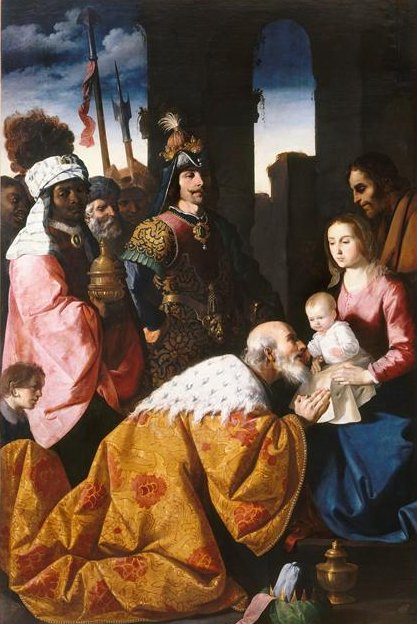
Francisco de Zurbaran’s “Adoration of the Magi,” painted around 1640, is a sumptuous and deeply devotional interpretation of one of the most beloved scenes in Christian art. The composition brings together the richly dressed kings from the East, the humble Holy Family, and a small entourage of attendants within a monumental architectural setting that opens onto a strip of bright sky.
At the center of the painting, an elderly Magus kneels in front of the Christ Child, who sits calmly on Mary’s lap. The old king kisses the infant’s tiny hand while presenting his gift, a gesture of reverence that encapsulates the theological meaning of the scene. Behind him, the other two Magi stand upright, regal and self possessed, with their gifts held in ornate vessels. The Virgin Mary, clothed in soft pink and deep blue, looks down with quiet tenderness at her child, while Joseph lingers in the shadows behind her, leaning forward as a contemplative witness.
Zurbaran unites all these figures through his mastery of light, color, and surface detail. The golden brocade of the kneeling king’s cloak, the dark skin and white turban of the African Magus, the gleam of armor on the central king, and the gentle luminosity on Mary’s face all contribute to a visual symphony that celebrates both the mystery of the Incarnation and the universal homage offered to Christ.
The Biblical Narrative and Its Symbolic Resonance
The story of the Magi comes from the Gospel of Matthew. Guided by a star, wise men from the East travel to Bethlehem to pay homage to the newborn “King of the Jews.” They bring gifts of gold, frankincense, and myrrh, each traditionally understood to have symbolic meaning. Gold honors Christ as king, frankincense acknowledges his divinity, and myrrh prefigures his death and burial.
Zurbaran’s painting compresses the moment of their arrival into an image of intense devotion. The Magi are not merely paying polite respects to a royal infant; they are bowing before the divine presence. The kneeling king’s act of kissing the Child’s hand echoes the gesture of vassals toward a sovereign. At the same time, the simplicity of Mary’s surroundings and the modest posture of Joseph remind viewers that this king is born in poverty.
In seventeenth century Spain, the Adoration of the Magi carried strong devotional and political significance. It affirmed the global reach of Christianity and the idea that all nations are called to worship Christ. The inclusion of a Black Magus symbolized the conversion of Africa and, by extension, the universality of the Church. For a Spanish audience, accustomed to empire and overseas missions, the scene resonated strongly with themes of evangelization and global Catholic identity.
Composition and the Flow of Movement
Zurbaran arranges the figures in a pyramidal formation centered on the kneeling king and the Child. The apex of this arrangement is formed by the standing royal figure in armor, whose plumed helmet and upright stance draw the eye upward. From there, the viewer’s gaze moves down toward Mary and the baby, then along the diagonal of the kneeling king’s brilliant cloak, and finally out toward the gifts and the small child at the lower left.
The architecture in the background, with its broken arches and suggestion of a ruined classical structure, frames the group like a stage set. Through the central arch we glimpse a pale blue sky and the vertical silhouettes of standards or lances. This opening creates depth and suggests a world beyond the immediate circle of worshipers. At the same time, the ruins subtly echo the theological idea that the old order of the world is passing and a new covenant is being born in Christ.
The figures are tightly grouped. There is no empty space between them, which enhances the sense of intimacy. The crowding of heads and shoulders around the small Child conveys eagerness to see and adore. Even the attendant on the far left, partly turned away, leans in with a gift in hand. The positioning of everyone in a semicircle around Mary and Jesus reinforces their centrality.
The Kneeling King and the Splendor of His Cloak
The kneeling Magus in the foreground is the visual anchor of the painting. His body occupies a large portion of the canvas, robed in an opulent cloak of golden broodcloth patterned with delicate motifs. Fur trim runs along his shoulders, catching the light and emphasizing the luxury of his garment. Zurbaran’s fascination with textiles is on full display here. He paints the folds of the fabric with extraordinary realism, using highlights and shadows to suggest its weight and richness.
Yet this splendid cloak is pressed to the ground, its luxury humbled in the dust before a poor infant. The king’s posture reinforces the message. He bows deeply, head inclined, eyes focused on Christ. His old age, suggested by bald scalp and white beard, gives his gesture added gravitas. This is not youthful enthusiasm but the considered homage of someone who has seen much in life and now recognizes the true King.
His hands are also eloquent. One supports the Child’s hand to his lips in a delicate gesture of reverence, while the other perhaps holds or has just set down his container of gold. The intimacy of this encounter, in which a powerful ruler becomes like a suppliant, mirrors the Christian call to humility before God regardless of earthly status.
The Standing Magi and the Diversity of Nations
Behind the kneeling king stand the other two Magi, each rendered with distinctive features and clothing. On the left, a dark skinned king wears a white turban wrapped around a head covering, with a pink cloak draped over his shoulders. He carries a golden vessel, likely containing frankincense, held steady at chest level. His expression is calm, his gaze directed toward the infant Christ.
In the center, a younger, fair skinned king stands in elaborate armor with richly decorated sleeves and a feathered helmet. He appears almost like a Spanish military hero transposed into biblical narrative. His hand rests on the hilt of a sword or on his belt, suggesting both authority and readiness. Yet his stance is not aggressive. He looks on with respect, as if waiting his turn to kneel and present his gift.
Together these figures embody the universality of the Church. They represent different ages, ethnicities, and cultural backgrounds, yet all converge on the same object of worship. The presence of the African Magus in particular was important in Baroque Spain, reflecting both theological universalism and fascination with exotic peoples. Zurbaran handles this figure with dignity rather than caricature, granting him the same contemplative seriousness as the other kings.
The Holy Family: Humility at the Center
While the Magi are richly dressed, the Holy Family appears in simple garments. Mary wears a soft rose colored gown and a blue mantle that falls over her lap in heavy folds. Her face is young and serene, with downcast eyes fixed on her child. She does not seek attention; rather, she quietly presents Jesus to the kneeling king, gently supporting the child as he leans forward.
The Christ Child, dressed in a modest white garment, reaches out with a baby’s curiosity yet carries the dignity of the central figure. His small body is turned toward the king, and his gesture of extending a hand to be kissed suggests both childlike spontaneity and royal condescension. Zurbaran avoids excessive idealization; the infant looks like a real child, plump and vulnerable, yet his position in the composition leaves no doubt about his significance.
Joseph stands in the background, partially in shadow. His brownish robe and more weathered features contrast with Mary’s youthful freshness. He leans slightly forward, watching the exchange with a contemplative expression. In many Spanish paintings Joseph is presented as an older, modest figure who silently protects and supports the Holy Family. Zurbaran continues this tradition, placing him at the edge of the main action yet ensuring his presence is felt as a steady, humble guardian.
Light, Color, and the Spiritual Atmosphere
Zurbaran’s characteristic use of light is central to the impact of “Adoration of the Magi.” A soft but focused illumination falls from the left, bathing the main figures in a warm glow. The brightest areas are the face and hands of the kneeling king, the skin of the Child, and the garments of Mary and the Magi. In contrast, the background architecture and some secondary figures recede into cooler, muted tones.
This contrast creates a strong sense of depth and hierarchy. The light highlights what matters most spiritually. The kneeling king’s golden cloak almost seems to capture and reflect the light, drawing the eye toward the act of homage. Mary’s face and the Child’s body are painted with delicate, pearly tones, conveying purity and calm.
Color plays an important symbolic role. The blue of Mary’s mantle is a traditional sign of her heavenly role and purity. The red and gold of the Magi’s clothing signify royal authority and the richness of the gifts they bring. The pink cloak of the African king and the bright accents in the attendants’ garments introduce variety and visual interest without overwhelming the central area.
The sky seen through the arches is a cool blue, suggesting the early morning light of Epiphany. This natural light balances the warmer interior illumination, hinting that the event taking place inside has cosmic significance, touching both earth and heaven.
Gesture, Expression, and the Narrative of Worship
One of the strengths of Zurbaran’s painting lies in his detailed attention to gestures and facial expressions, which together tell the story without need for extraneous symbols. The kneeling king’s deep bow and the tender kiss he offers the Child communicate reverence more effectively than any inscription could.
The standing Magi display more restrained but still eloquent body language. The African king holds his vessel reverently, as if already engaged in silent prayer. The armored king adopts a stance of dignified readiness, his body upright but his face softened by contemplation of Christ. The attendants behind them watch with curiosity and respect, some craning forward to get a better view.
Mary’s gentle tilt of the head, Joseph’s quiet observation, and the Child’s reaching hand all contribute to the emotional atmosphere. This is not a cold ceremonial event but a moment of personal encounter. Each participant approaches the infant with a slightly different nuance of devotion, reflecting the variety of human responses to the divine.
Zurbaran’s Style and the Spanish Baroque Context
“Adoration of the Magi” fits within the broader world of Spanish Baroque painting but also showcases Zurbaran’s distinctive voice. While other artists like Velazquez or Murillo often emphasized atmospheric softness or flowing movement, Zurbaran tends toward solid forms, clear outlines, and a sculptural sense of volume. His figures have a statuesque quality, grounded and weighty, as if carved out of light and shadow.
At the same time, his love of textiles and surface textures links him to the broader Baroque fascination with sensory richness. The golden cloak, the patterned fabrics, the polished metal of the vessels, and the glint of armor all demonstrate his ability to delight the viewer’s eye while keeping the narrative focused.
In religious terms, the painting reflects Counter Reformation ideals. It is didactic without being stiff, devout without being sentimental. The viewer is invited to imitate the Magi’s humble worship and to recognize that Christ is worthy of honor from every culture and social class.
Emotional and Spiritual Impact for Modern Viewers
For contemporary viewers, Zurbaran’s “Adoration of the Magi” still carries strong emotional resonance. The contrast between the opulence of the kings and the simplicity of the Holy Family speaks to enduring questions about wealth, power, and true greatness. The kneeling king’s act of lowering himself before a vulnerable child challenges modern notions of success and invites reflection on what or whom we truly worship.
The diversity of the Magi also continues to be meaningful. In a world increasingly aware of cultural differences and global interconnectedness, the image of people from different backgrounds united in reverence has renewed relevance. The painting silently proclaims that dignity and spiritual longing are shared across boundaries of race and nationality.
On a more personal level, the composition encourages viewers to imagine themselves among the figures. One might identify with the old king who has finally found the truth he seeks, with the younger king who stands ready to offer his strength, with the attendant who approaches hesitantly, or with Mary and Joseph who quietly receive others into the circle around Christ. This variety of possible identifications increases the painting’s contemplative richness.
Conclusion
Francisco de Zurbaran’s “Adoration of the Magi” offers a profound meditation on worship, humility, and the universal reach of the Christian message. Through a carefully orchestrated composition, luminous color, and expressive detail, he transforms the familiar biblical account into a scene that feels both majestic and intimate.
The kneeling Magus in his golden cloak, the standing kings of different ages and ethnicities, the gentle Virgin and her Child, and the quiet presence of Joseph all converge to create a visual sermon. It proclaims that worldly greatness finds its true meaning only when it bows before the mystery of God made flesh.
More than three centuries after its creation, the painting continues to draw viewers into its circle of light, inviting each person to approach the Christ Child with the same reverent amazement that shines on the faces of the Magi.