Image source: wikiart.org
Introduction
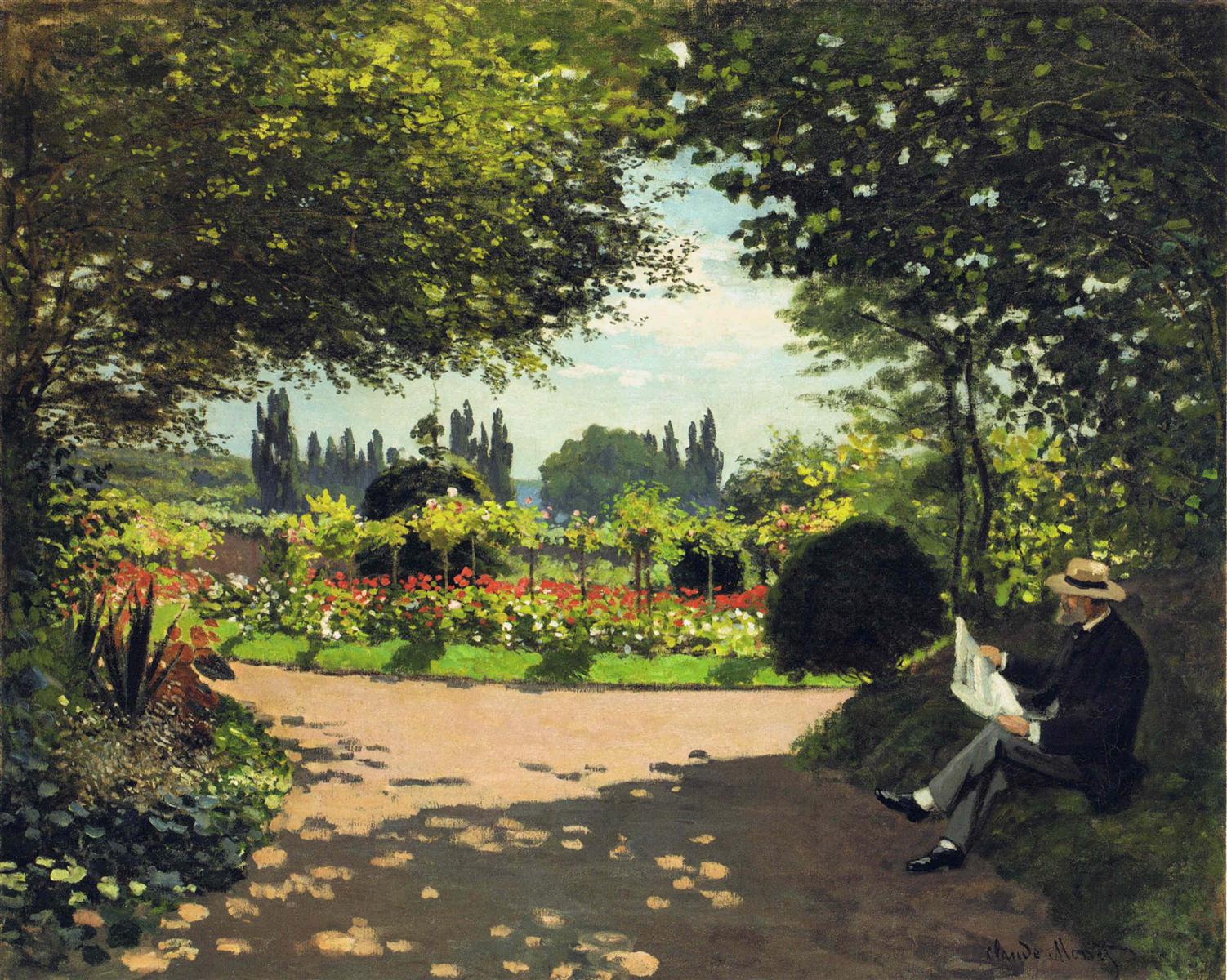
Claude Monet’s Adolphe Monet Reading in the Garden from 1866 offers a quiet, deeply rewarding look at the artist’s early ability to transform an ordinary moment into something memorable. At first glance, the painting seems simple. A man sits in the shade, reading in a lush garden while sunlight falls across a path and bright flowerbeds beyond. Yet the more closely the picture is studied, the more it reveals Monet’s exceptional sensitivity to atmosphere, color, and visual balance. This is not merely an image of a relative resting outdoors. It is also a meditation on light filtering through leaves, on the contrast between cool shadow and warm illumination, and on the way a cultivated garden can become both a personal refuge and a painterly stage.
The title identifies the seated figure as Adolphe Monet, Claude Monet’s father. That detail gives the painting a personal dimension, but the work does not feel like a strict portrait in the traditional sense. Monet is less interested in sharply defining facial features or presenting a formal likeness than in placing a human presence within a living environment. The man is important, but so are the trees, the path, the beds of flowers, and the summer air itself. In this way, the painting already points toward the concerns that would later make Monet one of the defining painters of modern art.
What makes this work especially fascinating is its position in Monet’s development. Painted in 1866, it belongs to an early period when he was still refining the visual language that would later blossom into Impressionism. Even so, many of the qualities associated with his mature art are already here. There is a love of outdoor light, an attention to natural effects that resist rigid finish, and a desire to capture visual experience as something immediate and alive. The painting feels observed rather than staged, sensed rather than academically constructed. That quality gives it freshness even today.
A Scene of Calm and Cultivated Beauty
The first strength of Adolphe Monet Reading in the Garden lies in its mood. This is a painting of rest, but not of emptiness. It is still, yet full of life. The seated figure occupies the lower right section of the canvas, tucked into a bank of shade beneath the trees. Before him stretches an open path, pale and sunlit in places, leading the eye toward a bright middle ground filled with flowering plants and trimmed garden forms. Beyond that, darker vertical trees rise against a pale blue sky. The entire scene suggests an ordered garden shaped by human care, but one that remains richly alive with foliage and changing light.
The emotional tone is gentle and contemplative. Nothing dramatic happens. No gesture interrupts the quiet. The reader is absorbed in his newspaper or document, and the garden seems to breathe around him. Monet turns this ordinary moment into an experience of serenity. The painting invites viewers to slow down and inhabit the stillness of the scene. It becomes easy to imagine the rustling of leaves overhead, the warmth of the day beyond the shadows, and the muted calm of a private afternoon.
This sense of calm depends on the balance between shelter and openness. The foreground is dark and cool, almost enclosed by the dense canopy above and the foliage at the edges. The middle ground opens into light, color, and cultivated order. The background recedes into a softer horizon. The viewer moves visually from protection to brightness, from intimacy to spaciousness. That structure gives the painting emotional depth. It is not simply a garden view, but a garden experienced from within, as someone seated in shade might actually perceive it.
Composition and the Architecture of Vision
Monet organizes the painting with remarkable intelligence. The composition appears effortless, but it is carefully built. The large trees at the top and sides create a framing device, almost like a natural arch. Their branches and leaves form a canopy that encloses the upper portion of the painting and draws attention toward the bright opening in the center. This contrast between dark framing elements and luminous central space gives the painting both cohesion and visual drama.
The path in the foreground serves an important structural function. It creates a broad horizontal zone that separates the shaded area from the vivid flowerbeds beyond. It also provides a space of rest for the eye, allowing the brighter colors of the garden to stand out more intensely. Sunlit patches scattered across the path animate this area, preventing it from becoming flat or empty. These flecks of light echo the broken visual rhythms found throughout the foliage.
The placement of Adolphe Monet at the far right is equally significant. He is not centered, and that choice gives the painting a more natural and modern feeling. A conventional portrait might have emphasized the sitter more directly. Monet instead allows the figure to exist as part of the scene’s overall balance. The dark clothing of the seated man anchors the right side of the composition, while the darker shrubs and shaded foliage on the left provide counterweight. Between them, the light-filled garden becomes the central visual event.
Even the distant trees contribute to the painting’s order. Their tall vertical forms punctuate the horizon and prevent the background from dissolving into vagueness. They create rhythm and stabilize the scene, almost like columns in a landscape architecture. Monet is not merely painting what he sees. He is arranging visual relationships so that the eye moves naturally and continuously through the composition.
Light as the True Subject
Like so many of Monet’s greatest works, this painting is fundamentally about light. The title names a person, but the eye is repeatedly drawn to the luminous effects that define the scene. Sunlight filters through the leaves overhead, breaks into scattered patches across the path, touches the flowerbeds in the middle ground, and fades into the pale sky beyond. Light is never uniform here. It is fragmented, fleeting, and dependent on the shapes through which it passes.
This makes the painting feel immediate and believable. Rather than treating light as a generalized illumination, Monet observes how it behaves in a real outdoor setting. Under the trees, forms are submerged in cool shadow. In the open garden, color brightens and expands. Along the path, sunlight appears in irregular spots, suggesting the shifting play of leaves above. These details make the scene feel momentary, as though it belongs to a particular hour of a particular day.
The handling of shadow is especially impressive. Monet does not use darkness simply to indicate absence of light. The shaded areas are full of variation. Browns, greens, deep blues, and muted grays all contribute to the cool interior atmosphere beneath the canopy. This richness prevents the shadows from becoming dead space. Instead, they feel atmospheric and alive, holding visual information even where forms soften.
By making light so central, Monet also transforms the emotional meaning of the painting. The glow beyond the shaded foreground creates a sense of invitation and renewal. At the same time, the dark shelter around the seated figure gives the scene privacy and repose. Light here is not just optical. It is emotional. It shapes the viewer’s experience of calm, warmth, and gentle distance.
The Garden as a Living Space
The garden in this painting is not a background decoration. It is one of the main subjects. Monet presents it as a carefully maintained environment, but he avoids making it look stiff or overly formal. Flowerbeds stretch across the middle ground in horizontal bands of red, white, pink, and green. Rounded shrubs and trained plant forms introduce structure, while the looser foliage of the trees keeps the entire scene from feeling rigid. The result is a garden that combines human order with natural vitality.
This matters because Monet treats the garden as a place of lived experience. It is not a symbolic paradise in the academic sense, nor a grand aristocratic display. It is a domestic outdoor world, cultivated yet personal. The seated figure reinforces this feeling. We are not looking at a public spectacle. We are looking at a private environment where one can read, sit, think, and enjoy the day.
The painting also captures the garden as a sensory experience. One can almost feel the difference between the cool earth under the trees and the warm brightness near the flowerbeds. The vivid blossoms are not rendered botanically, but they are convincing as bursts of seasonal color. Monet does not catalogue plants. He paints their visual effect. This approach anticipates his later fascination with gardens, especially in works where flowers, water, and foliage become vehicles for pure perception.
In this sense, the garden becomes an ideal subject for Monet. It allows him to study color relationships, shifting light, layered space, and the meeting of natural abundance with human design. It is a place where observation and pleasure merge.
Adolphe Monet as Figure and Presence
Although the painting is not a formal portrait in the strict academic manner, the presence of Adolphe Monet remains essential. He gives the image its human focus and emotional grounding. Seated quietly in the shade, dressed in dark clothes and a light hat, he appears self-contained and absorbed in reading. There is no theatrical pose, no direct engagement with the viewer. Instead, he inhabits the garden naturally, as though Monet has captured him in an unguarded moment.
This lack of display is one of the painting’s greatest strengths. The figure does not dominate the scene, but neither is he incidental. He acts as a measure of scale, a point of stillness, and a symbol of cultivated leisure. Reading in the garden suggests education, reflection, routine, and comfort. The act is quiet, but meaningful. It implies a life shaped by habit and by a certain social stability.
Monet’s treatment of the figure also reveals a modern instinct. He is willing to let part of the subject remain obscure. The face is not highly detailed, and the dark suit merges somewhat with the surrounding shadows. Rather than forcing sharp definition, Monet accepts the optical truth that a seated person under shade may appear partially absorbed by the environment. This choice sacrifices some descriptive precision, but gains a greater sense of atmosphere.
The figure’s relation to the rest of the painting is also emotionally suggestive. He is placed close to the viewer, yet turned inward. We observe him, but do not interrupt him. That distance creates respect and quiet intimacy at once. It feels like a personal glimpse rather than a posed presentation.
Color, Contrast, and Visual Harmony
Color plays a major role in the success of this painting. Monet builds the scene through carefully controlled contrasts between dark and light, cool and warm, subdued and vivid. The dominant greens of the foliage create an enveloping natural atmosphere, but these greens are far from uniform. Some are deep and shadowed, others bright and yellowish where sunlight strikes them. This variation gives the canopy and garden their shimmering complexity.
Against these greens, the flowerbeds become centers of chromatic energy. Reds, whites, and soft pinks appear in lively bands across the middle ground. Their brightness is heightened by the darker framing foliage and by the neutral tone of the path. Monet understands that color is most effective when relational. The flowers do not shout because they are inherently loud. They sing because the surrounding tones allow them to do so.
The pale sky at the center of the composition is equally important. It cools and opens the image, preventing the dense foliage from becoming oppressive. This opening of light blue and soft white acts almost like a breath within the painting. It gives the eye release and adds depth to the enclosed foreground.
Even the clothing of the seated figure contributes to the harmony. The dark suit helps integrate him into the shaded zone, while the pale hat and white paper echo lighter notes elsewhere in the painting. Nothing feels isolated. Every color participates in a broader orchestration. This sensitivity to harmony is one reason the painting remains so satisfying to study.
An Early Monet and the Road Toward Impressionism
Because the painting dates from 1866, it belongs to a formative stage in Monet’s career. He had not yet become the fully mature artist of the water lilies, haystacks, or Rouen Cathedral series. Yet this work already shows the foundations of his later achievement. Most importantly, it demonstrates his desire to paint modern life outdoors, under real atmospheric conditions, with close attention to visual sensation.
Academic art in the mid nineteenth century often valued clarity, finish, and idealized composition. Monet moves in another direction. While this painting is carefully structured, it does not feel stiff. While recognizable in detail, it is not obsessed with linear precision. Brushwork, color relations, and light effects matter as much as exact contour. The painting suggests that seeing is active and variable, shaped by light, distance, and time.
This work also reveals Monet’s growing independence. He is willing to make a family member part of a broader environmental study. He treats an everyday garden scene as worthy of serious art. That choice reflects a modern sensibility. Beauty is not confined to mythology, history, or grand narrative. It can be found in private life, in ordinary leisure, in sunlight passing through leaves.
Viewed in this way, Adolphe Monet Reading in the Garden becomes more than a charming family scene. It becomes an early declaration of Monet’s artistic priorities. He is already turning away from inherited hierarchies and toward lived perception.
Brushwork and Surface Life
Monet’s brushwork in this painting deserves close attention because it animates the entire surface. The leaves overhead are not rendered with painstaking individual definition. Instead, they are suggested through clustered touches that create density, movement, and flicker. This method allows the canopy to feel alive rather than fixed. It captures the visual complexity of foliage as it appears to the eye, especially in shifting light.
The same is true of the flowers and plants in the middle ground. Monet does not paint each blossom separately in a detailed botanical manner. He uses patches and touches of color that register as flowers within the whole. This approach makes the garden feel vibrant and immediate. It is painted as something seen in a glance and then examined through sensation, not dissected through rigid description.
The path, too, is enlivened by brushwork. Sunlit spots are laid across its surface in irregular forms that suggest broken light. This gives the foreground a rhythmic texture and prevents the broad area from becoming inert. Everywhere one looks, Monet’s handling resists dead smoothness. The painting breathes because the surface remains active.
This active surface is one of the most modern aspects of the work. Monet is not hiding the fact that the painting is made of paint. Yet he never lets brushwork become an end in itself. It always serves perception. The visible strokes help communicate how the world appears under specific visual conditions.
Themes of Leisure, Observation, and Family Intimacy
Beyond its technical brilliance, the painting carries subtle thematic richness. One of its clearest themes is leisure. Adolphe Monet is not working, walking, or performing. He is reading in the shade. The garden is a place of repose, and the painting honors that state. In a century marked by industrial change and urban growth, such scenes of private outdoor rest carried special appeal. They suggested a world in which time could slow down and attention could settle.
There is also a theme of observation itself. A man reads while a painter observes him reading. The scene becomes layered with acts of looking. The father studies a page, while the son studies the father within the environment. The viewer, in turn, studies both. This chain of attention deepens the painting’s reflective quality. It is about stillness, but also about concentrated seeing.
Family intimacy is another important element. Because the figure is Monet’s father, the painting has a personal dimension that cannot be ignored. Yet Monet does not sentimentalize the relationship. He does not dramatize affection. Instead, he records presence. That restraint makes the intimacy more convincing. The painting feels affectionate because it is patient, observant, and respectful.
Why the Painting Still Matters
What makes Adolphe Monet Reading in the Garden so compelling today is the way it joins personal subject matter with larger artistic innovation. It offers the warmth of a family scene, the beauty of a cultivated garden, and the excitement of an artist discovering how to translate light and atmosphere into paint. It is both accessible and historically significant.
The painting also feels surprisingly contemporary in its appreciation of small, restorative moments. Modern viewers can immediately understand the appeal of sitting outdoors with something to read while light filters through trees. The subject remains relatable, even timeless. At the same time, the painting rewards deeper study because it shows Monet shaping a new way of seeing.
This is one of those works that reveals how great artists often announce themselves before they fully arrive at their most famous style. Monet’s mature masterpieces may be more radical in some respects, but this painting already contains the essence of his vision. Nature is not static. Light is never simple. Everyday life is worthy of art. Painting can record not only objects, but atmosphere, sensation, and mood.
Conclusion
Adolphe Monet Reading in the Garden stands as an elegant and revealing work from Claude Monet’s early career. It captures a quiet domestic moment, yet opens onto larger questions about perception, modern life, and the role of light in painting. Through thoughtful composition, rich color, sensitive brushwork, and a subtle treatment of human presence, Monet transforms a garden scene into a deeply atmospheric experience.
The painting’s lasting beauty comes from its balance. It is intimate without being sentimental, structured without feeling rigid, and luminous without losing calm. The garden feels both carefully cultivated and visually alive. Adolphe Monet appears both specific and universal, a father in a private setting, but also a figure of contemplation and repose. Above all, the painting shows Monet already moving toward the artistic path that would define him. He is learning how to paint not just things, but the living conditions in which they appear.
That is why this work deserves sustained attention. It is not simply an early Monet of historical interest. It is a fully engaging painting in its own right, one that reveals the poetry of ordinary life and the extraordinary visual intelligence of an artist on the verge of greatness.
