Image source: wikiart.org
Introduction
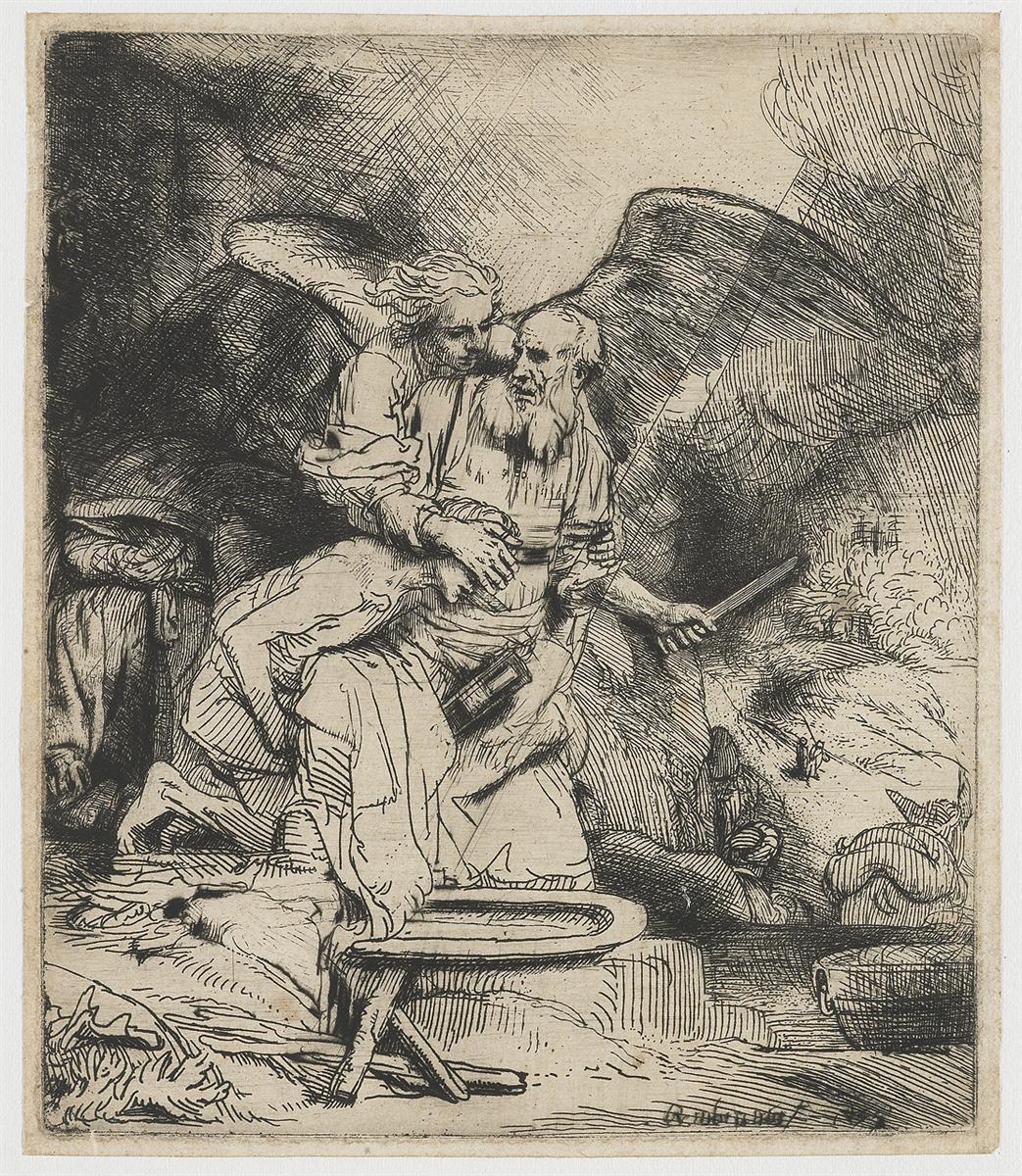
Rembrandt’s “Abraham’s Sacrifice” (1655) is a compact, electrifying etching in which the drama of faith unfolds at arm’s length. The plate captures the very instant the angel stays Abraham’s hand: a knife glints in the patriarch’s fist, Isaac is bound, and a winged messenger wraps Abraham in an arresting embrace. Rather than spreading the story across multiple episodes, Rembrandt compresses it into one urgent, tactile knot of limbs, drapery, and light. The scene feels immediate because the artist draws as though he is touching—lines press, scratch, and soften; drypoint burr breathes around contours; open paper flashes as sudden illumination. In this small sheet, theology becomes muscle and breath. The grandeur of patriarchal obedience, the terror of filial vulnerability, and the mercy that overtakes both are distilled to a single, decisive stoppage.
A Story Chosen for the Instant of Reversal
The biblical narrative from Genesis culminates not in Abraham’s action but in his interruption, and Rembrandt understands that the essence of the story lives in that reversal. Many artists had painted the sacrifice as a tableau of intent, with Abraham poised over the altar and Isaac resigned. Rembrandt chooses a more difficult second: the moment after intent but before aftermath, when the air still trembles with danger. The angel does not declaim from a cloud; he grabs Abraham from behind in a tender tackle, cheek close to ear, one hand circling the wrist that holds the knife. The decision to stage the angel as a touch rather than an apparition is the sheet’s moral invention. It renders mercy not as an idea but as contact.
The Composition as a Knot That Suddenly Loosens
The composition is built as a centralized knot that begins to loosen the instant we look. Abraham’s torso anchors the middle of the plate, pivoting left as the angel’s weight turns him and Isaac’s body twists downward. The altar reads like a circular stone basin fronted by a low bench; rope and wood sprawl as if spilled by the reversal. The great, winglike arc of shadow at right both shelters and presses the group, while a slope of light in the upper right quadrant opens toward a small, distant landscape where the ram is implied among foliage. Everything converges on Abraham’s right hand, the hand that is seized. From there the lines radiate outward: Isaac’s bound legs, the angel’s drapery and hair, the stone’s curved edge. The eye is caught, then released—the same rhythm the narrative enacts.
Etching Technique as a Vocabulary of Touch
Rembrandt brings his mature command of the medium to bear. The primary figures are modeled with mixed etching and drypoint, so that some contours print crisp while others carry soft burr. Burr around the angel’s hair and wing creates a velvety halo that reads as movement and divine nearness. Straighter, deeper bites articulate the knife and the altar’s edge, securing the crucial geometry. Cross-hatching builds the dark cave of shadow behind the protagonists and slides in parallel strokes toward the margin, letting the paper’s whiteness act as light. The balance between bitten line, rich burr, and reserved paper produces a living surface: you sense the roughness of rope, the stone’s cool curve, the pressure of the angel’s grip. This physicality turns doctrine into sensation.
Light That Behaves Like Mercy
There is no painted glow, and yet the sheet is radiant. Rembrandt organizes light as preserved paper: the faces of Abraham and Isaac, the angel’s arm, and a wedge of brightness at the right where foliage catches day. These whites are not evenly distributed; they focus where mercy alights. The darkest passages—behind Abraham’s back and under the altar—hold the story’s dread, now displaced but still present. The transition from shadow to brightness is fast, as if light itself arrives with the angel. The effect is theological without emblem: mercy is an intervention that clarifies, that reveals face and hand, that stops the blade.
Abraham’s Body As the Theater of Obedience
Abraham is not monumentalized by height but by density. His chest is barrel-like, his arms powerful, his beard thick—a craftsman’s anatomy. Rembrandt refuses to idealize. The patriarch’s obedience has been bodily, a willingness to bind, lift, and strike. When the angel halts him, we feel the torque in the torso, the sudden check in the shoulder, the way fingers recalibrate around the knife. The face carries muscular surprise rather than melodramatic awe: brows knit, mouth open, eyes cast toward the messenger at his ear. Obedience in this reading is not a posture but a strenuous act that can be redirected. The redirected body becomes the etching’s central drama.
Isaac’s Vulnerability and the Ethics of Depiction
Isaac is drawn with a mix of specificity and modesty. His limbs are bound; his head is turned away; his body rides over the curve of the altar rather than lying splayed on a flat surface. Rembrandt gives him weight—we see the pull of gravity at his thighs—but he also keeps him somewhat schematic, avoiding gratuitous detail. The result is a child who is intensely present without becoming spectacle. His most expressive feature is the foot that presses against the stone edge as if seeking purchase in a world suddenly unstable. That small gesture binds the viewer to the boy: we recognize the body’s reflex for survival even as faith’s plot transcends it.
The Angel as Embrace Instead of Interruption
Perhaps the most radical decision here is to present the angel as an embrace. Hair streams like flame, wing unfurls as a dark sail, and the body plunges into Abraham’s space. The hands do not hover; they hold. One arm wraps the chest; the other encloses the wrist. Even the head leans close to whisper. Mercy, in Rembrandt’s imagination, is not a distant decree but a nearness that takes weight and risk upon itself. This makes the angel the scene’s most human element, and the theology more intimate: divine command arrives as touch that steadies and redirects.
The Altar, Knife, and Ram: Objects with Narrative Gravity
Rembrandt devotes careful attention to the objects that carry the plot’s machinery. The altar’s bowl-like form reads both as place and as container: a receptacle that nearly holds death. The knife, short and heavy, is drawn with crisp lines and a subtle highlight along the blade’s back—no decorative flourish, only function. In the distance a tufted thicket implies the ram, its presence suggested rather than showcased. The low firewood and the rope sprawl across the foreground where the narrative slackens. These props are not anecdotal; they are gravitational. Each holds a clause of the story’s logic: intent, means, and substitute.
Background as Breath and Witness
The background in late Rembrandt prints often functions as a kind of breath, and so it does here. The dark cave of cross-hatching at left and behind the figures compresses the drama, while the open sky at the right gives the scene its exhale. The halftone slope leading toward the thicket suggests path and prospect. Within the gloom a secondary figure—perhaps a servant—hovers half-seen, the way witnesses do at the edge of great decisions. The etching thereby situates the miracle within the mundane world, a hillside with rocks, shrubs, and people waiting out of the spotlight.
Compression of Time into a Single Instant
A virtue of printmaking is the ability to condense time. Rembrandt seizes it. Before this instant there were steps up the hill, the gathering of wood, the binding of Isaac. After it there will be a loosening of ropes, a ram led from the thicket, a sacrifice transformed into thanksgiving. The plate bears all those times invisibly, held within the density of this stop. The viewer feels the before and after as stored energy, which is why the scene vibrates with more life than the stillness of the figures would suggest. The knife’s halted path becomes a hinge for a narrative arc that exceeds the frame.
The Psychology of Faith Without Piety
Faith in this print is not piety in repose but the capacity to re-hear. Abraham has heard one command and acted; now he hears another, nearer voice, and yields. Rembrandt paints neither defiance nor credulity. He shows a man whose obedience has strength enough to turn. The angel’s urgency implies that obedience is not a trance but a listening that must remain awake to new instruction. This is a psychologically modern reading: faith is not blindness; it is attention under pressure. The etching honors that attention by making the voice literally hands-on.
Line, Speed, and the Sensation of Breath
The sheet’s energy owes much to Rembrandt’s speed of line. The angel’s hair is a rush of strokes; the folds around Isaac are quick and broken; the cavern of shadow is built from long rhythmic hatching that curves like wind. In contrast, Abraham’s arm and knife are more measured, as if force were gathering. This alternation—whip-fast where interruption arrives, slower where decision has weight—gives the drawing a soundtrack of breath: an inhalation at the surprise, an exhalation as the knife lowers, breaths returning to normal as the ram appears.
Theology Rendered as Composition
The print’s theology is in its structure. Centered mass, seized hand, light focused on faces—each formal choice incarnates a doctrine. Substitution is suggested by the distant thicket, not trumpeted; grace is the nearness of a figure who shares human scale; covenant is visible in the fact that father and son will leave together rather than divided by death. Even the paper’s whiteness participates, ringed by line as if by revelation. Rembrandt’s genius is to make belief legible without symbolism. He trusts the anatomy of the scene to do the doctrinal work.
Comparisons to Rembrandt’s Other Treatments
Rembrandt approached this subject more than once, including a celebrated oil from earlier in his career where the angel covers Abraham’s eyes. Between that painting and the 1655 etching lies a shift from theatrical gesture to intimate intervention. The oil relies on dramatic spotlight and a sweeping angelic presence; the etching brings everything closer, puts the viewer within reach of the knife, and replaces stagecraft with contact. The mature version thus feels quieter and truer: the miracle happens neither at a distance nor amid showy light, but in the feel of a hand against a wrist.
The Viewer’s Vantage and Ethical Address
Because the altar and figures occupy the lower half of the plate and tilt toward us, we stand within the scene, not outside it. There is no barrier of steps or columns. Our proximity is ethical. We become witnesses bound to the outcome by nearness. The image asks us to consider what it would feel like to reorient action when better instruction arrives. It rehearses, in visual form, the courage to change one’s hand mid-swing. That rehearsal may be the print’s deepest pastoral gift.
Process Left Visible as a Metaphor for Revision
Rembrandt allows traces of reworking to remain—lines reinforced, shadows thickened after initial bites, edges softened by later drypoint. This visibility of process mirrors the story’s own revision: a life course is corrected; a narrative is rewritten. The plate’s history becomes a parable of mercy inscribed in copper. Viewers sense that the image could only have emerged from decisions made and unmade, which makes the final arresting gesture feel earned rather than contrived.
Modern Resonance
Contemporary audiences read this image as more than biblical illustration. We know what it is to be gripped by a new imperative mid-action, to replace a well-laid plan with a truer one at cost. The etching captures that pivot exquisitely. It also speaks to debates about obedience and ethics, reminding us that fidelity to a higher call need not calcify into violence; it can be interrupted by compassion without ceasing to be faithful. The sheet’s small scale helps here: it invites personal, handheld contemplation rather than monumental awe.
Conclusion
“Abraham’s Sacrifice” distills Genesis into one breath held and released. With a needle and a plate, Rembrandt writes mercy onto muscle and stone: a hand stopped, a body turned, a child spared, a substitute waiting in the brush. The angel’s embrace is theologically audacious and emotionally persuasive; the light that blossoms across faces reads as recognition as much as illumination; the crowding of forms communicates urgency without confusion. Few prints achieve such density of meaning with such economy of mark. To live with this image is to rehearse the courage to be interrupted by grace, and to remember that the most decisive acts of faith are sometimes the ones that never occur because a nearer voice has said, “Stop.”