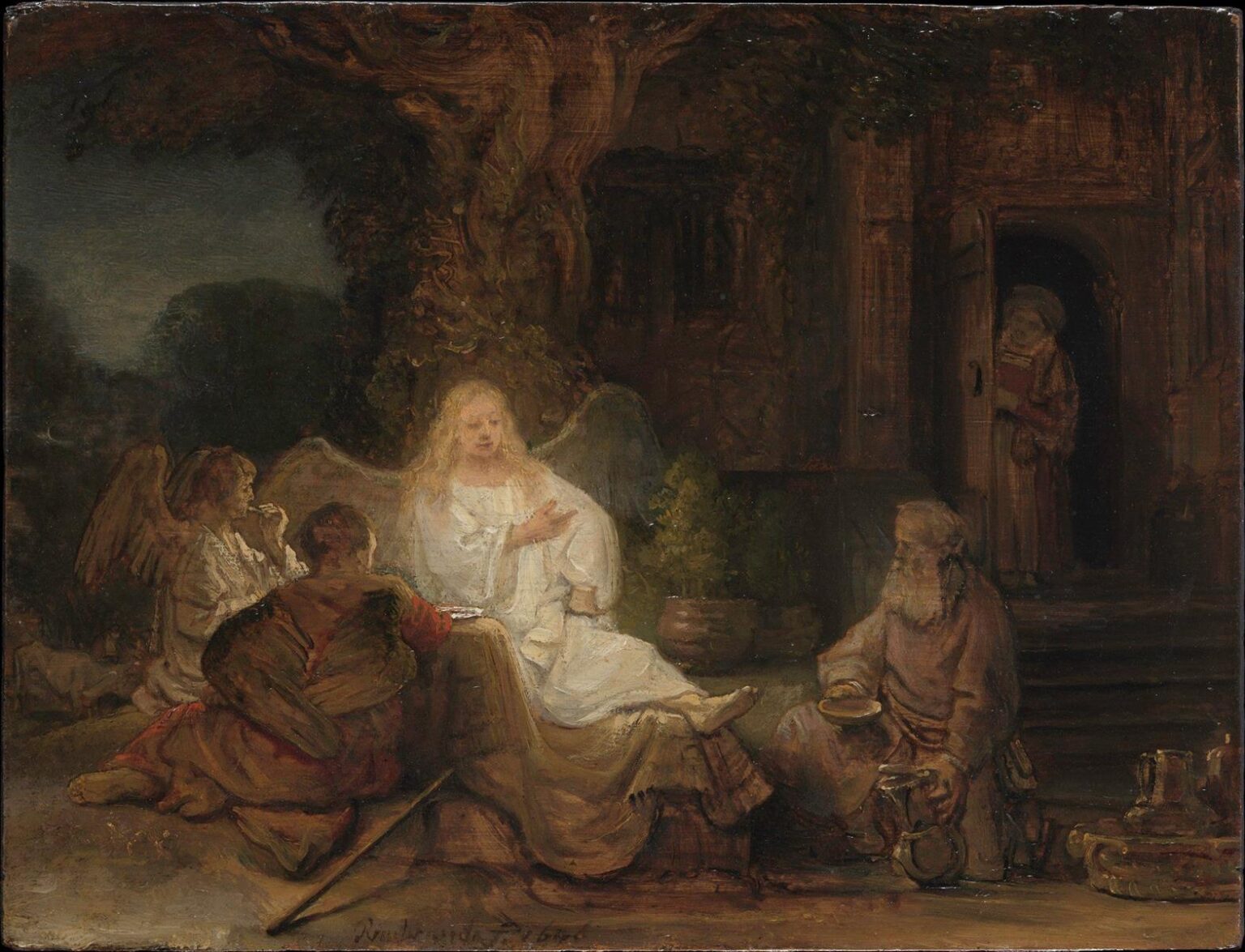
Image source: wikiart.org
Introduction to Rembrandt’s “Abraham Serving the Angels” (1646)
Rembrandt’s “Abraham Serving the Angels” condenses one of Genesis’s most resonant encounters into a chamber-sized nocturne of light, gesture, and hospitality. Three angels sit at table beneath a broad tree; their garments glow with a pearly inner radiance. Abraham, bearded and earthy, kneels at the right with a platter and jug, his whole posture an offering. From a doorway in the shadowed house, Sarah peers out with a book in hand, a witness half hidden by architecture and by doubt. The scene takes place in that unstable hour between late afternoon and evening when leaves darken and vessels gleam. With a handful of warm tones and decisive highlights, Rembrandt stages not only a meal but a moment when the human and the divine become neighbors.
The Scriptural Moment and Its Human Stakes
The episode comes from Genesis 18. Abraham sees three strangers near his tent and urges them to rest and accept food. As they eat, one declares that Sarah will bear a son, and she laughs privately at the impossibility of the promise. The story’s drama lies in the ordinary: a meal under a tree, water for feet, bread and calf. Rembrandt holds close to this domestic core. There are no theatrical vistas, no glittering retinue. The artist’s interest is ethical and relational—how welcome is enacted, how news enters a household, how reverence can look like service. The painting reads the text as a study in the virtues of attention and care.
Composition as a Circle of Hospitality
Rembrandt builds the composition around a circular flow that returns to its source like a blessing. The three angels, grouped in a loose arc at left, form the brightest pole. Their circle extends through the drapery on the table and returns via Abraham’s kneeling body to the pitchers and dishes gathered in the lower right. The opening at the house door completes the loop as Sarah’s presence sends attention back toward the table. This rotational design produces a quiet centripetal force, drawing the viewer into fellowship without collapsing the hierarchy: the divine figures remain the anchor, but the human participants are necessary to the scene’s coherence.
Light as the Language of Revelation
Light in this painting is not neutral illumination; it is the very grammar of meaning. The angel facing us, hands raised in a speaking gesture, emits a cool, milky glow. That radiance does not burn like fire; it behaves like air made luminous, a fit metaphor for speech that carries promise. The second angel, in profile, catches a softer share of that light along wing and shoulder. The third, kneeling with back to us, reflects a warm bounce that fuses his form to the drapery. Abraham’s garments receive a modest glow sufficient to read as included yet subordinate. The house and door recede into browns and umbers until Sarah’s face and the red of her book lift from the dusk. Light thereby narrates the scene: revelation at the table, assent in service, and the private testing of the word at the threshold.
Color, Warmth, and the Temperature of Faith
The palette is restrained—earths, warm greys, mossy greens, and the creamy whites of the angels—punctuated by small coppery notes in pitchers and basins. That restraint is theological. The story is about promise landing in a modest household, and the color accords with such humility. The whites of the angels are neither chalky nor cold; they possess the tone of linen in lamplight. The reds remain muffled in Abraham’s garments and in Sarah’s book, where their chroma symbolizes ardor tempered by time. The overall temperature is warm without feverishness, creating a climate in which trust could plausibly take root.
Abraham’s Gesture and the Ethics of Service
Abraham kneels with a platter in one hand and a jug in the other, angled slightly toward the center of the angelic circle. His body does not prostrate; it extends. The torso leans, the elbow bends, the wrist prepares to pour. Service for Rembrandt is kinetic: generosity becomes visible when it moves. The beard and coarse hair are rendered with feelable strokes, insisting that the patriarch is a man used to work. In the deep pocket of shadow under his arm and in the creases of his robe, Rembrandt records the weight of age; yet the posture carries the spring of a younger man. The figure teaches hospitality without didactic emblem—a way of being that combines readiness, humility, and vigor.
The Angels as Persons, Not Abstractions
Each angel holds a distinct presence. The central speaker’s face is humanly specific; the head tilts in explanation, the mouth opens at the middle of a sentence, the brow is calm. Wings are given the faintest of bodies, more optical effect than anatomical assertion. The angel in profile listens with a hand near the face, a gesture of thought rather than swoon. The kneeling angel, back toward us, contains a muscular weight that anchors the triangle. These are not vaporous messengers or hard-edged apparitions; they are persons whose gravity is moral rather than physical. Rembrandt’s approach allows the viewer to register the miraculous within the bounds of human fellowship.
Sarah at the Door and the Drama of Privacy
The painting’s most subtle figure may be Sarah, half seen in the doorway. Her book and the architecture make a frame within the frame; she inhabits another chamber of meaning. The hand at her chest hints at inward dispute—skepticism edged with longing. Her position at a remove intensifies the story’s tension. The promise concerns her body; the conversation happens in her house; yet she receives it indirectly. Rembrandt preserves this complexity. He neither accuses nor idealizes. The shadow that covers her is not condemnation but the natural privacy of a woman wrestling with news others proclaim. The door becomes the ethical boundary where public revelation waits for private assent.
The Tree and the House as Theological Architecture
The great tree above the table is a living canopy whose roots seem to hug stones and steps. It is the organic counterpart to the rigid geometry of the house. Together they stage two kinds of shelter: nature’s spread and human construction. In Genesis, Abraham meets the visitors by the oaks of Mamre; Rembrandt lets the tree remember that site while also allowing it to function as an emblem of time. Vines twist across the bark like the handwriting of seasons. The message that arrives under its leaves promises a future that will outlast human masonry. The house, with its millwork and heavy door, offers the other half of the covenant: stability, law, a place for the family that will follow.
Table, Bread, and the Sacramental Undertone
On the table, drapery folds in generous arcs; plates and bread sit at the rim of light. The scene is unmistakably domestic, yet the composition allows a sacramental undertone to sound. Bread at the center of a circle of revelation, a host who kneels, a stranger who becomes a channel of promise—these resonate with a Christian viewer’s memory of sacred meals. Rembrandt never makes the symbolism blunt. He prefers the double register where an object can serve dinner and meaning at once. This duality is part of the painting’s breadth: it can be read by the devout and by the neighbor who simply recognizes good manners.
Human Scale and the Calm of the Small
Rembrandt keeps the figures small in relation to the panel, ensuring that air, tree, and house remain coequal participants. This scale choices matters. Grandeur, he suggests, can arrive quietly. The smallness invites literal closeness; one must approach the painting to enter the glow. In that proximity, brushwork resolves into a language of touch—flicks for foliage, dragged strokes for bark, soft fusions along fabric edges. The calm that results is not emptiness but composure. Events of permanent consequence can take place within the measured pace of a meal.
Brushwork, Texture, and the Breath of Paint
The painting’s surface is alive with tonal variety. Angels’ garments are built from layered whites that catch and release light depending on thickness. Abraham’s robe is a woolen field of warm strokes, traveled by small highlights where folds turn. The ground near the vessels carries scumbled browns that read as dust disturbed by feet. Metal catches quick, bright touches at the lips of jugs and basins, convincing in their minimalism. Such tactility is not ornament; it is the means by which the room’s temperature and the story’s credibility are established. The viewer senses the weight of plates, the coarseness of bread, the cool of evening air under the tree.
Sound, Scent, and the Multisensory Scene
Though paint is silent, Rembrandt’s choices imply a rich soundscape: murmured speech from the angel, the dull knock of vessel against step, the scrape of chair legs, leaves rubbing in a mild wind, Sarah’s breath caught at the door. Scent is here too—the warmth of baked bread, damp earth near the roots, oil on wood. These inferences arise because textures and proximities are so convincingly built that other senses feel licensed to participate. The multisensory illusion deepens the viewer’s conviction that they are present at an event rather than contemplating an illustration.
A Narrative of Time Rather Than a Snapshot
Rembrandt avoids the frozen tableau. The angels’ conversation will continue; Abraham will pour; Sarah will step forward or retreat. The composition holds these prospects without forcing a resolution. The slight turn of the speaking angel’s hand, the angle of Abraham’s wrist, the half-open door—all are verbs caught mid-conjugation. The painting therefore respects the temporal character of faith and hospitality. Welcome is not a stance; it is an ongoing action. Belief is not an instant; it ripens.
The Viewer’s Position and the Ethics of Witness
We stand just outside the circle, slightly to the right, at the level where Abraham kneels. The vantage is ethically chosen. We are not in the place of the angels, nor inside the house with Sarah; we are neighbors invited to watch a good man serve and to let the scene judge our own readiness to welcome strangers. Rembrandt rarely humiliates his viewers with moralizing, but he often grants them a role that carries implication. Here, proximity encourages emulation. To see well is to learn how to serve.
Comparisons Within Rembrandt’s Angelic Visitations
This painting speaks to earlier and later treatments of angelic meals in Rembrandt’s oeuvre, where the supernatural enters domestic or rustic settings with unforced naturalism. Compared to more dramatic nocturnes, “Abraham Serving the Angels” is luminous rather than dazzling. Its authority comes from the credibility of behavior—how people actually lean, pour, and listen—rather than from special effects. In this it shares the temperament of the artist’s best sacred interiors: revelation hosted with good dishes, prophecy issuing from a mouth that might also ask for water.
The Promise and the Laughter
Sarah’s laughter in Genesis is both doubt and defense, a human response to the audacity of joy proposed too late. Rembrandt does not paint the laugh; he paints the pause in which it gathers or dissolves. The small distance between table and door is the space in which the promise must cross into the body. The composition honors that journey. Light from the table does not yet fully reach the doorway; it will, if the door opens. In that conditional atmosphere, the viewer senses a drama more intimate than any battle scene: will hope be allowed to live?
Legacy and Contemporary Resonance
For modern viewers, the painting remains newly relevant. It honors the social virtue of hospitality at a time when strangers often trigger fear; it models listening in a culture of noise; it treats promises as events to be hosted rather than slogans to be shouted. The work also argues for the dignity of small settings. A porch, a tablecloth, a jug, a tree—these suffice when attention is paid and care is offered. In its layered quiet, the picture teaches that community can be built wherever the human instinct to serve meets the courage to welcome the unexpected.
Conclusion: A Meal of Light
“Abraham Serving the Angels” is finally a meal of light. Bread sits in the glow, wings become luminous edges, a jug waits to pour daylight into a cup. Abraham’s service and Sarah’s listening frame the encounter. Rembrandt keeps the world small so that meaning can be large. He trusts the viewer to feel the gravity of hospitality, the tenderness of promise, and the way revelation prefers ordinary tables. The painting’s enduring beauty comes from this trust. It invites us to come closer, to take a seat just outside the circle, and to learn again how to offer and receive what arrives.