Image source: wikiart.org
Introduction to Abraham Receiving the Three Angels
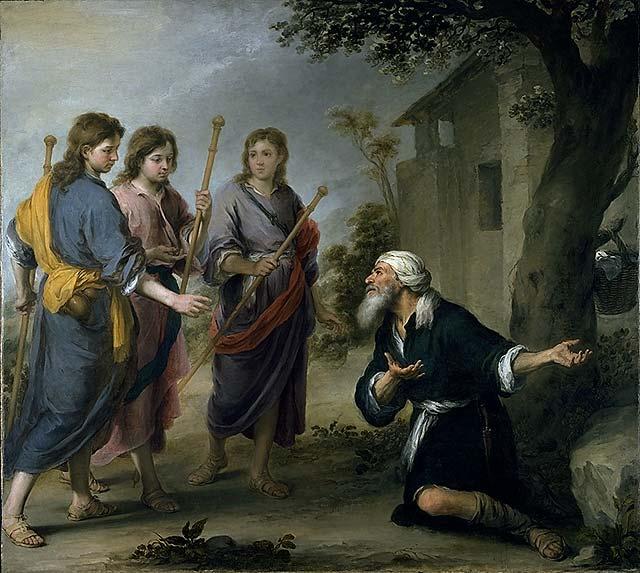
“Abraham Receiving the Three Angels” by Bartolomé Esteban Murillo, painted in 1667, is a refined Baroque interpretation of one of the most mysterious episodes in the Book of Genesis. The work shows the patriarch Abraham kneeling on the right while three youthful visitors stand on the left, cloaked in traveling garments and carrying staffs. At first glance it appears to be a simple scene of hospitality at a rural doorway. Closer study reveals that these three travelers are angels in human form who come to announce the birth of Isaac and to renew God’s covenant with Abraham.
Murillo transforms this Old Testament narrative into a deeply human encounter. The painting is neither harshly dramatic nor overloaded with symbolism. Instead it is quietly luminous, suffused with the soft light and tender realism that characterize his Sevillian style. The work encourages contemplation of divine presence hidden in the everyday world and invites viewers to reflect on themes of faith, welcome, and promise.
Biblical Story Behind the Painting
The story depicted comes from Genesis 18. Abraham is sitting by the oaks of Mamre in the heat of the day when he sees three men standing nearby. He runs to meet them, bows to the ground, and offers water, rest, and food. As the visitors accept his hospitality, they reveal a message from God. Sarah will bear a son despite her advanced age, and the promise of descendants as numerous as the stars will begin to take visible form.
Christian theology often reads this scene as a prefiguration of the Trinity, three persons visiting Abraham as one presence. In Western art the subject was frequently titled “The Hospitality of Abraham” or “Abraham and the Three Angels.” Murillo chooses the moment of welcome, before the meal, when the patriarch first approaches the unknown visitors with reverence and generosity. By selecting this encounter rather than the later announcement, he emphasizes the virtue of hospitality and the mystery of recognizing God in strangers.
Composition and Spatial Organization
Murillo structures the painting with a clear division between the standing group of angels on the left and the kneeling Abraham on the right. The three travelers form a compact cluster of verticals, their staffs echoing the tree trunk above and the architectural lines of the distant house. Abraham forms a diagonal along the ground, one knee bent and one arm extended, which leads the viewer’s eye toward the figures of the angels.
The background is a quiet rural setting. A large tree rises over Abraham, its branches spreading into a luminous, cloud filled sky. Behind the angels we glimpse a simple building that suggests Abraham’s dwelling. The landscape recedes softly into atmospheric distance rather than showing detailed vistas. This restraint keeps the focus on the human interaction in the foreground.
Murillo uses perspective to place the viewer slightly below the central encounter. The angels stand almost at eye level, while Abraham kneels lower, his head tilted upward. This height difference reinforces the sense of reverence. At the same time, the balanced distribution of figures prevents the angels from appearing oppressive. The painting feels like a conversation across an invisible threshold, with Abraham positioned at the edge of his home and the strangers at the edge of his land.
Figures of Abraham and the Three Angels
Abraham is depicted as an elderly man with a flowing white beard and a wrapped head covering. His clothing is dark, modest, and practical, cinched at the waist with a simple belt. Murillo captures the tension of his movement. One hand rests on his chest in a gesture of humility and sincerity, while the other extends outward in invitation. His face is turned upward, lined yet animated, as if he is both pleading and welcoming at the same time.
The three angels appear as handsome youths dressed as travelers. Murillo does not mark them with obvious wings or glowing halos. Their angelic nature is suggested instead through subtler means: their idealized beauty, their calm expressions, and the quiet harmony of their grouping. The central figure stands slightly forward, holding his staff in his left hand while raising his right hand as if speaking. His companions flank him, also holding staffs and listening attentively.
Their clothing introduces a gentle play of color. One wears a blue tunic with a golden sash, another a soft mauve robe with a deeper cloak, and the third a violet garment with an orange red drapery. These hues echo each other across the group, weaving a chromatic unity that distinguishes them from the more subdued tones of Abraham and the landscape. The angels’ bare feet remind the viewer of their apparent human vulnerability while hinting at their sacred mission.
Murillo’s fascination with youthful beauty is evident in the delicate features and flowing hair of the angels. Their faces are individualized yet share a serene inwardness, as if they carry knowledge that Abraham has not yet fully understood. This contrast between Abraham’s urgent gestures and the tranquil poise of the visitors embodies the meeting of restless human faith with the calm certainty of divine purpose.
Light, Color, and Atmosphere
Light in “Abraham Receiving the Three Angels” is soft and enveloping rather than harsh or theatrical. It falls from the left, illuminating the figures of the angels and casting gentle highlights on their garments and hair. Abraham, though placed somewhat in the shadow of the tree, is still touched by this light, especially on his face and beard. The effect suggests that the divine presence radiates outward from the visitors and reaches the patriarch even as he kneels in humility.
Murillo’s palette combines cool grays and blues of the sky and stone with the warmer earth tones of soil, tree bark, and garments. The angels’ robes introduce more saturated color in shades of blue, violet, and rose, while Abraham’s dark clothing anchors the right side of the composition. These color relationships create harmony and guide the viewer’s attention.
The atmosphere is characteristically Murillesque; edges are softened, transitions are gentle, and nothing feels rigid. The tree above Abraham frames the scene with a natural canopy, while the distant house and soft foliage place the episode in a believable world. At the same time, the luminous haze and lack of sharp detail in the background lend an almost dreamlike quality that suggests a sacred moment suspended between time and eternity.
Symbolism of Hospitality and Covenant
The subject of Abraham receiving the three angels carries strong symbolic weight. In biblical tradition Abraham is the father of faith, and his immediate eagerness to welcome strangers becomes a model of generous hospitality. Murillo captures this eagerness in the forward lean of Abraham’s body and the open gesture of his hand. He appears to be inviting the travelers to rest, eat, and share fellowship.
The three visitors symbolize the hidden presence of God. Their number hints at divine fullness and hints for Christian viewers at the mystery of the Trinity. Their staffs highlight their identity as pilgrims, which can be interpreted as an image of God coming to meet humanity while sharing its journey.
The modest dwelling in the background and the simple rural setting underline the idea that divine encounters occur in ordinary places. There is no palace or temple, only a home and a tree. The basket hanging on the rock near Abraham suggests provision and daily labor. Within this humble environment, the covenant between God and Abraham will be renewed through a promise of descendants and blessing.
From a moral perspective the painting invites viewers to see every stranger as a possible messenger of God. The respectful tension between Abraham and the angels reflects the responsibility to offer welcome even before recognizing the full identity of the guest. Murillo’s gentle realism makes this lesson feel grounded in real human experience.
Murillo’s Baroque Style and Sevillian Context
Painted in 1667, “Abraham Receiving the Three Angels” belongs to Murillo’s mature period, when his reputation in Seville was firmly established. Spanish Baroque art is often associated with intense chiaroscuro and dramatic martyrdom scenes, yet Murillo developed a softer variant marked by warmth, tender emotion, and luminous color. This canvas exemplifies that approach.
Instead of violent contrasts and rigid anatomical display, Murillo offers flowing draperies, relaxed poses, and an atmosphere suffused with quiet light. The figures are idealized yet believable, capturing both spiritual significance and human immediacy. His experience painting religious narratives and genre scenes of children and poor families informs the naturalistic gestures and expressions here.
Seville in the seventeenth century was a city where religious imagery played a central role in public and private devotion. Confraternities, monasteries, and churches commissioned large cycles of paintings to instruct and move the faithful. Murillo’s interpretation of Old Testament themes like this one would have been intended to complement New Testament scenes and Marian images, building a visual narrative of God’s interaction with humanity from Abraham to Christ.
The softness of the figures and the gentle light also reflect Counter Reformation ideals. Art was expected to be clear, emotionally engaging, and theologically sound. Murillo’s choice to present the angels without overt wings meets that demand for realism while preserving sacred meaning. Viewers are drawn into the story through familiar human forms rather than distant celestial beings.
Emotional Tone and Viewer Experience
One of the strengths of “Abraham Receiving the Three Angels” is its emotional balance. The scene is significant and mysterious yet not overwhelming. Abraham’s posture expresses a mixture of reverence, urgency, and hope. The angels respond with composed seriousness, acknowledging his welcome without yet revealing the full message they carry.
For the viewer, this moment feels like standing on the threshold of revelation. We sense that something momentous is about to be spoken, yet the painting pauses just before that disclosure. This choice allows us to meditate on the attitude of faith before we see its reward.
Murillo encourages identification with Abraham through the naturalism of his aged body and the expressiveness of his face. Even without grand gestures, we feel his desire to honor his guests and his openness to the unknown. At the same time, the calm dignity of the angels reassures us that the story unfolds under divine guidance.
Standing before the canvas, a viewer can almost imagine stepping into the space between Abraham and the visitors, hearing the first words of greeting and sensing the subtle shift in the air that signals the presence of God. This interplay between narrative suspense and contemplative stillness is a hallmark of Murillo’s storytelling.
Legacy of Abraham Receiving the Three Angels
While Murillo is often celebrated for his Madonnas and scenes of children, “Abraham Receiving the Three Angels” shows his skill in handling Old Testament themes with equal sensitivity. The painting translates a complex theological episode into a clear visual drama filled with human feeling.
Later artists and viewers have appreciated the work for its harmonious composition and its serene treatment of divine visitation. It illustrates how Baroque religious art could be both instructive and deeply personal. The painting invites repeated viewing, since each return reveals new nuances of gesture, color, and expression.
In the broader history of art, this canvas stands alongside other interpretations of Abraham’s hospitality, from Byzantine icons to works by Renaissance and Baroque masters. Murillo’s contribution to this tradition is his insistence on tenderness and everyday realism. The angels look like travelers one might genuinely meet on a dusty road. Abraham’s posture resembles that of any humble host eager to serve.
The enduring appeal of “Abraham Receiving the Three Angels” lies in its ability to connect the viewer’s own experience of welcoming or being welcomed with the grand narrative of covenant and promise. Through his gentle brush and balanced composition, Murillo reminds us that the divine often appears at the edge of the ordinary, waiting to be received with open hands and a generous heart.