Image source: wikiart.org
A Room Where Friendship, Faith, and Thought Converge
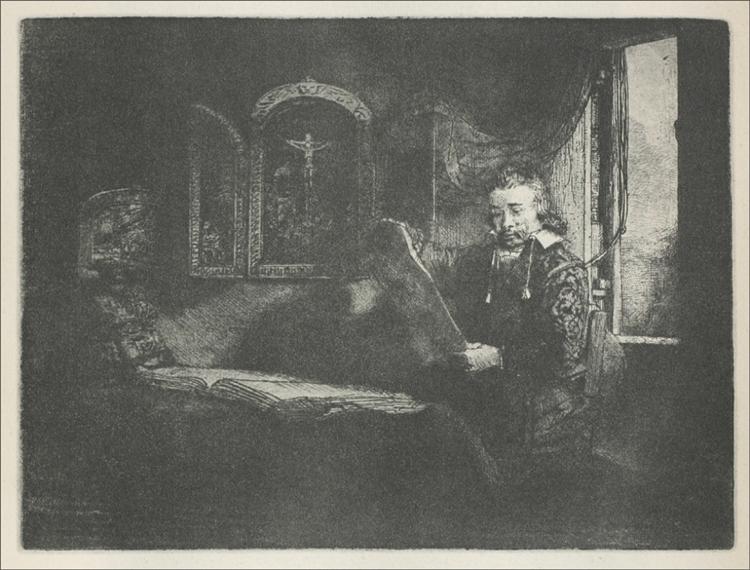
Rembrandt’s “Abraham Franz” draws the viewer into a quiet Amsterdam interior where a seated gentleman—widely identified with Abraham Francen, an apothecary and one of the artist’s steadfast friends—reads or contemplates in the half-light of a window. A triptych hangs behind him, an open folio lies in the foreground, and a heavy curtain frames the casement. The mood is intimate and reflective. Rather than celebrating status, the image honors a life of the mind lived among treasured objects. Across the sheet, Rembrandt’s orchestration of light and shadow transforms a small room into a chamber of inwardness where intellect, devotion, and friendship come into balance.
The Composition’s Quiet Geometry
The design is organized around a gentle triangle that runs from the open book at the lower left up to the triptych on the wall and then across to the sitter’s illuminated face near the window. This triangular circuit guides the eye through the room’s principal concerns—study, devotion, and person—without any abrupt emphasis. The window at the right provides a vertical axis, a source of illumination and a visual counterweight to the dense sofa and wall on the left. Rembrandt makes the space legible with very few strong lines: the lip of the sill, the rectangular panels of the triptych frames, the slope of the cushion, and the arc of drapery above. Everything else is a play of tones that settle into place like thought coming to rest.
Light as a Moral Atmosphere
A wash of daylight nudges in from the right, catching the sitter’s forehead, cheek, and the downturned page, then dissipating into soft shadow across the rest of the interior. It is not the theatrical blaze of stage lighting but a domestic, thoughtful illumination—the sort of light that encourages reading and conversation. The window is left partly bare, as if the curtain has been drawn back just enough for study. The triptych, though darker, holds a small halo of reflected light, allowing the sacred imagery to remain present without competing with the living face. The supremacy of light over line aligns the picture with Rembrandt’s late sensibility, in which mood and value do the structural work usually assigned to contour.
A Portrait Woven from Interior Space
Unlike a conventional bust, this likeness depends upon its surroundings for character. The sitter is not an isolated head; he is the focal point of a room that mirrors his habits. The soft couch suggests long sits; the open folio implies learned leisure; the devotional triptych reveals spiritual allegiance; and the curtain at the window hints at a desire to tune the world’s brightness to the inner life. The portrait thus emerges from context. We infer temperament—attentive, patient, and reflective—by the way the figure occupies the space that he himself has curated.
The Triptych and the Open Book as Paired Emblems
The two most explicit objects communicate a dialogue between revelation received and knowledge pursued. The triptych presents sacred images in fixed form, the kind one contemplates slowly over years. The open book, by contrast, is mutable; it can be turned, annotated, set aside, and resumed. Together they represent a life measured by both faith and inquiry. Rembrandt resists identifying the text or the exact iconography, inviting the viewer to read the scene as a general statement about interior devotion and learned friendship rather than as a pedantic inventory.
The Window’s Liminal Meaning
The window is more than an architectural detail. It is a threshold between world and chamber, the place where weather and time of day enter the rhythm of reading. Rembrandt places the sitter just inside this threshold. The light that touches his face has traveled from the street and the sky, gathering the city’s presence and softening it for domestic use. The profile’s nearness to the window suggests intellectual hospitality: the mind is open to the world but not overwhelmed by it. The curtain’s soft arc signals control and privacy, elements essential to the reflective life portrayed.
Textures and the Language of Etching
The image’s persuasive depth is built from the varied languages of the etching needle: dense cross-hatch for the sofa’s mass, broader bitten fields for the room’s general dusk, fine parallel strokes for the book’s pages, and crisp accents for the highlights that kiss the sitter’s features. Drypoint burr may play at the edges of certain lines, lending velvety softness to the darkest passages, particularly around the drapery and the couch. Such variety does not show off virtuosity for its own sake; it calibrates atmosphere. The eye trusts the room because the textures rhyme with lived experience—cloth looks weighty, wood reflects reluctantly, and paper flickers with pale light.
The Psychology of a Face at Ease
The sitter’s expression is composed rather than stiff. The slight forward lean, the relaxed hands, and the attentive gaze toward the page or object in his lap convey a person settled into a habitual practice. There is no flirtation with the viewer; we are permitted to witness concentration but not to interrupt it. Rembrandt consistently associated such inward faces with moral seriousness. Here, the air of quiet competence becomes moving because history tells us that the artist counted on this man during a season of hardship. The portrait radiates the stability of someone who knows how to keep company with thought.
A Roomful of Friendship
Abraham Francen, as tradition maintains, was an apothecary who extended loyalty to Rembrandt during the painter’s financial difficulties in the mid-1650s. Whether or not every anecdote surrounding their friendship is exact, the etching reads as a thank-you in the language Rembrandt knew best. The generosity lies in the time he lavishes on the man’s environs, the indulgent softness of the couch, and the respectful light that finds the features without interrogation. Portraiture becomes a social instrument, binding artist and sitter in reciprocal regard. The picture honors the friend not by grandeur but by granting his domestic world a durable, public quiet.
The Year of Hardship and a Choice for Intimacy
Dated 1656, the image belongs to a year of crisis for the artist, whose insolvency proceedings forced the sale of household goods and paintings. At such a time, Rembrandt’s choice to stage a scene of interior sufficiency rather than public display feels deliberate. The picture speaks for a culture of survival through inward resources—books, faith, friendship, and the measured daylight of a small room. The etching’s stillness is not escapist; it is defiant in its own soft register, insisting that worth resides where attention is, not where money flows.
The Balance of Sacred and Secular
While the triptych asserts a devotional center, nothing in the space tips toward fanaticism. The open folio could be Scripture, a medical compendium, or a collection of prints; the sitter’s dress is well-made but not ostentatious; the room is tidy without fuss. Rembrandt harmonizes sacred imagery with the scholar’s calm, proposing that the examined life unites prayerful contemplation with responsible study. In a city that prized both piety and commerce, the harmony feels accurately Dutch.
Furniture, Drapery, and the Tact of Comfort
The sofa’s sloped mass and deep cushion suggest the kind of comfort that makes long reading possible. The drapery near the window serves a similar function, tempering glare to ease the eyes. Comfort here is moral rather than merely sensual. It is the arrangement of matter in support of attention. Rembrandt’s loving description of such practical aids elevates the everyday labor of arranging a life for learning and devotion.
Space as a Map of Mind
The room divides into zones that mirror the sitter’s mental economy. The darkest corner gathers the weight of the day’s distractions and keeps them at bay; the middle range of tone hosts the objects of study and remembrance; the brightest zone lands on the pilgrim’s face where light meets understanding. Even the path of the eye—book to triptych to sitter to window—feels like a repeated inner route, a familiar circuit along which thoughts habitually travel. The picture lets us walk that circuit without intruding.
The Viewer’s Role as Guest
The vantage point places us at the near edge of the couch, between book and sitter. We feel invited but not addressed. That invitation shapes our behavior: we lower our voices internally, slow our scanning, and allow our pupils to adapt to the room’s level light. The etching trains us in the courteous art of looking. It asks us to mirror the sitter’s calm and to inhabit his pace. In return it offers the rare privilege of shared quiet.
Echoes and Departures within Rembrandt’s Oeuvre
Rembrandt made many images of readers and thinkers by windows, but each arranges interior elements to a distinct end. Compared with his more theatrical depictions of scholars peering into globes or apostles seized by revelation, this sheet is domestic and cumulative. Nothing sudden occurs; meaning accrues iteratively with every page turned and every look lifted toward the triptych. The image therefore leans toward the genre of friendship portrait rather than showpiece. It is a lesson in scale: the great emotions—gratitude, fidelity, reverence—can live comfortably in a room no larger than this.
The Poetics of Black and White
Etching’s monochrome proves a perfect vehicle for the subject. The absence of color concentrates attention on value relationships, which in turn sustain the work’s moral tenor. The light that makes the folio legible is the same light that makes the face humane. The dark that protects the corners is the same dark that deepens the space behind the curtain. In this economy, every tone performs two tasks, one descriptive and one symbolic, binding form and meaning invisibly together.
Time Felt in Objects and Air
The image luxuriates in slow time. The couch shows the sag that only years of sitting can teach it. The book is thick and patient, meant for a lifetime rather than an afternoon. Even the dust-like grain of the plate’s darker passages reads as the room’s air made visible. The etching captures not an instant but a habit, the repeated hours by which a person becomes himself in a particular place among well-chosen things.
Why This Image Persuades
The picture persuades because it is proportionate—to the scale of a room, to the stamina of a reader, to the balance a city needed between devotion and inquiry, and to the kind of gratitude that is better shown than proclaimed. Rembrandt refuses rhetoric and gives us instead a climate of sustained attention. The sitter’s calm becomes contagious. By the end of our looking, we feel steadier, as if we, too, had sat in a good chair by a window and read long enough to remember what matters.