Image source: wikiart.org
Introduction
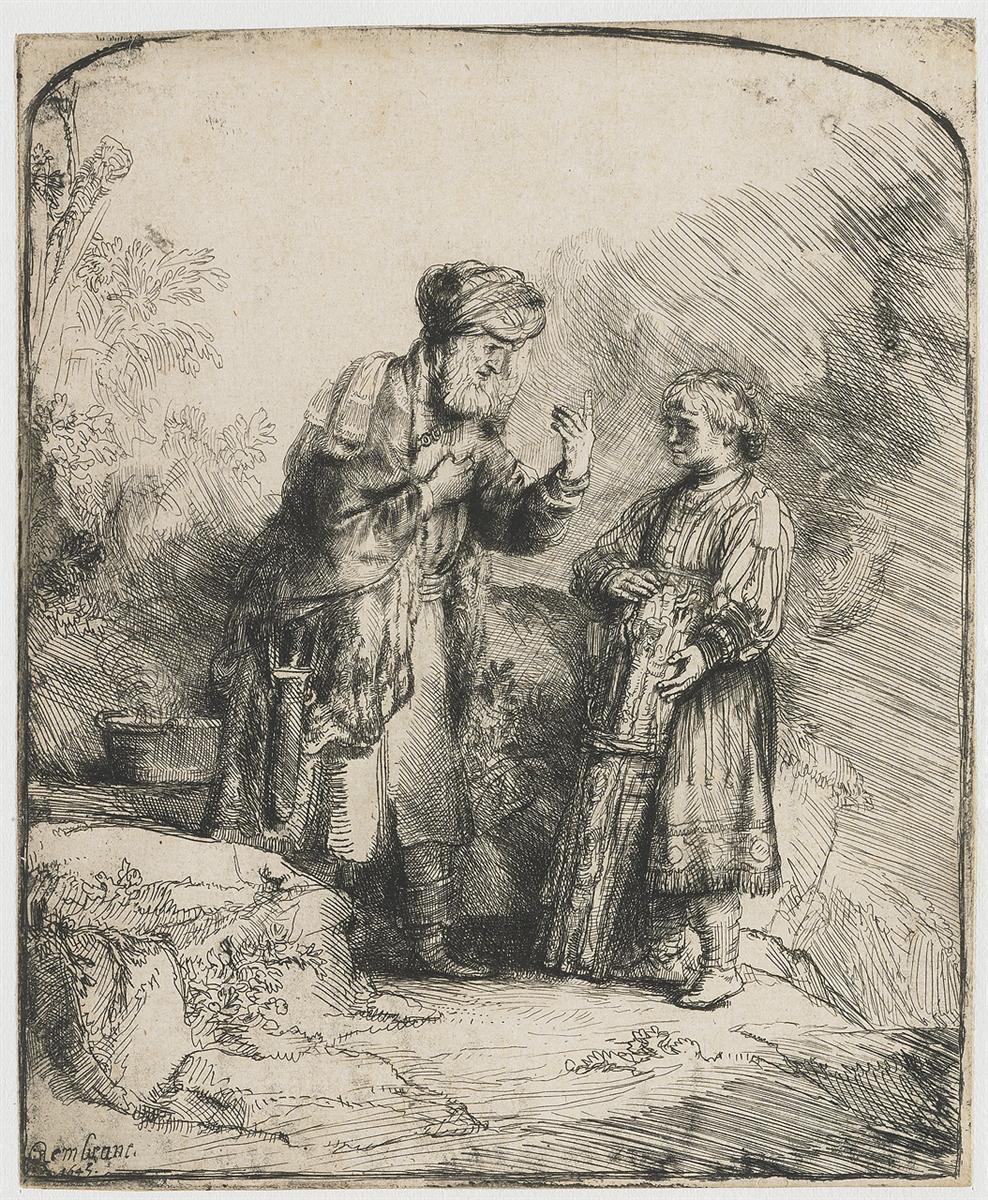
Rembrandt’s “Abraham and Isaac” (1645) is a compact etching that transforms one of Scripture’s most harrowing episodes into a tense, quiet conversation. Rather than the split-second of angelic intervention that many artists favored, Rembrandt chooses the moment just before ascent—when Abraham, already carrying the knife at his belt, signals heavenward while Isaac, arms full of bundled wood, searches his father’s face. The entire drama of obedience and love is compressed into two figures standing on a rocky ledge, their bodies modeled by flickering hatch marks and their emotions carried by gesture alone. The scene feels immediate and intimate: there is no crowding landscape, no panicked movement, no theatrical lightening—only the weight of a father’s faith and a son’s trust.
The Biblical Instant Rembrandt Selects
Genesis tells the story with terrifying simplicity: God commands Abraham to sacrifice his son Isaac. They travel together to Moriah; Isaac carries the wood, Abraham the fire and knife; at the last moment an angel stays Abraham’s hand and a ram appears in a thicket. Rembrandt’s etching arrests the narrative at the moment of the question—“My father… where is the lamb for a burnt offering?”—and the enigmatic reply—“God will provide.” Abraham’s raised finger, the other hand drawn to his chest, is as close as the print comes to speech. Isaac’s downturned gaze and the bundle of wood tucked in his arms signal both innocence and participation. By selecting this hushed pause, Rembrandt relocates the story from spectacle to conscience.
Composition and the Architectonics of Space
The figures stand slightly right of center on a slanted foreground shelf, the rocky ground described with swift, irregular strokes. A low bank rises behind them into a screen of diagonally hatched tone, which pushes the pair toward the lighted void at the upper left. That structured emptiness is not a blank but a deliberate field of breath; it frames the scene with the invisible presence of God while giving the eye a place to rest from the dense cross-hatching around the bodies. The frame corners are softly rounded, and Rembrandt lets the background foliage in the left margin curl upward like a borrowed architectural flourish. The design reads like a shallow stage, but one whose back wall is the atmosphere itself.
Chiaroscuro as Moral Weather
The etching’s light is gentle and local, falling mainly on the two faces and the gleaming edges of garments. Rembrandt refuses the blazing chiaroscuro of revelation. Instead, he gives us a luminous penumbra that leaves large areas unresolved. The band of darker hatching behind Isaac accentuates the turning of his head toward Abraham; the lighter air above Abraham elevates his raised hand into a small beacon. Shadow gathers at their feet and in the folds, insisting on the physical weight of the moment. The effect is a moral weather that belongs to the inside of obedience rather than to outward miracle.
Gesture as Theology
Rembrandt often composes with hands. Here the whole argument is written across the palms and fingers. Abraham’s left hand rises with the forefinger extended, as if pointing to the source of the command and, simultaneously, to the promise of provision. His right hand presses his chest, acknowledging the request’s cost and claiming it as his own. Isaac’s hands cradle the wood and partially cover it, a child’s instinctive gesture of responsibility. Between the two sets of hands runs a current: question to assurance, burden to faith, human love to divine claim. No angel is necessary; the gestures themselves carry the theology.
Clothing, “Oriental” Fantasy, and Historic Distance
Abraham wears a turban, a roomy robe, and a fur-lined cloak; Isaac is dressed in a long, ornamented tunic. These “orientalized” costumes were part of the studio wardrobe Rembrandt used to evoke biblical antiquity while indulging Amsterdam’s fascination with exotic textures. The costumes do more than date the story; they add layers of tactile reality—sheen, weight, warmth—that heighten the body’s presence. Abraham’s fur and heavy sash underscore age, status, and responsibility; Isaac’s patterned sleeves and hemline keep his figure lively and youthful. Historically improbable details become psychologically precise.
The Rocky Ground as Inner Landscape
The foreground is a marvel of economical mark-making: a few angular cuts indicate stones; short curls and dots stand for plants that clutch at the ledge. This broken terrain mirrors the brokenness of the command. The earth is not smooth; it asks careful footing. The climb that lies ahead is felt in the roughness underfoot. Rembrandt’s rocky ledges often double as emotional diagrams; here the jagged ground records the unevenness of a father’s heart.
Etching Vocabulary: Line, Burr, and Plate Tone
Rembrandt’s line shifts character across the plate. Long, diagonal hatches in the right background knit a toned field; short, hairline scratches in Abraham’s beard and Isaac’s hair create lifelike textures; confident contours swell around limbs and hems. Drypoint burr appears in select accents—around the eyes, in the deeper folds—printing softer and darker to enrich the midtones. Impressions vary: some are wiped cleaner, making the scene bright and airy; others carry a veil of plate tone that thickens the atmosphere and deepens the gravity. The print is thus a performance; each pull from the press re-tells the story with slightly different weather.
Symbols in the Props: Knife, Wood, and Staff
The hilt of Abraham’s knife peeks at his belt, a blunt reminder of the command. It is not brandished; it waits. Isaac’s bundle of wood is not precarious but secure, a sign that he has accepted his role in the ritual they believe they are going to perform. Behind Abraham, a staff or walking stick angles diagonally, the line of a long journey already undertaken. Together, these modest objects—knife, wood, staff—form a triangle of necessity: means, material, and pilgrimage.
Father and Son: Psychology in Profile
Rembrandt resists easy caricature of age and youth. Abraham’s face is not a mask of grim duty; it is a sensitive, worn visage tuned to the son beside him. His eyes, shadowed by the turban, look not up into heaven but toward Isaac, as if measuring how much to say. Isaac’s expression is respectful, curious, only half alarmed. He is old enough to carry wood and to ask questions, young enough to accept assurance. The space between their faces—close but not touching—is the etching’s true arena. It’s where love steadies command, and where trust braces itself against uncertainty.
The Silence in the Image
Many depictions squeeze narrative into a single torrent of action. Here the dominant sound is silence. You can almost hear wind scudding over the rocks and the soft creak of bundled wood. That silence is not emptiness; it is attention. The figures listen—to one another and to the command that has brought them here. In that quiet, Rembrandt returns the story to the difficult interior where faith actually happens: not in storm and spectacle, but in the breath between speech and reply.
Comparisons with Rembrandt’s Other Versions
Rembrandt interpreted the Akedah several times. Earlier works emphasize the violent instant of the stopped knife, the angel’s intervention, the ram’s sudden revelation. By 1645, he privileges conversation and inwardness. The shift may reflect his growing interest in the ethics of attention—that discipline of seeing a person rather than merely illustrating an event. In this etching the miracle is implicit rather than depicted. The real wonder is a father who can speak of God’s provision while his hand rests over a chest full of fear.
The Rounded Arch and the “Picture within a Picture”
The plate’s upper corners are softly rounded, like the top of a niche or window. That architectural echo frames the encounter as a devotional image—a small sanctuary carved from the world. It also compresses space, guiding our gaze to the actors while preventing the background from sprawling into scenery. The arch is a quiet reminder that stories like this are to be contemplated, not consumed.
Variations Across Impressions and What They Mean
In some impressions the background tone is heavier; the figures rise like reliefs from a dusk of cross-hatching. In others, a cleaner wipe leaves more white paper on the ground and around the faces, making the exchange feel lighter, almost conversational. These differences are not merely technical. They offer distinct readings: in the darker prints the command is a shadow Abraham must walk through; in the brighter ones the promise that “God will provide” seems to hover already like a thin radiance.
The Ethics of Obedience
The etching understands obedience not as absence of feeling but as feeling held within a vow. Abraham’s left hand points upward, but his right hand, over the heart, acknowledges the cost. Isaac’s trust is not blind; it is the trust of a son who knows his father’s character. No stone, no thicket, no angel interrupts the exchange; there is only the pressure of an unseen word and the slow consent of two human beings. That ethical subtlety is Rembrandt’s signature: he paints the labor of conscience rather than its slogans.
The Viewer’s Place in the Scene
We stand on the same ground, close enough to read expressions, far enough to keep the privacy of the exchange intact. The openness at the upper left functions like an aperture for our thoughts; the diagonal of the rock in the foreground invites our step yet restrains it. We witness without intruding. The composition thus echoes the command’s difficulty: to be present with another’s ordeal while not seizing control of it.
Influence, Echoes, and Afterlives
Though small, the print became a touchstone for later artists who preferred the moral murmur to the trumpet blast. Its power lies in showing that revelation may take the form of conversation—hand to heart, finger to heaven, question to promise. In galleries alongside noisier depictions, this sheet often stops viewers longer, its restraint sharpening their attention. To look is to stand in the hour before certainty, where trust and fear speak gently to each other.
Why the Etching Endures
The image endures because it refuses to sensationalize a story already charged with danger. It respects both the father’s faith and the son’s dignity. It also honors the craft of etching as a medium of thought: lines that search, tones that hover, whites that wait. Its smallness is part of the gift. Held close, the print becomes an intimate counsel about how to live when clarity has not yet arrived—speak truthfully, hold what you love, and point toward the promise that exceeds you.
Conclusion
In “Abraham and Isaac” (1645), Rembrandt offers a theology of hands and faces. A father gestures upward while securing his heart; a son bears wood and looks for meaning; rocks shift beneath their feet; air attends; the knife is present but quiet. With a few inches of copper and an unmatched sensitivity to human presence, Rembrandt converts the Akedah into a conversation in which obedience and love refuse to part. The angel will come later; for now, the miracle is this: two figures sharing the difficult light between command and provision.