Image source: wikiart.org
Introduction
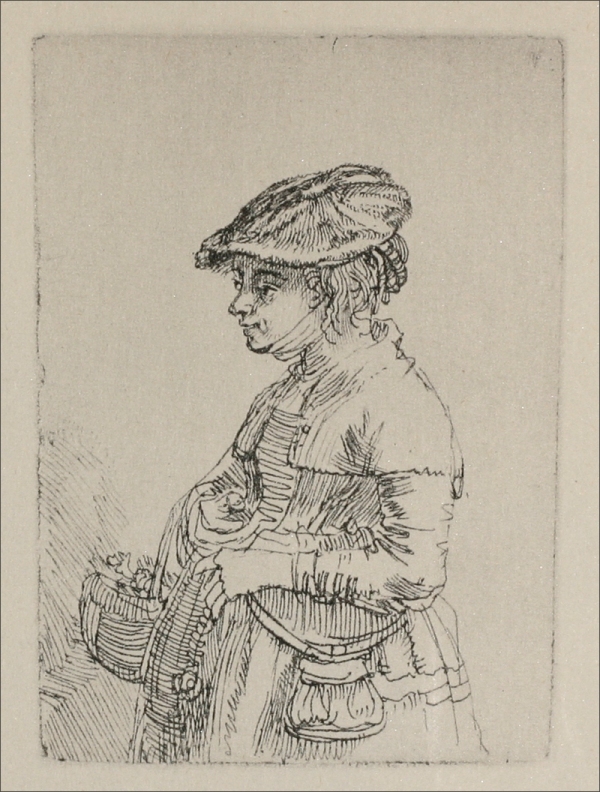
Rembrandt’s “A Young Woman with a Basket” (1642) is a jewel of understatement. In a few inches of etched copper he gives us a side-profile portrait of a working woman paused mid-errand, her hat pulled low, her hand steadying a woven basket that brims with the day’s necessities. The image is spare, almost conversational, yet the longer one looks the larger it becomes. Clothes and basket turn into a ledger of labor; the quickness of Rembrandt’s line becomes a measure of weather and time; the young woman’s half-smile suggests a mind already one step ahead of our gaze. What might have been a casual street sketch gathers the quiet dignity of character study. This is not allegory or costume piece; it is attention given to a person whose day would otherwise pass without record.
Subject and Everyday Narrative
The subject is immediate and unpretentious: a young woman in profile, carrying a basket, perhaps a market-goer or a maid dispatched on household business. Her hat sits broad across her forehead; wisps of hair and a ribbon or cap peek from beneath it. She wears a short jacket over a striped bodice; the skirt falls in even, practical folds. A small purse or pouch hangs at her waist, cinched and secure. Nothing in the print announces wealth. Instead it registers capability and purpose. The basket’s rim carries what may be greens or cloth; the left wrist cradles fabric that could be an apron or shawl. The woman stands neither posing nor hurrying. She is momentarily still, as if she has paused to listen or to consider the next stop. In that pause, Rembrandt finds the whole human transaction between work and self.
Composition and the Architecture of Pause
Rembrandt organizes the sheet with elegant economy. The figure fills the right two-thirds of the plate, turned inward so that her gaze and the basket’s arc lead us toward a softly hatched corner at left. That left zone—little more than a veil of strokes—acts like open air into which the woman is about to step. The diagonal of her forearms forms a shallow triangle with the rim of the basket, creating a stable base that keeps the composition grounded. The hat’s wide oval mirrors the oval of the face; repeated curves—in brim, basket, pouch, and sleeve—give the figure a rhythmic cohesion. The blank upper background lets the head read cleanly against paper white, a device that grants the sitter quiet authority without theatrics.
Line, Touch, and the Etcher’s Hand
Everything depends on line, and Rembrandt’s line here is supple, unforced, and alive. The jacket’s fabric is built with short parallel strokes that swell and thin to mark folds and edges, while the bodice’s stripes are brisk verticals that announce structure beneath cloth. The hat is drawn with elastic, lightly broken arcs; its brim darkens where shadow thickens over the eye. The basket is a masterclass in economy: a few cross-hatches at the lip and bands along the side are enough to conjure woven reed. The pouch at the waist is rendered with rounded, pouchy curves and a crisply indicated cord. Facial features are modeled with the fewest possible marks—an outline of nose and lips, a small crescent for the eyelid, a quick, softened line for the chin and jaw—yet they register as a presence rather than a diagram. Rembrandt trusts the viewer to complete forms that the line only suggests, and this trust is the print’s breath.
Light, Tone, and the Weather of the Sheet
Although the plate contains very little heavy shading, light is everywhere. Rembrandt achieves it not by flooding the scene with white but by placing darkness precisely. The short jacket’s seams and cuffs carry the densest hatching, which allows the face, throat, and hand to read as bright even though they are only lightly touched. A faint curtain of strokes behind the head pushes it forward, a classic etcher’s trick to produce depth without overworking the field. The result is a daylight clarity of tone, as if the sitter stood by a window or in the open shade of a street. The atmosphere is plain and breathable. Light does not decorate; it encourages our attention to rest where character lives.
Costume, Accessories, and Social Temperature
Clothing here is both identification and poetry. The short, practical jacket with a seam across the upper arm, the striped bodice, the sensible skirt, the pouch tied on a ribbon—these are the grammar of working life. Rembrandt does not sentimentalize them; he respects their form and function. The hat, with its soft crown and extended brim, shields the eyes and keeps hair in order. It also tilts the face into a profile that feels self-possessed rather than coy. The basket is integral to the portrait, not a prop. It states what the woman does and how she moves through the city. Accessories are modest and exact, transmitting the rhythms of urban life in the Dutch Republic where households relied on formal markets and informal errands to knit community and economy together.
Gesture and Psychology
The print’s most eloquent feature is the sitter’s hands. The right hand steadies the basket with a grip that is secure but not tense; the left hand gathers the apron or cloth, preparing for the next step. This choreography of fingers and fabric tells us she is in motion even as she stands still. Her mouth turns in the faintest of smiles, or perhaps the readiness to speak. The eye, shadowed by the brim, angles slightly downward, as if she is watching the street while hearing someone address her. The posture—upright torso, weight settled, attention divided between task and world—feels authentic. Rembrandt has chosen the split second when identity reveals itself not through drama but through poise.
The Basket as Motif of Provision
The basket holds the picture’s theme. It is the portable architecture of care, used to bring food, cloth, or goods from market to home. As a motif it recurs throughout Dutch art because it is the emblem of a society grounded in daily provision. Here, its woven bands echo the stripes of the bodice and the ribbing of sleeve and skirt; its roundness softens the linearity of jacket seams and apron folds. The basket’s interior is deliberately ambiguous—sprigs of herbs, heads of flowers, corners of fabric—so that the viewer can imagine the woman’s errand according to memory. In this way the print becomes porous to a range of stories: a maid bringing greens to the kitchen, a daughter returning with bread, a seller of small things between stands.
Space, Negative Space, and Breath
The left third of the plate, occupied only by pale hatching, is as important as the figure. It creates a corridor of air where the woman will soon move; it balances the weight of jacket, basket, and skirt; it gives the profile room to speak. Rembrandt frequently uses negative space as a participant in the scene rather than a leftover. Here, the unworked sky and wall become the social space of a street—lightly textured, unobtrusive, generous. The viewer experiences a sensation rare in small prints: the ability to breathe.
Scale and Intimacy
The print’s modest size invites close looking, a distance at which the etched line reveals its quickness and the sitter feels within whisper’s reach. Rembrandt places us at a polite angle—just ahead of the woman and slightly below her eye level—where we can see her profile without forcing confrontation. Intimacy arises from the way the line handles small transitions: the soft tuck under the lower lip, the crease at the wrist where fabric flexes, the scallop of the brim’s shadow across the cheek. Such details never become precious; they serve the larger sense of a person caught on the way to somewhere else.
The Sound of the Scene
Though silent, the etching hints at sound. One can imagine the wicker creak of the basket handle, the brush of skirt against apron, the muffled trade of morning voices in a market lane, the distant clack of a cart. Rembrandt allows this auditory imagination by keeping the background open and by choosing a profile that looks not at us but into the world of that sound. The print is not a frozen portrait; it is a still from a moving day.
Technique, States, and Printing Intelligence
Many of Rembrandt’s etchings were issued in multiple states as he adjusted biting, added shading, or changed signatures. In a subject like this, variations in plate tone—the thin veil of ink left on a wiped plate—can shift the mood dramatically. A slightly toned impression will deepen the left background and sharpen the face’s emergence; a cleanly wiped impression will feel cooler and breezier. Paper tone matters too: a warmer sheet softens the hat’s shadow and gives the jacket a gentle glow; a whiter paper throws the profile forward with crispness. These technical choices are not mere printing trivia; they are part of the artist’s ability to match material atmosphere to human temperament.
Dutch Urban Life and the Ethics of Attention
Seventeenth-century Amsterdam pulsed with domestic commerce—fishmongers, bakers, cloth sellers, vegetable stalls, and the constant shuttle of household helpers and daughters. Rembrandt’s print registers that pulse at human scale. He does not paint a crowded market square; he honors one errand runner. In doing so he articulates an ethics of attention that runs through his work: ordinary people deserve the dignity of depiction. The young woman is neither mocked nor idealized. She is seen. The gravity of that seeing is why such small prints continue to resonate.
Comparison with Other Gendered Work Scenes
Rembrandt etched beggars, street musicians, mothers with children, and occasionally maids at task. “A Young Woman with a Basket” stands out for its clarity and restraint. Unlike more theatrical prints where deep burr and heavy cross-hatching produce dramatic chiaroscuro, this sheet trusts the sparseness of day. Compared to the bustling narrative density of his larger genre scenes, it offers a single figure and a single act of carrying. The reduction is deliberate: by stripping away crowd and setting, Rembrandt concentrates the viewer’s empathy on one life moving through public space with purpose.
The Play of Youth and Responsibility
The sitter’s youth gives the print its spring. The hat’s brim cannot hide the softness of the cheek; the mouth still has roundness before age carves it thin. Yet everything she carries—basket, pouch, apron—signals responsibility. The combination produces the image’s tenderness: early adulthood outfitted for service, a self beginning to belong to others through tasks kept and errands run. Rembrandt resists melodrama and moralizing. He shows adulthood arriving as a habit of competence, and he marks that habit with love.
Lessons for Artists and Viewers
For artists, the print is a distilled lesson in how to stage figure against space with minimal means. Build forms from varied parallel hatchings that respect the body’s curvature; allow negative space to carry half the composition; let accessories perform structural duties; and trust a few lines to carry the face. For viewers, the lesson is different: pay attention to the people who pass you carrying baskets. The world is built every day by such journeys, and art is one of the ways we learn to acknowledge them.
Legacy and Influence
Rembrandt’s humane way of looking at working people influenced Dutch contemporaries and later schools that sought poetry in daily life—from the understated interiors of Pieter de Hooch to the nineteenth-century realism of the Hague School and the drawings of Jean-François Millet. The print’s specific contribution is the profile rendered with understated elegance: a format that later portraitists and photographers would adopt when they wanted presence without confrontation. By demonstrating how much a few inches of etched line can hold, the image also set a standard for intimate printmaking that remains modern.
Conclusion
“A Young Woman with a Basket” is a portrait of capability. It renders a person mid-errand with such sympathy and economy that the viewer can feel the day moving around her. Rembrandt uses open air, lightly hatched tone, and a harmony of curves to produce an image both calm and alert. The basket is not ornament; it is the center of the woman’s world in that hour, and it becomes the center of ours as we look. In a time when grand canvases recorded power and spectacle, this small plate records a different kind of importance: the steadfast beauty of ordinary provision. The print leaves us with gratitude—for the sitter, for the errands she runs, and for the artist who thought such a life worth engraving into copper.