Image source: wikiart.org
Introduction
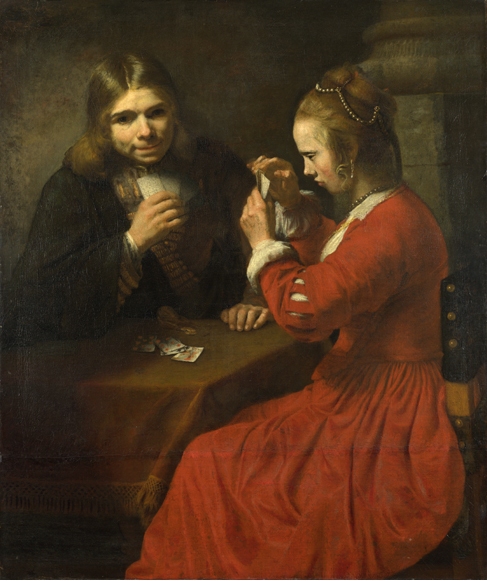
Rembrandt’s “A Young Man and a Girl playing Cards” is a compact drama staged at a small tavern table. Two figures lean into a pocket of lamplight: the man, slightly older, watches with canny attention while nursing a glass; the girl, in a vivid red dress, studies the cards with brow furrowed and lips pressed, her thoughts as readable as the creases in her sleeve. The painting belongs to the artist’s world of interiors where moral tension, human warmth, and psychological nuance occupy equal ground. Here, the theme of gaming—bound up with chance, seduction, and risk—becomes an occasion for a finely tuned portrait of interaction.
Subject And Narrative Premise
The narrative is simple and resonant. Two players sit so close that the space between them feels charged. The cards on the tabletop act as catalyst and pretext: they justify proximity, create competition, and trigger a web of gestures. The man’s half-smile and narrowed eyes imply calculation; his raised glass signals leisure and a touch of bravado. The girl, absorbed in her hand, pinches one card delicately while another rests on the table’s edge, as if the outcome depends on the next flick of her wrist. Rembrandt sets their exchange within a shallow room whose stone pier and heavy tablecloth evoke a tavern or household corner. No third figure interrupts, and no window opens to the outside; the drama is entirely interpersonal, the world condensed to a board of felt, a clutch of cards, and shifting expressions.
Composition And The Geometry Of Tension
Compositionally, the picture is built on triangular relations. The diagonal of the girl’s back leads to her profile; from there, the line of sight jumps to the man’s face, then falls to the cards and returns along the tablecloth fold to her hands. This triangular circuit locks the viewer into the game. A rectangular counterweight—tabletop and cloth—stabilizes the scene, while the circular forms of the man’s glass and the girl’s hair ornaments soften structural severity. The seated figures fill the lower two thirds of the canvas, keeping our attention close and denying any easy escape into distance. Rembrandt leverages this compression to heighten suspense: the stakes feel higher when space is tight.
Light, Shadow, And The Stage Of Intimacy
A warm, directional light spills from the left, touches the man’s forehead and the girl’s cheek, and deepens into shadow across their garments. The light has a practical function—making faces legible and hands expressive—but it also operates symbolically. The girl’s red dress catches and reflects more of it, seeming to emanate warmth. By contrast, the man’s darker costume absorbs the light, allowing his expression to emerge from penumbra. The balance of illumination suggests a contest between openness and concealment, impulse and calculation. The tablecloth acts as a reflector, sending a soft glow upward that underlights knuckles and cards, a trick of studio optics that renders the scene tactile.
Color And Material Presence
Color is spare and purposeful. The saturated red of the girl’s dress is the picture’s visual engine, opposed by the man’s blacks and browns and the golden umbers of the cloth. Small highlights—on pearls, hairpins, the rim of the glass, and the white of a lace cuff—sparkle like punctuation. Rembrandt’s handling of texture is keen: the nap of the tablecloth, the stiff sheen of the girl’s sleeve bands, the slick translucence of the beverage, and the softened wool of the man’s mantle give the eye multiple points of contact. The cards themselves are tiny rectangles of white, slightly soiled at the edges, their modesty reminding us that objects of chance are also objects of touch.
Psychology In Gesture And Gaze
Rembrandt’s genius lies in his ability to make gesture tell the truth. The man’s right hand, half-hidden, curls around the stem of his glass while his left anchors the tabletop; he has settled in for the long game. His look is not merely at the cards; it is at the girl, assessing her skill and innocence. The girl’s hands are the most eloquent forms in the painting. The left cradles her hand of cards; the right lifts a single card to the light as if testing its value against her opponent’s expression. Her head tilts toward the card while her eyes angle slightly down, creating a loop of concentration. The scene captures that delicious instant before a decision becomes public.
Costume, Age, And Social Coding
Clothing provides social cues without didacticism. The girl’s dress is fashionable, with slashed sleeves showing white underfabric and a bodice that fits snugly but modestly; the pearls and hair ornaments indicate self-regard and perhaps a special outing. The young man’s costume, darker and plainer, suggests a different register—less display, more streetwise experience. Their pairing sets up an intergenerational dynamic: he is past his first innocence; she is poised at the threshold of worldliness. The game becomes both literal entertainment and a metaphor for entry into adult negotiation.
The Table As Theater
The austere table, draped in heavy cloth, functions like a stage. On it, the drama of the hands plays out: the teensy tableau of cards, knuckles, and edges choreographed in a shallow depth. The surface also bridges the figures, creating a neutral ground where power can tilt either way with each move. The slight disorder of the cloth’s edge—a few rough folds, an uneven hang—adds a lived-in authenticity, an antidote to the stiffness of staged genre scenes. Rembrandt’s interiors often rely on such tactile particulars to keep high drama anchored in ordinary life.
Morality Of Gaming And The Echo Of Proverbs
Seventeenth-century Dutch viewers knew that images of card-playing often carried a moral charge. Gaming could signal idleness, temptation, and the risk of losing more than money. Rembrandt acknowledges that tradition but resists blunt sermonizing. There is no spilled purse, no visible cheat, no leering bystander. Instead, he offers ambiguity. The girl seems earnest rather than reckless; the young man seems amused rather than predatory. This moral suspension allows the painting to function as a mirror for the viewer’s judgment. Are we witnessing innocent play, subtle seduction, or a cautionary moment on the brink of error? The answer shifts with the beholder’s own measure of human nature.
Space, Architecture, And The Weight Of Stone
Behind the players rises a massive pier or column with a carved torus molding. That block of stone adds architectural gravity and hints at a public or semi-public setting—a tavern or a large domestic hall. Its cool gray sets off the warmth of the figures and reminds us that such pleasures occur within a larger social order. The column also contributes to the composition’s asymmetry, its vertical mass echoing the uprightness of the man’s pose and resisting the forward lean of the girl. The push and pull of these elements produces a room that feels real: thick-walled, slightly dim, hospitable to focused talk.
Brushwork, Paint Surface, And Rembrandt’s Hand
The paint surface coordinates virtuosic touches with passages of restraint. Flesh is handled with small, blended strokes that model cheeks and fingers without gloss. Fabrics receive broader, directional sweeps that follow folds and describe weight. Highlights on the glass and pearls are tiny dabs of thick, light pigment set atop darker layers, catching actual light and creating an illusion of sheen. Throughout, Rembrandt prefers suggestion to enumeration; he leaves small transitions open so that the viewer’s eye completes them, a strategy that makes the scene feel alive rather than cataloged.
Sound, Time, And The Sense Of Event
Though painted in silence, the scene hums with implied sound: the faint clink of glass against wood, the slide of a card across cloth, a breath drawn before a risk is taken. Time hangs on the cusp of the girl’s decision. Rembrandt specializes in such thresholds—moments when the next gesture will change the pattern of the scene. That charged pause makes the painting replayable; every look reinstates the instant before disclosure.
Comparisons Within Rembrandt’s Oeuvre
Rembrandt’s career is rich in interior scenes that stage human connection under warm light—musicians, readers, trios around a table. Compared with earlier, more boisterous guardroom or tavern genre pieces popular among his contemporaries, this work is quieter and more psychologically focused. The closeness of the two players echoes the intimacy of his portraits, where eyes and hands reveal character. The red dress recalls the artist’s love of saturated textiles, as in his portraits of Saskia and other sitters who wear crimson garments that catch and hold light.
Themes Of Chance, Courtship, And Consent
The painting triangulates three themes: chance embodied by the cards, courtship suggested by proximity and flirtatious glances, and consent articulated by the girl’s agency in play. She is not a passive ornament; she thinks, chooses, and acts. The man’s attitude, though slightly complacent, remains watchful rather than coercive. This balance remarks upon the social rituals of youthful interaction in Rembrandt’s day, when games provided sanctioned contexts for pairing-off under the watch of custom. The image’s strength is that it allows the charm of that ritual and its hazards to coexist in one scene.
The Card Faces And The Game Itself
Rembrandt offers just enough information to stir curiosity. A few cards lie face-up on the table—small, white slips where suits are barely legible. Their ambiguity keeps us focused on the human game rather than the rule-bound one; what matters is not which trick will be taken but how knowledge and concealment circulate between players. The cards function as actors whose identities remain just out of reach, much like the inner thoughts of the figures themselves.
The Girl’s Red Dress And The Choreography Of Color
The dress deserves its own consideration. Its chroma sets the emotional key: red for warmth, vitality, risk. But Rembrandt tempers that heat with control. The white slashes and collar cool the ensemble; the muted background prevents the red from shouting; the pearls restore a note of decorum. As the dress curves around the chair and pools into folds, it creates a moving architecture that echoes the card game’s rhythms—gathering, releasing, folding, holding.
Ethics Of Looking And The Viewer’s Role
We, too, are players. Positioned across from the man and beside the girl, we see what each does not. The viewer becomes the third participant, complicit in the exchange. Rembrandt courts that complicity by placing the table almost at the picture plane; our world touches theirs. The effect is both intimate and ethically charged: our gaze evaluates, empathizes, and perhaps judges, but it must also respect the privacy of thought that the girl’s bowed head claims.
Legacy And Contemporary Resonance
Genre scenes of gaming persisted across European art, often veering toward moralism or theatricality. This painting’s legacy lies in its refusal of caricature. It offers a subtle field where human motives mingle and remain partly unknowable. Contemporary viewers will recognize the atmosphere of small stakes that can feel large—the social risks of saying yes or no, of holding or showing one’s cards. The painting remains timely because it understands interaction as a negotiated dance rather than a fixed script.
Conclusion
“A Young Man and a Girl playing Cards” condenses Rembrandt’s strengths into an intimate stage: controlled light that sculpts faces and hands, color used as emotional architecture, objects that serve both narrative and metaphor, and a psychological equilibrium that trusts viewers to read and reread motives. The game at the table mirrors the larger game of life—chance mixed with intention, charm bound up with risk. In the end, the painting’s great gift is its humanity. It honors the moment before decision, the spark of wit in a glance, and the dignified complexity of ordinary people negotiating pleasure and prudence.