Image source: wikiart.org
Introduction
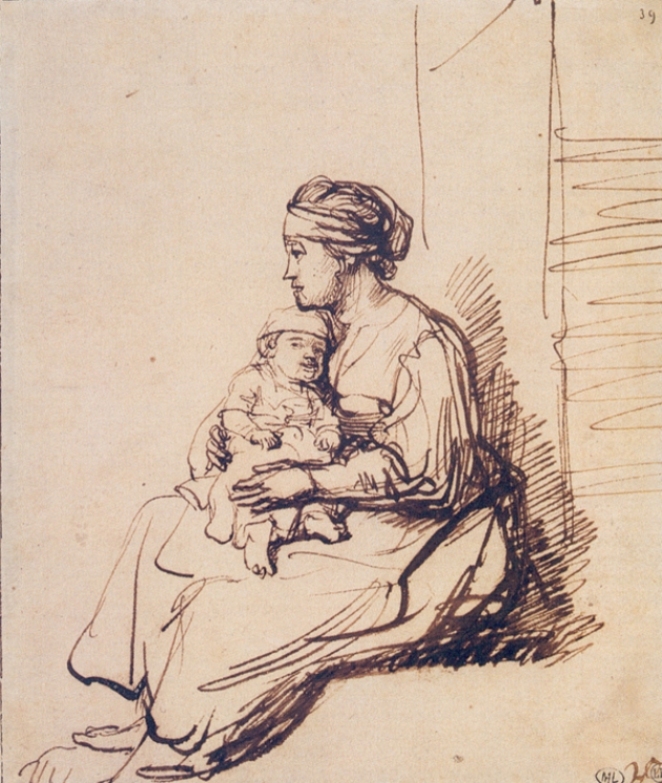
Rembrandt’s “A Woman with a Little Child on her Lap” is a small miracle of observation in ink. With an economy of strokes and a sensitivity to everyday tenderness, the artist transforms a fleeting domestic moment into a scene that feels both intimate and universal. The mother sits in profile, knees bent, body turned slightly toward the child who rests securely in her arms. The infant’s face, open and animated, is framed by the crook of the mother’s elbow, while a handful of quick hatching lines suggest the wall or chair that supports them. Nothing in the sheet is elaborate, and yet everything is eloquent. The drawing distills Rembrandt’s philosophy of looking: truth, dignity, and feeling can be expressed with the simplest means when attention is absolute.
A Drawing That Breathes
Although often labeled a “painting” in modern summaries, the work is a drawing executed with pen and ink, possibly accented by a wash that has since faded or mellowed with time. The medium matters because it communicates breath and tempo. Ink lines preserve the velocity of the hand; they reveal where the artist slowed to caress a contour and where he sped up to catch a passing motion. In this sheet, the contour of the mother’s cheek and the soft oval of the child’s head are laid with measured certainty, while the hem of the dress and the folds at the lap are rhythmically abbreviated, as if the artist were simply following the way cloth pools around a seated body. The result is a page that feels alive, not diagrammed—an image that seems to have been discovered rather than invented.
Composition As Architecture Of Care
The composition is a study in structural empathy. The mother’s upper body forms an anchoring triangle that stabilizes the page, while her bent legs and the child’s compact form create a second, smaller triangle nested inside the first. These interlocking shapes produce a visual cradle. The child does not simply sit on the lap; the entire geometry of the drawing gathers to hold the infant securely. Rembrandt places the figures close to the right edge, letting a margin of blank paper breathe on the left. That space becomes the room’s air and our viewing distance, a silent buffer that heightens the sense of privacy. A few hurried verticals and cross-hatches behind the woman suggest a wall, a shutter, or perhaps the rough edge of furniture. They are less setting than soundstage: just enough context to make the intimacy plausible.
The Language Of Line
Rembrandt’s line is never generic. It thickens at joints and softens at cheeks; it frays into small, furry touches at the baby’s cap and compresses into elastic bands where sleeves tighten at the forearm. Notice how the contour of the mother’s near forearm is a continuous, confident stroke, while the far forearm is broken into smaller, searching marks. This is not indecision; it is sensitivity to depth and light. In places, he allows the pen to skate lightly, leaving half-suggestions that the eye gladly completes—such as the toes softening into the margin or the skirt’s outer edge dissolving into successive arcs. The drawing’s vitality springs from such exchanges between statement and suggestion.
Gesture And The Psychology Of Touch
The most moving element is the choreography of hands and heads. The mother’s left arm wraps behind the child, palm upward, in a gesture that supports without squeezing. Her right hand gathers the infant’s legs and the loose garment with a practical competence any parent will recognize. Meanwhile, the child’s head tilts outward toward us, mouth open as if mid-babble or small laugh. Rembrandt captures this micro-drama with just a few lines around the lips and eyes; the expression is credible and contagious. The mother’s profile is calm and alert, the slight forward tilt of her head registering attention rather than exhaustion. You sense not only safety but the conversation of bodies—the way an infant’s weight rebalances the adult’s spine and the way a parent’s arm teaches a child what security feels like.
Everyday Life As Noble Subject
Throughout his career, Rembrandt gave the domestic sphere the same visual seriousness he reserved for biblical epics. This drawing belongs to that humanist tradition. There are no attributes of wealth, no decorative interiors, no heraldic devices. The woman’s headscarf and simple gown could belong to any time of day; the infant is swaddled in a pragmatic bundle. By refusing anecdotal embellishment, Rembrandt allows the universal to shine through the particular. The scene reads as a portrait of motherhood itself rather than of a specific, named sitter. In an art world where grandeur often required mythology, this sheet insists that the ordinary can be equal in dignity to the grand.
Speed, Revision, And The Visible Mind
One of the pleasures of Rembrandt’s drawings is how plainly they show thinking. Look closely at the overlapping marks around the woman’s lap and the child’s garment: the artist appears to have adjusted positions while drawing, allowing earlier, lighter strokes to remain as ghosts under firmer lines. These pentimenti register time and revision, turning the page into a record of attention rather than a polished product. The quick, looping hatch at the right suggests that Rembrandt was calibrating the balance of dark and light across the sheet; its almost calligraphic energy counterweights the gentle density of lines that model the figures. Such visible process pulls the viewer into the drawing’s making and deepens the intimacy of the scene.
Light Without Shading
Even with minimal wash, the drawing glows with an implied light source. Rembrandt achieves this not by filling broad areas with tone but by placing and spacing lines so the paper itself supplies illumination. The mother’s cheek is left almost untouched, letting the raw paper act as skin. He thickens lines in shadow zones—the underside of the forearm, the creases of the sleeve, the recess beneath the infant’s chin—so that the eye reads depth without the need for heavy modeling. This technique preserves freshness and lends the figures a buoyancy akin to breath. The blank field is not emptiness; it is light captured.
The Mother’s Face And The Ethics Of Attention
Rembrandt’s profile studies are renowned for their psychological economy, and this face is a gem of the type. The forehead slopes gently into a straight nose; the lips are lightly pressed, neither smiling nor stern; the eyelid sits half lowered, signaling tranquility rather than fatigue. It is the countenance of someone inwardly steady. There is no flattery here and no caricature—only respect. The drawing’s moral force comes from that respect. By giving time and precision to an ordinary mother’s face, Rembrandt suggests that attention itself is a kind of honor. In a sense, the drawing mimics the woman’s task: to steady, to support, to look with care.
Rhythm, Silence, And The Page As Room
The drawing’s rhythms matter as much as its lines. The repeated arcs of skirt and sleeve create a lulling cadence that echoes the lullaby role of a seated parent. The vertical scratches at the right break that cadence just enough to prevent stiffness, like a window’s sash in the room or a quiet piece of furniture that keeps human presence from floating unmoored. The large area of untouched paper on the left functions as silence—space for the viewer to breathe in step with the scene. Many artists clutter such margins; Rembrandt trusts the power of omission. The page becomes a room without walls.
Comparisons Within Rembrandt’s Oeuvre
This sheet converses with Rembrandt’s many drawings of Saskia and later Hendrickje with their children, as well as with studies of beggars, washerwomen, and street scenes. The same blend of precision and generosity appears across those works. Unlike the elaborate “presentation” drawings in red chalk or highly finished pen studies, this page retains the speed of life. It also echoes Rembrandt’s etchings of the Holy Family, where domestic tenderness stands in for theological abundance. If the child’s cap and swaddling hint at sacred associations, Rembrandt keeps them subtle, allowing the subject to remain a human reality before it becomes symbol.
Anatomy Of Economy
Every effective drawing is a lesson in what can be left out. Here, toes are hinted rather than articulated; the far hand is barely more than a dark wedge; the chair’s structure dissolves into parallel hatches; the room’s corner is a single line. What remains is precisely what matters: the contour that describes weight, the features that describe mood, the hands that describe care. Such economy is not minimalism for its own sake; it is the result of long practice and confident empathy. The sheet teaches how to prioritize seeing over inventory.
The Child’s Spark And The Joy Of Particularity
Amid the study’s quiet virtues, one detail flashes with delight: the child’s expression. A few curves around the mouth, two dots and a small arc for eyes and brow, and suddenly there is a person—cheerful, curious, responsive. The infant’s slight twist outward gives the drawing its liveliness; we feel the micro-motions of a baby eager to engage the room. Rembrandt’s gift is to capture that spark without over-describing it. He remembers that babies are motion and warmth first, detail second. The mother’s arms cradle that movement without extinguishing it, and the drawing preserves the same balance.
The Sheet As Devotional Object
Though secular in subject, the drawing has the aura of a small devotion. Its scale encourages close viewing; its simplicity invites privacy. You feel that you could tuck the sheet into a book and carry it as a reminder of tenderness. This quality owes something to the line’s humility and to the paper’s unassuming tone, which has aged into a warm, bread-like color. Nothing about the drawing demands attention; everything rewards it. In a culture that often equates importance with size and polish, the work asserts a counter-truth: intimacy can be monumental.
Technique, Tools, And The Body In The Hand
Pen and ink on paper translates bodily sensation directly. The pressure of Rembrandt’s hand becomes the thickness of a line; the speed of his wrist becomes the curve of a hem; the angle of his posture becomes the tilt of a head. Looking long enough, you begin to feel the work in your own body—how your fingers might have to rest lightly to trace the infant’s cheek, how your arm would slow to place the mother’s nose, how your wrist would loosen to scratch in the background. The drawing is thus both an image and a record of the human machine that made it. That doubleness is part of its pleasure.
Why The Work Feels Modern
Despite its age, the sheet reads with contemporary freshness. Its selective description anticipates modern reportage drawing; its blank spaces align with our taste for minimal design; its subject aligns with the current reverence for the everyday. But beyond these stylistic echoes, the drawing feels modern because it trusts viewers to complete it. It meets us halfway, offering enough to convince and enough to invite. Such trust is the opposite of spectacle and the essence of enduring art.
How To Look At The Drawing
Stand close and trace the path of the main contour from the headscarf down the nose, along the upper lip to the chin, across the infant’s cap and cheek, around the small shoulder, and back to the mother’s wrist. Notice how often the line lifts and reappears, letting light do the connecting. Step back and let the blank paper cohere into air around the figures. Move to one side and feel how the nested triangles of bodies hold you in front of them. Then return to the child’s face and let its small liveliness bring the whole page to life again. The drawing rewards this rhythm of approach and retreat.
Legacy And Continuing Relevance
“A Woman with a Little Child on her Lap” persists in memory because it is honest. Its honesty is technical—lines that report more than they boast—and human—an affection unforced, a dignity shared. For artists, the sheet is a primer in economy and empathy. For viewers, it is a reminder that the most consequential moments rarely announce themselves; they happen on laps and in quiet rooms, in the ordinary exchange of warmth between one body and another. Rembrandt’s drawing gives that truth a form so spare and luminous that it feels inexhaustible.
Conclusion
With a few strokes of ink, Rembrandt makes room for love. The mother, settled against a sketched wall, becomes the architecture that supports a life; the child, lively and secure, becomes the spark that animates the space; the surrounding paper becomes breath. The drawing demonstrates how a great artist can move from observation to meaning without passing through rhetoric. It honors the human scale—the scale of a lap, a hand, a profile—and suggests that from such scales entire worlds are built. In a museum or on a page, the sheet speaks softly and clearly: attention is love, and love is worth recording.