Image source: wikiart.org
Introduction
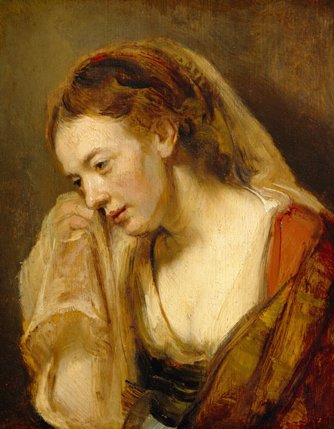
Rembrandt’s “A Woman Weeping” (1644) is one of those intimate oil studies in which the artist compresses an entire drama of feeling into a head and shoulders. The figure turns inward, her eyes lowered, her cheek pressed to a soft veil she lifts toward her face. The gesture is gentle rather than theatrical, and yet the effect is overwhelming: grief and tenderness fuse under a warm light that grazes the cheekbone and dissolves into shadow along the jaw and hairline. The palette—earth browns, honeyed ochres, and muted reds—forms a low, human temperature against which the pale skin glows. Although the subject is simple, the painting balances two ambitions at once. It is a tronie, a character study that explores a specific expression; it is also a meditation on compassion, a visual essay about what it means to witness another’s sorrow without exploiting it.
A Character Study That Feels Like a Portrait
Seventeenth-century Dutch artists produced “tronies” as experiments in expression, costume, and lighting rather than as commissioned likenesses. “A Woman Weeping” belongs to that category: no identifying attributes or inscriptions tie the subject to a name. Still, Rembrandt shapes the woman with the psychological specificity we associate with portraiture. The tilt of her head has weight; the lower lip catches a tiny highlight that suggests moisture; the eye, though downcast, is alert beneath lashes that the painter touches with the thinnest dark accents. Tronies often risk feeling like demonstrations. This one breathes. The flesh seems alive because the brushworks mimic physiology: thin glazes pooled at the temples read as warmth beneath skin; thicker, chalky passages across the cheekbone record how light bloats over rounded forms.
The Gesture as Emotional Grammar
The veil is not a mere accessory; it is punctuation. By lifting the translucent cloth to her face, the woman completes a sentence of feeling that begins at the brow and flows down the bridge of the nose. Her hand, half-hidden by the fabric, presses the textile toward the cheek in a motion that is both protective and absorptive. We sense rather than see the tears. Rembrandt sidesteps literal droplets—which would verge on sentimentality—and instead paints the aftereffect of weeping: slight puffiness under the eye, reddened rims, a softened focus to the gaze. The gesture makes grief legible without spectacle. It is a privacy we are allowed to approach.
Light as Consolation
The painting’s light behaves like a companion rather than a spotlight. It arrives from the upper left and squares itself on the forehead, cheek, and the ridge of the nose; it thins over the veil and sinks into the eye socket. There is no harsh cast shadow. Instead, a warm radiance slides off the rounded forms and mingles with the brown ground. Rembrandt often uses light to divide moral space—bright truth against dark confusion—but here the light is tender. It does not expose the woman; it keeps her company. Chromatically, the glow results from layers of transparent amber glazes over a light ground. The ground’s luminosity leaks through and gives the flesh an inner life, a subtle “breathing” that viewers feel more than see.
The Palette’s Human Temperature
Rembrandt’s mid-1640s palette tended toward deep earths enlivened by warm highlights. In “A Woman Weeping” the color scheme is close and comforting: umbers and ochres for the background, raw sienna and lead-tin yellow for lighted flesh, soft carmine or red lake for lips and inner eyelid, and warm grays tempered with black for the hair. The garment offers just enough chromatic contrast—a muted orange-brown lining and a dull red sleeve—to tether the figure to the world of cloth and touch. None of the colors shout. They gather into a human temperature that suits the subject: a weeping face should be warmed by nearness, not chilled by theatrical blues.
Brushwork that Alternates between Revelation and Reticence
Rembrandt’s handling is thrillingly variable. He skates a soft, wide brush across the cheek to catch the most diffused light, then switches to small, directional strokes around the eye to sharpen the anatomy. The veil is built with fast, semi-transparent streaks that leave the underlayer visible; those streaks behave like woven threads, allowing the face to show through while maintaining the textile’s integrity. Along the hairline, dragged bristles break and clump, creating an irregular edge that reads as loose strands against skin. Around the shoulders, impasto accumulates in the folds of fabric, catching light and registering weight. This variety of touch keeps the viewer’s eye alert, as if moving from the softness of skin to the slightly rougher drag of cloth and finally to the airy scrim of the veil.
The Composition’s Quiet Architecture
The figure is framed close, but the composition is spacious because Rembrandt choreographs diagonals and arcs that keep the eye circulating. The line of the brow and nose forms a long, graceful diagonal that meets the rising diagonal of the veil; the shoulder slopes away in a counter-movement that stabilizes the head’s tilt. Two arcs—one from the hairline to the cheek, another from the veil to the lower edge—create an embrace around the face, like parentheses of empathy. Negative space at the upper right remains warm and unworked, a pocket of air that gives the head room to lean. Even without obvious geometry, the design yields a palpable rightness, a fit between inner emotion and external structure.
Private Devotion or Secular Sorrow?
Viewers have long debated whether the image should be read as a penitent Magdalene—one of Rembrandt’s recurrent subjects—or as an unnamed woman overwhelmed by private grief. The painting encourages either reading. The veil, the introspective gaze, and the hand near the face all appear in Magdalene imagery, where the saint’s tears testify to spiritual turning. Yet the absence of traditional attributes—a skull, an ointment jar, a book—keeps the image anchored in the everyday. Rembrandt often favored such ambiguity. He trusted that the human body alone could carry spiritual resonance. In this case, the woman’s sorrow invites the devotional response of compassion regardless of iconography.
A Study in Empathy rather than Spectacle
One of Rembrandt’s ethical strengths is his ability to depict intense emotion without voyeurism. “A Woman Weeping” accomplishes this in several ways. The figure looks down, not out, denying the viewer the dominance of a direct gaze. The veil creates a soft barrier between her feeling and our curiosity. The paint refuses dazzling finish; it keeps the surface human, even rough in places, so that our response is tenderness rather than admiration for polish. The result is a painting that makes the viewer a companion rather than an audience.
The Role of Memory and the Model’s Identity
The model’s identity is unknown, and it is worth resisting speculative certainty. Rembrandt sometimes used family members as sitters for tronies, sometimes hired models, and often adapted features from several drawings. What matters artistically is that the face feels remembered rather than invented. The slightly prominent nose, the strong cheekbone, the narrowness between eyelid and brow—these details have the specificity of observation. They keep the painting from slipping into generality and grant the emotion a home in a particular physiognomy.
Time, Touch, and the Evidence of the Hand
Seen up close, the surface records the time of making. Quick, wet-in-wet strokes on the veil interlock with earlier, tacky paint on the cheek; small pentimenti around the contour suggest that Rembrandt shifted the head’s angle or the veil’s length as the image evolved. These traces are not flaws. They are the historical texture of empathy. The painting preserves the artist’s searching adjustments as he tried to match paint to feeling. That search gives the work a present tense that resists museum distance: we do not just look at a weeping face; we look at a mind paying attention to it.
Chiaroscuro as a Mode of Thinking
Light and shadow in Rembrandt are not simply optical phenomena; they are ways of thinking. Here, the illuminated cheek and temple are not mere highlights—they are the parts of the mind that remain available to understanding, the areas where experience can still be named. The dark behind the ear and along the back of the head is the private remainder of grief, the portion not yet ready for speech. The painting therefore models a humane epistemology: we know partly, we feel largely, we leave room for what cannot be said.
Comparisons with Other Mid-1640s Figures
Placed beside Rembrandt’s other figures from the same period—the candle-lit scholars, the tender “Saskia as Flora,” the penitential saints—“A Woman Weeping” occupies a crucial midpoint. It has the immediacy of his tronies and the moral seriousness of his biblical pictures. The scale is intimate like his small panels of single figures, yet the emotion is expansive. The study also anticipates the later portraits of Hendrickje Stoffels and other women whose faces Rembrandt paints with an almost parental protectiveness. In that sense, the work is both experiment and promise: a rehearsal for compassion that will mature into the great late portraits.
Material Reality and the Haptics of Sorrow
Few painters make us feel the physicality of crying as Rembrandt does. The veil’s edge, slightly damp, clings to the cheek; the nostril flares just enough to imply altered breath; a faint redness touches the eyelid—a hue that the artist achieves by allowing thin red lake to mingle with warm flesh tones beneath. The paint’s thickness varies like tissues picking up or reflecting moisture. Such haptics matter because they ground feeling in the body rather than floating it as rhetoric. The image respects the biology of grief.
The Viewer’s Distance and the Etiquette of Compassion
The painting positions us close—perhaps arm’s length—yet establishes clear etiquette. We encounter the woman from the side, not face-on; she does not return our gaze; the veil remains between us as a translucent boundary. This choreography prevents the thrill of intrusion and encourages a posture akin to sitting beside someone who is crying. The etiquette is quiet: soften your voice, keep your hands still, let the person breathe. Rembrandt builds that social knowledge into the picture’s very design.
Cultural Context and the Value of Tears
Seventeenth-century moralists debated the proper display of emotion, especially in the context of piety and bodily restraint. Tears could be seen as weakness, but also as evidence of sincerity. Rembrandt, who often revised conventional subjects to favor lived experience over doctrine, paints tears as dignifying. The woman’s sorrow neither diminishes nor sensationalizes her. It humanizes her. The image thus participates in a broader Dutch interest in everyday morality, where the quality of one’s attention—to family, to neighbors, to the poor—mattered more than public show.
Why the Painting Still Feels Contemporary
Modern viewers recognize themselves in this picture because it honors privacy while extending care. In a culture saturated with performative grief, “A Woman Weeping” models a quieter empathy. It refuses spectacle. It asks the viewer to stay, to look gently, to accept not knowing the whole story. Its surface—unvarnished in feeling though exquisitely made—speaks to a hunger for sincerity: paint that acknowledges the body, light that consoles rather than interrogates, composition that gives sorrow a safe room.
Conclusion
“A Woman Weeping” (1644) is a small painting with a large heart. It holds the viewer at a respectful distance while inviting a profound closeness of attention. Through a limited palette, pliant brushwork, and the choreography of a simple gesture, Rembrandt makes sadness luminous without making it theatrical. The work belongs to his tradition of tronies, but it exceeds the category by teaching a way of seeing. We learn to attend to the minute signals of feeling—the tilt of a head, the warmth of light on skin, the fabric lifted to a cheek—until the person before us becomes not a type but a presence. Few images carry such wisdom with such modest means.