Image source: wikiart.org
Introduction
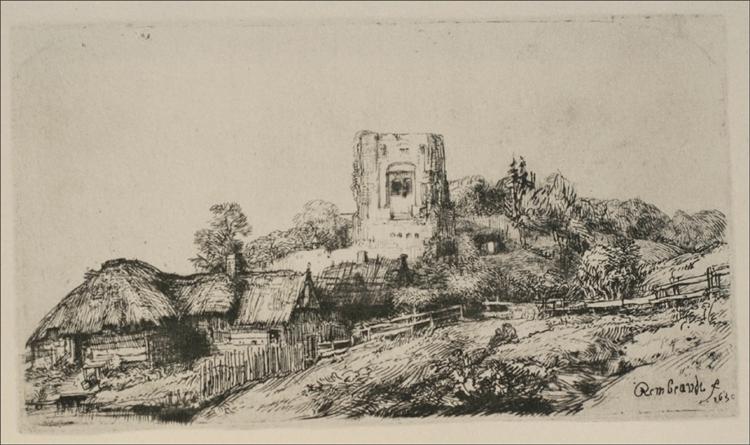
Rembrandt’s “A Village with a Square Tower” (1650) is a compact etching that opens like a window onto a lived corner of the Dutch countryside. A cluster of low thatched cottages settles into the left foreground, plank fences gather and wander, and a rutted lane climbs toward a hill crowned by a stout, almost fortress-like square tower. Trees knit the scene together in dark, breathing masses, while the sky remains a pale reserve of unmarked paper. The print is modest in size and subject, yet it feels large because the artist stages a complete social world: shelter, path, enclosure, vantage, and history pressed into a few hundred strokes of the needle. In its balance of intimacy and breadth, this landscape belongs among Rembrandt’s most persuasive evocations of place.
The Square Tower and the Drama of Height
The tower is the motif that first seizes attention. It rises from the middle distance like a secular keep—square-sided, thick-walled, and perforated by a high opening that reads as belfry, lookout, or ruin. Unlike the picturesque spires of many Dutch village views, Rembrandt’s tower is heavy and mute; its rectangular geometry opposes the huddle of pitched cottage roofs below. This opposition produces a low drama of height: shelter and surveillance, domestic life and civic watchfulness, the work of fields and the memory work of stone. The tower’s situation on a rounded hill makes the print’s space breathe vertically as well as horizontally. We feel the climb of the lane and the lift of the eye toward an object that has seen more seasons than any living villager.
Composition and the Sway of the Lane
Rembrandt composes the plate with a patient sense of sway. The left foreground is anchored by the cottages, their thatch rendered in clustered strokes that sit heavy on timber frames. From that anchor the fences begin to wander, drawing the eye along a lane that curves to the right, then back toward the hill, the way a walker’s path negotiates ditches and rises instead of cutting them. This drawn-out S is vital. It gives the little world narrative: you start among doors and sheds, step through a gate, climb, pass under the tower’s flank, then disappear beyond hedges into the light. The viewer’s eye travels as feet would. In this way the print is not simply a picture of something; it is a remembered route.
Chiaroscuro as Weather and Depth
The plate’s tonal structure is a study in atmospheric gradation. Rembrandt places his darkest hatching under the thatch eaves, along the cottage walls, and in the tree cores, then eases values as the land recedes to the hill and beyond. The tower is given a mid-tone that balances solidity with distance, while the far slopes thin into a delicate haze. Most of the sky is left untouched, a decision that grants the scene a clean, airy weather—neither stormy nor bland. The chiaroscuro thus functions like weather forecasting: shadows make the foreground intimate and cool; the paler hill and sky promise moving air and visibility. Without a single theatrical cloud, the print speaks climate fluently.
The Architecture of Shelter
One of the pleasures of the sheet is its unpretentious architecture. The cottages press together like neighbors at a market stall, an economy of adjacency dictated by shared fences and the need for mutual windbreak. Their thatch is heavy and practical, drawn with short, blunt marks that achieve the feeling of thickness rather than the fuss of detail. Doors, lofts, and shed extensions are sketched with a carpenter’s grammar of vertical and horizontal strokes. Nothing is picturesque for its own sake; everything reads as a choice made by people who repair, add, and brace as means allow. This respect for the improvisations of rural building is part of Rembrandt’s broader ethic: truth before prettiness, shelter before show.
Fences, Gates, and the Social Geometry of Land
The fences are the print’s connective tissue. They are not straight military lines but loping enclosures built from posts at hand and rails that have already lived other lives. Their angles and interruptions create an audible rhythm across the middle ground—tick, rest, tick, rest—like a line of music scudding over a staff. Gates hinge the scene’s social logic. One swings open toward the lane, admitting passage; another points up-slope, guiding animals or carts; a third is implied where fence becomes low wall. In a society that prized land stewardship and neighborly order, these modest structures count for more than decoration. They articulate where one domain ends and another begins, and they do so without baring teeth.
Line, Burr, and the Material Voice of the Plate
Rembrandt’s etched line in this landscape is alive with nuance. Under the cottages and in the wooded pockets he lets burr stand, the raised copper ridges printing as velvety darks that root the buildings in shade. On the tower he favors cleaner, longer strokes that suggest stone’s weight without over-describing its surface. For sloped ground he uses angled, paired strokes that mimic the logic of plow ridges and grass runs. The stream or drainage at lower left is simply a handful of horizontal glides with darker accents beneath the bank. Nowhere does the needle overreach. The line remains line—confident, abbreviated, and candid. The medium’s voice is never swallowed by illusion.
The Tower’s Meaning Between Past and Present
Whether the tower is church, civic keep, or remnant of an older fortification, its presence bends the landscape toward time. The cottages and fences speak the present tense of chores; the tower holds the pluperfect of remembered watch. Rembrandt often threads such time-bearing motifs through his landscapes—a ruin, a mill, a distant city wall—so that the eye can move not only through space but through memory. Here the square tower’s blunt endurance throws the village’s renewals into relief: fresh thatch, repaired fences, ruts that record last rain. Past and present exchange glances across the slope.
Animals, Figures, and the Scale of Life
Human figures appear almost as punctuation, small strokes that confirm scale. A passerby leans on a fence or ambles along the lane; a figure appears near a gate; a dot suggests a distant neighbor. Livestock may graze near the cottages or rest against the hill—brief marks that breathe animal warmth into the architecture. The scale is deliberate. People are present but not focal; they inhabit the world rather than commanding it. This equality of standing—person, animal, and structure sharing the same modest authority—is a Rembrandt hallmark.
Water, Drainage, and the Grammar of the Left Edge
In the lower left a shallow watercourse or ditch glints beneath reeds and planks. It is a small passage but essential. Dutch land is always negotiating water; drainage is both nuisance and ally. By introducing this wet edge, Rembrandt welds the scene to the country’s hydrological reality and supplies a counter-rhythm to the upward climb of the lane. The water draws the eye inward, pauses it, then releases it into the curving fences. The composition’s music is richer for that first, quiet note.
Season, Time of Day, and the Feel of Air
No brash shadows cut the land; no leaves are shorn. The trees are in full dress but not yet heavy, the thatch dry, the ruts distinct, the air pale—strong cues for late spring or summer under a moderate sun. The day feels worked-in rather than spectacular, the sort you measure by tasks finished and errands on the lane. The absence of dramatic sky events is a choice. Rembrandt values the believable tone of a useful day over the thrill of painterly weather.
The Arcing Horizon and the Invitation to Walk
The horizon rises gently from left to right, cresting at the tower before falling again into the far slope. This arc partners the eye’s natural desire to walk the image. You can almost hear footfall on the packed earth, the creak of a gate, the muffled wind in the thatch. The etching is generous with path-like cues: a low wall that telescopes into the distance, a fence that merges into hedgerow, the suggestion of a track beyond the hill. The viewer completes these cues in imagination and feels, in doing so, the companionship of the place.
The Ethics of Modesty and the Beauty of Use
The beauty here is the beauty of use. Every object holds a job: roofs shed rain, fences gather animals, lanes carry feet and wheels, the tower keeps time, trees break wind and give shade. Rembrandt renders each with the exact amount of attention required, withholding finish where suggestion serves better. This refusal of spectacle is not austerity; it is charity toward both subject and viewer. He trusts that if he draws the world as it works, it will reward our looking with more than enough beauty.
Comparison Within Rembrandt’s Landscape Oeuvre
Seen beside “A Peasant Carrying Milk Pales” or “Landscape with a Cow Drinking,” this plate shares the long, low format, the pale unworked sky, and the preference for one stabilizing motif—in this case the tower—around which daily life organizes itself. Where those prints pivot on a single creature or figure, this one pivots on a structure that binds generations. It is a deeper time signature. The tower makes the village a biography rather than a snapshot; it becomes the chapter title under which cottages and fences are written.
Printmaking as Weather Control
Across impressions, Rembrandt’s wiping of plate tone lets the day shift. A thin film left in the upper corners rounds the sky and can read as slight overcast; a cleaner wipe sharpens the tower and brightens the air behind it. Slightly richer tone over the cottages pushes them forward, creating a cupped, shady intimacy against which the hill shines. In this way the print refuses to be only one hour. It can be morning or late day, a wind up or a lull, within the same etched drawing.
Micro-Stories at the Thresholds
The print rewards patient eyes with tiny narratives. A plank propped at a door suggests repair. A wedge of timber leans at a fence like a make-do brace. A narrow stair or path bites into the hill toward the tower, implying daily movement between village and height. These micro-stories do not distract; they locate the viewer in a place where one can hear neighbors calling and tools being set down.
Why the Scene Still Feels Fresh
The landscape remains fresh because it trusts the ordinary and because its honesty about process is part of its poetry. Large reserves of paper stand for sky; line remains line; burr is heard rather than concealed. The world on the plate is both convincing and handmade. In an age that often confuses spectacle with meaning, this etching offers a different pleasure: the calm of a place that has been used well and drawn with care.
Conclusion
“A Village with a Square Tower” is Rembrandt’s hymn to a durable settlement under a clear sky. The tower holds memory, the cottages hold families, the fences hold animals, the lane holds footsteps, and the small wet ditch holds the land’s bargain with water. The print’s beauty lies in its right relations—between height and shelter, past and present, enclosure and path. Nothing is forced; everything belongs. The viewer, invited to walk from door to gate to hill, leaves the image steadier, as if having visited neighbors who know their place and keep it kindly.