Image source: wikiart.org
A Monumental Still Life From a Year of Upheaval
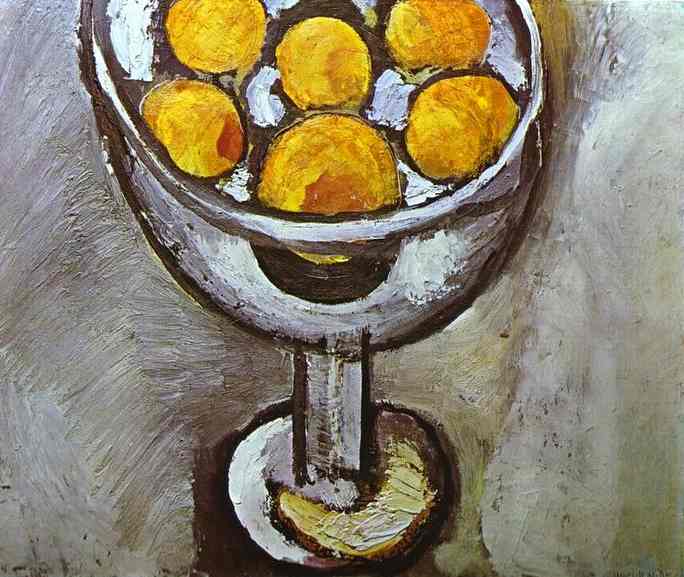
Henri Matisse’s “A Vase with Oranges” (1916) compresses the exuberance of his earlier colorism into a forceful, almost sculptural meditation on form. Painted during the First World War, the canvas trades Fauvist fireworks for a concise vocabulary: a limited range of grays and off-whites, dense black contours, and the blazing orange of fruit seen from above. The result is a still life that feels both intimate and monumental. A goblet-like vessel rises from a rough, gray ground; within its elliptical rim, round fruits press against one another like planets in a bowl. The painting is spare, but it holds a remarkable energy—an energy earned through weighty drawing, thick paint, and a carefully engineered collision between warm and cool tones.
What Meets the Eye
At first glance, the composition reads as a single iconic object isolated against a neutral field. A stemmed metal vessel occupies the center, cropped at the top as if we are leaning over it. Inside are seven or so oranges, their disks described with flat planes of orange and ocher, their edges inked by heavy black. Around them flicker broad touches of white and gray that behave as reflections or perhaps chunks of ice; either way, they intensify the oranges’ heat by contrast. At the very bottom, on the pedestal’s foot, a wedge of peeled fruit glows pale yellow, echoing the circular logic of the bowl above. The background is worked in sweeps and scumbles of gray and brown, without distinct setting or tabletop. Everything essential sits on the surface.
Composition and Geometry
The organizing geometry is a conversation between circles and ellipses. The rim of the vessel is a wide ellipse, bisected by the thick lip and interrupted by a dark inner shadow. Within that ring, Matisse places a cluster of near-perfect circles—the oranges—so that the viewer experiences alternating bands of light and dark, warm and cool, convex and concave. The stem of the vessel is a vertical counterforce, a narrow rectangle that plugs the round bowl into the round base. This vertical spine steadies the composition, making the image feel like a totem planted in space.
Cropping intensifies the geometry. By clipping the bowl’s upper edge, Matisse denies us a comfortable, centered symmetry. The composition breathes upward and outward, implying a continuation beyond the canvas. From an overhead vantage we see the fruit almost diagrammatically, yet the off-center crop keeps the image from becoming static. It is a still life designed like architecture: load-bearing lines, interlocked shapes, and a carefully distributed mass.
The Palette’s Tightrope
Color operates here as a high-wire act. Most of the canvas lives in a cool range of grays, silvers, and muted earths. Against that atmosphere, the oranges blaze. Their chroma is heightened because the surrounding tones are not equal competitors; the cool field behaves like a stage washed in winter light, so that each orange appears sunlit from within. Matisse pushes this contrast with decisive black contours that act like solder seams: the blacks trap and intensify the color they surround.
Warmth participates in more subtle ways. The inner shadow of the bowl contains a murky olive, and the small wedge on the base carries a buttery yellow; these notes extend the oranges into neighboring zones so that the warm and cool worlds interpenetrate. The painting is not a duel but a negotiation—a balance between the metallic chill of the vessel and the organic heat of the fruit.
Drawing with Paint
Matisse’s line is not a thin ink; it is paint dragged with a full brush, sometimes doubling back, often leaving a ridge. The outlines around fruit, rim, stem, and base are thick, assertive, and uneven in places. That irregularity matters. It keeps the image alive, avoiding the sterility of a machine-cut silhouette. The line adjusts to each form’s weight: heavier under the bowl to suggest mass, lighter along the upper rim where glare would soften the edge. This is drawing as performance—decisions made in full view.
Inside the forms, the brushwork is equally declarative. The oranges are built from broad swathes of color, not tiny descriptive strokes. Highlights are blocks of lighter value, not pinpricks. The metal of the vessel reads as metal because Matisse lays down long, cool strokes that sweep around its curve, then interrupts them with whitish flashes where light would strike. Without resorting to illusionistic detail, he convinces us of texture, curvature, and sheen.
A Space Without Tabletop
Unlike many still lifes that anchor objects on a clearly defined surface, this painting floats the vessel in a indeterminate field. The background’s scumbled grays show no horizon or edge. That lack of setting pushes the vessel forward as a graphic emblem. Yet space is not abandoned; it is suggested through the bowl’s inner shadow, the foreshortened ellipse of the rim, the plunge down the stem, and the oval base that tilts toward us. Matisse gives us just enough cues to read depth while insisting that the surface of the painting remains paramount. The tension between objecthood and flatness—between a solid cup and a pattern of shapes—creates much of the picture’s charge.
The Vessel as Character
The container is not a silent prop. It behaves like a second protagonist alongside the fruit. Its silvery skin reflects light in blunt patches; its thick rim casts a dark mouth of shadow; its stem is built like a column tapped into a plinth. The bowl’s material identity—metal or glazed ceramic—is intentionally ambiguous. What matters is its solidity and its reflective logic. The vessel’s cool, engineered form meets the oranges’ organic roundness. In that meeting, the painting finds an emotional temperature: disciplined but not austere, sensual but not indulgent.
The base, with its small wedge of peeled fruit, is a masterstroke. It repeats the curve of the bowl at a smaller scale, linking top and bottom. The wedge introduces a new texture—the fibrous pale of rind and pulp—while remaining within the painting’s limited palette. It also adds a narrative whisper: someone has just handled the fruit, or will soon. The still life is briefly human.
The Oranges as Suns
Matisse treats the oranges as small suns, each radiating color into the surrounding gray. Their surfaces are not delicately modeled; instead, they’re divided into zones: deeper ocher where the sphere turns away, lighter orange where it faces light, sometimes a blunt patch of brighter yellow as a flare. These zones are large enough to read from a distance and simple enough to unify the cluster. Because the fruits are seen mostly from above, their roundness depends on value changes rather than contour. Here Matisse shows his economy: minimal shifts, maximum effect.
Placed together, the oranges form a honeycomb of circles. Some touch, some barely separate by slivers of gray or white. The arrangement keeps the eye circulating, hopping from one round to the next. The repeated shape becomes a rhythm, like notes on a staff. The music is warm, direct, and steady.
Light, Reflection, and the Status of White
White in this painting does many jobs. It catches on the fruit as highlights; it streaks across the metal rim as glare; it pools between the oranges as reflective pops; it lays down underlayers in the background that peek through the scumbled gray. Because the white is actual paint—opaque and tactile—it behaves as a material presence as much as an illusion of light. Where white sits next to the oranges, the latter ignite; where white breaks the gray, the field breathes. Matisse understands that white is not emptiness but a powerful chromatic actor, capable of cooling or brightening any neighbor.
Wartime Discipline and the Search for Order
The year 1916 was one of strain across Europe. For Matisse, it coincided with a consolidation of means. He pared his vocabulary, not from poverty of invention but from a drive toward clarity. “A Vase with Oranges” exemplifies that discipline. Excess is trimmed away. Decoration shrinks to essentials. Instead of a crowded tabletop with patterned cloth and scattered utensils, we get one vessel and one kind of fruit, sobered by gray surroundings. The restraint does not deprive the image of pleasure; it focuses it. The painting declares that beauty can be built from a few luminous relationships—orange against gray, circle against ellipse, weight against light.
This economy also anticipates the interiors he would paint soon after in Nice, where patterned fabrics, luminous windows, and simplified objects coexist under a set of rules set by contour and balanced color. Here, in 1916, we witness the grammar being codified.
Decorative Intelligence Without Empty Ornament
Matisse’s lifelong fascination with pattern and Islamic ornament is present, but distilled. Instead of an all-over fabric, pattern appears as repetition: multiple circular fruits in a circular container, the oval base echoing the bowl, the vertical stem dividing the field. The painting turns structure itself into decoration. It is decorative because it arranges shapes for visual pleasure, yet it avoids the charge of mere prettiness because the shapes behave like necessities—they hold the composition together.
Materiality and Revision
Look into the background and the bowl’s contour and you will find places where the brush has been dragged back and forth, where the edge hesitates, where a previous line shows through. These are not errors concealed; they are thinking left visible. Matisse believed that painting should carry the memory of its making. The scumbled ground reveals dry-brush passages and thicker skids of paint. The fruit’s edges sometimes bleed slightly into surrounding grays. Such traces of adjustment keep the surface human and active, resisting any impression of mechanical finish.
Between Still Life and Icon
Because the vessel is isolated and frontally presented, the image reads almost like a devotional object. The stemmed chalice form, the central placement, and the luminous disks of fruit recall the presence and clarity of an icon. Yet Matisse disrupts the sacred stiffness with the cropped rim, the tilted base, and the feral brushwork of the ground. The painting hovers between ritual object and everyday bowl, between sanctity and kitchen. That ambiguity brings depth: the humble orange becomes worthy of the painter’s liturgy, while the formal cup is brought down to earth by a slice of fruit perched casually on its base.
Symbolic Associations Without Program
Matisse was not a programmatic symbolist, but viewers inevitably read meanings into his choices. Oranges carry Mediterranean associations—sunlight, health, the south. In a gray room and a gray year, they register as concentrated warmth. The metal vessel suggests permanence and order; the fruit suggests life and seasonality. Placed together, they sketch a gentle dialectic: stable form holding transient pleasures; discipline containing abundance. Nothing in the painting insists on this reading, yet the pairing’s resonance contributes to the work’s staying power.
Kinship and Difference with Contemporary Movements
While Cubism of the time fractured objects into facets, Matisse preserves wholeness. He simplifies rather than shatters. The geometry is no less considered than in Cubism, but it serves legibility and sensual presence. Likewise, compared with Expressionists who often pushed paint into turbulent emotion, Matisse’s turbulence is tempered. He allows the brush to show, but subsumes gesture to design. The painting thus stands at a crossroads: aware of the avant-garde’s structural experiments yet committed to clarity, balance, and the primacy of color.
How the Eye Moves
The viewer’s path has been choreographed. We enter via the brightest orange near the rim, slide along the ellipse to the dark mouth of the bowl, hop across the fruits like stepping stones, and then drop down the stem to the base where the pale wedge awaits. From there the eye retraces the vessel’s outer contour back up to the rim. This loop is satisfyingly closed. Matisse keeps our attention inside the picture by refusing any strong diagonal that would shoot outward or any perspective line that would lead to a vanishing point off screen. Our looking circulates and returns, like a breath.
Why It Endures
The painting endures not because of complexity of subject but because of the lucidity of its solution. A handful of decisions—circle inside ellipse, orange against gray, black against white, crop against center—are placed so intelligently that the image feels inevitable. It is easy to describe and hard to forget. In reproductions, the work reads with graphic punch; in person, its thickness and touch reward prolonged study. It demonstrates how an artist can conjure monumentality from the kitchen table, and serenity from a moment of historical anxiety.
A Closing Reflection
“A Vase with Oranges” shows Matisse at a turning point: the fireworks of early color tamed into a steady flame, the love of pattern converted into structural rhyme, the sensitivity to light expressed through paint that admits its own material body. The painting offers a lesson in sufficiency. With grays, black line, and a fistful of oranges, Matisse constructs an image that feels complete, dignified, and alive. The fruit will be eaten, the metal will tarnish, the moment will pass; the painting holds their encounter—cool vessel, warm suns—as a lasting, luminous fact.