Image source: wikiart.org
Introduction
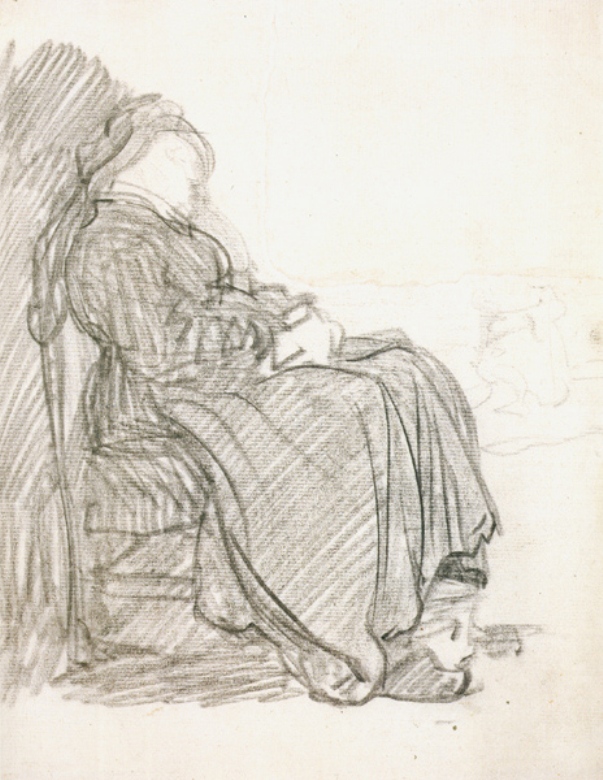
Rembrandt’s “A Study of a Woman Asleep” from 1630 captures a private, unguarded instant with remarkable tenderness. The figure slumps gently in a chair, hands folded, head tipped back as sleep overtakes her. There is no setting to secure her in narrative and no decorative detail to distract the eye. What animates the sheet is the breath of line itself—broad, velvety hatchings that run diagonally across the dress, firmer contours that locate the weight of the body, and a few strategic accents that keep the form from dissolving into shadow. With spare means, the young artist creates a scene that feels as intimate as a whisper. The drawing is both an exercise in observation and a manifesto for the dignity of everyday life.
Leiden Years and the Fascination with the Human Figure
The date places this study in Rembrandt’s Leiden period, when he was in his early twenties and deeply engaged in drawing and etching as independent, exploratory practices. In those years he made swift studies of beggars, scholars, old men, and anonymous sitters, all rendered with an honesty that would become his hallmark. Rather than confining drawing to preparatory status, he used it as a thinking medium—an arena where the hand could test how little it takes to persuade the eye. “A Study of a Woman Asleep” emerges from that artistic climate. It is not a preparatory cartoon for a known painting. It feels like something made because the sight itself was irresistible: a body at rest, surrendering to gravity and time.
The Subject and the Ethics of Privacy
Sleep is the most defenseless state, and artists often turn it into spectacle. Rembrandt avoids voyeurism by positioning the figure modestly in profile and half-occluding the face. The head tilts away; the features blur into soft planes; the bonnet or kerchief shields her expression. What we read is less an identity than a condition—fatigue resolved into rest. The hands clasp at the abdomen with the casual orderliness of someone who has drifted into sleep while waiting or listening. The privacy of the moment is preserved, and the viewer is invited to attend respectfully to posture, weight, and light.
Paper, Medium, and the Language of Hatching
The sheet appears to be executed with soft black chalk or graphite used broadly, then tightened in passages with firmer pressure. Across the skirt, Rembrandt lays down diagonal hatching of consistent angle and spacing. Those parallel strokes create a unified field of tone while subtly contouring the swell of the fabric. Around the hem he darkens the hatching and thickens the contour to anchor the mass to the ground. The chair receives rougher, more vertical strokes that differentiate its rigid structure from the pliable dress. On the sleeves and bodice, short directional marks ride the form, suggesting the twist of cloth and the slight rotation of the torso. The drawing reads as a complete image precisely because the marks vary according to surface.
Composition and the Architecture of Rest
The figure inhabits the left half of the sheet, leaving a long swath of pale paper to the right. That emptiness behaves like silence, amplifying the mood of drowsy stillness. The chair backs a vertical column of tone that buttresses the woman’s form. From the downward tilt of the head, an elegant curve runs through the shoulder, elbow, and knee, creating a single, slow arc. This arc is the drawing’s structural melody. It stabilizes the image while suggesting the soft fall of sleep. The feet are sketched with just enough firmness to register as supports but not so much as to interrupt the flow of the silhouette. Nothing in the design fights the central idea: gravity has won gently.
Light, Value, and the Breath of the Page
Because the medium builds darkness with line and leaves highlights as untouched paper, the sheet’s light is the paper itself. Rembrandt uses that luminous reserve to model the neck, forearms, and the broad plane of the skirt. In the transition from the bright skirt to the shaded seat, the hatching gathers density, making the shadow feel breathable rather than opaque. The small, saved sliver of white along the upper arm functions like a whisper of reflected light, keeping the body round. Even the blank right side participates: it is not empty but filled with all the light the artist chose not to draw.
The Hands and the Psychology of Sleep
Hands are often the site where Rembrandt concentrates feeling. Here they are lightly interlaced at midsection, a modest, practical posture that says as much about the woman’s character as her face could. The fingers are not diagrammed; they are suggested by broken contours and soft overlaps, which mirrors the condition of sleep—articulation softened but not erased. The gentle clasp conveys safety and self-composure. We sense that this is not collapse but repose, not exhaustion verging on distress but the kind of nap that comes to someone who trusts the surrounding world.
Drapery as Narrative of Weight
The drawing’s most commanding feature is the large skirt, a dome of fabric described by sweeping hatchings. That surface does more than clothe the body; it narrates weight distribution. Where the thighs rest on the chair, the texture compresses; where the fabric hangs free, the hatching lengthens and opens; at the hem, a darker lip of line marks contact with the floor. These decisions let the viewer feel the physical fact of sitting—the inward pressure at the seat, the outward billow of unsupported cloth, the pooled heaviness near the ankles. The drama is not anecdotal but physical, and it is conducted entirely through value and direction.
The Head, the Bonnet, and the Refusal of Ornament
In many seventeenth-century figure drawings, headgear can serve as a site for flourish. Rembrandt declines the opportunity. The bonnet is indicated with two or three nested contours and a soft tone where shadow falls under the brim. Its purpose is to darken the upper silhouette and to suggest a domestic, everyday identity. By keeping the head understated, he prevents theatricality from entering the picture. The focus remains on the act of sleeping, not on the costume of the sleeper.
Comparison with Rembrandt’s Other Studies of Everyday Life
This drawing sits comfortably among Rembrandt’s early studies of beggars, readers, and figures by windows. Like those, it elevates the ordinary without sermon or satire. It also anticipates later, more finished works where inwardness governs the composition. In portraits from the 1650s and 1660s, Rembrandt will often let features blur at the edges, inviting mood to blur into matter. The seed of that approach is present here: contour is a suggestion rather than a prison, and the truth of the sitter is discovered in the weight of her pose and the movement of the hand.
The Rhythm of the Line and the Music of Sleep
Look long enough and the sheet resolves into a series of rhythms. The diagonal hatchings across the skirt keep time like a slow accompaniment; the heavier accents at hem and sleeve act as downbeats; the barely indicated background figure at right, quickly smudged, behaves like a distant counter-melody we choose not to hear. Such musical analogy is not fanciful. Rembrandt orchestrates attention through repetition and variation, the same means by which music sustains feeling over time. The result is an image you don’t just see; you almost hear it breathing.
The Discipline of Omission
What the drawing leaves out matters as much as what it gives. There is no detailed chair rung, no interior décor, no explicit setting. The face remains an oval with minimal articulation. These omissions are not failures; they are part of a discipline that keeps the image open and alive. By withholding descriptive excess, Rembrandt lets the mind do quiet work, completing the scene from experience. The viewer supplies the room, the light source, and even the soft sounds of sleep. This collaboration between artist and beholder is one reason the sheet feels fresh rather than fixed.
The Body at Ease and the Ethics of Attention
One of Rembrandt’s enduring contributions is his insistence that attention itself can dignify a subject. In this sheet the model does nothing heroic. She sits, dozes, and becomes a small universe of lines and values. The artist gives her time and skill without irony or sentimentality. That ethic of attention has a moral flavor without preaching: look carefully, and you will find significance where others find none. The drawing teaches a way of seeing that moves outward from empathy rather than downward from judgment.
Technique Lessons Embedded in the Sheet
For artists, the drawing offers practical instruction. Tone can be built quickly and convincingly by consistent, directional hatchings that follow the form. Depth can be created by concentrating value where weight settles and allowing highlights to remain as paper. Edges need not be equally sharp; firm them where structure demands and let them soften where air and light intervene. Above all, economy clarifies intention. The sheet demonstrates how two or three kinds of mark—broad hatching, tightened contour, and compressed accent—can yield the full register of volume, weight, and mood.
Time of Day, Light Source, and the Feel of Air
Though the drawing gives no explicit location, its light reads as daylight entering from the right, perhaps through a window just outside the frame. The evidence lies in the gradient across the skirt and the faint highlight brushing the forearm and chest. That directional light, set against the left-hand shadow of chair and wall, suggests a quiet interior—a workshop or domestic room—where the air is still enough that sleep can gather. The sheet therefore holds not only a figure but also a weather of calm.
The Modernity of the Image
“A Study of a Woman Asleep” feels modern because it acknowledges the sufficiency of the moment. It does not convert the model into a myth or even a story. It trusts that the way a person yields to sleep can be as compelling as any historical drama. The partial abstraction of the right half, the dominance of large tonal fields, and the overall restraint anticipate later sensibilities that prize process and perception over anecdote. Yet nothing about the drawing is cold. Its warmth comes from the visible thinking in the lines and from the courtesy with which the artist approaches the sitter.
Possible Identities and the Value of Unknowing
Speculation often surrounds early drawings like this: is the model a member of the artist’s household, a studio assistant, a hired sitter? In 1630 there is no compelling reason to attach a name, and the drawing benefits from anonymity. Unknowing keeps the image open to a broader human story. She becomes anyone who rests after work, anyone caught by a shaft of afternoon light, anyone whose body trusts a chair enough to let go. The universality strengthens rather than weakens the emotional pull.
Relationship to Sleep in Art History
Sleep has a long pictorial history, from mythic slumbers to devotional visions. Rembrandt’s study differs in its humility. There is no allegory, no eroticism, no supernatural visitation. The drawing aligns more closely with the quiet interiors of northern art where domestic moments are honored for their own sakes. In later centuries, artists will revisit the theme of ordinary sleep with similar restraint; the lineage can be traced back through sheets like this, where a young Dutch master demonstrates how the simplest human states deserve the most careful looking.
Endurance of the Sheet and the Patina of Time
Many drawings from the period have survived with all the incidental marks of age—faint creases, softening at the edges, slight unevenness in tone. Far from diminishing the effect, such patina can enhance the drawing’s sense of breath and presence. Because Rembrandt builds the image from confident, structural decisions rather than fragile tricks, the composition tolerates wear. The pose remains legible, the light believable, the mood intact. The drawing reminds us that what lasts are the artist’s choices about weight, direction, and omission.
Conclusion
“A Study of a Woman Asleep” is a compact meditation on rest. It demonstrates how line can hold air, how hatching can evince weight, and how restraint can invite intimacy. In the simple curve of the figure and the pooled shadow beneath the chair, Rembrandt finds a world. The sheet resists spectacle and embraces attention. Across a quiet field of paper, a young artist listens closely to an ordinary human state and returns it to us with patience and grace. That gift of attention is why the drawing continues to speak, centuries later, in tones as soft as sleep itself.