Image source: wikiart.org
First Encounter With Skin, Light, and the Humility of Study
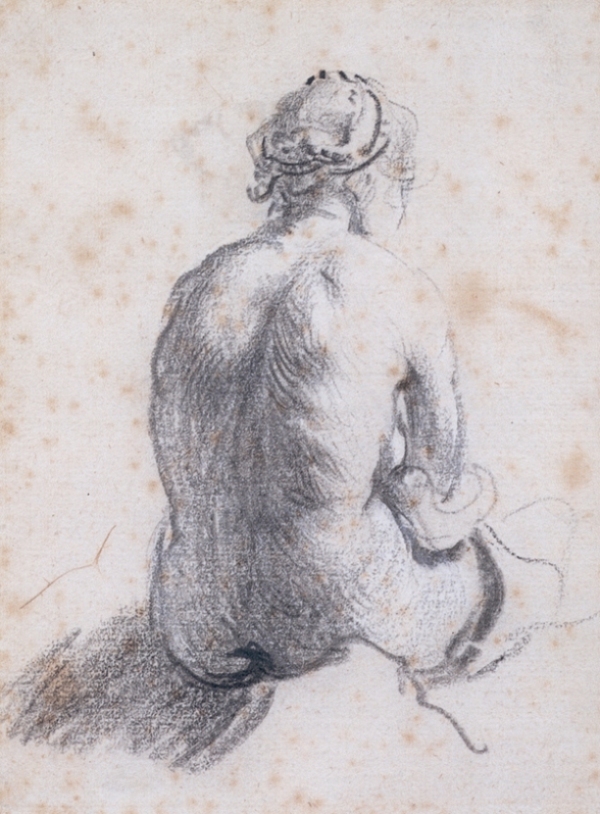
Rembrandt’s “A Study of a Female Nude Seen from the Back” (1634) greets the eye with a frank, unornamented pose: a seated model turned away, her spine, shoulders, and hips mapped in soft charcoal and heightened chalk. There is no theatrical setting, no mythological alibi, no embroidered drapery to soften the fact of flesh. The sheet is about looking and learning—an artist’s hand testing how light settles on skin and how the architecture of the body declares itself through weight and turn. Because the figure faces away, the drawing disarms voyeurism and quietly redirects our gaze from personality to perception. What remains is one of the most intimate genres in art—the studio study—as Rembrandt practices it with extraordinary candor.
The Year 1634 and the Culture of the Studio
The drawing belongs to Rembrandt’s early Amsterdam years, a period of eruptive productivity in paint, print, and drawing. In the studio he taught pupils to study from life, to distrust formulas, and to let light rather than line dictate form. This sheet is a living syllabus of that approach. Instead of a polished ideal, we meet a specific body: shoulders rounded by the seated posture, a subtle compression at the waist, the broad plane of the back softened by skin. The immediacy signals a working session with a model, likely one of the professional sitters who supplied artists with hours of practiced stillness. Rembrandt’s line keeps the tempo of such sessions—brisk but attentive—so that the body feels present, warm, and mortal.
Composition as a Spiral of Attention
The composition sets the figure slightly left of center, turned three-quarters away. From the nape of the neck the viewer’s eye spirals down through the shoulder blades, over the swell of the sacrum, then back up along the arm resting across the lap. The rhythm is circular and inward, encouraging us to “read” the body as a continuous topography rather than as a collection of parts. The faintest suggestion of the head’s profile keeps the figure human while letting the back remain protagonist. A darkened patch of tone beneath the sitter anchors the weight and becomes, in pictorial terms, the studio floor upon which the study rests.
The Language of Media: Black Chalk, Soft Contour, Reserved Whites
Rembrandt’s tools on this sheet are minimal—primarily black chalk or charcoal with sparing heightening. He draws edges with a tender pressure that leaves a velvety contour; where he wants mass rather than outline, he drags the side of the stick to lay soft tone that can be gently smudged with the finger. The brightest “highlights” are simply the paper left bare, so that light feels breathed into, not painted onto, the body. In places the chalk gathers into hatching to state structural planes—the wedge of the scapula, the dimple over the iliac crest, the tightened cylinder of the upper arm. The economy is instructive: with a handful of marks he secures weight, temperature, and presence.
Anatomy Under the Hand: Structure Without Pedantry
The back is a difficult subject because its narrative features are few; it must be rendered through planes and transitions. Rembrandt maps these with a physiognomic intelligence that never becomes anatomical display. The spine is not a drawn line but a corridor of alternating lights and half-tones. The shoulder blades read as buoyant ovals beneath skin, their edges softened by the surrounding musculature. Under the left shoulder the latissimus dorsi flares and then thins as it dives toward the lower back. The pelvis is indicated by the shift in volume where the sacrum tucks and the gluteus rounds outward, the sitting weight compressing one side a measure more than the other. Everything convinces—not because each muscle is named, but because each form behaves in the logic of gravity and light.
The Decision to Show the Back and What It Means
Choosing the back does more than solve a studio problem; it changes the ethics of looking. The model’s turned head and averted face remove the performative element that often shadows nudes. We are not asked to read expression or seduction; we are asked to read light and structure. That humility gives the sheet its unusual intimacy. It is not “about” the woman as subject of narrative or desire; it is about the body as shared human architecture, and about a draftsman serious enough to study it without disguise.
Light as Sculptor and Historian
The light in this drawing is disciplined, as if coming from a high window to the left. It shears across the back, creating a ladder of small highlights that step down from trapezius to lumbar curve. Those lights are not all equal: Rembrandt differentiates the fresh, cool gleam along taut skin from the warmer, broader glow on thick muscle. Subtle temperature shifts—achieved solely by pressure and density of graphite—give the sensation that blood lives beneath the surface. The light is also historical. It tells us where the studio window was, what hour the session may have occupied, and what tradition of northern daylight, not southern theatrics, Rembrandt preferred when he studied the figure.
The Head and Hair: A Small Drama of Edges
Though the head is not the center of interest, Rembrandt refuses to let it blur into anonymity. A few looping strokes describe hair tied up with a ribbon or cloth; a tiny hooked line marks the ear; a ghost of profile leans right. The decision to keep the head unfinished keeps the back dominant, yet these touches prevent the figure from becoming a mannequin. They also set a tender counterpoint: the fragile loops of hair contrast the robust planes of the back, reminding us that this is not a diagram but a person.
The Seated Pose and the Truth of Weight
Because the sitter is seated, two forces meet in the body: gravity from above and compression from below. Rembrandt explores that meeting with tactile care. A darker lode of shading gathers where the buttock meets the surface; the outer thigh widens slightly as weight spreads; the torso inclines a degree forward, creating small vertical pleats of skin that are neither flattery nor ridicule but the simple physics of sitting. In those pleats, some viewers sense Rembrandt’s characteristic empathy: he renders what is there, including what other artists often edited out, because truthfulness is more dignifying than idealization.
The Studio Floor and the Shadow as the Drawing’s Base
The broad, rough patch at lower left is more than a cast shadow; it is the sheet’s ballast. Its direction and density tell us where the light comes from, and its texture—scrubbed, grainy, and slightly diagonal—keeps the image from floating in the paper’s blankness. As in many Rembrandt studies, the ground is not fussed into a perspectival plane. It is simply enough to hold the body and to say “here.” That sufficiency gives the drawing modern freshness; it refuses theatrical stagecraft and remains honest about its means.
Comparisons Within Rembrandt’s Nude Studies
Rembrandt returned to the unsentimental nude again and again, particularly in drawings of women bathing or combing their hair, and in sheets where a model turns or bends in a cramped studio. Across those drawings, he privileges specificity over type. The bodies are aging or young, stout or slender; they are caught mid-motion, with all the small asymmetries that make life believable. This 1634 back view belongs to that stream. It is quieter than the bathing scenes and more concentrated than the multi-figure sheets, yet it carries the same ethos: the human body is worth studying as it is, under truthful light.
The Refusal of Idealization and the Ethics of Truth
Seventeenth-century art often softened the nude with myth or perfection. Rembrandt’s sheet stands in a different lineage—the observational nude that refuses to flatter, not because it delights in exposing flaws, but because accuracy is a deeper courtesy. By recording creases, small dimples, and the weight of flesh on a surface, the drawing accepts the body’s reality and therefore honors it. Viewers frequently remark that such honesty paradoxically increases beauty; freed from cliché, the body becomes more human, and humanity is what Rembrandt’s line loves best.
The Pace of Making: Where the Hand Speeds and Where It Lingers
Tracing the marks, one can reconstruct the session. The outer contour of the back arrives quickly, with an assured sweep from neck to hip. The darker emphases at scapula and sacrum are applied afterward, pressing the chalk to insist on structure. The arm across the lap is lightly indicated—Rembrandt saving time where the form escapes the main light. The head receives a few final flourishes, and the ground is scrubbed in at the end to seat the model. The sheet carries the breath of this sequence; it feels like a memory preserved at the speed of seeing.
Paper as Skin, Skin as Paper
Because he uses the paper’s tone for the highest lights, the sheet itself becomes part of the body’s illusion. Foxing spots and warm fibers peek through in places; far from ruining the work, they intensify the sensation of living surface. The drawing demonstrates a metaphoric reciprocity: paper can be skin, and skin can behave like paper receiving light. Rembrandt senses that reciprocity and keeps his touch light enough to let the sheet’s life remain visible.
The Study’s Relevance to Painting and Printmaking
Studies like this fed Rembrandt’s larger projects. The comprehension of back anatomy informs countless painted figures seen in action from behind—apostles turning, soldiers lifting, women twisting at a basin. In etchings, where line alone must suggest volume, knowledge gained in chalk is indispensable. The discipline of this drawing—how to state a spinal trough with two strokes and a reserve—translates across media, making it a cornerstone of Rembrandt’s craft rather than an isolated curiosity.
How the Image Still Feels Contemporary
Modern viewers, accustomed to candid photography and quick studies, are startled by the drawing’s immediacy. It reads like a moment from a life-drawing class today: model seated, artist counting minutes, hand moving with sympathy and precision. The modest scale and directness feel closer to our era’s sketchbook culture than to the grandly staged allegories often associated with the seventeenth century. That contemporaneity comes from Rembrandt’s abiding interest in un-staged truth.
The Silence of the Back and the Poetry of Reserve
By turning the figure away, Rembrandt grants the model privacy and the viewer quiet. The back has no eyes; it does not meet us. That absence of exchange empties the drawing of social performance and lets a different poetry emerge—the poetry of reserve, of being near without claiming, of caring for a form without possessing it. Few artists have described that ethical nearness as persuasively.
Lessons for Draftsmen: What To Steal From the Sheet
Draftsmen reading this study learn at least three practical things. First, begin with a confident, continuous contour, then lock form with a few structural accents. Second, let the paper work—reserve lights, hatching only where planes turn, and avoid over-modeling. Third, never sacrifice gravity: anchor weight with a shadow large enough to convince the body to sit. These lessons, distilled from Rembrandt’s page, remain fundamentals in every studio where the figure is drawn.
A Meditation on Mortality Without Melodrama
Because the back carries age more plainly than the face, the drawing whispers about time: slight loosenings of skin, a deepening groove beside the spine, the dreamlike droop of the shoulder. Rembrandt treats these not as tragedies but as part of the body’s truthful music. The sheet is thus a gently stoic meditation: to be alive is to bear weight, to be warmed by light, to leave traces where flesh meets the world. No grand symbols are necessary; the back is sufficient.
Closing Reflection on Attention, Dignity, and the Life of a Line
“A Study of a Female Nude Seen from the Back” is small, quiet, and inexhaustible. It asks us to slow our seeing until planes, not stories, hold us; to value honesty over ideal; to feel how a line can be both edge and breath. In 1634 Rembrandt already understood that drawing is not merely a preliminary step but a way of knowing. The modest sheet holds that knowledge like a cupped flame—steady, warm, and human.