Image source: wikiart.org
A Springtime Vision in Waterhouse’s Late Style
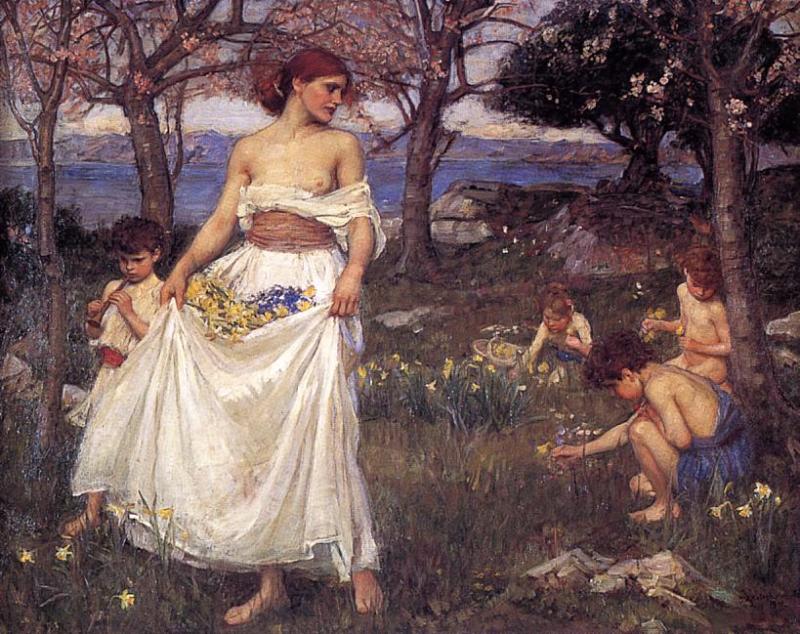
John William Waterhouse’s A Song of Springtime from 1913 belongs to the artist’s late period, when his imagination often returned to women in open air settings, poised between the everyday and the mythic. Here, Waterhouse shapes spring not as a simple season, but as a lived atmosphere. The painting feels like a brief inhalation of mild air after winter, a moment when the world’s color and motion begin again. Rather than presenting a dramatic narrative, the work offers a lyrical situation: a young woman and several children gathering flowers near the water’s edge. The scene suggests music without showing instruments, a “song” carried through posture, gesture, and the soft rhythm of repeated actions.
Waterhouse builds the theme through calm clarity. The figures are legible at once, yet the painting rewards slow looking because its emotional focus is distributed across small details: hands selecting blossoms, cloth lifted like a sail, bare feet meeting earth, and distant water holding a cool line behind the warmer foreground. Springtime here is not only a subject but a structure. The composition moves like a refrain, repeating the motif of gathering and holding. Each figure participates in the season’s renewal, as if the landscape itself has invited them into an old ritual that happens every year.
Composition and the Flow of Attention
The painting is arranged to guide the viewer’s eye in a gentle circuit. The central woman dominates the foreground, her pale dress and exposed shoulders catching the most light. She stands slightly turned, head angled to the side, as if listening or responding to something just beyond the frame. This turn is crucial: it prevents the figure from becoming merely posed, and it introduces a sense of present time. Her attention is not on us, and not wholly on the children either. That outward glance implies a wider world continuing beyond this moment, which makes the scene feel like an excerpt from life rather than a staged tableau.
Around her, the children create a secondary pattern that both balances and extends the composition. Their small bodies bend, crouch, and reach in different directions, echoing the varied growth of spring plants. Waterhouse positions them across the right half of the image so that the scene does not collapse into a single focal point. Instead, the painting breathes. One child is close to the ground in the foreground, intent on selecting a flower. Others appear farther back, similarly engaged, forming a chain of activity that recedes into space. These repeated actions create a visual rhythm like recurring notes, reinforcing the title’s promise of a “song.”
The landscape acts as both setting and framework. Bare tree branches spread overhead, creating an airy lattice that divides the sky and softens the horizon. The water and distant shore form horizontal anchors, while the woman’s upright figure provides a vertical counterweight. This interplay of vertical presence and horizontal calm gives the painting stability, but the lifted fabric introduces movement, like a breeze passing through the scene. Waterhouse uses that cloth almost as a compositional tool, stretching it outward to connect figures and plants, and to draw the eye downward into the floral foreground.
Color, Light, and the Season’s Emotional Temperature
Waterhouse’s palette is tuned to spring’s delicate contradictions. Spring is both bright and cool, both fragile and insistent, and the painting reflects that duality. The woman’s white dress is not a flat white but a shifting surface that catches faint lavender and warm cream tones. This subtle tinting makes the fabric feel responsive to the surrounding air. It also allows the white to harmonize with the environment rather than dominate it. The dress becomes a luminous field where light can pool, emphasizing the figure’s central role without turning her into an artificial spotlight.
The surrounding colors are earthbound and restrained: muted browns, soft greens, and grayish violets in the branches and ground. Against this quieter base, the flowers appear as concentrated sparks of yellow and blue. Those blossoms function almost like punctuation marks. They interrupt the subdued ground with clean notes of color, suggesting how spring arrives: not as an instant transformation, but as scattered signs that gradually multiply. Waterhouse’s handling of these small bright accents gives the painting a sense of freshness without resorting to harsh contrast.
Light is diffused rather than dramatic. The scene feels as if it is lit by a mild sky, the kind that makes shadows soft and edges gentle. This even illumination supports the painting’s mood of peaceful continuity. Nothing is stark. Even the water in the background is calm, painted as a cool band that holds the scene in quiet balance. The distant horizon reads as a promise of space and air, reinforcing the idea that spring is expansive, opening outward after winter’s enclosure.
The Central Figure as Muse and Participant
Waterhouse often placed women at the heart of his compositions, but the women in his paintings are rarely mere ornaments. In A Song of Springtime, the central figure occupies a role that is both aesthetic and symbolic. She is presented as youthful, poised, and intensely present, but she is also integrated into the action through her interaction with the cloth and the gathered flowers. She is not simply standing in nature; she is engaged with it, literally holding spring’s bounty in the folds of her dress.
Her posture suggests both responsibility and reverie. One hand draws the fabric outward, shaping a cradle for flowers, while the other hangs with a relaxed naturalness. That combination conveys a person who is simultaneously working and thinking. The slightly turned head reinforces this impression, as if she is caught between being part of the children’s activity and drifting into private reflection. This tension is part of the painting’s poetry. Springtime is often associated with youthful energy, but Waterhouse adds a note of contemplation, implying that renewal can bring both joy and a thoughtful awareness of time passing.
The figure’s bare feet ground her in the landscape. Waterhouse includes this detail not for shock or sensuality, but for immediacy. Feet on earth imply direct contact with the season’s warmth and softness. It also aligns her with the children, who are similarly close to the ground, bending and touching. The painting therefore suggests a shared physical experience: the feel of grass, the coolness of shade, the delicate resistance of stems as they are gathered.
Children and the Ritual of Gathering
The children in the scene bring a specific kind of life that changes how spring is understood. They are not observers of beauty but active participants in it. Their movements are small and concentrated, focused on selecting and picking. That action is one of the most archetypal spring gestures, and Waterhouse treats it as a quiet ritual. Each child repeats the season’s theme of collecting what has newly appeared.
The variety of the children’s poses also enriches the painting’s emotional range. Some figures are upright and tentative, others deeply bent into their task. This range suggests different temperaments and ages, but it also creates a visual metaphor for growth. Like plants, the children occupy different stages of height and strength. They are part of spring not only because they gather flowers, but because they embody the season’s idea of becoming.
The presence of children changes the mood from solitary reverie to communal warmth. Many Waterhouse compositions center on a single figure whose inner world dominates the scene. Here, the central woman is surrounded by youthful attention and movement. The painting becomes less about isolation and more about companionship, caretaking, and shared time outdoors. The woman’s role is not explicitly maternal, but the arrangement implies guidance and shelter. The cloth she holds becomes a gathering place, both for flowers and for the children’s efforts, as if she is collecting their contributions into one shared offering.
Landscape, Trees, and the Sense of Place
The setting is carefully chosen to express early spring. The trees are still largely bare, their branches thin and intricate, suggesting that winter has only recently released its grip. Yet the ground is alive with flowers and emerging greens, creating a layered seasonal moment. This transitional state is more emotionally complex than a full summer bloom. It carries a sense of anticipation. The world is waking up, but it is not yet fully awake, and that half-awakened quality gives the painting its tenderness.
The water in the background introduces a note of calm distance. Water often functions symbolically as time, memory, or emotional depth, but here it also serves a practical compositional role, giving the eye a place to rest. It creates cool space behind the figures, helping the warm foreground feel intimate. The distant shore, barely detailed, suggests a broader landscape beyond the immediate gathering. This subtle sense of “elsewhere” prevents the scene from becoming too enclosed. The figures have room to breathe, and spring itself feels like an opening into wider possibility.
The trees also frame the figures like a natural architecture. Their branches form a pattern above, while the trunks anchor the sides. This framing gives the scene a slight stage-like quality, but it remains organic, as if the landscape has spontaneously arranged itself around the gathering. Waterhouse’s brushwork in the foliage and branches is suggestive rather than sharply botanical, which helps the scene stay poetic. The trees are not scientific descriptions; they are expressive forms that convey air, light, and seasonal change.
Symbolism and the Meaning of “Song”
The title A Song of Springtime invites the viewer to interpret the image through sound and rhythm, even though the painting is silent. Waterhouse translates the idea of song into visual equivalents. The repeated gestures of picking and holding are like repeated musical phrases. The scattered flowers are like notes across a staff. The cloth lifted by the woman resembles a banner, and banners can be associated with procession, celebration, and communal rituals. All of these elements make the scene feel like a gentle ceremony.
Spring itself functions as the painting’s symbolic core. Spring is an old metaphor for youth, renewal, and beginnings. Waterhouse draws on these associations but avoids heavy-handed allegory. The woman is not explicitly labeled as a goddess, and the children are not dressed as mythological attendants. Yet the scene carries a timeless, almost classical simplicity that nudges it toward allegory without crossing into theatrical costume. This balance allows the painting to feel both familiar and elevated. It could be a memory of a real day, and it could also be an ideal image of the season’s spirit.
The act of gathering flowers carries its own symbolic weight. Flowers are transient, beautiful precisely because they do not last. By making flower-picking the central activity, Waterhouse gently acknowledges spring’s fleeting nature. The gathered blossoms will fade, just as the season will pass. The painting therefore contains a quiet awareness of time. It celebrates renewal while hinting that renewal is always temporary, always part of a cycle that includes loss and return.
Technique and the Late Waterhouse Touch
In 1913, Waterhouse was working in a mature style shaped by his long engagement with Pre-Raphaelite ideals and broader Victorian and Edwardian painting traditions. His surfaces often combine careful figure drawing with a freer, more atmospheric handling of landscape. In this work, the figures feel solid and designed, while the environment dissolves into softer strokes and subtle tonal shifts. That contrast emphasizes the human presence as the scene’s emotional anchor, while letting nature remain a surrounding mood.
The fabric is especially telling. Waterhouse’s ability to paint drapery is on display in the dress’s folds, where highlights and shadows communicate weight and movement. The cloth is not stiff; it sags and lifts convincingly, responding to gravity and the woman’s grip. This physical believability matters because it supports the painting’s theme of gathering. The dress is not only clothing but a vessel, almost a basket made of fabric, and Waterhouse renders it with enough realism that the viewer feels its texture and tension.
The faces are treated with restraint. Waterhouse avoids over-describing expression. Instead, he suggests feeling through posture and direction of gaze. The woman’s turned head becomes more expressive than an exaggerated facial emotion would be. The children’s concentration is similarly conveyed through their bodies. This approach keeps the mood gentle and timeless, and it fits the painting’s lyrical intent.
Emotional Atmosphere and the Painting’s Quiet Drama
Although the scene appears peaceful, there is a subtle drama in its psychological distance. The woman’s gaze outward suggests thought, perhaps even longing. Spring is often linked with hope, but hope can include a trace of melancholy because it points toward what is not yet here. The painting seems to acknowledge this. The children are immersed in the present, absorbed by immediate discovery. The woman, older and more reflective, holds both the present moment and an awareness of something beyond it.
This contrast gives the painting depth. It becomes not only a celebration of spring but an image of how different ages experience time. Children live in detail. Adults often live in layers, feeling the present while also remembering and anticipating. Waterhouse captures that layered experience without making it heavy. The light remains soft, the colors remain tender, and the overall impression is one of calm beauty. Yet beneath that calm is a thoughtful note that makes the painting feel human rather than purely decorative.
The “song” of springtime, then, is not only the season’s brightness. It is the mixture of freshness and transience, the feeling of a world returning and the awareness that it will move on again. Waterhouse’s achievement is to embody that complex emotion in a scene that remains accessible and serene.