Image source: wikiart.org
Opening the Scene in “A Roman Offering”
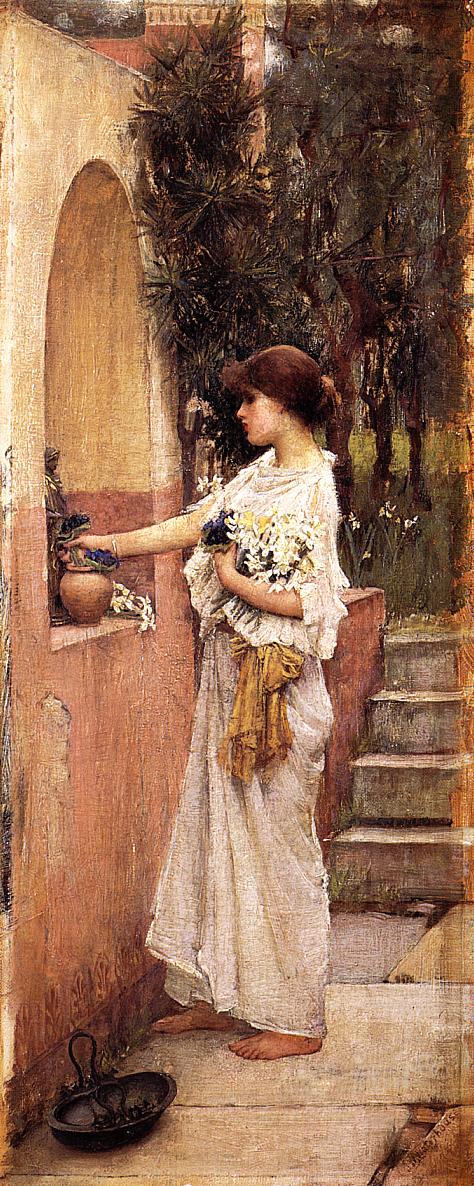
In “A Roman Offering” (1891), John William Waterhouse builds a whole emotional world out of a quiet action. A young woman stands in profile at a small wall shrine, reaching forward to place fresh flowers before a little statue. Nothing dramatic happens in the obvious, storybook sense. There is no crowd, no procession, no theatrical gesture. Instead, the painting turns devotion into atmosphere, and atmosphere into meaning.
The format is tall and narrow, which immediately affects how the scene reads. We look up and down the figure’s full length, from the bare feet on stone to the lifted arm and the arched niche. That verticality makes the act feel ritualistic, as if the woman’s body becomes a column linking ground and offering, earth and belief. Waterhouse chooses a moment that is both private and public: it takes place outdoors, in a courtyard or garden passage, yet it is intimate enough that the viewer feels like an accidental witness.
This is one of Waterhouse’s great strengths. He often paints myth, legend, or antiquity not as distant spectacle, but as something lived and breathed, as ordinary as stepping into light or laying down flowers. Here, Roman religion is not presented as an academic reconstruction. It becomes a tender habit, a daily gesture, a small pause in the flow of time.
A Ritual Made Human
The central action is simple: the woman offers flowers to a deity represented by a small figurine set inside the niche. The clay vessel beneath her hand functions like an altar accessory, both practical and symbolic. Flowers are temporary, fragile, and destined to fade, which makes them a perfect offering for a painting that cares about fleeting states of mind.
Her expression is calm and focused. Waterhouse gives her no exaggerated emotion, because the painting is not about ecstasy or fear. It is about steadiness. The face is turned toward the shrine with a soft seriousness, suggesting respect rather than desperation. Even her posture feels measured. The arm extends in a straight line, not dramatically but deliberately, like someone who has performed this action many times and still treats it as meaningful.
The bouquet cradled against her body matters as much as the flower she places. It implies that this is not a single token but a careful gathering. She brings abundance, yet she offers it one piece at a time, turning plenty into intention. This slow pacing, implied by the staged movement, is part of the painting’s spiritual mood. Waterhouse invites us to feel how ritual stretches a moment, how belief can be expressed through repetition rather than spectacle.
Composition and the Architecture of Quiet
The setting is built from a few strong shapes: the pale wall and arched niche on the left, the figure in the center, and the steps rising on the right. These elements create a gentle enclosure, like a sheltered corner where sound would soften and sunlight would linger. The niche itself is a visual anchor. Its curve echoes the curve of the woman’s bowed head and the rounded forms of vessel and bouquet, tying architecture to the human body.
The steps add another kind of structure: they suggest movement, yet the woman is still. That contrast makes her pause feel chosen. The stairs imply that life continues beyond this moment, that she could climb upward and leave, but she has stopped here to complete something. Waterhouse uses the steps almost like a reminder of time’s forward pull, which ritual briefly resists.
The background foliage deepens the feeling of seclusion. Dark greens and browns form a textured screen behind her, so the pale dress stands out clearly. The greenery does not open into a grand landscape. It remains close, dense, and shadowed, strengthening the intimacy of the courtyard space. This is not Rome as empire. It is Rome as lived environment, with warm plaster, stone, plants, and daily devotion tucked into a corner of home.
Color, Light, and the Warmth of Antiquity
The palette is restrained but rich. Warm terracotta tones dominate the lower wall and ground, while the niche interior glows with a softer, sandy light. The woman’s dress is white, but not a cold white. It carries creamy, sunlit notes and delicate shadows that keep it grounded in the warm setting.
Waterhouse places small color accents with care. The blue or violet flowers near her hand punctuate the warm wall tones, creating a brief, jewel-like contrast. The golden ochre sash at her waist adds another warm highlight, bridging the terracotta surroundings and the creamy whites of the fabric. These touches keep the scene from becoming monochrome and also guide the eye: first to the offering, then to the body that carries the rest of the flowers.
Light in the painting feels indirect, as if filtered through open air and foliage. The shadows are soft, and edges often blur slightly into the surrounding tones. This softness supports the mood of reverence. Sharp, hard light would make the scene too literal, too immediate. Instead, Waterhouse’s light suggests memory, stillness, and contemplation, as if the viewer is seeing not just a place but a feeling attached to that place.
The Figure as a Study in Grace and Reality
The woman’s clothing reads as classical in spirit, a draped white garment that evokes Roman dress without obsessing over archaeological detail. The folds are generous and weighty, and Waterhouse takes obvious pleasure in the way fabric catches light, gathers at the waist, and falls toward the floor. The drapery is not merely decorative. It communicates restraint, modesty, and quiet dignity.
Her bare feet are important. They connect her physically to the stone ground and make the ritual feel immediate and bodily. Shoes would have introduced distance, a sense of going somewhere. Bare feet suggest home, intimacy, and sincerity. They also subtly elevate the act: many devotional traditions, across cultures, associate bare feet with reverence or purity of approach. Whether or not that is historically specific, it is emotionally legible.
Waterhouse avoids idealizing her into a marble statue. The face has softness, the posture has natural weight, and the gesture is practical. This blend of beauty and ordinariness is key to the painting’s success. He makes a devotional scene feel believable, not because he documents Rome with scientific precision, but because he understands how people inhabit spaces and habits.
Symbolism in Flowers, Vessels, and the Small Shrine
The shrine is small, almost domestic. That scale changes the meaning of the offering. Rather than a grand public temple ritual, we witness a personal act of piety, the kind of devotion woven into daily life. The figurine inside the niche becomes a focal point for a household’s relationship to the divine. It implies protection, gratitude, and continuity.
Flowers carry layered symbolism. They can signify celebration, mourning, seasonal change, or the desire to honor something beyond oneself. Here, their freshness reads as immediacy: devotion offered now, not promised later. Their fragility introduces a gentle melancholy, because we know they will fade. That fading gives the act poignancy. The offering is sincere precisely because it is temporary, because it will have to be renewed, like faith practiced again and again.
The clay vessel is equally suggestive. Earth turned into form, a container for water and flowers, it echoes the idea of shaping life into meaning. Its simple, rounded body feels humble. Waterhouse contrasts this humble object with the sacred presence it serves, implying that holiness is met through ordinary materials. Belief, the painting suggests, does not always require grandeur. It can live in clay, in petals, in an alcove in a wall.
Near the ground sits a dark lamp-like object, possibly an oil lamp or ritual vessel. Its placement at the bottom of the picture grounds the spiritual act in physical practice. Offering is not only emotion or thought. It involves objects, preparation, and care. Waterhouse includes these details to make devotion feel enacted, not merely imagined.
Waterhouse, Victorian Classicism, and the Pre-Raphaelite Echo
Although John William Waterhouse is often linked with the Pre-Raphaelite tradition, his relationship to it is nuanced. He shares the movement’s love of literary and historical subjects, its attention to surface beauty, and its fascination with the emotional interior of women. Yet his handling is often softer, more atmospheric, and more painterly than the crisp, jewel-bright precision associated with early Pre-Raphaelite work.
“A Roman Offering” fits into the late Victorian appetite for antiquity, where classical settings provided a stage for exploring mood, beauty, and morality without the clutter of modern life. Rome becomes a mirror, reflecting Victorian ideals of femininity, devotion, and calm self-possession. At the same time, Waterhouse avoids turning the woman into a mere symbol. She is not only an emblem of piety. She feels like an individual caught in a private moment.
The classical theme also gives Waterhouse a chance to unify architecture, costume, and landscape into a harmonious decorative whole. The painting’s appeal lies partly in that harmony, the way terracotta wall, pale niche, white drapery, and dark greenery settle into a balanced, almost musical arrangement. It is classicism not as cold monumentality, but as warm design and lived ritual.
Brushwork, Texture, and the Painting’s Handmade Presence
One of the pleasures of this work is how it looks built from paint. The surface suggests layered strokes, with textures that remain visible rather than fully smoothed away. This is especially noticeable in the wall and foliage, where the paint seems to catch and scatter light, creating a tactile sense of plaster and leaves.
The figure is handled with a different touch. The transitions of light across her face and arm are soft, and the fabric folds are described with sensitivity rather than sharp outlines. Waterhouse uses contrast in handling to guide attention. The shrine wall and background can be rougher, more suggestive, because what matters most is the clarity of the gesture and the serene presence of the woman.
The overall effect is a kind of controlled softness. The painting is detailed enough to feel real, but it resists the clinical. That resistance keeps the scene poetic. We are not meant to read it like an inventory of Roman objects. We are meant to feel it as an image of reverence, an image of quiet meaning made visible.
Why the Painting Stays With You
“A Roman Offering” lingers because it treats devotion as something gentle and human. The painting does not insist on a single dramatic interpretation. Instead, it opens a space for the viewer to project: gratitude, remembrance, hope, routine, mourning, or simply the desire to do something thoughtful before moving on.
There is also a subtle tension between stillness and movement. The stairs suggest continuation, the courtyard suggests daily life, and the flowers suggest change and decay. Yet the woman pauses, and in that pause the world seems temporarily held. Waterhouse captures the feeling of stepping outside ordinary time for a few seconds, the feeling of making a gesture that is not efficient but meaningful.
Ultimately, the painting offers a portrait of attention. The woman’s focus on the small shrine becomes a model for how the viewer might look at the painting itself: calmly, closely, without rushing. Waterhouse turns a simple offering into an invitation, asking us to notice the beauty of ritual, the warmth of humble spaces, and the way belief can be expressed through the smallest actions.