Image source: wikiart.org
Introduction
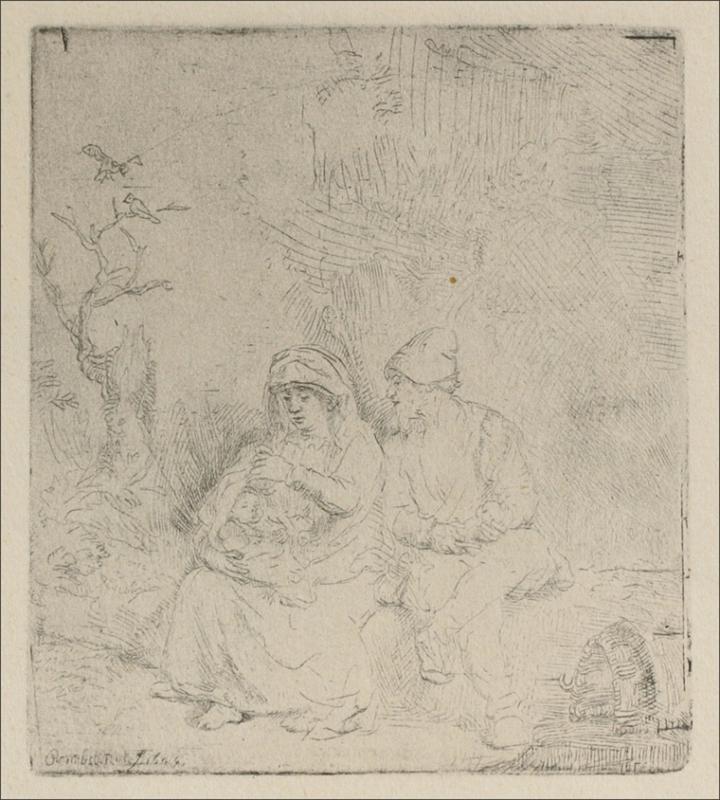
Rembrandt’s “A Repose in Outline” (1645) is a tiny revelation about how little an artist needs to conjure a world. Rather than laboring the copper with dense cross-hatching and heavy plate tone, Rembrandt whispers with line. Two travelers rest at the edge of a bank: a woman gathers an infant against her chest, and a bearded companion—staff at his shoulder, cap low—leans toward her in quiet conversation. At the far right a basket or traveler’s bundle sits like an exclamation mark of ordinary life. A few leafless branches arc from a sapling at the left, birds skitter through the air, and then… openness. The top and right halves of the sheet are nearly bare, the sky a pale expanse where faint parallel strokes barely disturb the light. The print’s title, “in outline,” tells you the wager: can tenderness, landscape, and time be carried almost entirely by contour? Rembrandt’s answer is yes.
A Composition Built from Breath
The first pleasure of the print is its air. Rembrandt pushes the family to the lower left, tucking them into a pocket defined by the small tree and a lifted mound of ground. This leaves a generous triangle of unmarked paper above, a visual breath that makes the figures’ rest feel earned. The emptiness is not negligence; it is composition. By letting space open, he gives the figures room to speak to one another and to us. The eye enters from the upper right, glides across the light field, and descends naturally to the woman’s bowed head. The resting travelers glow against this emptiness without the need for strong contrast. Even the birds—etched with a few tiny darts of line—help steer our glance, describing a diagonal drift toward the couple and the child.
Gesture as Narrative
Because the marks are spare, gesture bears the drama. The woman’s torso curves protectively around the infant, her left arm forming a cradle while the other hand steadies a fold of cloth. She is not posed; she is mid-soothe, the hum and small sway that parents know. The man angles toward her, knee lifted, elbow resting, a posture that signals wakeful watch rather than fatigue. His head inclines just enough to suggest that he is speaking softly or listening. Nothing theatrical: a family settles itself, a moment of care as the day pauses. That ordinariness is the point. The etching honors the grammar of everyday love—lean, cradle, hush.
Why “Outline” Matters
The term “outline” in Rembrandt’s title is both technical and philosophical. Technically, he limits himself to the first vocabulary of drawing: contour, a few short internal folds, scant hatching to keep forms from floating. There is almost no tonal modeling, no dense shadows to persuade us of three-dimensionality. Philosophically, outline respects privacy. By not filling every volume with detail, Rembrandt allows the figures to remain partly theirs, not wholly ours. We understand what we need—fatigue, affection, safety—and the rest is left to the quiet within the lines.
The Intelligence of the Line
Even in restraint, the line varies like voice. Where the woman grips the infant’s wrap, the strokes tighten and angle; where her skirt pools at the ground, they extend in long, slow arcs. The man’s beard is a field of short, wiry scratches; his cap is a single, confident contour. The small tree at left is gnarly, its bark described with broken verticals; the birds are no more than abbreviations—two or three cuts each—yet they lift from the paper. This sensitivity to material keeps the scene plausible. Different things receive different marks, and so the world feels sorted and true.
Space, Economy, and the Dutch Landscape
The sparse setting evokes the low country without drawing the whole of it. A bank, a suggestion of water beyond, a few reeds and scratches that might be a path—these are all that is needed to pull the figures into a believable place. The empty sky is the Netherlands in winter; the bare branches carry the chill of a season between harvest and blossom. Yet nothing in the setting darkens the mood. The lightness of the plate, the openness of the air, imply a day that allows rest. The landscape is not an allegory; it is hospitality.
Plate Tone and the Feel of Weather
Impressions of this etching vary. When the plate is wiped clean, the sky is pristine and the hour feels crisp. When a thin film of plate tone is left across the surface, everything softens; the large blank becomes atmospheric, as if a thin haze hangs over the field. Rembrandt welcomed this variability—each print a slightly different weather. In a sheet devoted to pause and breath, the printing itself participates in the theme: the mood changes with the air.
The Basket and the Ethics of Use
At the right sits a humble basket or pack, drawn with the same economy as everything else. Its presence matters because it anchors the travelers in a life of use. They carry food or swaddling, tools or clothing; they are on their way somewhere and will resume their going. The object’s placement—slightly apart—keeps the composition balanced while signaling that even in rest they stay ready for movement. This gentle ethic of use runs through Rembrandt’s rural prints. Things are not ornaments but companions.
The Family as Republic
Rembrandt was a citizen of a young republic that prized domestic virtue, labor, and steadiness over courtly display. “A Repose in Outline” can be read as a miniature of that civic ideal. There is no patron, no heraldic emblem, no moralizing inscription. There is simply a family traveling together and stopping when the body asks. The man does not dominate; he leans toward the woman and child. The woman is not idealized; she is busy with real care. The infant is not a symbol; it is a small, breathing center of gravity. Out of such simple balances a society imagines itself.
Theological Echoes Without Iconography
Rembrandt had painted and etched many biblical rests—the Holy Family on the flight into Egypt chief among them. It is tempting to see echoes here: the staff, the journey, the protected child. He withholds every overt attribute, but the tenderness of the grouping resonates with those sacred scenes. Whether or not one reads theological meaning into the sheet, the feeling is kin: provision in transit, shelter found on the way, love that pauses to catch breath. The print is devotional not because it names a subject but because it trains the eye to revere small mercies.
The Risk and Reward of Leaving Things Unfinished
To modern eyes the upper right quadrant may look unfinished, and that is part of the work’s power. Rembrandt lets the viewer finish the image. The sky completes itself in our seeing; the ground levels under the weight of our attention. This is not laziness; it is trust. When an artist leaves room, the viewer steps in. The act of filling becomes a form of participation, and the repose depicted becomes the repose of looking.
Comparison with Rembrandt’s Denser Landscape Etchings
Place this sheet beside “The Three Trees” or “The Goldweigher’s Field” and the difference is startling. Those prints pulse with dense cross-hatching, storming skies, and dramatic shafts of light. “A Repose in Outline” chooses the opposite road: clarity, clarity, clarity. Yet the family scene gains by the refusal of drama. In the thunderous landscapes, man is small before weather. Here, weather offers a truce, and the human scale returns to the center—not as triumph, but as quiet priority.
Drawing the Body with Compassion
Because there is so little tone, Rembrandt cannot hide inaccuracies in shadow; he must draw. The woman’s shoulder slopes in a single elastic line, her headscarf breaks at the brow, and the weight of the infant tugs her forearms inward. The man’s foreleg is pulled up on the bank; his heel hangs; his upper body turns so that his ribcage reads under the thin blouse. These choices demonstrate a draughtsman’s compassion: the body is respected as a language. Even the child—mostly a bundle—shows a cheek and the roundness of an arm. The lines do not merely describe; they care.
Time and the Rhythm of the Path
One feels the day in the print: a morning or late afternoon when travel pauses, when light is generous but not strong. The faint horizontal strokes behind the couple could be a river or path. If it is a river, then the stop may involve water and washing; if it is a path, the moment belongs to a longer journey. Rembrandt’s lines are ambiguous enough to let both readings live. That ambiguity, far from a weakness, enlarges the image’s time. The family is every traveling family; the bank is any place where a day chooses rest.
The Viewer’s Position and the Etiquette of Looking
We sit slightly below and to the right of the figures, as if we have come upon them and decided to keep polite distance. This vantage matters. We are not intruders standing over them; we are fellow travelers who have paused across the way. The unmarked expanse that separates the basket from the couple doubles as our patch of ground. The print teaches an etiquette of looking: give people space, attend without prying, let quiet be.
Material Presence and the Trace of the Needle
Even without heavy tone, the plate carries a tactile presence. Look at the parallel strokes sweeping up the center right: you can feel the needle dragging in long pulls, the copper resisting slightly, the printer later wiping so that a whisper of ink remains within those grooves. That physicality—minute but real—gives the image a factual grounding that suits its subject. Life’s pauses are material: the weight of a child, the scratch of grass, the drag of a coat. The plate remembers the hand that made it, just as the bank holds the imprint of the travelers’ rest.
The Birds and the Scale of Alive Things
The birds near the left tree hardly exist—each is three or four incisions—and yet they change the temperature of the print. They are witnesses and they are timing: quick pulses against the slow human rest. Their inclusion keeps the world large; this is not a studio exercise but a place where other lives move. They also sharpen scale. Because we register the birds as small and near, the family’s size feels right within the space, the tree more proximate, the sky wider than our arms.
The Gift of Modesty
Everything about “A Repose in Outline” is modest: size, means, subject, ambition. But modesty here is not lack. It is the ethical stance of a master who knows when to step back so that ordinary life can shine. The print asks nothing of the viewer beyond attention. It rewards that attention with the calm that comes when art refuses to shout. In a century famous for naval battles, marble halls, and civic triumphs, Rembrandt reserves a copper plate for a mother adjusting a wrap and a father leaning close. That is a decision about what matters.
Why This Image Endures
The etching endures because it teaches a way of seeing that remains rare: to honor intervals. Most images pursue event; this one cherishes pause. Most images insist upon fullness; this one trusts outline. Most images climb toward spectacle; this one kneels toward care. In doing so, it equips the viewer with a quiet skill useful far beyond art: to notice when someone needs rest, to offer space, to measure the day not only by what is achieved but by the breaths that make achievement possible.
Conclusion
“A Repose in Outline” (1645) shows Rembrandt at his most sparing and most humane. By setting a family down at the edge of a bank and surrounding them with air, he lets line carry life. Every mark is tuned: the cradle of an arm, the tilt of a bearded head, the scratch of a tree, the tiny wings of birds. The sky is mostly paper; the feeling is mostly tenderness. The etching is a lesson in the grace of enough—how a handful of lines can hold love, travel, weather, and time. Look, linger, and then carry its gentleness into your own pauses.