Image source: wikiart.org
Introduction
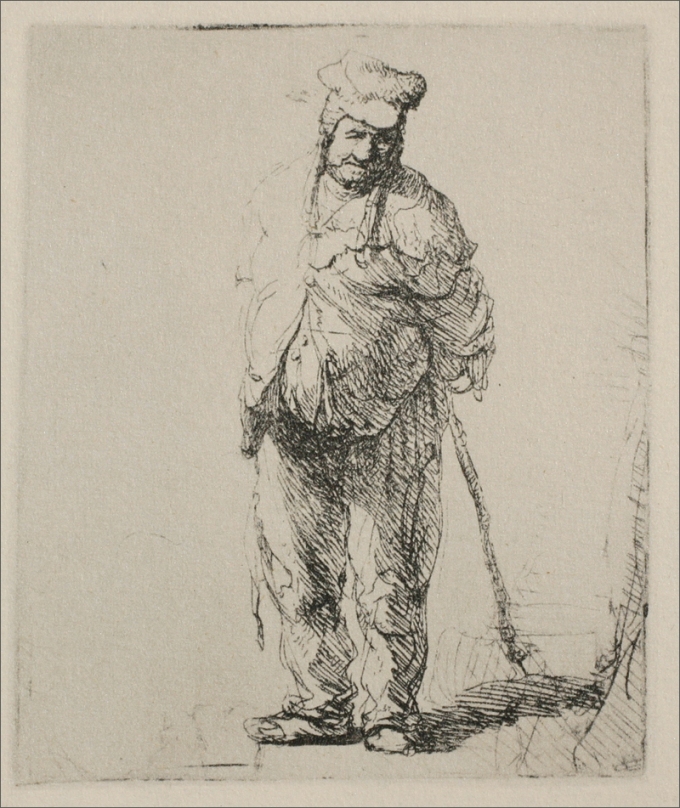
Rembrandt’s “A Ragged Peasant with his Hands Behind Him” (1635) is a small etching with the gravity of a novel. A solitary figure stands, slightly bowed, his weight set into worn shoes, his head tilted under a shapeless cap. The hands are hidden behind his back—an unshowy, almost defensive posture—while a staff leans against the ground near his right side. The rest is air. There is no elaborate landscape or architectural setting; there is only the peasant and the space that surrounds him. In a few inches of copper bitten by acid and charged with ink, Rembrandt offers a meditation on fatigue, dignity, and witness. The image is not a caricature nor a picturesque genre scene; it is a frank, humane encounter with a person whose clothes are frayed but whose presence is unmistakably whole.
Historical Context and Purpose
The year 1635 found Rembrandt newly established in Amsterdam, already famous for his biblical paintings and spreading renown as a printmaker. Etching had become his most flexible laboratory—a place to test light and line, to study faces and postures, to honor the ordinary with the attention formerly reserved for the grand. Dutch cities of the period were animated by markets and streets where all ranks mingled. Artists could see merchants, sailors, soldiers, and laborers within a single block. In this current of everyday life, Rembrandt drew and etched people not as types to be mocked but as neighbors worth noticing. “A Ragged Peasant with his Hands Behind Him” belongs to a group of small sheets that dignify working-class figures with candid observation and luminous restraint.
Subject, Gesture, and the Language of the Body
The figure is rendered full-length but not monumental. He stands with a slight forward fold at the waist, the head bowed yet still responsive to the world. The hidden hands behind his back are eloquent. They gather the body’s energy inward and telegraph a mood that might be caution, patience, or resigned waiting. The staff at the right suggests age, labor, or a long walk; it also adds a second vertical that echoes the figure’s stance. The peasant’s clothes sag in creased volumes, and the cap sits like a soft crown of survival. Every gesture is minimal yet readable, the body speaking the truth of a day’s work without theatre.
Composition and the Architecture of Space
Rembrandt places the peasant to the left of center and lets him face into a field of open paper. That open space is the picture’s quiet engine: it creates time and breath, the interval into which the man could take his next step or his next thought. A lightly hatched wedge at the lower right grounds the staff and prevents the figure from floating. Otherwise the plate is nearly bare. The decision to leave the background unarticulated transforms the peasant from a minor character in a busy anecdote into the singular subject of our attention. Space here is not emptiness; it is respect.
Etching Technique and the Intelligence of Line
The drawing is all line, but of many kinds. Rembrandt’s needle nicks a soft contour for the cap, then tightens across the brow and nose to give the face structure. He uses brisk, parallel hatching to darken the inside of the sleeves and the crumple of trousers, while the vest and belly are stated with broader, more relaxed strokes that admit the white of the paper as light. The shoes are compressed into a few decisive curves and short cross-strokes, perfectly weighted. Nothing is fussed and nothing is sloppy. The economy of means makes the figure feel immediate, as if the artist had drawn in the street and walked on.
Light, Tone, and the Weather of the Plate
Although there is little explicit modeling, light pervades the image. It seems to fall from the upper right, catching the cheek and breast, and thinning across the trousers. The deepest darks are modest—under the cap, inside the sleeves, in the cast shadow at the feet—and their placement locks the figure into legible volume. Rembrandt allows the paper to do much of the work. Unprinted white becomes daylight, and the figure reads through contrast as palpably three-dimensional. The sheet’s tonal weather feels clear and cool, the kind of light that shows everything without cruelty.
Clothing, Texture, and the Reality of Wear
The title’s “ragged” is not moral commentary; it is a frank description. Edges of fabric fray; hems hang unevenly; knees bulge through loose cloth. Rembrandt delights in these textures not to diminish the man but to place him in a tactile world. The trousers are drawn with long, meandering folds that speak of heavy cloth gone soft; the vest balloons slightly over the belt; the sleeve gathers at the elbow into a shadowed knot. The cap’s battered softness is captured with a few squashed curves that, once seen, cannot be unseen—they are exactly right. Such attention to wear transforms costume into biography.
Psychology and Dignity
Because the face is small and not heavily detailed, the peasant’s interior life appears primarily through stance. The lowered head suggests modesty or thought; the closed posture of the arms suggests withholding; the weight into the near foot suggests both fatigue and steadiness. Yet there is no humiliation here. The figure meets the world on his own terms, contained, a little wary, but not erased. Rembrandt’s compassion is structural: he gives the man the entire field of the print and lets him have the time he needs to stand there.
Social Vision and Dutch Golden Age Humanism
Seventeenth-century Dutch art is famous for genre scenes of peasants at revels or taverns, often comic or moralizing. Rembrandt charts another path. He looks without sneer or sermon. The peasant is neither a warning nor an entertainment; he is a fact and a neighbor. This humanism sits comfortably within a culture that valued work and sobriety. By dignifying a laborer’s stillness, the etching proposes that attention is a form of justice: to be seen clearly is to be granted a measure of worth.
Relation to Rembrandt’s Other Street Figures
Rembrandt etched numerous solitary figures in these years—beggars, “Polanders,” vendors, strolling men and women. Many occupy small squares of paper with similarly open backgrounds. Compared to the energetic walkers, this peasant is paused. Compared to the exotic costumes of Eastern European types, his clothes are stubbornly local and poor. Within the family of prints, he represents the still point, the moment in which a life composed of steps and tasks interrupts itself to rest. The variety across the series shows a mind restless for human particularity.
The Role of Negative Space
The expanse of blank paper around the peasant is not merely stylistic; it recalibrates the viewer’s empathy. Without a busy setting, our eyes have nowhere else to go, and the body’s smallest inflections grow eloquent. The space also performs a quiet symbolism: poverty is sometimes a landscape of emptiness—few possessions, few walls—and here that emptiness is given visual form without melodrama. Negative space becomes narrative space, charged with possibilities the picture refuses to decide.
Theatricality versus Realism
Rembrandt often stages biblical scenes with bold chiaroscuro and complex ensembles, yet in his small etchings of ordinary people he prefers understatement. Theatricality slips away; the camera—if one can use a modern metaphor—stays still and close. In “A Ragged Peasant with his Hands Behind Him,” drama lies in the refusal of drama. The image trusts the viewer to find significance in posture, crease, and pause. This realism is not photographic but ethical: representing the world at human scale and tempo.
Printing, Plate Tone, and the Living Impression
Rembrandt treated printing as performance. Slightly different inking or wiping could shift the mood of a plate like this dramatically. A thin veil of plate tone might pool toward the lower right, deepening the staff’s shadow and adding dusk to the air; a bright, clean wipe could make the peasant stand in crystalline daylight. Even in pristine impressions, the etched line has a springy, handmade character that keeps the figure lively. The print never feels mechanical because each impression carries the memory of the press and the hand.
Comparisons with Contemporary Views of Peasantry
In paintings by some contemporaries, peasants appear as comic drunks or as colorful props in rustic festivities. Rembrandt does not deny humor or color elsewhere, but here he strips away stereotype. The figure could be tired after harvest, waiting for news, or simply resting in a doorway. By leaving narrative undetermined, the artist avoids the moralizing that often accompanied depictions of the poor. The peasant’s poverty is visible and unromantic. The image acknowledges hardship without exploiting it.
The Ethics of Looking
To look at this print is to practice a particular kind of attention—one that resists curiosity about gossip or spectacle and settles into a respectful gaze. Rembrandt has already modeled that gaze for us in his drawing: concise, honest, and free of derision. The hidden hands behind the back create a boundary we cannot cross; we do not pry. Instead we accompany. The exchange feels mutual: the peasant permits himself to be seen; we accept the terms of that permission by remaining quiet.
Modern Resonances
The print retains freshness for contemporary viewers because it mirrors urban encounters still common today. We pass people paused at the edge of work, at the seam of street and door, bearing the fatigue that accumulates across a week. The image refuses both cynicism and sentimentality. It offers, instead, the possibility that art can meet ordinary lives where they are, without translation. The minimalism of the composition even anticipates modern graphic design: one figure, one gesture, a field of breathing space.
Conclusion
“A Ragged Peasant with his Hands Behind Him” is a masterclass in humane economy. With a few etched lines and a field of light, Rembrandt builds a person whose posture contains a lifetime of weather. The ragged clothes tell of use, not shame; the hidden hands speak of inwardness; the open background converts stillness into time. Nothing here begs for attention, yet everything rewards it. In an age crowded with spectacle, this small sheet reminds us that the most profound images can be almost empty, save for a single human figure standing, thinking, and being.