Image source: wikiart.org
A Face Framed by Shadow and Linen
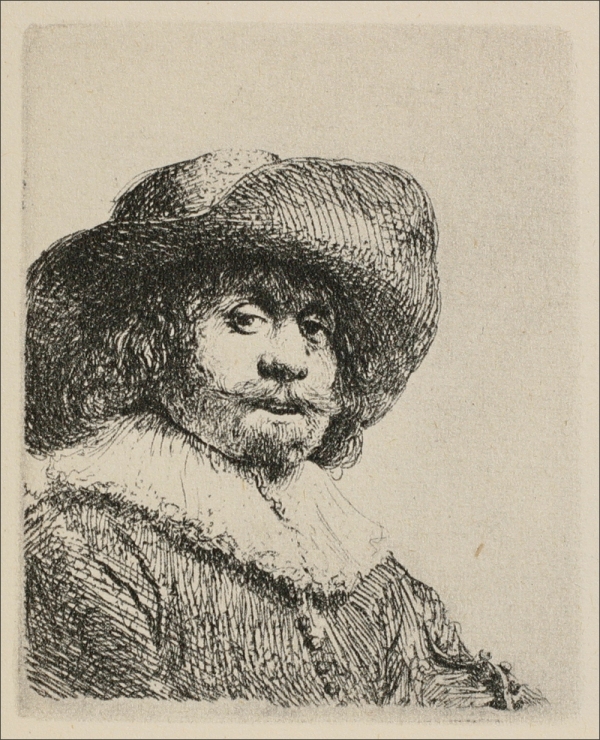
Rembrandt’s “A Portrait of a Man with a Broad Brimmed Hat and a Ruff,” made in 1638, is a masterclass in how a small etching can project monumental presence. The sitter turns three-quarter toward the viewer, shoulders angled, head pivoted so that one eye meets ours directly from beneath the brim’s shadow. The hat is vast, a felt disc that sweeps across the upper half of the plate; the ruff, soft and luminous, forms an answering halo under the chin. Between those two circles—a dark crown and a bright collar—the human face becomes a stage where intelligence and watchfulness play out in a few square inches of ink.
Etching as a Language of Breath
The medium here is etching, which allowed Rembrandt to draw freely with a needle through a wax ground on copper, then bite those lines in acid. He uses this freedom to vary pressure and tempo in ways that read like speech. Short, parallel strokes thicken into the pooled shadow under the hat. Wider, freer hatch models the felt’s texture without diagramming every fiber. Along the cheek and mustache the lines shorten, curl, and soften, letting the paper’s white perform as flesh. He reserves the brightest highlights for the ruff and the forward cheek plane; everywhere else, light is a matter of delicate spacing between lines. Breathing room in the network of strokes becomes literal breath for the sitter.
A Composition Built from Two Crowns
The portrait’s composition rests on the dialogue between hat and ruff. The brim forms a dark, sheltering semicircle that pushes the face forward; the ruff is a paler ring that receives and reflects light upward. Together they create a double frame that isolates the head from the world and concentrates attention. The shoulders, indicated with brisk diagonals and cross-hatching, broaden into a triangular base, stabilizing the head’s turn. Rembrandt leaves the right field of the plate relatively open, a parchment-colored expanse that lets the brim’s curve breathe and keeps the composition from feeling cramped.
The Eye under the Brim
Rembrandt often builds portraits around a single, arresting visual thought. Here it is the eye under shade. A small, sharply inked highlight sits on the right eye, crisp against its surrounding shadows. That glint changes the entire psychology of the portrait: the sitter is not a type; he is a thinking person engaged in looking. The near symmetry between the dark hat above and the deep shadow around the eye gives the impression that thought itself has a weight. Yet the glance is not suspicious or theatrical. It possesses the casual alertness of someone momentarily attended to by the artist and, through the print, by us.
The Ruff as a Soft Architecture
Where Dutch painters of the early century often made ruffs into stiff lace monuments, Rembrandt treats this one as softly constructed fabric. He avoids counting pleats. Instead he maps the collar with long, slightly sagging strokes and a few bold accents that indicate folds turning into shadow. The ruff becomes a cloud of light, practical and warm, whose purpose is to hold the face aloft. This moderation fits the etched medium and the sitter’s character; it also becomes an acoustic device: the ruff catches light the way a shell catches sound, making the voice of the portrait carry.
Texture: Felt, Hair, Skin, and Cloth
The pleasure of the plate lies in its textural counterpoints. Felt is rendered with closely packed, directional hatch that grows denser toward the brim’s inner edge. Hair falls from beneath the hat in stringier, more irregular lines, suggesting a slightly unkempt fullness. The mustache receives strokes that alternate between wiry and soft, reflecting how facial hair breaks the light differently than scalp hair. Skin is largely the untouched paper surrounded by supportive lines, a technique that retains warmth. The coat is written in quick, descending marks that cohere into a sober fabric. None of these textures are labored; Rembrandt trusts the viewer to complete what the line proposes.
The Psychology of Turn and Pause
The sitter is neither rigidly posed nor caught mid-gesture; he is at the still point between those extremes. The shoulders angle away, suggesting the body’s readiness to continue turning; the head counter-turns to meet us, a small act of accommodation. That coordination is a hallmark of Rembrandt’s portraiture: the image honors a person who is busy existing, not merely performing for us. The mouth is set but not clenched; the mustache hides its exact expression while letting the corners hint at composure rather than bravado. The face reads as someone used to keeping his own counsel.
A Democratic Grandeur
Dutch society of the 1630s teemed with prosperous citizens who commissioned portraits to anchor status and memory. This etching participates in that culture while quietly reforming it. Instead of a chorus of expensive signals—lace like architecture, jewels, weapons, heraldry—Rembrandt constructs dignity out of light, fabric, and gaze. The broad hat is fashionable, the ruff respectable, but they feel earned rather than displayed. The result is a democratic grandeur: a person of consequence made legible by character more than by costume.
The Background as Social Air
There is no heavy curtain, no column, no niche. The background is simply air—a gradation from nearly blank plate tone at the top to faintly worked hatching at the lower left. That air is social space. It places the sitter in a world without trapping him in place. By keeping the backfield quiet, Rembrandt compels us to supply context from our own imagination: a merchant in daylight, a writer by a window, an artisan at rest. The portrait, thus, is portable across rooms and centuries.
The Signature of Speed
Look for the places where Rembrandt lets the needle fly. Along the brim near the sitter’s left shoulder the strokes run quickly and then brake, as if the hand enjoyed the curve and then recollected its task. In the coat’s lower right corner, lines stack loosely into a shadow mass that does the job without pedantry. Such passages are signatures of speed and faith in the viewer. They tell us this likeness was not composed as a theorem; it was found in the momentum of looking.
The Hat as Social Threshold
A broad-brimmed hat meant different things: fashion, shade, a traveler’s practicality, even a mark of profession. In portraiture it becomes a threshold—the line between public presentation and private thought. Because the brim shades the eyes, the sitter decides how much we see; lifting or lowering his head could admit or deny access. Rembrandt plays with that social calculus. He places the sparkle in the eye within shadow, a paradox that grants intimacy while preserving reserve. We feel admitted without being indulged.
The Plate’s Tonal Architecture
Value in an etching is the distance between lines, the frequency of cross-hatch, and the depth of the bite. Rembrandt calibrates these variables to organize the plate. The densest blacks cluster at the hat’s inner brim, the hair’s deeper tufts, and the ruff’s few darkest folds. Mid-tones sweep across the hat’s crown and the coat’s shoulder. The lightest values—the paper itself—carry the cheek’s forward plane and the ruff’s upper edge. This arrangement makes the head luminous and keeps the rest supportive. A viewer can step across the values like stones in a stream, never losing balance.
A Conversation with Painted Portraits
Rembrandt’s etched heads talk to his painted portraits of the decade. In paint, he would build flesh with layered glazes and impasto, making light a physical substance. In etching, light is a lacuna—an area tactfully left unmarked. The challenge is the same: make a person’s presence felt. Seen alongside painted works, the print proves that presence can be conjured with less. It is not a reduction but a distillation of his portrait method.
The Mouth and the Mask of Hair
The mustache and beard play a double role. They complicate the reading of expression by hiding parts of the mouth, while also telling their own story with line direction and density. Rembrandt makes the hair slightly unruly at the edges, freeing the sitter from fussiness and suggesting a temperament that values substance over display. Because the mouth remains partially veiled, the viewer must read cheeks, eyes, and the set of the head more carefully. The portrait trains our attention away from easy signals.
The Economy of Identity
Who is the man? The etching provides no inscription beyond Rembrandt’s signature and date. That anonymity is not a lack; it is a form of generosity. Without a name the portrait avoids becoming a private document and instead enters a wider social life where viewers can recognize a type and then exceed it. He could be a merchant, a militia officer in civilian dress, a workshop owner, a scholar, or a neighbor. The etching’s power lies in letting character speak before biography.
How to Look, Slowly
Begin at the bright rim of the ruff directly under the chin and travel up the cheek to the flash in the eye. Cross the bridge of the nose, feel the short strokes that model its shadow side, then curve into the mustache where lines overlap like a small current. Move into the shadow under the brim, noticing how Rembrandt stops short of filling it—leaving space for air. Trace the hat’s outer edge around to the left and sense the slight, irregular wobble that makes the felt tangible. Drop to the coat’s shoulder, sweep along the diagonal hatch, and finally return to the ruff’s soft edge. After a few circuits the portrait begins to breathe in time with your looking.
Why the Image Feels Contemporary
Strip the ruff and hat of period meaning and what remains is a direct human encounter. The open background, the emphasis on the eye, the refusal of fuss, the quickness visible in the mark—these are values shared by modern photography and contemporary drawing. The etching’s small scale invites close viewing in a way that recalls smartphone portraits, yet the craft is entirely hand-made. Its modernity lies not in style but in its ethical stance: respect for the subject, faith in the viewer, and delight in the precision of noticing.
The Print as Portable Presence
Unlike a single painting, an etching produces many impressions, each a portable version of the encounter. Plate tone may vary, making some impressions warmer or duskier than others. That variability does not dilute identity; it enlivens it. The sitter appears a touch earlier in the day in one print, a touch later in another, as if time and weather change around a constant character. Collectors in Rembrandt’s Amsterdam prized this variability; present-day viewers experience it as realism heightened by chance.
A Final Weighing of Character
What remains after long looking is steadiness. The man meets us from his patch of shade without bravado. He is dressed well but not loudly. He holds himself in that poised interval between moving on and staying to talk. Rembrandt gives him what every good portrait grants a sitter: the dignity of complex presence. The etched lines carry that dignity forward to us, four centuries later, as if the ink still remembered the pressure of the artist’s hand.