Image source: wikiart.org
Introduction
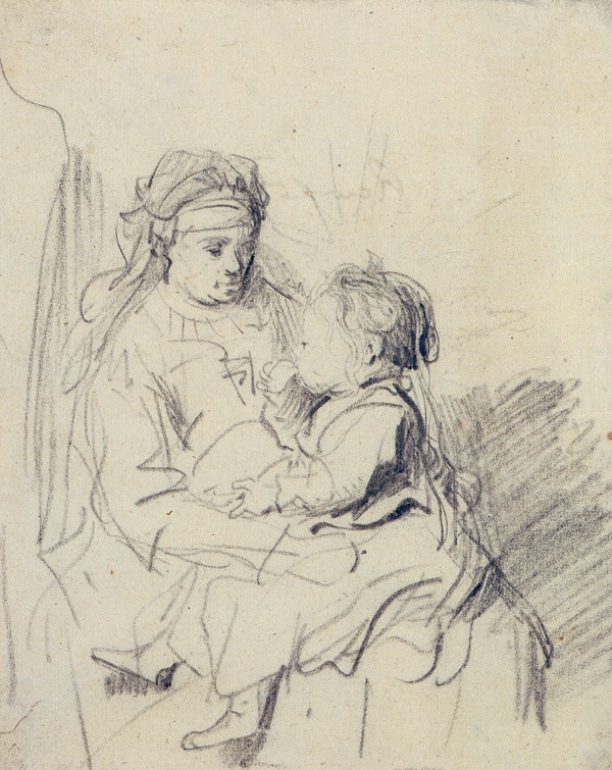
Rembrandt’s “A Nurse and an Eating Child” (1635) is a small drawing with a disarming power. Made in soft, economical strokes, it captures a quiet instant of domestic life: a nurse seated with a toddler in her lap, the child intent on a morsel of food, the woman’s gaze steady and affectionate. Nothing monumental occurs—no throne, no temple, no drama of court or scripture—yet the scene glows with the seriousness of care. This is Rembrandt in the key of intimacy, using line and touch to honor the ordinary labor that keeps households and communities alive. The drawing offers a window into the artist’s lifelong fascination with parents, children, and the everyday gestures that communicate love and patience better than speeches ever could.
Historical Context And The Attraction Of The Ordinary
By the mid-1630s Rembrandt had relocated from Leiden to Amsterdam, a mercantile city alive with family-making, childrearing, and the bustling trades of domestic service. Painters often courted elite patrons with mythologies or grand histories, but Rembrandt repeatedly turned his eye toward the home. His circle included friends and patrons who valued sympathetic portrayals of daily life; his own partnership with Saskia van Uylenburgh and the memory of his mother’s tenderness fed this attention. In drawings especially, he explored how a few charged lines could carry the weight of human connection. “A Nurse and an Eating Child” belongs to that inquiry. It is a study in care as an art, showing how a caretaker’s body shapes itself around a child’s need, and how attention itself becomes a kind of light in the drawing.
Composition That Breathes
The composition is deliberately simple. The nurse occupies a three-quarter view, her body forming a protective curve that cups the toddler. The child, turned toward her, sits astride her lap with one leg dropped and the other perched, the classic toddler sprawl that artists either miss or ruin with stiffness. Rembrandt uses the arc of the caretaker’s arms and the soft oval of the child’s head to create a loop of attention: the viewer’s eye travels from the nurse’s face down to her forearms, across the child’s hands to the mouth, and back to the nurse’s gaze. Space opens generously around their heads, an airy reserve that prevents the scene from crowding, while a darker patch of parallel strokes behind them functions as a soft backdrop, lifting the figures forward without imprisoning them. The result is a drawing that feels as if it is breathing—a pause between bites and words, between movement and rest.
The Language Of Line
Rembrandt’s line in this drawing is confident and tender. He alternates quick, light tracings with weightier, velvety pressure, almost as if he were adjusting his voice to the mood of the room. The contours of the nurse’s garments are laid down in long, elastic strokes that flex at elbows and drape at the lap. The child’s curls and cheek are modeled with more circular, feathery marks that radiate warmth. In places the artist allows lines to flicker and vanish, leaving the brain to complete what the eye suggests—a technique that grants the scene its immediacy. The viewer senses not only the final forms but the hand that found them, the speed and hesitation of the draughtsman searching for the right edge of a sleeve or the weight of a tiny foot.
Light That Feels Like Care
Although this drawing is monochrome, Rembrandt conjures light with the restraint of a poet. The paper’s untouched surface provides the brightest areas—the child’s face and the upper planes of the nurse’s linen—while soft hatching creates a cushion of tone where fabric turns away from light. Behind the figures, the slightly darker ground acts like a gentle halo, especially around the child’s head, making the moment feel quietly blessed without resorting to overt symbolism. That glow is consistent with the subject: feeding is a daily act of mercy. The illumination therefore seems to emanate from an ethical reality rather than from a lamp. Viewers feel it first as tenderness, only later as technique.
Gesture And The Choreography Of Feeding
The success of the drawing hinges on gesture. The nurse’s left arm cradles the child’s back with a firmness that disappears into ease; her right forearm crosses the lap as a natural barrier keeping the little body balanced while leaving both hands free. The child’s left hand curls around the food, the right steadies the bundle of clothes, and the mouth purses in concentration. Rembrandt’s reading of anatomy is essential here: a toddler’s torso is not a small adult’s; it lists and counterbalances with a different rhythm. He captures that truth with a few lines at the waist and the subtle angle of the neck. The figures are not posing; they are doing, the drawing a record of their shared work.
Clothing As Texture And Biography
Rembrandt gives us just enough costume to locate the scene without turning it into a fashion plate. The nurse wears a cap or scarf bound around her head and a simple, practical gown with ample sleeves. The child is swaddled in layered garments that bunch and fold at the knees. The clothes imply a household of modest means—comfortable, not ostentatious—and the very ordinariness of the fabrics invites empathy. Textures are suggestive rather than insistent: a few cross-hatched strokes gesture to wool; soft outlining suggests linen; the headscarf’s knot receives only two pressed marks, and suddenly we can see and almost feel its weight. By refusing excessive detail, Rembrandt keeps our attention on what the garments are doing—keeping bodies warm, giving room for movement—and not on what they say about status.
The Psychology Of Looking
What makes the drawing deeply moving is the exchange of gazes. The nurse looks at the child, not with surveillance but with attention. Her eyes are set just low enough to track both the child’s mouth and hands—where risk and need live during feeding—while her head tilts a few degrees inwards, a micro-gesture of availability. The child’s eyes turn down to the morsel, focused with an intensity only the very young can sustain. The two gazes do not cross; they harmonize. This relational geometry—one person attending to another who is attending to a task—is the essence of care. It teaches trust without language. Rembrandt shows it with a few lines, and viewers recognize it instantly from their own lives.
The Drawing As A Study In Time
There is a deep time signature in the sheet. The soft, searching lines suggest the drawing was made quickly, perhaps from life, as the child actually ate and wriggled. But the moment depicted—feeding a child—is one that repeats countless times across days and years. Rembrandt’s speed is therefore not haste but fidelity to an action that never holds still. He catches the gist rather than the photographic detail, the way one might sing a lullaby: the tune matters more than the precise ornaments. The drawing’s temporality is double—immediate and archetypal at once.
Domestic Work As Art
In elevating this quiet task, Rembrandt aligns himself with a broader current in Dutch art that treated household activity as worthy of attention. However, where some genre scenes moralize (warning against sloth or gluttony), Rembrandt’s tone is observational and reverent. The nurse’s competence is beautiful; the child’s appetite is innocent. The drawing makes a claim: daily nurture is itself a creation, a disciplined, improvisational art practiced not in galleries but in kitchens and nurseries. That claim resonates with the artist’s own craft. As a draughtsman, he feeds the eye with marks; as a caretaker, the woman feeds a child with food and presence. The parallel is gentle but profound.
Echoes With Other Rembrandt Studies Of Children
Throughout the 1630s and 1640s Rembrandt produced drawings of infants and toddlers—sleeping, crying, reaching, and tumbling. He seemed endlessly curious about how small bodies negotiate the world. “A Nurse and an Eating Child” stands among the tenderest of these studies. Unlike the comic tumble of a child falling or the bustling crowd of a street scene, this sheet focuses on a relationship dyad. It shares a spirit with “Child in a Tantrum” but inverts the mood: instead of turbulence, we find concentration; instead of adult exasperation, we find calm guidance. Seen as a pair, such drawings form a miniature psychology of early childhood: need and nurture dancing in close quarters.
The Ethics Of Touch
Touch is the quiet protagonist of the drawing. The nurse’s forearm supports but does not immobilize; her lap provides a ground; her proximity offers security. The child’s hands report curiosity and agency, while the feet—one visible, one implied—rest in the arena of the nurse’s skirt, a tactile field that confers balance. Rembrandt’s line weights emphasize these functions. Darker pressure marks the nurse’s cradling arm and the child’s clenched hand; lighter strokes articulate the cloth where contact is gentle. In short, the drawing is a map of good touch—firm where safety requires, soft where freedom helps.
Spiritual Overtones Without Iconography
Some viewers detect a faint halo of lines around the child’s head, a pattern that could simply indicate light but also reads as a glow of significance. Rembrandt often allowed such suggestions to arise naturally from his mark-making rather than insisting on overt symbols. Here, the effect is fitting: to the caregiver, the child is luminous, not as an altarpiece figure but as a person entrusted to her care. The drawing says, without pressure, that ordinary love makes holiness visible.
The Role Of Negative Space
One of the most striking choices is Rembrandt’s luxurious use of blank paper. The upper right and much of the background remain unworked, allowing the figures to emerge like a relief from silence. This negative space acts like breath. It sets the rhythm of the drawing, preventing visual noise from crowding the quiet drama. It also invites the viewer into the scene: the untouched paper can be imagined as air, as room for the child to grow, as the unspoken margin around every act of nurture where potential waits.
From Observation To Empathy
Rembrandt’s drawing converts observation into empathy. Technical understanding produces emotional understanding. Because the hand knows where the child’s weight sits and how a nurse must angle her forearm to sustain it, the heart recognizes the labor involved and honors it. This is why the sheet feels true beyond its time and place. Anyone who has fed a child—or been fed by a patient caretaker—can feel the rightness of it. The drawing is not trying to impress with virtuosity (though it possesses plenty); it is trying to be accurate to human experience.
The Modern Viewer’s Encounter
Contemporary audiences, used to high-speed images and polished finishes, may be surprised by how incomplete the drawing seems at first glance. But the incompletion is an invitation. Our eye participates, finishing a sleeve, rounding a cheek. That co-creation mimics the collaborative nature of care itself: the child eats, the nurse steadies, the viewer completes. In a culture that often undervalues caregiving because it leaves no monument, this small sheet becomes a corrective, teaching us to see and praise what keeps life going.
Technique And Materials
The softness suggests black chalk or graphite with occasional stumping, though the exact combination matters less than the handling. Rembrandt works close to the edge of erasure; some lines are so faint they risk disappearing. That risk creates intimacy. We lean in. The artist’s pressure registers like heartbeat: heavier where weight or emphasis belongs, lighter where the image should float. Notice how a few stepped strokes at the lower right generate a seat, and how two or three angled lines at the left imply a chair back or curtain. Such economy is hard-won; it presupposes decades of looking and drawing from life.
The Drawing As A Silent Blessing
There is a benedictory hush over the page. Perhaps it is the way the nurse’s gaze steadies the scene, or the way the child’s intensity sanctifies the act of eating, or the way the artist’s hand refuses to fuss. Whatever the cause, the drawing leaves the viewer quieter than it found us. It reminds us that tenderness is not weakness but skill practiced daily, and that the arts of nurture and depiction share an ethic: attend to the small, be faithful in detail, let light arise from within.
Legacy And Influence
While Rembrandt’s etched and painted dramas often overshadow his drawings, sheets like this shaped the visual culture of care in Northern Europe. Later artists—from Dutch genre painters to nineteenth-century realists—learned from his capacity to dignify common life without sentimentality. In the modern era, photographers of family life and documentary filmmakers resonate with this approach: let the moment stand; trust the small gesture; do not over-direct. “A Nurse and an Eating Child” feels like an ancestor to every honest image of parent and child shared today, carrying forward an ethic of seeing that turns routine into revelation.
Conclusion
“A Nurse and an Eating Child” is a masterclass in making the intimate monumental without making it grand. Through measured lines, generous blanks, and a choreography of hands and laps, Rembrandt gives lasting form to the fleeting work of feeding. The drawing honors the professional caretaker and the vulnerable child, shaping their exchange into a tender loop of attention that the eye cannot help but follow. In its modesty, the sheet proposes a big idea: that the health of a culture can be read in how it notices and respects the labor of care. Four centuries later, the page still breathes, and we breathe with it—calmer, more attentive, newly grateful for the art that keeps us alive.