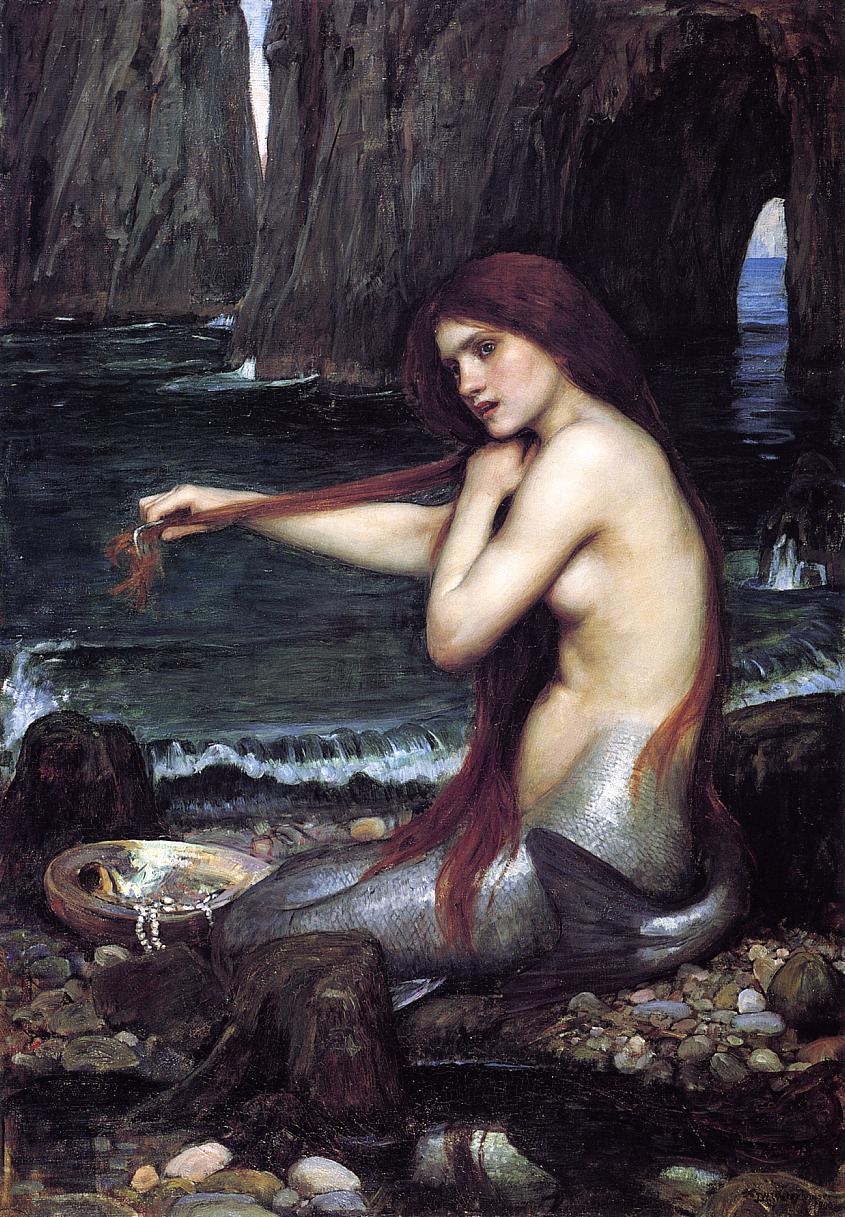
Image source: wikiart.org
First Impressions and the Painting’s Quiet Spell
John William Waterhouse’s A Mermaid (1900) pulls you in with an unusual mix of allure and restraint. The subject is a mythic creature, but the mood is not triumphant or theatrical. Instead, the scene feels hushed, private, and slightly uneasy, as if we have arrived at the shoreline at a moment we were never meant to witness. The mermaid sits at the edge of the sea, her body turned in profile, her attention absorbed by her own hair and the small objects beside her. Nothing “happens” in a dramatic sense, yet everything feels charged. Waterhouse builds tension out of stillness: the faint curl of foam on dark water, the looming rock walls, the distant opening to blue sea, and the mermaid’s guarded expression.
This is a painting that works by contrasts. The mermaid’s pale skin and luminous tail emerge from a setting dominated by deep, stony browns and green-black water. Her long red hair becomes a vivid ribbon of color that both warms the composition and binds the figure to the landscape, like a strand pulled between human presence and the untamed coast. The overall effect is hypnotic: the viewer is invited to look, but also made to feel the weight of looking.
Composition, Pose, and the Art of Withholding
The composition is carefully staged to keep the mermaid close and unreachable at the same time. Waterhouse places her in the foreground, large enough to command the frame, but he angles her body so that she does not fully open toward us. Her torso twists subtly, her shoulder draws inward, and her face turns only partially toward the viewer. Even her gaze feels sidelong, as if she senses our presence but refuses to meet it directly. This withholding is crucial. The painting is not simply presenting a mythical beauty; it is presenting a consciousness, a being with privacy, suspicion, and interior thought.
Her pose is built from long, elegant lines. One arm reaches outward, drawing her hair across the image, while the other bends close to her chest, creating a protective curve. The line of the hair is especially important: it stretches from her head toward her extended hand, forming a diagonal that leads the eye through the painting. That diagonal is echoed by the sweep of her tail and the angled rock ledges behind her, so the entire scene feels knit together by slanting movements rather than rigid symmetry. The shoreline stones in the lower portion of the painting add a granular texture and a stable base, but they also emphasize how exposed she is, seated where sea meets land.
Waterhouse also composes with thresholds. The mermaid sits on the boundary of elements, and the background repeats that theme: the rock formations open into a distant arch where brighter sea and sky appear. The eye moves from the enclosed darkness around her to that far aperture of light, like a visual suggestion of escape or an unreachable elsewhere.
Setting and Atmosphere: A Coastline Like a Cave
The coastal setting is not an idyllic beach but a rugged, almost cavernous shore. Dark rock walls rise behind the figure, forming a kind of natural chamber. The sea is close, but it is not sparkling. It is heavy, cold, and restless, marked by small bands of foam that break against the stones. The space feels damp and echoing, as if sound would bounce between rock faces. This atmosphere matters because it redefines what “mermaid” means here. Rather than a decorative fantasy, she becomes part of a coastal ecology that is harsh and ancient.
The background includes striking vertical and curved openings in the rock that frame glimpses of brighter water. One narrow, pale strip reads like a seam of light cutting through the cliff, while the larger opening on the right reveals a calmer, bluer distance. This contrast between near darkness and far brightness gives the painting depth, but it also builds emotion. The mermaid is set against confinement, while the far opening suggests freedom that remains separated by stone and distance. The environment becomes psychological scenery, not just a location.
Even the water’s surface contributes to that psychology. It is not painted as a pleasant shimmer. It is a dark plane with subtle movement, implying that the sea’s power continues whether the figure is calm or not. The setting is a reminder that myth is not always sweet. Myth can be lonely, erosive, and indifferent.
Color and Light: Red Hair, Pale Flesh, Metallic Sea
The palette is restrained but strategic. Waterhouse uses the darkness of the rocks and water as a stage for three central notes: the mermaid’s skin, her hair, and her tail. Her skin is rendered with cool highlights and gentle transitions, giving it a soft, living presence. It is not an abstract “ideal” surface. It has weight and warmth, even under the coastal gloom. That naturalistic flesh against the near-black sea intensifies the sense that she is real within this unreal story.
Her hair is the painting’s emotional color. The red is not a flat bright red; it shifts toward auburn, russet, and wine tones, catching light in some strands and sinking into shadow in others. As it trails across her arm and toward the objects at her side, it becomes almost a compositional instrument, binding figure to still life, body to possessions, desire to reflection.
The tail introduces a different kind of light altogether. Its silvered scales catch illumination in a way that feels metallic and cool, like moonlight on armor. That surface is not only beautiful; it is slightly alien. The tail’s sheen separates her from the human world, while the softness of her skin draws her toward it. Waterhouse lets the viewer feel that dual nature through paint alone: warmth versus cold, matte versus reflective, living flesh versus scaled brilliance.
Objects at Her Side: Mirror, Pearls, and the Language of Self-Regard
Near the mermaid lies a small arrangement of objects, including what appears to be a reflective surface and strands of pearls or jewelry. This detail shifts the painting from pure figure study into narrative suggestion. A mirror in mermaid imagery often carries familiar meanings: vanity, self-recognition, seduction, and the idea of the sea as a place where identities blur. Here, the objects do not feel like trophies or treasure in a triumphant sense. They feel intimate, like personal items set down during a private ritual of grooming.
The act of combing or arranging hair becomes more than grooming. It becomes self-construction. Waterhouse shows a being who is in the process of presenting herself, perhaps to the world, perhaps to herself. The mirror implies the desire to see and to be seen, but her expression complicates that desire. She does not look pleased or carefree. She looks pensive, watchful, maybe even troubled. That tension makes the still life poignant: beautiful objects beside a face that does not fully surrender to beauty’s comfort.
Pearls also carry ocean symbolism naturally, but they can suggest something sharper: value extracted from the sea, adornment taken from nature and turned into status. Placed beside a mermaid, pearls become an ironic echo of commerce and possession. They hint at human fascination with the ocean’s riches, and at the way mythic beings are often treated as curiosities, prizes, or warnings.
The Mermaid as Character: Between Seduction and Solitude
Waterhouse’s mermaid is not performing. She is not singing, luring, or rising dramatically from waves. She is seated, grounded, almost weary. This choice gives her psychological gravity. The mermaid becomes less a symbol of temptation and more a figure of liminality, someone who belongs fully to neither realm. She is half of the sea and half of the land, yet the land is stone and the sea is dark, and neither seems welcoming.
Her expression is central to this reading. The eyes and mouth are painted with subtlety, balancing softness with tension. She appears aware, but not inviting. There is a guarded quality, as if her beauty is not a gift but a condition others project onto her. The mythology of mermaids often involves desire and danger, but Waterhouse tilts the balance toward emotional cost. What does it mean to be endlessly looked at, endlessly imagined, endlessly feared or desired? The painting quietly poses that question by making her feel like a person rather than a decorative emblem.
This approach also aligns with Waterhouse’s broader interest in mythic and literary women who carry complex inner lives. In A Mermaid, the mythical element heightens the mystery, but the emotional realism anchors it. The mermaid’s solitude reads as lived, not staged.
Pre-Raphaelite Echoes and Waterhouse’s Late Romanticism
Although Waterhouse is often associated with Pre-Raphaelite themes and methods, A Mermaid shows a mature handling of those influences rather than a strict imitation. The attention to hair, skin, and symbolic objects recalls the Pre-Raphaelite fascination with tactile detail and charged femininity. Yet the brushwork and atmosphere feel more subdued and tonal, leaning into late Romantic mood rather than jewel-like brightness. The background is not a crisp catalog of nature; it is a brooding environment painted for feeling.
Waterhouse’s handling of the figure combines classical grace with an almost modern psychological emphasis. The mermaid is idealized in form, but individualized in mood. The setting is carefully composed, but it does not distract with excess narrative clutter. Everything serves the central emotional note: a beautiful being alone at the edge of a cold world, half at home, half displaced.
The year 1900 matters here not as trivia but as context for sensibility. This is a moment when art often turns toward introspection, symbolism, and the uneasy underside of beauty. Waterhouse’s mermaid embodies that shift. She is enchanting, but the enchantment is not carefree. It is shadowed, private, and edged with vulnerability.
Symbolism and Themes: Liminality, Desire, and the Sea’s Indifference
The painting can be read through several interlocking themes. Liminality is the most obvious: sea and land, human and animal, self and other. Waterhouse reinforces liminality through repeated thresholds, especially the distant rock opening that reveals brighter ocean beyond. The viewer senses passage, but also obstruction. The mermaid sits where worlds meet, yet those worlds do not merge peacefully.
Desire is present, but it is complicated. The nude upper body and the mythic subject could invite a simplistic reading of sensuality, but the painting resists that by emphasizing mood over display. Her posture is not open. Her face is not triumphant. The objects suggest adornment, but the atmosphere suggests isolation. Desire becomes a force that surrounds her rather than something she confidently wields.
The sea itself operates like a silent character. It is close, moving, and indifferent. It does not celebrate her. It does not threaten her openly either. It simply continues. That indifference can be read as tragic, because it suggests that even mythic beauty cannot change nature’s rhythm. The waves will keep coming. The rocks will keep looming. The mermaid’s private ritual will remain a small moment against a vast coastline.
There is also an undercurrent of self-awareness. The mirror implies reflection, but reflection can mean more than vanity. It can mean identity, uncertainty, and the search for a stable self when one’s very body is divided. In that sense, the mermaid becomes a symbol of inner conflict, not just outer charm.
Why the Painting Endures: A Myth Made Human
A Mermaid endures because it humanizes myth without stripping it of mystery. Waterhouse does not treat the mermaid as a special effect. He treats her as a being who exists in a world of textures, temperatures, and emotions. The viewer feels the chill of the setting, the weight of wet hair, the hardness of stones under the tail, the distant pull of open sea. These sensory cues make the myth credible, and that credibility allows the emotional dimension to land.
The painting also lasts because it refuses easy answers. Is the mermaid content in solitude, or trapped by it? Is she preparing to lure someone, or simply caring for herself in a moment of quiet? Are the pearls a sign of treasure, or a sign of human intrusion and objectification? Waterhouse leaves these questions open, and that openness gives the image its haunting quality. The viewer returns not to solve the painting, but to sit with its mood again.
In the end, A Mermaid is not only about a mythical creature. It is about the boundary between inner life and outer perception. It is about the tension between beauty and loneliness. And it is about the sea as a place where stories are born, where reflections shimmer, and where the deepest emotions can feel as dark and endless as the water itself.