Image source: wikiart.org
Introduction
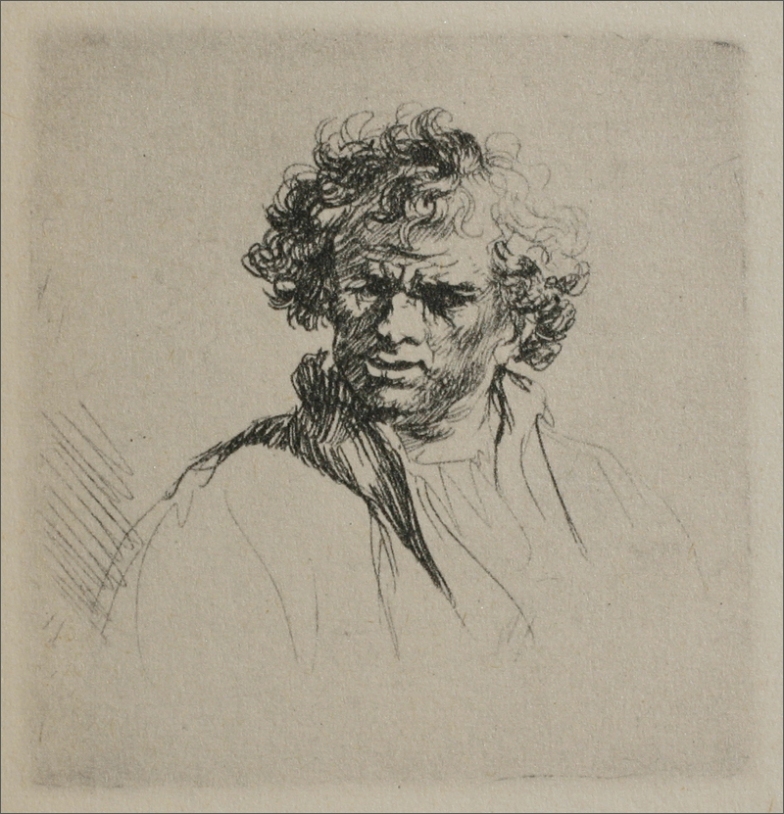
Rembrandt’s “A Man with Curly Hair” (1635) is a compact marvel of observation and graphic virtuosity. Executed in etching with a few searching drypoint accents, the image shows a half-length figure turning sharply to his left, his brow knotted, lips parted, and hair surging in a storm of curls. The garment is barely stated, the background nearly blank save for a hatched wedge at the left. Everything concentrates on the head and its expression. In a handful of lines Rembrandt conjures anatomy, mood, and presence so immediate that the figure seems to breathe. This sheet belongs to the artist’s fertile decade of the 1630s, when he explored faces and feeling through “tronies”—character studies not meant as portraits of specific individuals but as laboratories for expression, light, and line.
Historical Moment and Artistic Aims
By 1635 Rembrandt had settled in Amsterdam and was already celebrated for his narrative canvases and groundbreaking prints. His studio was busy, his reputation expanding across Europe through the portability of etchings. In this context the quick, searching character study served multiple aims. It allowed him to refine a vocabulary of lines for hair, skin, and shadow that he could redeploy in larger compositions. It gave collectors intimate, affordable access to his imagination. And it positioned the printmaker—traditionally seen as a copyist—as an inventor whose needle could think as freely as a brush. “A Man with Curly Hair” crystallizes these ambitions: fast yet controlled, simple yet inexhaustibly rich, it demonstrates how graphic economy can rise to the level of poetry.
The Tronie and the Freedom to Invent
The subject is not a named sitter but a tronie, a study of a head taken from life or from the artist’s own features and pushed toward a particular state of mind. The man’s expression is difficult to pin down—irritation, inquiry, suspicion, and sudden attention all flicker through the furrowed brow and tense mouth. That multivalence is deliberate. Rembrandt keeps the moment open so the viewer can participate in finishing the thought. In the bustling marketplace of Dutch prints, tronies with vivid feeling and striking physiognomy were prized both by amateurs and by painters who used them as repertoires of types. Here the “type” is not a social role but a psychological instant, a mind in motion.
Composition and the Architecture of the Head
The composition is startlingly simple. The figure occupies the left half of the plate, turning into the empty right, where the garment dissolves into a few tentative strokes. The head forms a compact mass whose curls push outward like a low cloudbank, checked by the blunt vertical of the nose and the tight knot of the mouth. A diagonal from the left shoulder to the right cheekbone guides the eye upward into the face, while the slight tilt of the head adds kinetic energy. The only block of tone outside the head is the small hatch to the left, which stabilizes the figure and prevents it from floating in a void. The result is a balance between presence and openness, density and air.
The Grammar of Line
Rembrandt’s etching needle writes in multiple dialects. For the hair, he loops and whips the line into elastic curls that bunch and separate, creating a living tangle of light and shadow. For the brow and eye sockets he drives the line more insistently, cutting darker grooves that swell with ink and cast firm shadows under the frontal light. The nose is a model of restraint: a contour, a few interior strokes, and a small shadow where nostril meets cheek. The mouth is built from angular marks at the corners and a short stroke under the lower lip, enough to convey tension and a hint of breath. Across the neck a few parallel hatches suggest tendons and turn, and the collar emerges with a handful of quick, descriptive strokes. Every mark is reasoned; none is redundant.
Light, Shadow, and the Invention of Volume
The print uses light as a sculptor. Illumination falls from the left, grazing the forehead and upper cheek while throwing the far eye and the right side of the face into a measured penumbra. Rembrandt refuses the easy trick of outlining. Instead he lets the forehead and cheek melt into the white of the paper, as light would in reality, and uses shadow alone to close the head on the far side. This selective modeling compresses the face into a powerful three-dimensional knot despite the economy of means. The few darks—the eye sockets, under the nose, the cleft of the lips, the side of the neck—are placed with surgical precision to lock the forms together.
Gesture and Psychology
The head’s turn is abrupt, as if the man has been called or startled. The brows crash toward each other; the lids narrow; the mouth half opens in a skeptical or impatient reply. The hair, agitated into curls, amplifies the inner weather. Everything speaks of the instant when a thought meets resistance or surprise. Rembrandt resists melodrama. He does not widen the eyes or contort the mouth. Instead he pursues the small physiognomic signals that real faces use, trusting that viewers will recognize truth in their own muscles. The effect is more compelling than theatrics, because it replays a known expression rather than a staged mask.
Economy, Abbreviation, and the Pleasure of Incompletion
One of the sheet’s greatest pleasures is its deliberate incompletion. The cloak at the right and the shoulder at the left are sketched almost not at all, and the background is blank. This leaves the head floating in a world of possibility, the way a thought floats before it finds words. Abbreviation is not negligence but strategy. It insists that a few convincing parts can pull the rest of reality into being. The viewer’s brain supplies the absent garment and the space around it, just as a musician hearing a theme imagines the orchestra behind the solo line. Rembrandt understood that graphic art thrives on this collaboration between mark and mind.
The Artist’s Hand and the Evidence of Process
Looking closely, one can map the order of operations. The artist likely set the head’s general placement with light contour, then strengthened key features—brow, eyes, nose, mouth—before weaving the curls. The hatched wedge at left seems to be a late addition, a compositional counterweight added once the head’s energy threatened to tip the sheet. This legible process is part of the sheet’s charm. Viewers witness thought turning into line, revision turning into structure. The honesty of the making becomes a kind of intimacy with the maker.
Relationship to Other Heads and Self-Studies
Rembrandt produced a rich series of self-studies and tronies in the mid-1630s, often using his own features in a mirror to try on expressions. The curly hair, the strong nose, the compact mouth, and the head’s angle echo those experiments. Whether or not the sheet records the artist’s own face, it participates in that project of learning the emotional instrument. The exercise was not academic; it fed directly into narrative paintings and biblical prints where heads must tell stories without words. In “A Man with Curly Hair,” the story is a feeling trying to become speech.
Paper, Ink, and the Intimacy of Scale
The etching’s modest size invites close viewing. The grain of the paper, the richness of the ink in deeper lines, and the slight deboss of the plate mark around the image create an object meant for the hand as much as for the wall. Rembrandt’s prints are performances that change with each impression; plate tone left by a less thorough wipe can soften the lights and thicken the atmosphere, while a cleaner pull yields crisp brilliance. Even without marked state changes, such variations matter in a work so dependent on the tension between black line and white paper. Each impression carries a slightly different weather.
Influence and Collecting
Sheets like this one accelerated Rembrandt’s European fame. Collectors prized the freshness of invention and the virtuosity of line, while fellow artists studied the technique as a model for expressive economy. Later printmakers—from Tiepolo to Goya, from Meryon to Whistler—found in Rembrandt’s heads a precedent for using etching as a primary, not derivative, art. The lesson is enduring: a simple head, honestly observed and decisively drawn, can equal the narrative weight of a large composition.
The Ethical Dimension of Looking
A striking aspect of the study is its respect for the figure’s dignity. Despite the searching line and the candid rendering of wrinkled brow and tight mouth, nothing feels caricatured. The man is caught mid-reaction, not mocked. Rembrandt’s empathy is embedded in the very way he builds a face—allowing irregularities without exaggeration, letting vulnerability show in the pressured mouth and the slightly shadowed eyes. The print models an ethics of attention: to look closely is not to control but to understand.
Comparison with Painted Heads
When set beside painted studies from the same period, the etching shows both kinship and difference. Paint allows Rembrandt to float light in glazes and to drag impasto across dark grounds; etching asks for commitment and design. In the print he answers with clarity of contour and orchestration of hatch, achieving a sculptural punch that painting sometimes tempers with atmosphere. The two practices informed each other. The print’s decisiveness sharpened the painter’s drawing; the painter’s tonal sense enriched the printmaker’s hatching. “A Man with Curly Hair” stands where those skills meet.
The Poetics of the Unnamed
The absence of a name turns the figure into a vessel for the viewer’s own associations. He could be a workman absorbing news, a soldier picking out a distant sound, a friend about to reply, even the artist himself testing impatience in a mirror. Because Rembrandt leaves the role unspecified, the print remains available for new readings. It is a portrait not of a biography but of a moment of consciousness, and that universality keeps the image modern.
Time, Presence, and the Afterimage
What lingers after looking is the sense of a living person briefly intercepted by the plate. The curls continue to toss in the mind, the eyebrows continue to pinch, the lips continue to form words not yet spoken. The minimal background denies us any narrative closure, so the afterimage stays active, as if the figure’s next movement might occur outside the frame. In this way the print achieves a paradox of still art: a frozen instant that refuses to stop moving.
Conclusion
“A Man with Curly Hair” is proof that a few inches of copper, etched with conviction, can hold an entire world of thought and feeling. Rembrandt marshals an austere toolkit—line, hatch, and a handful of shadows—to discover a head that is at once specific and inexhaustible. The turn, the knit brow, the alert mouth, the restless curls—each element contributes to a psychology we recognize instantly. Within the economy of the sheet lies the richness of a conversation across time: an artist thinking with a needle, a viewer completing the gesture with the mind, and a nameless man who, four centuries later, still seems on the verge of speaking.