Image source: wikiart.org
Introduction
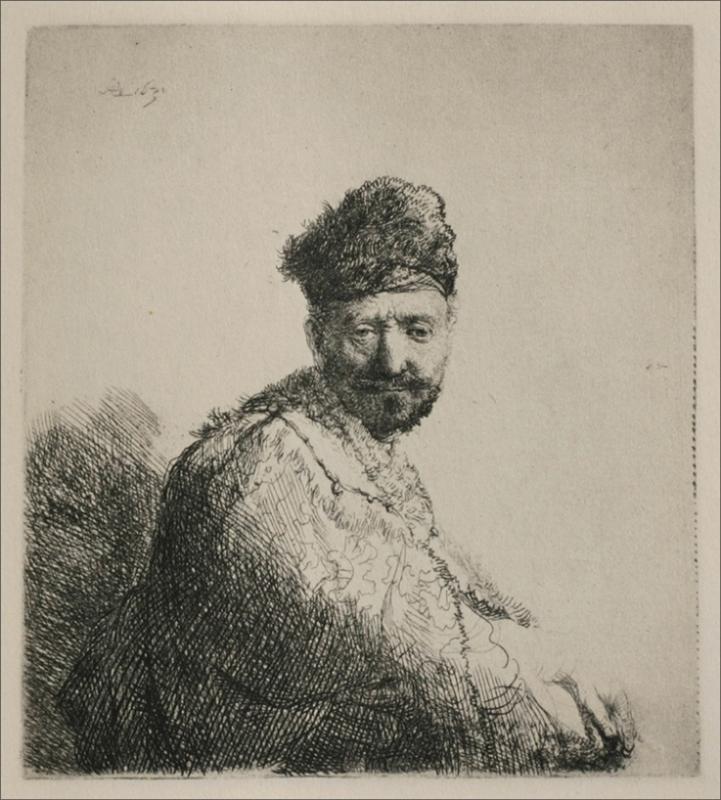
Rembrandt’s “A Man with a Short Beard and Embroidered Cloak” (1631) is an intimate etching that condenses the young master’s gifts into a single, concentrated encounter. At once restrained and luxuriant, the print pairs a modest head and short beard with a mantle worked up in a dazzling network of curling stitches. That friction between plainness and ornament is the central drama of the image. The sitter is not a grandee on display but a human presence caught in a quiet interval, his face assembled from spare, economical strokes while the cloak around him blossoms into pattern and texture. Within a few square inches of copper, Rembrandt explores status, character, and the eloquence of line.
Historical Moment And The Tronie Tradition
The date places the print at the threshold of Rembrandt’s Amsterdam years, when he was emerging from Leiden as a prodigy of both painting and printmaking. Many heads from this period are tronies: studies of character, costume, and expression that deliberately avoid the obligations of portrait likeness. This sheet fits that category. Rather than naming a specific man, it tests how different kinds of marks might project age, temperament, and social bearing. The short beard and fur cap recall Rembrandt’s fascination with elder types, while the embroidered cloak lets him push his etching needle toward decorative bravura without losing the sobriety of the sitter’s presence.
Composition And The Poise Of A Turned Bust
The composition follows a classic bust-length turn. The man’s body rotates to the right while his face looks back toward the viewer, a counter-twist that animates the otherwise tranquil pose. Rembrandt lets the left half of the sheet breathe—open plate tone and a faint scumble of lines suggest space—so the head and cloak can command the right and lower edges like a slow wave. The figure sits low, cropped boldly at the base so the mantle seems to overflow the frame, a strategy that amplifies tactile closeness. Nothing distracts from the encounter: no architectural niche, no elaborate background, only a shallow bench-like plane that grounds the sitter and a cushion of darkness behind his left shoulder to cradle the silhouette.
Light, Shade, And The Psychology Of Half-Tone
Light is not theatrical here; it is patient. It falls from high left, washing the forehead, ridge of nose, and the soft plane of the cheek while allowing the eye sockets and the hollow under the cap to remain hushed. The short beard receives a narrow ribbon of brightness that keeps it lively without turning it glossy. Across the cloak, light behaves as a weaver: it picks out a filigree of embroidered motifs, then sinks back into shadow where the fabric folds. The result is a sustained half-tone that sits between day and dusk—exactly the kind of tonal middle Rembrandt favored when he wished to imply thoughtfulness rather than spectacle. The sitter’s expression, neither stern nor ingratiating, emerges directly from this moderated light.
The Etching Line As Language
Rembrandt does not draw everything the same way. The face is written in brief, syllabic marks—short hatches and tiny commas that cohere into pores, wrinkles, and the soft down above the lip. The fur cap is a thicket of drier, feathery strokes that evoke nap without detailing each hair. The embroidered cloak, by contrast, is spun from flowing, calligraphic contours that chase one another across the surface in loops and tendrils. He thickens and thins these lines as though with a quill, sometimes letting them barely touch, sometimes letting them interlace into a low relief. The technical variety is not mere display; it tells the viewer what each thing feels like, from skin to fur to thread.
Embroidery And The Rhetoric Of Ornament
Why lavish so much attention on a cloak in a study otherwise intent on psychological presence? Because ornament, when properly managed, becomes a narrative of handwork and status. The curling motifs read as gold or silk thread couched on a heavy ground, the kind of costly trim that announces prosperity without shouting. Rembrandt respects the weight of this garment by allowing the pattern to lose focus where it falls into shadow or turns away from the light, a subtle refusal to turn decoration into wallpaper. The cloak’s richness makes the face’s simplicity more moving: the man carries expense, but he does not become it.
The Fur Cap As Compositional Anchor
The low fur cap does more than identify season or fashion; it stabilizes the composition. Its dark triangular mass caps the head like a low mountain, compressing the upper silhouette so the gaze concentrates on the eyes. The uneven edge of the fur breaks the contour in lively ways, preventing the head from reading as a rigid oval. Rembrandt keeps the cap’s interior shadow soft, which allows the brow to project forward and gives the sitter the look of someone emerging from shade into conversation. That sense of arrival is crucial to the print’s intimacy.
Facial Construction And The Ethics Of Restraint
Rembrandt’s early heads often court bravura, but here he practices restraint. The short beard is built from a few decisive strokes; the mustache is barely an echo; the mouth sits calmly in a shallow recess; the nostril is suggested rather than carved. Even the pupils are handled with minimal nicks of dark. This economy signals trust in the viewer. The image does not over-explain; it invites participation. Because nothing is exaggerated, the sitter feels like a person one might meet—alert, guarded, but open to exchange.
Plate Tone, Wiping, And The Breath Of The Background
One of the miracles of Rembrandt’s prints is how much atmosphere he can conjure with the wipe of a rag. In impressions where the background retains a veil of plate tone, the head floats in a breathable medium, neither clipped from the page nor drowned in murk. A cleaner wipe yields more graphic clarity and throws the ornament into sharper relief. Both moods suit the subject: the former for meditative warmth, the latter for crisp demonstration of line. The survival of both kinds of impressions testifies to the artist’s understanding of printmaking as a living performance.
Character, Class, And The Politics Of Looking
Tronies allowed artists to navigate social categories without the pitfalls of portrait patronage. In this case the embroidered cloak implies comfort or professional standing, yet the sitter’s directness prevents the image from curdling into status display. Rembrandt’s art, even when it touches wealth, remains stubbornly democratic in its attention to faces. The lines that describe wrinkles and rough beard are the same lines he would use for a beggar or a prophet. That parity of mark is an ethical position, and it explains why his heads feel unpatronizing across the centuries.
Kinship With Other Heads From 1630–1631
Viewed alongside the etched studies of old men in fur caps, soldiers with gorgets, and scholars leaning at windows from the same years, this print forms part of a laboratory of human presence. Compared to the more rugged studies, “A Man with a Short Beard and Embroidered Cloak” is gentler in contrast and more ornamental, as if Rembrandt were testing how far refinement could go without diluting psychological force. The answer is: very far, so long as the face remains the quiet nucleus and the light never becomes syrupy.
Tactile Illusion And The Viewer’s Haptic Imagination
Great early Rembrandt is a feast for the fingers, and this sheet is no exception. The embroidery seems to snag the eye the way thread might snag a fingertip; the fur looks as if it would give under pressure; the skin promises warmth. These haptic illusions arise not from photorealistic detail but from coherent textures that activate memory. The print reminds the viewer that etching is as much about felt knowledge as about sight, a principle Rembrandt would carry into later paintings where brush, knife, and impasto become touch translated into paint.
The Role Of Negative Space
The generous white field in the upper right might appear empty, but it is doing quiet architectural work. It balances the mass of the cloak, prevents the image from feeling cramped, and sets up a gradation from dense linework to untouched paper that keeps the eye moving. It also provides a stage for the faint inscription at upper left to stand discreetly, a signature that functions more like breath than like branding. Rembrandt understood that emptiness is not absence; it is reserve.
Printing Variants, Wear, And The Life Of The Plate
The fragile burr of any drypoint additions would have softened quickly with printing, while the etched lines remained resilient. Early pulls likely show more velvet in the fur and softer transitions across the face; later ones grow wirier and more graphic. Differences in inking across impressions bring out different characters in the same sitter—now pensive, now alert. This variability is part of the work’s charm and reflects Rembrandt’s composer-like approach to printmaking, where each impression is a performance rather than a carbon copy.
The Dialogue Between Ornament And Person
Perhaps the most striking achievement of the print is the equilibrium it keeps between a human being and the accoutrements that might overwhelm him. The embroidered cloak is seductive; it invites the eye to wander its labyrinth. Yet every meander returns to the face, which is drawn with quiet authority. Ornament here functions like harmony under a melody: enriching, never distracting. The man’s short beard, unshowy and practical, becomes the counterweight to decorative splendor. The print thus stages a subtle argument about what truly dignifies a person.
Sensibility And The Young Master’s Confidence
By 1631 Rembrandt already possessed astonishing technical command, but he was also developing the sensibility that would define his mature work: compassion fused with curiosity, discipline warmed by risk. This sheet radiates that confidence. It does not strain to impress, nor does it retreat into timidity. It simply posits that a head and a garment, honestly observed and intelligently organized, can hold a viewer as surely as any historical epic. That assurance would carry him through decades of experiment in both painting and print.
Modern Resonance And The Intimacy Of Scale
The print’s modernity lies in its intimacy. In an age of spectacles, it asks for close looking, the kind you grant to a friend across a table. Its head-on humanity, lack of flattery, and acceptance of aging skin feel contemporary in their candor. The patterned cloak could belong to fashion photography; the soft, unsentimental light could belong to documentary portraiture. Rembrandt’s language of line continues to read fluently because it is grounded in observation and empathy rather than in trend.
Conclusion
“A Man with a Short Beard and Embroidered Cloak” is a compact demonstration of what etching can do in the hands of a poet of line. Rembrandt orchestrates three textures—skin, fur, and embroidered cloth—into a visual chord that hums with life. The composition is simple yet dynamically poised; the light is gentle yet clarifying; the mark-making is varied yet coherent. Above all, the image honors a person without name by giving his presence room to breathe. In the quiet exchange between viewer and sitter, ornament enriches but never eclipses character. The print’s power arises from that balance, a balance that remains persuasive nearly four centuries after the needle left the copper.