Image source: wikiart.org
Introduction to “A Faun Grasping a Bunch of Grapes”
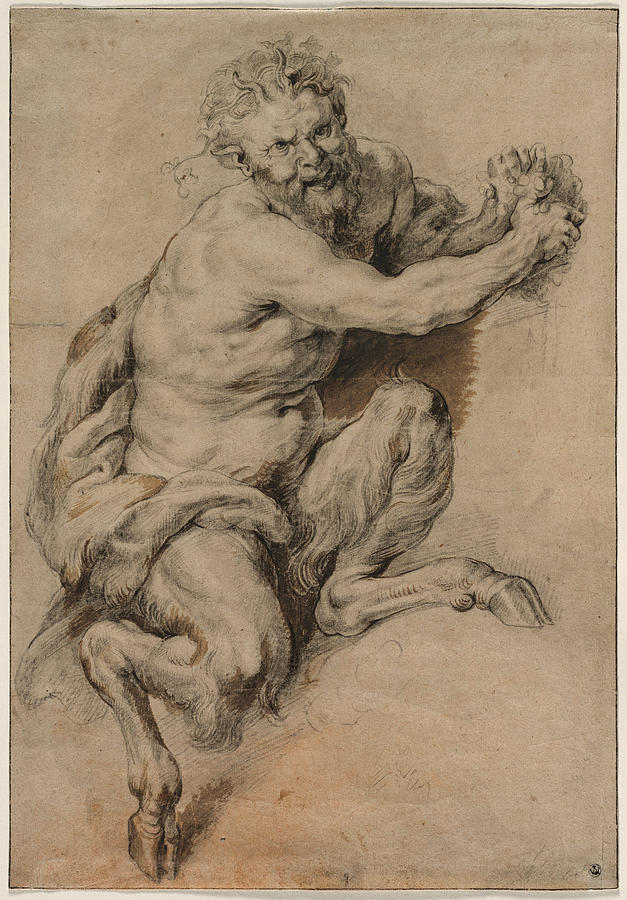
“A Faun Grasping a Bunch of Grapes” is a powerful drawing by Peter Paul Rubens that condenses the energy and sensuality of Baroque art into a single mythological figure. Executed in chalk with touches of wash and heightening, the work shows a muscular faun twisting his torso as he clutches an invisible vine or bunch of grapes, his goat legs folded beneath him and his face turned toward the viewer in a mischievous, almost feral grin.
Although it is a drawing rather than a large oil painting, the image feels monumental. Rubens uses expressive line, vigorous modeling, and a dynamic pose to create a figure that seems ready to spring out of the paper. The faun embodies the pleasures and excesses associated with Bacchus and the woodland world, while also serving as a virtuoso study of anatomy, movement, and emotion.
Mythological Background And Subject Choice
In Greco-Roman mythology, fauns or satyrs are hybrid creatures with human upper bodies and goat-like legs, living in the wild and following Dionysus or Bacchus, the god of wine. They symbolize unrestrained instinct, sensual pleasure, and the chaotic forces of nature. Grapes, of course, are Bacchus’s emblem, representing both the physical fruit and the intoxicating wine made from it.
By choosing a faun grasping grapes, Rubens taps into this rich symbolic tradition. The drawing evokes the moment of harvest or the playful theft of fruit from a vine, but on a deeper level it represents the irresistible pull of desire and intoxication. The faun’s wild hair, pointed beard, and intense eyes all underscore his connection to this unruly world.
Rubens was deeply familiar with classical mythology and frequently depicted Bacchic scenes filled with satyrs, nymphs, and revelers. This drawing fits into that broader interest, likely serving as a study for a larger composition or as part of his visual library of expressive figures he could adapt for paintings, prints, or decorative schemes.
Composition And Spiraling Movement
The composition is dominated by a sweeping spiral that runs through the faun’s body. Starting at the hooves, tucked under him at the lower left, the curve travels up through the muscled thighs, over the twisted torso, and into the raised arms gripping the unseen grapes. The head turns back toward the viewer, completing the spiral and directing our gaze inward again.
This twisting pose is a classic Baroque device, designed to convey energy and instability rather than static balance. There is no straight vertical axis; instead, diagonal and curved lines intersect to create a sense of motion. The faun appears caught mid-turn, as though he has just seized the grapes and is about to pull them closer or leap away with his prize.
Rubens manages the difficult foreshortening of limbs to make the figure convincing in space. The nearer leg and hand are larger and more detailed, while the farther ones recede slightly, supported by shadow and overlapping forms. The figure sits on an implied surface rather than a fully drawn rock or ground, which keeps attention on the body itself and the vigorous pose.
The Expressive Face And Psychological Charge
The faun’s face is one of the most compelling aspects of the drawing. Rubens gives him a broad forehead, thick brows, and eyes that lock directly onto the viewer. His mouth curls into a grin that is part laughter, part snarl. It is not the serene beauty of a classical god but the intense, slightly unsettling expression of a creature ruled by appetite and mischief.
Small details heighten the character: the pointed ears protruding slightly through the wild hair, the curling beard that echoes the vines he grasps, and the faint suggestion of wrinkles around eyes and mouth that make him feel seasoned rather than youthful. This is a mature satyr, very much aware of his own power and pleasures.
The expression creates a psychological tension. We are not just observing a mythological being; we are being looked at and perhaps appraised by him. That reciprocal gaze pulls the viewer into the scene, almost making us accomplices in his theft or revelry.
Human And Animal Anatomy In Harmony
Rubens was renowned for his understanding of anatomy, and “A Faun Grasping a Bunch of Grapes” showcases this expertise in hybrid form. The upper body is robustly human: broad shoulders, powerful biceps, and a torso where every muscle and rib is carefully modeled. Light falls across the chest and abdomen, defining pectoral muscles, obliques, and the twist of the spine.
Below the waist, the form transitions smoothly into goat-like legs covered in thick fur. The knees bend differently from human joints, and the hooves are cloven, yet the connection between human torso and animal limbs feels organic rather than awkward. Rubens modulates the shading where skin turns to fur, using softer lines and more textured strokes to indicate the change in surface.
This combination of human musculature and animal features reinforces the mythological character. The faun is neither simply a man in costume nor a generic beast; he is a creature of fantasy made believable through anatomical logic and careful observation of both human and animal forms.
Use Of Line, Shading, And Medium
The drawing likely employs black chalk with touches of red chalk and white heightening on toned paper, a combination Rubens favored for its ability to suggest volume and light. Contour lines are firm but varied, thicker where shadow falls and lighter where forms catch the light. In many areas Rubens allows the line to break slightly, letting the viewer’s eye complete the shape, which adds liveliness to the figure.
Shading is achieved through hatched and cross-hatched strokes that follow the direction of muscles and fur. On the upper arm, for example, lines curve around the biceps and triceps, emphasizing roundness and strength. On the belly and flanks, the hatching becomes denser in shaded zones, giving the torso sculptural depth.
White chalk or wash is used sparingly but effectively on highlights: the upper shoulder, the top of the thigh, the bridge of the nose. These touches stand out against the toned paper, creating a heightened sense of three-dimensionality. The background remains mostly bare, with just a darker area behind the upper body to separate it visually from the ground and suggest depth.
The Gesture Of The Hands And Grapes
Although the actual bunch of grapes is only faintly indicated, the faun’s hands make its presence vivid. His fingers interlace or clench around an invisible object above and slightly in front of him. The tension in the knuckles, the flexed muscles in the forearms, and the angle of the wrists all convey gripping force.
Rubens uses the suggestion of grapes rather than a fully drawn cluster, trusting that the viewer’s imagination will complete the image. The focus thus remains on the gesture, which becomes almost symbolic: the act of seizing pleasure, of grasping at abundance. The hands are large and rough, more suited to tearing vines than to delicate picking, reinforcing the faun’s raw physicality.
The upward thrust of the arms also draws the eye toward the top of the composition, balancing the weight of the coiled legs below. This vertical extension counteracts the otherwise compact, crouching pose, giving the figure dynamic reach.
Light, Shadow, And Dramatic Modeling
Light in this drawing appears to come from the front left, illuminating the faun’s chest, face, and nearer leg. Shadow gathers on the right side of the body, under the arms, and around the lower limbs. Rubens uses these contrasts to sculpt the figure and emphasize the twist of the torso.
On the back and far shoulder, deeper shading indicates receding forms, while the bright highlight along the upper arm brings it visually forward. The face is modeled with particular care: subtle transitions of tone define cheekbones, eye sockets, and the furrow of the brow, making the expression vivid without heavy outlines.
The overall effect is strongly three-dimensional. Even without a detailed setting, the faun seems to occupy real space, his body turning in light and shadow as if we could walk around him. This sense of presence is one of the hallmarks of Rubens’s draftsmanship.
Possible Function As A Study Or Independent Work
“A Faun Grasping a Bunch of Grapes” likely served as a study for a larger project, perhaps a Bacchic painting, tapestry, or decorative scheme involving mythological revels. Rubens often produced such highly finished figure drawings to explore poses, test lighting, and refine anatomy before transferring ideas to canvas.
However, the drawing is so complete and self-sufficient that it also functions as an independent artwork. Collectors in Rubens’s time valued such sheets for their virtuosity and for the insight they provided into an artist’s creative process. The carefully resolved modeling, the expressive face, and the subtle indications of grapes and ground suggest that Rubens was aware of its potential as a finished piece even as he used it for study.
Whether preparatory or autonomous, the drawing reveals how seriously Rubens took the task of designing a single figure. He investigates every aspect—structure, movement, expression, and symbolism—until the faun becomes a compelling character capable of anchoring a complex composition.
Symbolism Of Excess, Nature, And Human Instinct
Beyond its technical brilliance, the drawing invites symbolic interpretation. The faun’s semi-bestial body and eager grip on the grapes represent forces of appetite and instinct that lie outside or beneath social order. Unlike the serene gods of Olympus, satyrs are creatures of the forest, aligned with earth, animals, and unregulated desire.
In a broader cultural context, the image can be seen as a meditation on the dual nature of humanity. The faun’s torso is nearly human, emphasizing strength and intelligence, but his legs and hooves tie him to animality. His expression wavers between joy and menace. He embodies the tension between reason and passion, discipline and indulgence—an issue that fascinated Baroque artists and viewers alike.
At the same time, the grapes he clutches hint at both celebration and danger. Wine can be sacramental and life-giving, but it can also lead to excess and loss of control. The drawing captures the moment before consumption, when desire is at its peak and choices remain open.
Rubens’s Artistic Identity Reflected In The Faun
Rubens himself was often described as exuberant and energetic, qualities mirrored in the dynamic figure of the faun. While not a self-portrait in any literal sense, the drawing reflects the artist’s own interest in physical vigor, emotional intensity, and the pleasures of the senses. His broader oeuvre is filled with robust bodies, rich textures, and scenes of celebration, and this faun fits comfortably within that world.
At the same time, the disciplined structure of the drawing—the carefully planned pose, the rigorous anatomy, the balanced composition—reminds us that Rubens’s art, however exuberant, is always underpinned by deep study and control. The faun may embody wildness, but his depiction is the result of thoughtful design and technical mastery.
Conclusion
“A Faun Grasping a Bunch of Grapes” is a compact masterpiece that reveals Peter Paul Rubens at his most inventive and skilled. Through a single mythological figure, he explores complex themes of desire, nature, and the duality of human and animal instincts. The drawing’s spiraling pose, expressive face, and tactile rendering of muscles and fur demonstrate his command of the human body in motion and his ability to breathe life into classical subjects.
Though likely conceived as a study, the work stands on its own as an evocative image. The faun’s intense gaze and vigorous gesture draw the viewer into a world of Bacchic revelry and untamed energy, while the refined drawing technique invites close, prolonged looking. In this union of wild subject and disciplined execution, Rubens exemplifies the essence of Baroque art: passionate, dynamic, and profoundly alive.