Image source: wikiart.org
Introduction
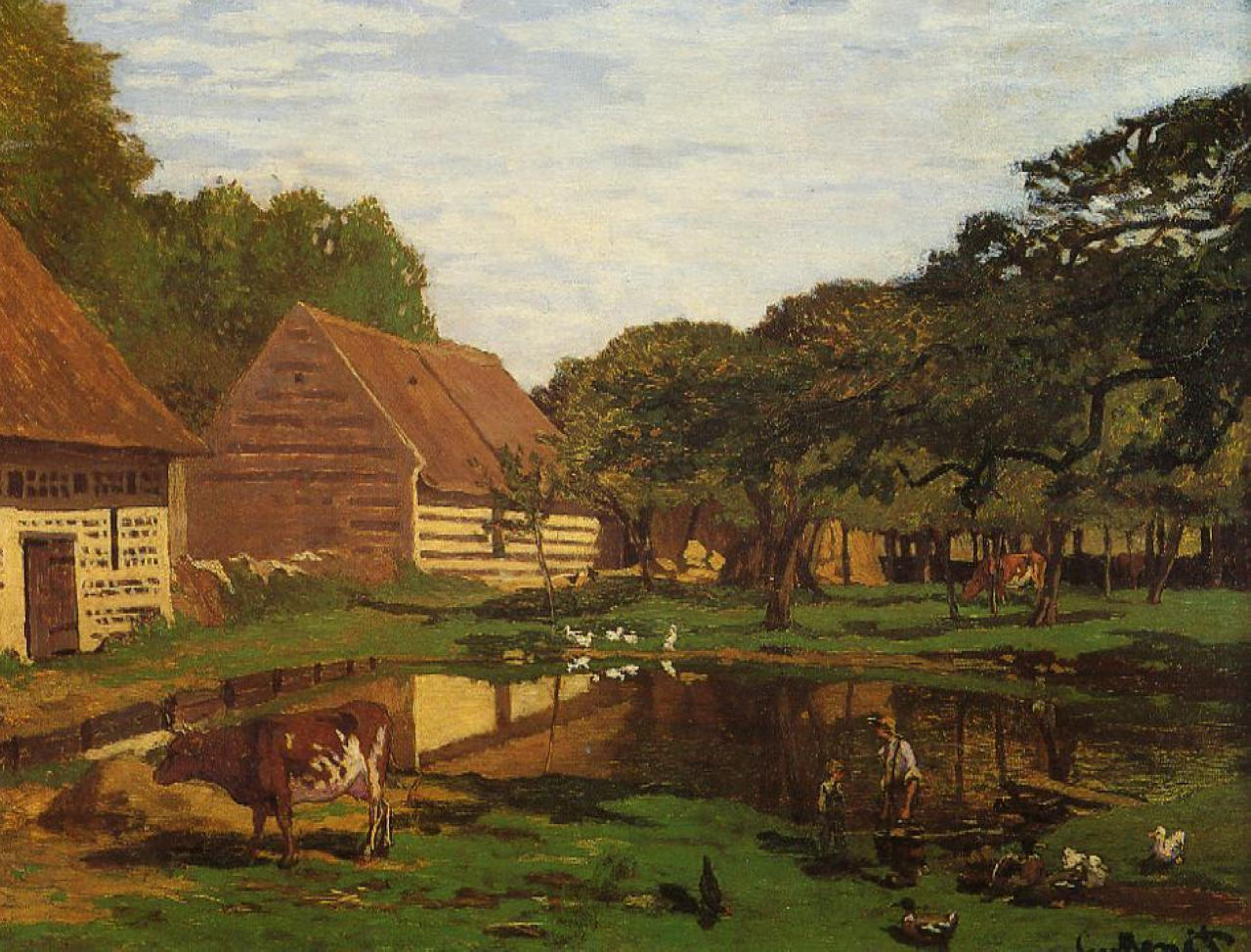
Claude Monet’s A Farmyard in Normandy from 1863 offers a remarkable glimpse into the formative years of an artist who would later transform modern painting. Long before the fully developed shimmer of Impressionism, Monet was already showing an unusual sensitivity to atmosphere, light, and the quiet poetry of ordinary life. This painting, with its humble barns, reflective pond, grazing cattle, and scattered figures, does not depend on spectacle. Instead, it draws its power from restraint. The scene is calm, rural, and unpretentious, yet it reveals a young painter learning how to turn a familiar place into a living visual experience.
At first glance, the work seems straightforward. It shows a farmyard in a Norman landscape, with rustic buildings arranged around a body of water and trees framing the view. Ducks and cows animate the foreground and middle distance, while human figures work near the pond. The setting appears peaceful and settled, shaped by daily labor and long agricultural rhythms. Yet the more closely one looks, the more complex the picture becomes. Monet is not merely recording a farm. He is studying how space opens through tonal contrast, how reflections deepen the scene, and how the meeting of sunlight, earth, foliage, and water can give emotional depth to an otherwise modest subject.
This painting belongs to a moment when Monet was still absorbing lessons from landscape traditions around him while beginning to move toward something more immediate and personal. In this sense, A Farmyard in Normandy is both an accomplished rural scene and an early sign of the vision that would later define him. Its importance lies not only in what it shows, but in how it shows it. The painting suggests that nature is never static, even in a quiet farmyard. Light shifts, surfaces flicker, shadows gather, and every ordinary element becomes part of a larger visual harmony.
Claude Monet in the Early 1860s
By 1863, Claude Monet was still a young artist in the early stages of his career. He had not yet become the central figure associated with Impressionism, but many of the qualities that would define his mature work were already beginning to surface. This period was marked by experimentation, observation, and study. He was looking carefully at natural settings, testing ways to capture both structure and sensation.
In a painting like A Farmyard in Normandy, Monet reveals a strong interest in direct visual experience. The work still carries aspects of traditional landscape painting, especially in its solid composition and earthy tonal range, but it also suggests an artist less interested in grand historical subjects than in the living presence of a place. This preference for ordinary outdoor scenes would remain central throughout his life. Rather than elevate rural life into sentimental drama, he presents it with attentiveness and honesty.
Normandy was especially significant for Monet. The region’s coastal light, agricultural landscapes, and varied weather offered endless visual possibilities. Its atmosphere could shift quickly, and its scenery combined human habitation with open natural space. Even in this early work, Monet seems fascinated by the way land, sky, water, and built structures coexist. He is not painting the countryside as an abstract ideal. He is painting it as a breathing environment shaped by work, weather, and time.
This stage of Monet’s development is especially compelling because it shows his roots. Before the broken brushwork and luminous color effects of later years, there was already a disciplined observer, someone deeply responsive to the mood of a place. That sensibility is very much present here.
The Subject of the Rural Farmyard
The choice of a farmyard is essential to the character of the painting. This is not a dramatic mountain landscape or a carefully staged pastoral fantasy. It is a working rural environment. The barns stand with quiet authority, their sloping roofs and weathered surfaces speaking of long use. The pond functions not as a decorative addition but as part of the life of the farm, serving animals, people, and the natural ecosystem around it. The cows, ducks, and human figures reinforce the sense that this is an inhabited and active place, even if the overall mood remains still.
What makes the subject so appealing is its balance between usefulness and beauty. Nothing in the scene appears arranged for display, yet Monet sees visual richness in every part of it. The irregular edges of the pond, the changing light on the buildings, the dark trees against the sky, and the reflections in the water all transform practicality into pictorial interest. The farmyard becomes a site where labor and landscape merge.
There is also something deeply local about the scene. Rather than generalizing the countryside, Monet grounds the painting in a specific regional atmosphere. The architecture, vegetation, and open grassy space create a sense of Norman rural identity. The result is not merely descriptive. It evokes the cultural texture of nineteenth century provincial life, where agriculture remained central and human existence was closely tied to seasonal patterns.
At the same time, the painting avoids anecdotal excess. The figures are small, and there is no obvious narrative event to dominate the image. This allows the viewer to experience the farmyard as an environment rather than a story illustration. Monet invites us to dwell in its spatial and atmospheric qualities. That decision gives the work its enduring quiet strength.
Composition and Spatial Design
One of the most impressive aspects of A Farmyard in Normandy is the careful organization of the scene. Monet arranges the buildings on the left and middle ground in a way that anchors the image, while the pond opens the foreground and creates a broad reflective surface that leads the eye inward. The large trees to the right balance the architectural weight of the barns and add a darker, more organic presence to the composition.
The eye first notices the strong diagonal created by the leftmost roof and the edge of the farm structures. These forms guide attention toward the center of the painting, where the pond becomes the visual heart of the scene. From there, the eye moves across the water toward the figures and animals, then upward into the dense foliage and pale sky. The arrangement is subtle but highly effective. Monet creates movement without agitation.
The pond is especially important because it functions as both a spatial and visual hinge. It reflects the nearby buildings and trees, doubling forms and softening transitions between areas of land and sky. Without the water, the composition would feel heavier and more enclosed. With it, the farmyard gains depth, air, and rhythm.
The figures and animals are placed carefully enough to animate the scene without overcrowding it. A cow in the left foreground helps establish scale and introduces a strong dark mass near the front of the image. Smaller figures near the pond create human presence while maintaining the painting’s overall calm. Ducks near the water’s edge add touches of movement and variety. These details prevent the composition from becoming static.
Monet also understands how to use open and closed areas. The dense foliage on the right and upper sections contrasts beautifully with the more open sky and grassy foreground. This alternation of fullness and emptiness gives the painting equilibrium. The farmyard feels enclosed enough to be intimate, yet open enough to breathe.
Light and Atmosphere
Even in this early work, Monet shows a striking sensitivity to light. The painting is not flooded with dazzling brilliance, nor does it rely on sharp theatrical effects. Instead, light is diffused and gentle, touching roofs, grass, water, and tree canopies in varied ways. This moderation is one of the work’s greatest strengths. It captures the sense of a real outdoor moment, perhaps later in the day, when sunlight has softened and the scene is held together by warm, subdued illumination.
The sky is pale and lightly varied, providing a quiet backdrop rather than a dominant spectacle. This restrained sky allows the darker masses of the trees to stand out more forcefully. The contrast between the open, light sky and the dense, shadowed foliage creates one of the painting’s most appealing atmospheric tensions. The farmyard sits between these two conditions, neither fully sunlit nor fully shaded.
The water intensifies the role of light by reflecting nearby forms in softened, broken patterns. Monet is already interested in the instability of reflected vision, in the way surfaces transform whatever they mirror. This fascination would become central to his later work, especially in river scenes and water lily paintings, but its early presence here is notable. The pond does not simply repeat the world above it. It alters and deepens it.
Atmosphere in this painting is created not through dramatic weather but through tonal unity. Everything seems held within the same air. The buildings, animals, people, and vegetation belong to a single environmental envelope. This coherence is part of what makes the painting feel believable and immersive. Monet is not assembling separate objects. He is painting a shared atmosphere.
Color and Tonal Harmony
The color palette of A Farmyard in Normandy is more restrained than the vivid chromatic effects of Monet’s later paintings, yet it is far from dull. Warm browns, muted greens, creamy whites, dark earth tones, and soft blues work together to create a balanced and naturalistic harmony. The limited palette suits the subject perfectly. It reinforces the solidity of the rural environment and avoids any decorative excess.
The barns are rendered in warm browns and ochres that suggest aged wood and sunlit surfaces. These colors connect naturally with the earth and the grassy banks around the pond. The greens vary across the painting, from darker and richer tones beneath the trees to brighter patches in the open grass. This variation keeps the landscape lively and prevents it from flattening into a single field of color.
Dark passages are especially important. The tree masses on the right side of the painting, along with the deep reflections in the pond, provide strong tonal contrast. These darker areas give the composition weight and mood. They also make the lighter parts of the scene, such as the sky, the white ducks, and portions of the buildings, appear more luminous by comparison.
Monet’s handling of white is subtle and effective. The ducks and lighter reflections near the water create small points of brightness that draw the eye. These accents are never excessive. Instead, they act like visual punctuation, enlivening the broader tonal field.
What stands out most is the painting’s overall unity. No single color overwhelms the scene. Everything is calibrated to sustain a rural mood that is grounded, quiet, and coherent. Even at this stage, Monet shows an instinct for making color serve atmosphere rather than ornament.
The Role of Water and Reflection
The pond is one of the painting’s defining features. It does far more than occupy space in the foreground. It introduces complexity, movement, and subtle beauty into the entire composition. Water allows Monet to explore reflection, and reflection allows him to turn a simple farmyard into a layered visual experience.
The mirrored shapes of the buildings and trees soften the boundaries between objects and their surroundings. Reflections are never exact duplicates. They shimmer, darken, and break apart. In this way, the pond introduces instability into a scene built from solid forms. The barns may appear stable and fixed, but their reflected versions become fluid and shifting. This tension between permanence and transience is central to Monet’s art.
The water also expands the painting’s sense of depth. Rather than moving directly from foreground land to middle ground buildings, the viewer passes through this reflective zone, which creates both pause and visual richness. The pond serves as a threshold between different areas of the farmyard.
Emotionally, the presence of water deepens the painting’s calm. Still water often suggests contemplation, and here it contributes to the atmosphere of quiet labor and rural continuity. The ducks moving across the surface add gentle signs of life, while the human figures nearby remind us that the pond is part of the daily life of the farm.
It is tempting to see this feature as an early signal of Monet’s lifelong fascination with reflective surfaces. Rivers, harbors, ponds, and water gardens would later become major themes in his work. In A Farmyard in Normandy, that interest already appears in modest but meaningful form.
Human Presence and Rural Labor
Although the landscape and buildings dominate the composition, the human figures are crucial. They are small and understated, but they ensure that the scene remains a lived environment rather than a deserted study of architecture and nature. Their scale also emphasizes the broad quiet of the setting. People do not master this space visually. They belong to it.
The figures near the pond appear engaged in ordinary activity. Monet does not dramatize them or turn them into symbols. They are simply part of the farmyard’s daily rhythm. This modest treatment is important because it preserves the painting’s observational honesty. Rural labor is present, but it is not sentimentalized.
The animals function in a similar way. The cow in the foreground and the cattle in the middle distance are not decorative additions. They reinforce the agricultural identity of the place and help connect the human world to the natural one. Ducks along the water’s edge bring animation and variation, adding a quieter domestic note to the larger presence of the cows.
Together, people and animals create a sense of continuity and interdependence. The farmyard is not just land with buildings placed upon it. It is a system of life, movement, care, and routine. Monet captures this without excessive detail. He suggests rather than explains, which allows the painting to retain both realism and openness.
Nature and Structure in Balance
One of the most appealing aspects of this painting is the balance between natural growth and built form. The barns and fences represent order, human construction, and agricultural purpose. The trees, grass, and pond represent organic development and environmental presence. Monet does not present these as opposites in conflict. Instead, he shows how they coexist within a single rural world.
The buildings have clear geometric strength. Their triangular roofs and solid walls give the painting a sense of structure. Yet they are softened by surrounding foliage and by the warm light that falls across them. The trees, for their part, are irregular and expansive, but they do not overwhelm the scene. They provide shelter, shadow, and visual complexity while remaining integrated into the whole.
This balance reflects a broader truth about rural life. Farming landscapes are shaped by human labor, but they remain inseparable from weather, soil, water, and seasonal growth. Monet seems attentive to this relationship. The farmyard is not imposed on nature from outside. It has grown within it.
The pond reinforces this harmony. It sits between architecture and vegetation, reflecting both. In that sense, it becomes the perfect emblem of the painting’s larger theme: the meeting of human order and natural flux.
Signs of the Future Impressionist
Although A Farmyard in Normandy is not yet a fully Impressionist painting, it contains important hints of Monet’s later direction. The most obvious of these is his attention to changing light and atmosphere. Rather than focusing only on precise detail, he is already concerned with the overall sensory unity of the scene.
His interest in water and reflection is another important sign. Later Monet would return again and again to surfaces that dissolve form into color and light. Here, that impulse is still controlled and secondary to the broader composition, but it is unmistakably present.
There is also an emerging preference for ordinary outdoor subjects over academic themes. Monet finds visual richness in a farmyard because he trusts direct observation. This trust would become foundational to Impressionism, with its emphasis on modern life, landscape, and transient visual effects.
At the same time, the painting still retains a degree of solidity and tonal depth that connects it to older landscape traditions. That mixture is part of what makes the work so fascinating. It stands at a threshold. One can sense Monet learning how far he can move from established methods while still grounding the image in structure and mood.
Emotional Tone and Lasting Appeal
The emotional atmosphere of A Farmyard in Normandy is one of quiet steadiness. Nothing dramatic occurs, yet the painting does not feel empty. Its emotional strength lies in its calm acceptance of rural life as something worthy of sustained attention. The barns, pond, figures, and animals all contribute to a world defined by continuity rather than disruption.
There is also a faint sense of intimacy. Because the space is enclosed by buildings and trees, the farmyard feels sheltered. It is not an expansive panoramic landscape. It is a particular place with a distinct rhythm and mood. This intimacy invites slow looking.
The painting’s lasting appeal comes partly from this modesty. Many works of art attempt to overwhelm the viewer. Monet instead offers a scene that unfolds gradually. Its beauty is discovered through attention. The more one studies the composition, the more one notices the interplay of dark and light, stillness and movement, solidity and reflection.
This kind of painting remains compelling because it reminds us that artistic greatness does not always announce itself through grandeur. Sometimes it begins in careful observation of the ordinary. In this farmyard, Monet finds enough visual and emotional richness to hold the viewer’s gaze, and in doing so he reveals the depth hidden within everyday life.
Conclusion
A Farmyard in Normandy is an important early work that shows Claude Monet’s gifts already taking shape. It presents a rural scene with honesty, restraint, and remarkable sensitivity to atmosphere. The barns, trees, animals, figures, and reflective pond all work together to create a world that feels both specific and universal. It is unmistakably a Norman farmyard, yet it also speaks more broadly about human life lived in close relation to land and weather.
What makes the painting especially valuable is its combination of solidity and openness. The composition is carefully built, the tonal range is rich, and the rural subject is clearly observed. Yet within that structure, Monet allows light to soften edges, reflections to complicate form, and atmosphere to unify the scene. These qualities point toward the innovations that would later define his art.
Seen today, the painting carries a double significance. It is rewarding in itself as a beautifully composed and deeply felt rural landscape. It is also illuminating as an early chapter in the development of one of the most influential painters in modern art. In this quiet farmyard, Monet is already discovering that the visible world is never truly still. Even the most ordinary place is full of shifting relations between light, surface, color, and mood.
That insight would shape the course of his career, but it is already present here in germinal form. A Farmyard in Normandy reminds us that before Monet became the painter of cathedrals, haystacks, poplars, and water lilies, he was a young artist looking closely at a rural pond, a cluster of barns, and the soft life of a Norman farmyard, and seeing in them the beginnings of a new way of painting.