Image source: artvee.com
A Stage-Bound Vision Through the Eyes of an Art Nouveau Master
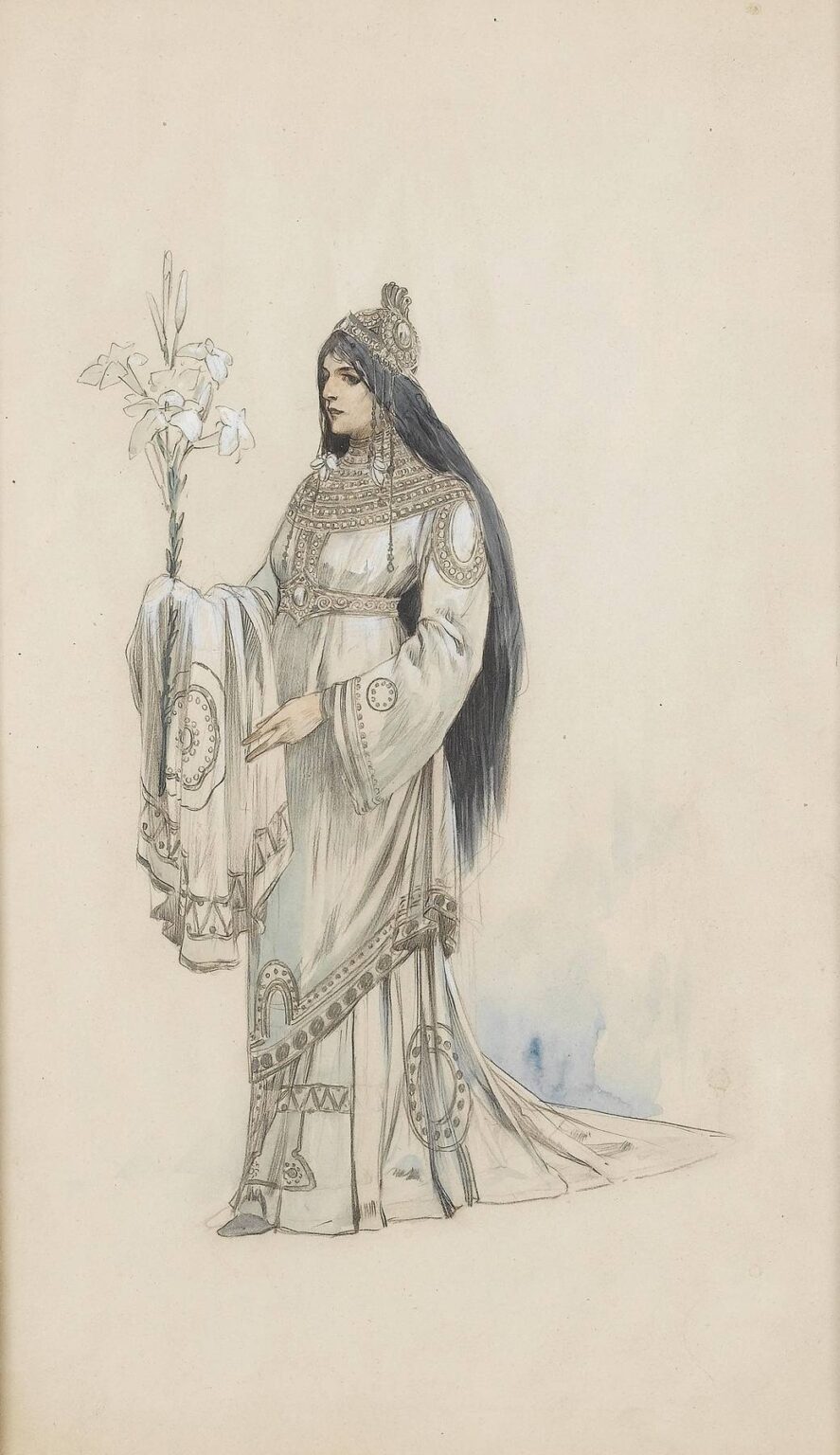
Alphonse Mucha’s “A costume design for the Théâtre de la Renaissance, Paris” presents a full-length figure quietly poised within a generous field of untouched paper. The woman stands in profile, her long black hair streaming down a robe of pale, pearly hues. She carries a cluster of white lilies and lifts an embroidered drape as if revealing the very fabric of her role. A diademed headdress, broad jeweled collar, medallioned belt, and patterned hems declare nobility. At first glance the sheet reads like a serene portrait, but every line and wash serves a theatrical purpose: to project character across the footlights and to guide makers in the wardrobe atelier. The drawing compresses Mucha’s signature arabesque line, his love of ornament, and his sensitivity to narrative into a single, lucid stage concept.
What the Design Shows and How It Works on Stage
The figure faces left, her body turned just enough to present the whole costume to the viewer. Mucha keeps the head and hands finely described while allowing the sweeping garment to flow in long, readable contours. This strategy is quintessential stagecraft. In performance, audiences must read character through silhouette first, detail second. The bell sleeves widen to a rounded terminus, the hem slides into a shallow train, and a sash-like band crosses the hips before falling as a pendant panel. Each contour creates a profile that can be recognized in a glance from the back row. Even the lilies she holds act as an extension of that silhouette, a pale vertical that punctuates the mass of the robe and adds a symbolic prop instantly legible under the glare of limelight.
A Working Sheet Born of Theatre Practice
Mucha’s costume drawings were not gallery props; they were working documents made to collaborate with directors, tailors, and performers. The Théâtre de la Renaissance, a crucible of Parisian modern theatre, frequently staged historical and romantic dramas that demanded costumes both evocative and practical. A drawing like this offered the company a pre-visualization of character, a shopping list of textures and decorations, and a dramaturgical cue sheet. The blankness around the figure is not empty; it is useful. It clarifies the silhouette, keeps notes legible if added later, and allows the sheet to be handled, annotated, and pinned without losing information.
The Materials, Touch, and Economy of Means
The sheet likely combines graphite with transparent watercolor and touches of opaque white, a mixture Mucha favored for rapid yet refined visualization. Graphite establishes the architecture of the pose: head set upon the column of the neck, elbows tucked beneath ample sleeves, feet stabilized beneath the skirt’s weight. Watercolor washes lay in cool grays and faint blue shadows, suggesting silk or fine wool that catches and diffuses light. Opaque heightening on beads, trims, and jewels charts where costume makers should add metallic thread, cabochons, or seed pearls. Mucha’s economy is striking; a few quick strokes define the hand lifting the veil-like drapery, while a fleet, darker line locks in the headdress. Despite restraint, the garment glows.
Iconography and the Lily as a Dramatic Device
The white lily, an emblem of purity, devotion, and sometimes martyrdom, orbits European religious painting and fin-de-siècle symbolism alike. In a theatrical setting it tells the audience who this woman is without dialogue. She might be a saintly princess, a consecrated bride, or a visionary priestess. Mucha uses the flower to tune the costume’s meaning; the lavish jewels and patterned hems could tip the role toward opulence or even decadence, but the lily pulls the reading back toward virtue and solemnity. It also introduces a vertical accent that balances the visual weight of the robe’s downward sweep, creating a compositional duet of line against mass.
Historical Echoes: Byzantine, Slavic, and Orientalist Currents
Mucha was fluent in historical vocabularies and inventive in recombining them. The broad, jeweled collar and domed headdress recall Byzantine court dress, with its mosaic-like fields of ornament and rigidly frontal dignity. The medallion bands and geometric trims gesture toward Slavic textiles and metalwork that Mucha knew intimately and would later celebrate in the Slav Epic. Parisian audiences of the era also savored a taste for the “exotic”—costumes inspired by Eastern Orthodox liturgy, Ottoman ceremonial wear, or imagined Eastern courts. Rather than tether the design to a specific place or date, Mucha fuses these sources into a single theatrical idiom, enabling the same costume to serve multiple plays with slight adjustments in color or trim.
The Silhouette as Narrative
On stage, the sweep of fabric tells a story before a word is spoken. The design’s silhouette conveys gravitas through verticals and horizontals: vertical hair and lilies, horizontal collar and belt, and sweeping hem that hovers like a low cloud. The body beneath is largely hidden, a choice that communicates modesty and authority. Compare this to Mucha’s poster figures whose bodies often unwind in sinuous S-curves; here, restraint is the rhetoric. The audience reads dignity, ritual, and a measured pace of movement. A single step would send the front panel and hem gliding; the character would not sprint but process, and the costume teaches the actor to do so.
Ornament that Obeys Anatomy
Ornament is everywhere, but it is never pasted on. Each band of jewels traces a boundary that anatomy or tailoring already proposes: collarbone to shoulder seam, waistline to hip, hem where the fabric turns under. Mucha aligns circles and ovals along those paths, using repetition to create rhythm while leaving small asymmetries that keep the eye awake. The ornament’s job is twofold—to suggest wealth and ritual status and to catch stage light. Raised embroidery and stones would glitter along the collar’s arc, marking the head as the locus of power, while border medallions along the hem would flicker in motion, animating the character’s steps without distracting from her face.
Hair, Headdress, and the Crown of Identity
Hair flows freely down the back, a dark river against pale cloth. In theatre, hair is costume as surely as fabric, and Mucha understands its expressive value. Left unbound, it speaks of youth, vision, or ferocity depending on context. The diadem with its round cabochons and pendant elements supplies the countervailing note of control and ceremony. The pair creates a nuanced persona: a woman anointed by office yet indivisible from her natural force. On a practical level, the dark hair also provides tonal contrast, ensuring the profile reads against bright stage sets.
Drapery Engineering and the Logic of Movement
Every seam in the drawing has a job. The bell sleeve, for example, narrows at the wrist before blooming outward, a form that grants the hand freedom while producing a grand gesture line. The hip band and pendant panel organize the skirt’s weight so that the train trails cleanly rather than bunching. The lifted drape, likely a veil or ritual cloth, introduces a secondary fabric whose lighter value and scalloped border create visual cadence. Mucha’s choices are less about fashion than performance dynamics: how cloth travels through space, how it frames the hand for a blessing or oath, and how it can be pre-set to reveal jewelry or props at the right moments.
Palette and Light in Service of Clarity
The palette is a study in restraint: whites, cool grays, muted golds, and a whisper of blue shadow. This limited range ensures the costume reads under mixed lighting and across varied sets. Too many colors would complicate quick changes and confuse the eye under gas or early electric light; Mucha keeps the center cool and uses gold only where it matters—around the face, neck, and edges that catch illumination. The white lily doubles as a light source within the drawing, echoing the gleam along cuffs and collar so the whole figure appears haloed without the literal halo so common in Mucha’s posters.
Relationship to Mucha’s Posters Without Repetition
Mucha’s poster heroines often stand before roundels, mosaic halos, and dense borders. Here the halo becomes a collar, the mosaic trades stone for thread, and the border shrinks to a hemline. The transformation is instructive. In a poster, a decorative circle isolates the head against a city’s visual noise; in costume, the collar performs the same isolating function by framing the face amid the visual noise of the stage. Ornament retains its job—direct the gaze—but moves from printed line to wearable architecture. The continuity reveals how Mucha’s art moved fluidly across media without losing its structural intelligence.
The Théâtre de la Renaissance and Mucha’s Theatrical Collaborations
The Théâtre de la Renaissance was a hub where literature, star power, and visual design converged. Mucha became a marquee name there through collaborations that included posters, sets, and costume ideas for leading productions. Even when Sarah Bernhardt moved to her own theatre, the style forged at the Renaissance continued to shape how Paris visualized historical and romantic drama. A sheet like this likely formed part of a larger package: scenic sketches, accessory studies, and colour notes delivered to the director and wardrobe mistress. It testifies to a working artist embedded in a collaborative ecosystem, not a solitary studio genius.
Jewelry Design, Decorative Arts, and the Fouquet Connection
Mucha designed for the jeweler Georges Fouquet, creating pieces in enamel, precious stones, and gold that still stand as pinnacles of Art Nouveau craft. The necklace-like collar and medallioned belt in this drawing translate that expertise into textile terms. Where a poster would draw a jeweled brooch, the costume drawing indexes which parts of the garment should glitter like a brooch when realized in metal thread or applied stones. The costume thus becomes a moving jewelry display, with brightness concentrated where the audience’s attention should fall.
Costume as Character Psychology
Beyond history and craft, the design sketches a psyche. The downcast eyes and composed mouth suggest inwardness; the lily affirms an ethical center; the regal robe proclaims responsibilities carried as much as privileges enjoyed. Mucha resists the temptations of theatrical extravagance that would turn the figure into mere spectacle. Instead he chooses quiet dominance. The robe’s breadth, the long hair, and the vertical lily coalesce into a character who governs space by presence rather than by noise. That psychological clarity helps an actor inhabit the role with economy.
How the Drawing Teaches Makers to Build
Wardrobe artisans would read this sheet like a blueprint. The collar’s zones announce different techniques: padded satin embroidery for broad fields, couched metallic cords for outlines, and seed beads for sparkle. The hem’s medallions encourage a repeating unit that can be scaled and mirrored with minimal pattern drafting. The sleeve edges, finished with smaller bands, keep fraying at bay and add weight for a better drape. Even the faint wash that pools in the train hints at stiffer interlining so the back falls in a controlled sweep. Mucha speaks to makers in the language of craft without cluttering the page with verbal notes.
The Poetics of Negative Space
The austerity around the figure is more than practical. It creates a hush that heightens the costume’s solemnity. The white margin functions like a proscenium arch: a neutral field where form can resonate. It also nudges the viewer’s imagination to supply a setting—temple, palace, or open court—making the design portable across narratives. In this way, Mucha treats empty paper as an active design element, the visual equivalent of a rest in music that makes the following note sing.
Continuities with Mucha’s Vision of the Feminine
Across posters, panels, and studies, Mucha created a modern archetype of woman—strong, decorative, self-possessed. The figure here belongs to that lineage. She is not an accessory to a male hero but a bearer of ceremonial authority. The costume does not sexualize; it sanctifies. Yet the sanctity is worldly, made of fabric and thread, hair and metal, lilies cut from a garden. Mucha’s genius lies in allowing the sacred and the sensory to coexist seamlessly, making the role believable in the human scale of the stage.
A Summation of Craft, Theatre, and Myth
This costume design compresses Mucha’s mature style into a practical sheet: calligraphic line that breathes, ornament that serves structure, symbolism that clarifies story, and a respect for materials that honors the hands who will translate drawing into cloth. It is artefact and instruction, image and instruction manual, devotional picture and working plan. Seen today, it also reads as a manifesto for collaboration across the arts. Painter, jeweler, playwright, actor, and tailor meet here, each finding in the drawing a cue to their own craft. The Théâtre de la Renaissance may have supplied the stage, but the cosmopolitan vision—the fusion of Byzantine splendor, Slavic memory, and Parisian modernity—belongs entirely to Mucha.