Image source: wikiart.org
Introduction
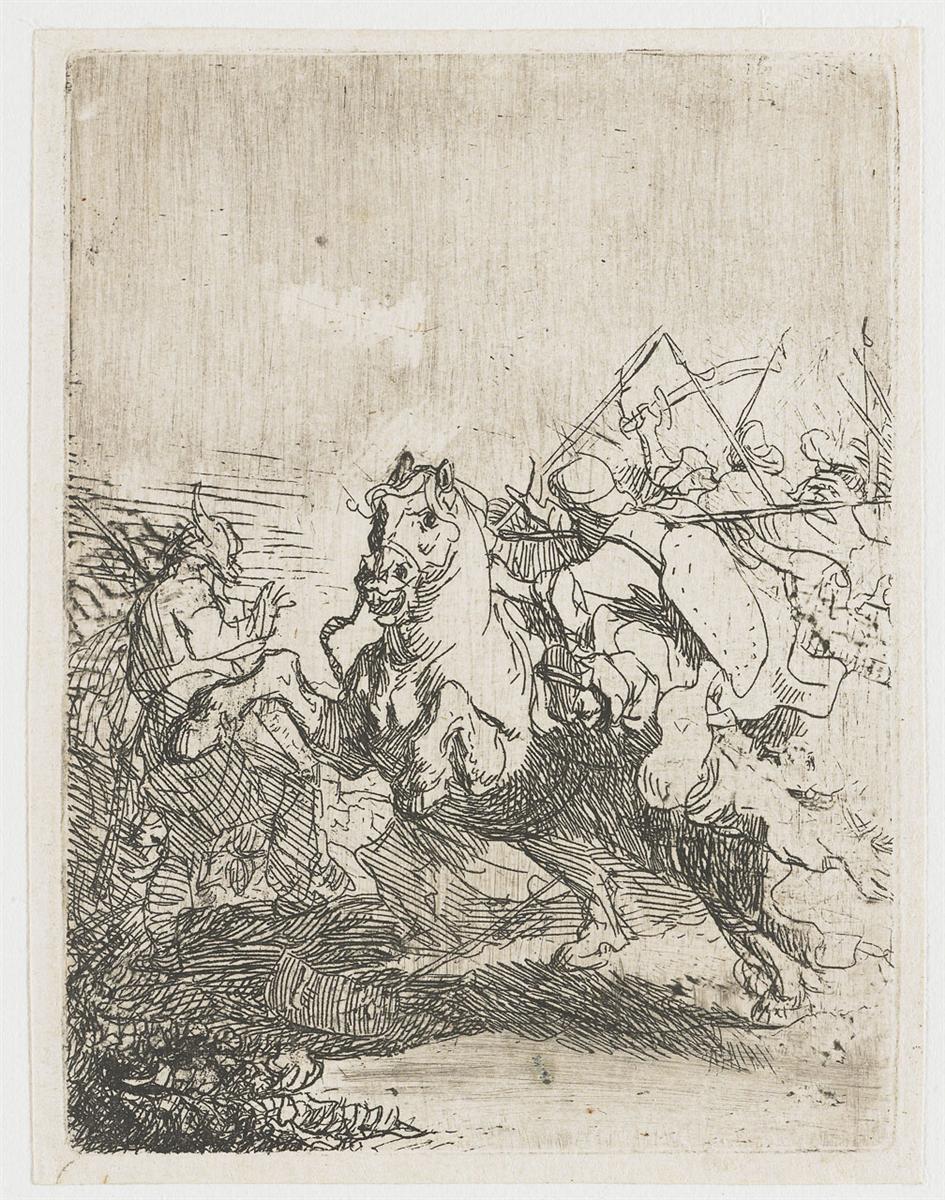
Rembrandt’s “A Cavalry Fight” (1632) is a small etching that detonates with speed. Two mounted soldiers crash through the lower half of the plate, lances thrust and shields lifted, as a third fighter reels backward, his body braced against the shock of impact. The horse at center rears and twists with a comic ferocity that is also terrifying, its open mouth gulping air as hooves carve the ground. Around these main actors, quick, angular marks sketch the turmoil of a larger melee. Above them hangs a startling emptiness, a pale sky of scraped plate tone that reads like dust, smoke, and the stunned silence that follows the first clang of steel. With nothing more than black lines and the alchemy of printing, Rembrandt converts copper into cinema.
Historical Moment And Artistic Intention
The year 1632 catches Rembrandt at the start of his Amsterdam rise. Fresh from Leiden, the twenty-six-year-old was securing patrons with portraits and religious canvases while pushing the etching medium into new territory. Scenes of beggars and street life recorded the city’s human texture; brisk narrative plates tested how far pure line could carry drama. “A Cavalry Fight” belongs to this laboratory of motion. It is not an illustration of a specific battle or regiment; rather, it is a study of violent encounter distilled to essential forces: mass, velocity, and the fragile geometry of bodies in collision.
Composition As Catapult
The plate’s energy is built on diagonals. The principal axis runs from lower left to upper right, established by the rearing horse’s chest and the rider’s leveled lance. A second axis, countering the first, is formed by the recoiling opponent at left and the zigzag of ground that buffers him from the horse’s hooves. These crisscrossing vectors keep the eye from finding rest. The upper third, by contrast, is nearly empty, a field of pale tone scored by faint vertical scrapes. That vast, quiet sky makes the lower zone feel compressed and explosive, as if the battle were a pocket of pressure ready to burst.
The Language Of Etched Line
Etching remembers pressure and speed. Rembrandt drives the needle fast through soft ground to create flickering lines for the horse’s mane and the dust kicked by hooves. He slows down and presses harder to articulate the muzzles, the risers of saddles, and the curve of a shield. Cross-hatching pools under bellies and between legs, creating the impression of weight settling into shadow. Instead of polishing forms into classical clarity, he lets ambiguous hatchings stand, trusting the viewer’s eye to complete limbs and clarify spatial overlaps. This confidence gives the print its modern feel: the drawing is an event, not a diagram.
Horses As Engines
No animal reveals a draftsman’s courage like a horse in motion. Rembrandt renders the central mount as a bulging engine with a mind of its own. The head thrusts at the viewer, nostrils carved in heavy bites, lips peeled back. The forelegs jackknife upward while the hind legs scramble for purchase, a torque captured by lines that change direction mid-stroke. It is not the prettified horse of parade or equestrian portraiture; it is a mass that tries to run and fight at once. The second mount at right is glimpsed in fragments—rump, hock, tail—enough to suggest a heaving cohort behind the foreground pair. The almost grotesque exaggeration of the front horse’s face is not caricature but rhetoric: the animal’s panic is the battle’s truth.
Men As Extensions Of Force
The riders are not portrait individuals; they are vectors. The central horseman leans forward, his torso a rigid shaft that aligns with his weapon. The left-hand combatant, seen mostly in contour, throws his arms up in a reflex both defensive and pleading, fingers spread against the incoming animal. Their helmets and shields are sketched with a few curves and dots of shadow that read instantly as metal. Behind them, a tangle of small heads and weapons repeats the main action at a higher pitch. What matters is not heraldry or costume but the anatomy of intention: thrust and recoil.
Weapons And The Geometry Of Violence
Lines that portray lances and pikes serve a double purpose. They are things in the scene and rulers laid across it. Their taut diagonals lock the rolling energy of horses and drapery into a legible design. The flat, oval shield at right provides a single, stable plane in a storm of curves; its edge carries a dense hatch that declares thickness and impact-readiness. Because the weapons are precise, the sketchier passages around them can vibrate without the composition losing coherence. The viewer unconsciously leans into these straight lines as handholds while eyes surf the chaos elsewhere.
Plate Tone And Atmosphere
One of the quiet miracles of the print is the involved sky. Rembrandt often left a veil of ink on the plate—the plate tone—when printing. Here it becomes dust and glare, the expanded breath of battle. Light scratches and wiping marks move vertically down the sky, subtly opposing the lateral thrust below. This soft, dirty air raises the combat from anecdote to climate. The fight is not just among men; it is also between bodies and the physical world that records their clash.
Space As Stage And Evidence
The lower foreground is knitted with dark hatchings that function as ground and as proof of momentum. Where lines are densest, they show churned soil and trampled brush. These densities also push the pale space backward, making the figures feel closer to the viewer. At the extreme front left, a dark clump of marks acts like a footlight, its shadow thrown back from an unseen boulder or bank. Such minor incidents set spatial cues without fussy description. The effect is of a rough stage on which the action lands hard enough to leave traces.
States, Impressions, And The Image’s Weather
Rembrandt frequently altered plates between printings, changing emphasis or testing new atmospheres simply by adjusting ink and wipe. In some impressions of “A Cavalry Fight,” the sky reads cleaner, pushing the foreground into sharper relief. In others, a heavier tone wraps the entire group, turning the scene into a dusty squall. Because the line-work is supple, the plate welcomes these shifts without losing legibility. The variability suits the subject: no battle looks the same twice.
Kinship With Contemporary Works
Although the theme of cavalry was popular among Dutch and Flemish artists—think of the elegant battles of Antonio Tempesta or Pieter Snayers—Rembrandt’s approach is notably different. Where others crowd the plate with patterned ranks and banners, he subtracts. His riders are not decorative; they are dangerous. The comparison with his own “Abduction of Proserpina” from 1631 is instructive. There, a chariot slashes diagonally through a dark landscape; here, a war horse and lance cut the plate with similar urgency. In both, Rembrandt treats velocity as subject and the world as a field of forces, not a backdrop.
Emotional Register
Despite the absence of close-up faces, the print vibrates with feeling. Panic and resolve are coded into posture. The rearing horse’s white-rimmed eye and bulging cheek transmit animal terror. The man at left, hat knocked askew, opens his hands in a gesture that combines command and prayer. Even the tiny soldiers behind them translate into a chorus of shouts through the multiplication of pikes and helmet brims. And yet the image never lapses into melodrama. The emotion is the by-product of accurate physics: when you render pressure and balance with truth, the heart supplies the rest.
The Viewer’s Position And Risk
We stand dangerously close, roughly at the height of the central horse’s chest, within the radius of striking hooves. This near vantage makes the scale of the animal personal rather than picturesque. Rembrandt refuses the elevated general’s view; he plants us in the roil, where coherence is provisional and survival is a matter of split seconds. The print thus recruits the viewer’s body. You feel your own stance adjust as you read the etched lines, a soft echo of the way the fighters continually reset their balance.
How To Read The Print Slowly
Start at the hoof planted near the plate’s lower edge. Notice the thick nests of hatch surrounding it, the way those lines sweep backward like water. Climb the leg to the bulged chest and the tobogganing curves that construct it. Leap to the horse’s face and trace the deep contour around nostril and mouth; it is one continuous gesture that rolls from light into shadow. Pivot to the rider’s arm and lance, following it as a taut wire toward the shield. Let your eye ricochet to the recoiling opponent at left and observe the flicks that build his lifted hands. Now step back and feel how the empty sky amplifies the scene’s volume, like space around a shouted name.
Violence Without Allegory
Seventeenth-century battle scenes often carried allegorical weight—glory of the fatherland, warning against hubris, or moralizing vanitas. Rembrandt’s etching is startlingly uninterested in emblem. No banner declares side or cause. The helmets and shields are generic. Without allegory, we are left with the human scale of combat: a man, a horse, a few yards of ground, and a hard instrument pointed at a body. That refusal to tell us what to think keeps the print contemporary and ethically alert.
Technique As Narrative
In the best Rembrandt prints, the making of the image becomes part of the story. Here the restless, searching line matches subject. The needle skids, hesitates, and corrects; crossed hatchings become scabs where pressure has accumulated; the plate tone has been wiped unevenly, leaving streaks like smeared dust. Every trace of process reads as the visual residue of impact. The sheet does not simply depict a fight; it bears its mark.
Why It Still Feels Modern
The print’s modernity lies in its economy, its use of negative space, and its trust in the viewer’s eye to resolve ambiguity. Rembrandt has, in effect, found a graphic syntax for speed that anticipates much later image-making, from reportage drawing to cinema storyboards. The forms are not polished for display; they are alive, provisional, and accurate to the sensation of being in motion. Present-day audiences who read gesture quickly and value the suggestive line find in this small etching a perfect tutor.
Legacy And Influence
Rembrandt’s battlefield prints were known and collected by artists who sought a more muscular alternative to courtly battle pageants. The central, rearing horse with a lance-bearing rider becomes a recurring motif in European art, but rarely with the same mixture of comedy and terror. Later printmakers learned from his example that the plate could hold both description and atmosphere, and that a handful of lines, if rightly placed, can outpace the clutter of details.
Conclusion
“A Cavalry Fight” is a compact masterclass in making motion legible. Diagonals organize the chaos; etched lines translate muscle and will; plate tone breathes dust into the air; and the open sky above magnifies the shock below. There is no story beyond the moment and no rhetoric beyond the truth of pressure meeting resistance. That purity gives the print its longevity. Nearly four centuries on, we still flinch at the forward thrust, still feel the ground jolt under the horse’s hooves, and still read in a few black lines the cost of speed.