Image source: wikiart.org
First Glance At A Weathered Presence
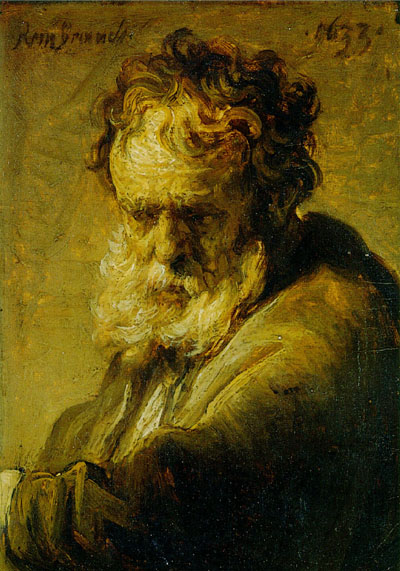
Rembrandt’s “A Bust of an Old Man” presents a compact storm of paint and personality. The panel is small, but the presence is grand: a half-turned figure with a luminous beard and a face carved by light into ridges of experience. The palette is restrained—earths, ochres, and warm umbers—yet it yields a surprising range of temperature and depth. Rather than narrate a story, the work concentrates on a single human inevitability: time inscribed on flesh, thought concentrated in a downward glance, a life that refuses to be summarized. The painting asks the viewer to look at age not as decline but as a summit from which inward sight extends.
A Construction In Light And Earth
The head emerges from a murky field like a sculpture lifted out of clay. Rembrandt’s light is not diffuse; it breaks powerfully upon the forehead, nose, cheek, and beard, while leaving the eyes embedded in a peninsula of shadow. The light itself feels solid, as if poured. Dark ground and mid-tones fuse around the shoulders to form a pedestal for the illuminated cranium. The result is not a portrait in a room but a portrait in an atmosphere, where illumination is the true setting. In a few inches of panel, Rembrandt essays a cosmos of browns made breathable by light.
The Grammar Of The Turned Head
The figure turns away from us, but the head rotates back in a slight, resistant torque. This dual twist—body receding, head returning—creates a psychological compound of reserve and attentiveness. The left shoulder closes like a door; the beard and forehead flare like open windows. The pose generates a rhythm: retreat, then reconsideration. It is easy to imagine the painter checking this rhythm with a mirror, feeling in his own neck the elastic pull that combines dignity with fatigue. The sitter is not caught mid-gesture; he is settled in the permanent gesture of thinking.
Brushwork That Thinks Out Loud
Close looking reveals a surface that records decisions in real time. The beard is executed with stacked, loaded strokes that curl and break like surf. The hair is written in separate arabesques, some laid wet into wet, others dragged across dried underlayers so that ridges catch the light. Flesh is modeled by veils and small, decisive swipes; a single stroke along the bridge of the nose holds the entire architecture of projection. These marks do not present finish as polish; they present finish as clarity. The viewer reads the painter’s path without losing the sitter’s coherence. Brushwork becomes a reading of life rather than a mannerism.
Color That Breathes Like A Hearth
Rembrandt often turns a limited palette into an organism. Here, warmth is dominant but modulated: honeyed highlights along the forehead and beard, tobacco browns in the recesses, and olive-tinged shadows that cool the picture’s core. The chromatic restraint produces an intimacy closer to firelight than to day. Within this gently smoldering world, small fluctuations carry meaning—a slightly cooler half-tone under the eye suggests moisture and fatigue; a warmer note at the cheek suggests circulation and vigor. Color reads as physiology.
Light As A Moral Instrument
The painting’s illumination behaves like a moral instrument, discriminating thoughtfully among features. The brightest emphases fall not on ornament but on the head’s architecture and the beard’s tide. The eyes sit in moderated shadow, encouraging the viewer to infer their focus rather than consume it. This hierarchy transforms light from spectacle into witness. The old man is not displayed; he is recognized. The light’s tender severity affirms the dignity of a face that has earned its reliefs and hollows.
The Architecture Of Beard And Brow
Beard and brow constitute the twin architectures of age. The brow is mountainous, cut by furrows that catch light on their crests and collect dusk in their troughs. The beard is a river system, flooding outward and downward in tributary curls. Together they frame the mouth, whose partial concealment heightens the sense of withheld opinion. The facial hair is not decorative; it is structural, the visible record of time’s slow carpentry. Rembrandt understands that in old age, hair is a second architecture that collaborates with bone to state character.
The Eyes As Reservoirs Of Thought
Even when partially veiled, Rembrandt’s eyes are the most articulate features. Here they occupy the recess beneath the ridge of brow like reservoirs dug into rock. The irises are not crisply drawn but suggested by a set of calibrated half-tones. This indirection makes the gaze more powerful; it feels withheld, interior, and consequential. We do not quite meet the old man’s eye; we meet his thinking. The painting thereby grants privacy while inviting interpretation, a balance that preserves dignity.
A Bust Without Ornament, A Character Without Costume
Rembrandt strips the figure of heraldic detail. There is no chain, no velvet collar with gilded trim, no bout of bravura fabric to commandeer attention. The clothing is rendered as a dark mass with minimal modulation, a container rather than a theme. This deliberate poverty of costume intensifies the wealth of face. The old man’s identity rests on the persuasive geography of his features, not on borrowed narrative. By refusing a theatrical role, Rembrandt crowns the sitter with personhood alone.
Temporal Depth In A Small Format
Paintings of this size often function as cabinet curiosities, designed for intimate viewing. Rembrandt turns intimacy into a chamber for temporal depth. The panel holds the present tense of the sitting—head turned, mind engaged—while simultaneously compressing an implied biography into its furrows and silvered hairs. The sensation is that of looking not at a moment but at a condensed life. Scale is defeated by concentration. A few square inches carry decades of weather.
The Psychology Of The Downward Angle
The slight downward angle of the head introduces a complex psychology. It implies weight, as if the skull’s mass has increased with thought. It suggests inwardness, the stance of someone reviewing a private ledger. It may also hint at a learned humility, the posture of one who has looked long and learned to refrain from quick judgments. The whole tilt resists sentimentality: this is not the theatrical droop of a sage seeking pity but a natural balance chosen by a man who has found thinking more useful than posing.
Material Presence And The Ethics Of Paint
Rembrandt’s materialism is ethical: he wants the paint to mean what it is. Impasto highlights in the beard do not only describe hair; they confess the hand’s pressure and the pigment’s body. Thinly scumbled shadows do not merely record darkness; they rehearse the way light sinks into absorbent ground. This honesty of substance dignifies the subject by refusing tricks. The old man is rendered with the same seriousness given to the paint itself. Substance recognizes substance.
The Studio As Invisible Partner
Though the background is plain, the studio’s conditions are present in everything. The direction of the light, the height at which it strikes, the decision to suppress distractions—these are studio choices that become content. One can almost chart the interval between easel and sitter from the intimacy of the brush’s approach. The painting invites the viewer into that working triangle, establishing a closeness that feels earned rather than invasive.
A Conversation With Earlier Heads
Rembrandt’s early 1630s output includes many tronies—studies of heads that explore expression, age, and costume without necessarily naming specific individuals. This painting converses with that tradition while exceeding it. It tests how much psychological resonance can be extracted from minimal context. The answer is ample: by concentrating on head and light, Rembrandt synthesizes the genre study with the gravity of portraiture. The old man is not type; he is personhood distilled.
The Tension Between Softness And Severity
Two contrary qualities organize the image. The beard and hair carry an almost edible softness, a buttery sweep of strokes that roll into one another. The bone structure—brow ridge, nose, cheek—asserts severity. Together they enact a drama of human nature, where tenderness and firmness mingle in a single face. The effect is persuasive because it echoes lived experience: age often amplifies both softness of feeling and hardness of principle. The painter’s dual handling teaches the eye to read this doubleness.
Edge, Atmosphere, And The Art Of Breathing
Rembrandt’s edges are rarely singular. Around the left shoulder, the contour dissolves into the ground, letting air and figure exchange molecules. Along the head’s crest, the edge tightens where light meets background, then loosens as hair wisps into space. These edge modulations make the portrait breathe. The panel does not contain a cut-out shape; it hosts a body in air. The viewer senses circulation—of light, of breath, of thought—inside the little climate of ochre.
The Refusal Of Idealization
Nothing in the face is corrected to flatter. The nose’s angle is uncompromising; the mouth’s downturn is admitted; the skin’s roughness is honored. Yet the refusal to idealize does not equal cruelty. Rembrandt’s realism is generous, finding beauty in function. Furrow becomes field, stubble becomes texture, and sag becomes volume for light. The portrait enlarges the concept of beauty to include truth told with affection.
The Viewer’s Role As Silent Interlocutor
The painting works only if the viewer accepts a role: to attend without demanding. The old man does not perform for us; he thinks in our presence. Our task is to keep company. This exchange converts looking into a form of conversation where silence is meaningful. As we prolong our gaze, new articulations appear—the faint plane shift along the temple, the tiny glint at the nostril, the irregular rhythms of the beard. Attention begets revelation, and the panel rewards the kind of slow reading that age itself has practiced.
Memory, Mortality, And The Comfort Of Matter
The panel inevitably invites reflections on mortality, but it also offers comfort through matter. The paint’s substantiality counters ephemerality; the sturdy planes of the face assert endurance. If time has written heavily on this person, paint writes back with its own durable script. The viewer leaves with a sense that matter—wood, pigment, hair, bone—can collaborate to hold presence a little longer against disappearance.
Why This Small Painting Feels Monumental
Scale in art is not only a question of size; it is a question of focus and consequence. This small panel feels monumental because every decision within it is consequential. Each stroke carries a precise job, each plane of light argues for a structural truth, and each omission respects the whole. The painting resembles a sonnet: strict limits harness intensity. Rembrandt turns a narrow frame into a chamber where age, light, and thought resonate like a bell struck softly but perfectly.
A Closing Reflection On Rembrandt’s Art Of Personhood
“A Bust of an Old Man” condenses Rembrandt’s lifelong fascination with the intersection of surface and soul. He does not seek a heroic narrative or a flattering likeness. Instead he seeks personhood in its elemental grammar: light on bone, breath in shadow, the mind’s weight bending the neck, the weather of years settled in hair and skin. The painting asks us to resist hurried seeing and to greet age as a summit of visibility rather than merely a slope of decline. In the small theater of this panel, dignity is not declared or awarded; it is quietly recognized, as if the light itself were saying, here is someone who has lived, and here, for a long minute, is the face that living made.