Image source: wikiart.org
First Encounter With A Ragged Profile And Streetlight Wit
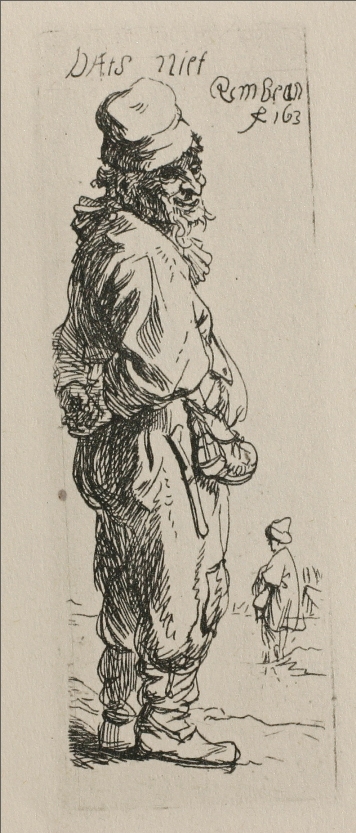
Rembrandt’s “A Beggar and a Companion Piece, Turned to the Right” of 1634 is a small pen-and-ink drawing that opens like a door onto the Dutch street. A bulky figure stands in profile, bundled in layered garments, hands tucked within sleeves; a smaller companion appears in the distance at lower right, echoing the stance. Above the main figure, in Rembrandt’s own hand, a brief phrase is written, and beside it his signature and date. The first sensation is one of proximity. We are not viewing an allegory from a respectful distance; we are standing on the same ground as a man who shifts his weight and turns his head as if he has just noticed us. In a few inches of paper, the artist composes a theater of survival, humor, and weather.
A Composition Built On Vertical Weight And Rhymed Figures
The sheet’s design is astonishingly efficient. The standing beggar forms a dark, swelling column from hat to shoes, placed near the left edge so that the remaining white field feels like cold air. His body leans slightly back while his head cranes forward, producing a counterthrust that animates the silhouette. The small figure at lower right is a deliberate rhyme, scaled down and placed on an implied horizon. This echo steadies the composition and supplies perspective without fussy architecture. The ground is a few brisk strokes; the rest is negative space doing expressive labor. The entire scene reads immediately, like a single strong chord.
Line As Voice And Weather
Rembrandt’s pen line is a voice you can almost hear. Short, cross-hatched flicks knit the heavy sleeve and cloak; elastic contours describe the bulges and sags of layered fabric; small zigzags turn dirt into terrain. The beard is a nest of quick loops; the cap is drawn with two or three curves and a clipped brim; the shoe, a flat ovular form underlined by a shadow that functions as both weight and punctuation. The drawing is not an inventory of detail but a demonstration that a handful of articulate marks can recreate temperature, texture, and attitude. Even the inscription participates in the weather; placed high, it behaves like a gust of spoken air that has drifted over the beggar’s head.
The Inscription That Turns a Figure Into a Moment
The scrawl above the figure, often read as a colloquial Dutch phrase meaning something like “that’s not [it]” or “that doesn’t [do],” gives the drawing its lived immediacy. Whether the words belong to the beggar’s mutterings or to the artist’s amused aside, they make the scene audible and situational. We feel the exchange that art historians cannot fully translate: a scrap of street talk paired with a picture that is all economy and tact. The signature and date nail the day to the page. What might have been a generic “type” becomes a glance recorded in real time.
Gesture, Clothing, And The Grammar Of Survival
Every fold and pocket has a job. The hands vanish into opposing sleeves, conserving heat and signaling the practiced posture of someone outdoors for long hours. The belt cinches layers at the waist, and from it hangs a small bag whose weight creates a convincing sag in the cloth. The cap sits down over the ears; trousers bunch into boots, not to flatter the leg but to keep water out and warmth in. Rembrandt details these things without preciousness or pity. He is attentive to the engineering of poverty—the ways bodies use fabric as weatherproof and storage—and he allows viewers to read a life from the solutions a body has invented.
The Ethics Of The Side View
The profile stance matters. Portraits that confront the viewer can become tests of character or pity; those that distance the subject can slide into objectification. Rembrandt chooses the respectful middle: he draws the beggar from the side, near enough for us to see the face’s planes and the beard’s wiry tufts, yet not so frontal that the figure is trapped in our gaze. The man remains on his trajectory, moving and thinking. We are observers, not judges. The artist’s habit of drawing workers, beggars, and passersby from this oblique angle is an ethics of looking disguised as compositional preference.
Humor Without Cruelty
A Rembrandt street study is frequently tinged with wit, but the humor never curdles into mockery. Here the beggar’s posture—head jutting forward, belly rounded under a hill of cloth—has comic verve, yet the lines that define him carry weight, not derision. The little figure at right, hands likewise tucked, mirrors the stance like a companionable joke shared between acquaintances. The phrase above reads like a muttered verdict on the weather, the alms, or the day’s luck. The drawing smiles with the figures, not at them.
The Dialogue Between Figure And Empty Space
The tall narrow format gives Rembrandt a lot of paper to leave blank, and he uses that space to create atmosphere. The emptiness is not lack; it is chill, distance, and breath. The few strokes beneath the shoes tie the figure to ground, but the wide unmarked field around him lets the viewer feel exposure. When a small companion is added in that pale field, the effect is almost cinematic: the camera pulls focus from near to far, and a street opens.
Economy Of Means And The Speed Of Seeing
Follow the ink and you can reconstruct the drawing’s sequence. The outer contour of the big figure likely arrived first, cut swiftly from hat to heel; then the interior hatches gathered in the sleeves, belly, and trouser legs; the face received just enough cross-contour to state cheekbone, jaw, and nose; the bag and belt were accented; the shoes anchored with small shadows; the secondary figure sketched in as a balancing echo; and finally, the words and signature. The speed is palpable and contributes to the sense that the draughtsman met this man, found him compelling, and recorded him before the moment cooled.
A 1634 Street Seen With Civic Clarity
The date lands the sheet in Rembrandt’s early Amsterdam period, when the bustling port city churned with sailors, shopkeepers, refugees, and the poor who did the precarious labor beneath a thriving economy. Printed series of beggars by Jacques Callot and his followers circulated widely; artists competed to outdo one another in inventiveness and detail. Rembrandt absorbs that tradition but strips it of mannerism. Instead of multiplying props and grotesque features, he concentrates on stance, fabric, and the heartbeat of a human presence. The result feels less like a social type and more like a citizen met in passing.
Comparison With The Pendant Turned To The Left
This drawing converses with its companion sheet, “A Beggar and a Companion Piece, Turned to the Left.” Together they operate like mirrored tiles in a small altarpiece of the everyday. One figure strides left in cold weather; this one stands right and mutters a comment. The rhymed formats and repeated motifs—the tucked hands, layered clothing, smaller distant companion—suggest that Rembrandt was not compiling a taxonomy of the destitute but practicing a set of formal problems: how to balance weight and space, how to suggest climate and character with minimal means, how to keep empathy intact when speed is required.
The Face As A Map Of Alertness
Even at this small scale, the profile is vivid. A sharp nose breaks the silhouette; the brow juts forward, shading the eye; the beard is a bristled mass defined by a few splayed strokes; the mouth is suggested rather than drawn, as happens when the pen trusts the viewer’s recognition. The expression is not pleading. It is alert, perhaps skeptical, perhaps amused. Rembrandt’s beggars often carry a touch of knowing that forestalls condescension. They are not passive recipients of pity; they are experienced readers of the street.
Hands Hidden, Agency Present
Hiding hands within sleeves is a practical gesture, but it also creates a small challenge: how do you show agency when the tools of touch are concealed? Rembrandt solves it by letting other parts of the body speak. The angle of the head, the set of the shoulders, the firm plant of the leading foot, and the slight hinge at the hip all declare a will moving through space. The little bag at the waist is another sign of agency—a portable economy, a life carried on the body.
The Bag, The Belt, And The System Of Small Necessities
The satchel hanging from the belt is not an ornament. It tells a story in a few curves and a dark accent. It could hold coins, bread, tobacco, or tools; its presence marks the beggar as someone who manages a micro-inventory of necessities. Rembrandt paints luxury superbly in his grand portraits, but here he gives equal attention to the humble hardware of survival. The rhythm of the belt’s lines, the sag of the bag, and the tension implied by the knot are part of the drawing’s quiet music.
The Companion As Perspective And Fellowship
The smaller figure at right acts as a scale gauge and a social sign. He places the main figure in a world and says: you are not alone. Perhaps he is a fellow traveler, perhaps a rival for alms, perhaps a fragment of the city’s chorus. The echoing gesture—hands tucked, head turned—creates a rhythmic call-and-response that animates the empty paper. Because this echo occupies the far field, we perceive depth without the machinery of linear perspective. Two lives make a street.
Why The Drawing Still Feels Contemporary
The sheet’s modern appeal lies in its candor. The image could live in a sketchbook today: quick, observant, annotated with a fragment of speech. It avoids melodrama and message and instead practices a humane attention that contemporary documentary photographers and urban sketchers still prize. The drawing proposes that to see someone carefully is already to enact a modest civic good. In a culture crowded with images that either glamorize poverty or erase it, Rembrandt’s accuracy and restraint feel fresh.
The Sound Of The Page And The Practice Of Fieldwork
Because we read the handwritten phrase, the drawing carries a soundtrack. We imagine the roughness of the beggar’s voice, the muffled friction of layered cloth, the scrape of a boot, the puff of winter breath. That acoustic dimension suggests something about Rembrandt’s method. He was not a studio recluse inventing figures from treatises; he walked, watched, listened, and drew. The sheet is not just art; it is fieldwork—evidence of a mind collecting the street’s data with ink and wit.
The Narrow Format As Ethical Frame
The tall, slender rectangle compresses the scene and discourages spectacle. There is no room for grand scenery or for a tableau of misery. The frame enforces intimacy; it asks us to stand, like the artist, at arm’s length and regard a person with enough time to record him but not enough time to spin a sermon. The format is thus an ethical choice disguised as design.
What Draftsmen Can Learn From The Sheet
For artists, the drawing is a compact manual. Build the silhouette first and be sure it carries weight on the ground. Vary line density to state materials—looser for wool and linen, tighter for leather and skin. Use negative space as air and temperature. Add one distant echo to establish depth. If there is something to be said, write it near the figure so words and image breathe the same weather. Above all, preserve respect in speed.
Closing Reflection On Ink, Dignity, And The Street’s Small Theaters
“A Beggar and a Companion Piece, Turned to the Right” condenses the city into a handful of strokes. A profile under a cap, sleeves hiding hands, a bag at the belt, a companion in the distance, and a tossed-off phrase make a complete world. Rembrandt’s genius is not only his command of light in grand paintings, but his ability to grant strangers the accuracy that equals dignity. On this narrow page, the street’s theater plays without scenery: one actor speaks a line, another answers, and the day goes on.