Image source: wikiart.org
An Opening Scene That Feels Like a Moment Interrupted
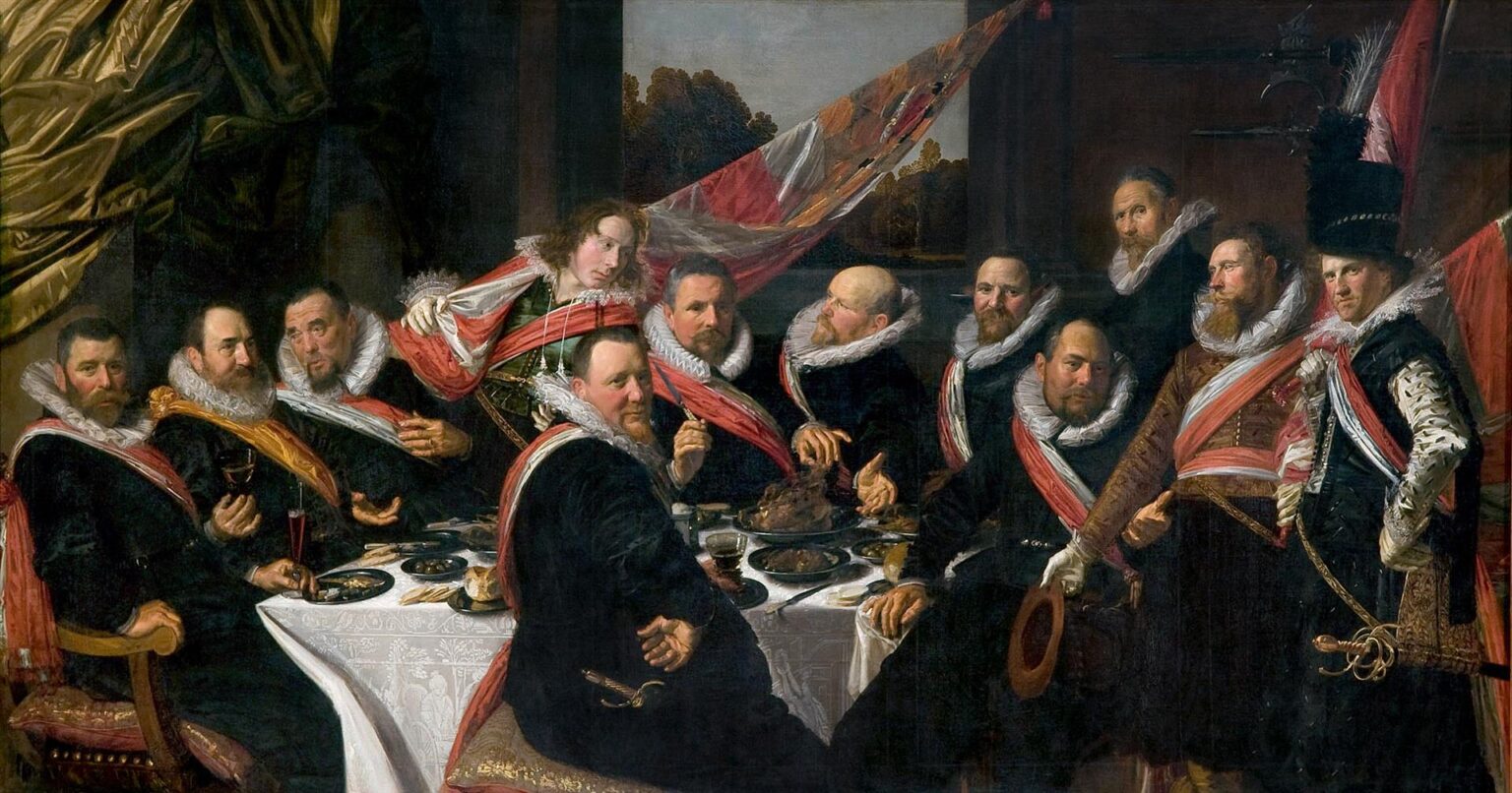
Frans Hals’s “A Banquet of the Officers of the St. George Militia Company” (1616) captures the sensation of walking into a room where something is already happening. The painting is not arranged like a frozen ceremony. It feels like a social event that has momentum, with talk, glances, and small gestures continuing even as the viewer arrives. That sense of interruption is one of Hals’s great gifts. He turns a formal group portrait into a scene with pulse, where each man registers as an individual and the group reads as a living organism.
At first, the eye takes in the sheer density of information: faces, ruffs, sashes, metalwork, flags, table linens, glassware, and the glint of weapons. But the painting quickly organizes itself around a more human logic. This is an image about belonging and rank, but it is also about personality. Hals uses the public language of civic pride to show private differences, the way one officer leans into attention while another retreats behind composure, the way a glance can establish authority without a word. The banquet setting becomes a stage where status is displayed, negotiated, and subtly contested.
The Civic Militia and the Social Meaning of a Banquet
To understand the painting’s impact, it helps to recognize what a militia company represented in the Dutch Republic. These groups were not simply military units in the modern sense. They were civic institutions, tied to urban identity, security, and public ceremony. Membership carried prestige, and the officers in particular belonged to the social class that shaped city life through governance, commerce, and networks of influence. A banquet was not only a celebration but a performance of unity and prosperity. The table, the food, the fine cloth, and the confident arrangement of bodies all communicate the stability of the city itself.
Hals paints this event with a sharp awareness of how civic pride works. The company gathers under banners that signal tradition and collective identity. The officers wear sashes and carry symbols of command, yet they sit among plates and goblets, surrounded by the pleasures of eating and drinking. This mixture is essential. The painting suggests that power is not only exercised in battle or formal council rooms. It is also exercised socially, through fellowship, display, and the ability to occupy space with ease. Hals transforms the militia banquet into a portrait of a ruling culture enjoying itself while affirming its legitimacy.
Composition That Balances Disorder and Control
One of the most impressive features of the painting is the way it appears spontaneous while being carefully engineered. The composition is wide and crowded, packed with bodies that overlap and push against the frame. Yet the scene never collapses into confusion. Hals arranges the officers so that the viewer’s gaze moves in a controlled rhythm across the canvas, guided by diagonals, repeating shapes, and bright accents.
A major diagonal sweeps through the scene via the red and white sashes and the dramatic presence of the flag. That diagonal gives the painting a sense of forward thrust, like a visual current running through the group. The white tablecloth anchors the lower half, acting as a stabilizing plane where objects gather and light collects. The officers’ faces form a chain of attention points, each one a small world of expression. Hals also uses contrast to prevent visual overload. Dark clothing creates broad masses, and those masses are punctuated by ruffs, cuffs, sashes, and metallic highlights. The eye is constantly refreshed by these bright interruptions.
The effect is a controlled bustle. It feels like a room full of distinct personalities, but the painting’s underlying structure keeps the scene coherent. Hals gives you both the noise of social life and the discipline of a civic institution.
Light as a Tool for Hierarchy and Liveliness
The lighting in the painting does more than illuminate. It organizes authority. Hals uses light to pick out faces and white ruffs, ensuring that the viewer’s attention repeatedly returns to the men themselves rather than dissolving into costume and décor. The ruffs are particularly important. They catch light in crisp folds, turning each head into a focal point framed by whiteness. This framing creates clarity in a crowded image, but it also signals refinement and status. Maintaining such garments required labor and wealth, so the ruff becomes both a visual and social highlight.
Light also interacts with the table setting. The white cloth reflects brightness upward, subtly lighting hands, goblets, plates, and the lower halves of faces. This creates an intimate banquet atmosphere where the table becomes a shared source of visibility, almost like a communal stage. Highlights on glass and metal punctuate the darker palette, suggesting the shimmer of wealth without turning the painting into a mere inventory of luxury.
Hals’s light is not theatrical in a dramatic, spotlight sense. It is practical and vivid, like the lighting of a real room. That realism helps the painting feel immediate. You can imagine the air, the warmth, the smell of food, and the low roar of conversation.
Color, Uniformity, and the Strategic Shock of Red
The color scheme relies on deep blacks, warm browns, creamy whites, and the vivid accent of red. The officers’ dark clothing establishes seriousness and unity, as if the group’s collective identity depends on visual coherence. Against that coherence, the red sashes stand out with symbolic force. Red and white read as both festive and official. They tie the men together while also drawing attention to individual gestures and postures.
This is where Hals’s sophistication shows. A uniform element can flatten personality, but Hals uses the uniform to intensify difference. Because the clothing is broadly similar, the viewer becomes more sensitive to how each man inhabits it. One officer sits with relaxed authority, another leans forward as if eager to engage, another holds himself back, watchful. The red sash becomes a device that links bodies into one company while tracing the subtle choreography of rank and temperament.
The warm tones of faces and food also matter. They prevent the painting from becoming too stark. Hals keeps the scene human by letting flesh tones glow, making the banquet feel like an occasion of warmth and appetite rather than a cold institutional portrait.
Gesture and Body Language as Social Narrative
The painting communicates through gesture as much as through faces. Hals builds a network of implied relationships via hands, turned shoulders, and the direction of gazes. Some men look directly at the viewer, acknowledging the portrait’s function as public display. Others look sideways toward companions, suggesting ongoing conversation. This variety gives the painting its sense of time. It is not a single posed instant. It feels like several seconds stitched together into one image.
Hands are especially expressive. A hand pointing, a hand resting on a chair, a hand holding a glass, a hand near a weapon: each gesture carries a message about control and confidence. The table becomes a site of interaction, where objects are handled and offered, where conviviality happens in the same space that authority is displayed. Even the positioning of chairs and bodies suggests hierarchy. Some officers occupy central space with ease, while others appear slightly peripheral, their presence still important but less dominant.
This is the brilliance of Hals’s group portraiture. He recognizes that a group’s identity is never purely abstract. It is made of small social negotiations, performed through posture and attention.
Portraiture That Refuses to Turn People Into Symbols
Group portraits can easily become stiff, where individuals feel like interchangeable components of a civic message. Hals resists that. He paints faces that feel alert and specific. The men do not share one standardized expression. Some appear amused, others stern, others contemplative. There is a range of energy, from flamboyant assurance to guarded composure.
This variety suggests a crucial truth about power: it is held by people with different temperaments. A militia company may present itself as unified, but it is made of individuals who carry private ambitions, rivalries, friendships, and anxieties. Hals hints at all of that without turning the painting into a melodrama. He simply paints them as human.
The directness of some gazes can feel almost startling. Rather than an idealized distance, Hals gives you a sense of being evaluated. The viewer is not only looking at the officers. The officers are also looking back, asserting their place in the social order.
The Table as a Symbol of Prosperity and Collective Identity
The banquet table is more than a setting. It is a visual argument. The white cloth, the spread of dishes, the presence of bread, meat, and drink all speak of abundance and organization. This is prosperity that can afford to be public. The militia company presents itself as secure enough to celebrate, and that celebration becomes part of its civic image.
At the same time, the table is a unifying plane. It physically connects the men, forcing their bodies into relation. It also provides a surface where light gathers and where the viewer can rest their eye amid the crowded faces and costumes. In compositional terms, it is a stabilizer. In symbolic terms, it is a shared resource, a metaphor for the city’s wealth and the company’s fellowship.
Food in painting often signals transience, the pleasures of the moment, the certainty that the feast will end. Hals does not lean into moralizing here, but the banquet’s temporary nature adds a subtle tension. The company’s image seeks permanence. The feast itself is fleeting. The painting holds both ideas at once, preserving a moment of celebration as a durable statement of status.
Flags, Weaponry, and the Theater of Authority
The flag and weaponry remind the viewer that this company’s prestige is tied to defense and civic duty. Yet Hals integrates these symbols into the banquet atmosphere rather than separating them into a purely martial display. The result is a portrait of authority that is comfortable, even indulgent, but still anchored in public responsibility.
The flag adds drama and movement, creating a sweeping backdrop that elevates the scene. It functions like a ceremonial canopy, turning the banquet into an event under the sign of collective identity. Weapons and decorative elements, including the gleam of hilts and the suggestion of military equipment, reinforce the officers’ role without dominating the composition.
This blending of feast and force is central to the painting’s meaning. It suggests that civic power is multifaceted. It must defend, govern, and also perform itself publicly. The officers look like men who belong in the city’s most important rooms, whether those rooms are banquet halls or council chambers.
Hals’s Brushwork and the Illusion of Effortless Life
Even when Hals paints with control, there is a sense of liveliness in his handling of paint. Textures come alive: the stiff ruffs, the sheen of sashes, the subtle variety in black fabric, the shine of glass. Black, in particular, becomes a demonstration of skill. Rather than a dead void, it contains shifts of tone and soft reflections that suggest depth and material.
The ruffs show a different kind of virtuosity. Their folds feel crisp and structural, and yet they also feel light, like fabric that can move as the men turn their heads. This balance of solidity and immediacy contributes to the painting’s realism. The viewer senses that these garments are being worn, not displayed on mannequins.
The overall effect is that the painting feels effortless, as if Hals simply caught the scene and translated it directly onto canvas. But the complexity of the composition reveals how much intelligence is behind that impression. Hals makes art that looks like life, even when it serves formal civic functions.
Status, Personality, and the Subtle Hierarchies Within the Group
Although the portrait presents a unified company, the arrangement hints at internal hierarchy. Not all figures occupy equal visual prominence. Some stand or sit in positions that draw the eye, their gestures larger, their faces more strongly lit, their posture more commanding. Others remain slightly recessed, still present but less central. These differences are not arbitrary. They reflect rank, reputation, and the politics of representation.
Yet Hals prevents hierarchy from becoming rigid. Even a less central figure can feel vivid through expression. Even a dominant figure can be made human through a candid gesture. This is what gives the painting its democratic energy within an obviously elite subject. Hals acknowledges rank while still allowing individuality to break through.
The painting also suggests camaraderie, the idea that these men share a bond formed by membership and public duty. But camaraderie does not erase difference. Hals paints a company that is both united and varied, a realistic portrait of any powerful group.
Why the Painting Still Feels Modern
Part of the painting’s enduring appeal is its refusal to behave like a conventional monument. It is monumental in scale and ambition, but it feels like an encounter rather than an icon. The officers do not dissolve into symbolism. They remain people, caught in the middle of social life. That quality makes the painting feel surprisingly contemporary. Viewers today recognize the dynamics: the performative aspect of group identity, the way status is asserted through clothing and confidence, the way a gathering can be both friendly and strategic.
The painting also rewards repeated viewing. Each return reveals another expression, another subtle gesture, another relationship implied by a glance. It functions like a social map. The more you look, the more you sense that the portrait is not simply documenting faces. It is documenting a world, a civic culture that believed in public identity and understood the power of representation.
Hals gives that culture a human face, and he does it without flattening complexity. The result is a painting that stands as both historical document and timeless study of group power, celebration, and the theater of belonging.