Image Source: wikiart.org
Introduction: Claude Monet’s Atmospheric Vision of the Seine at Bougival
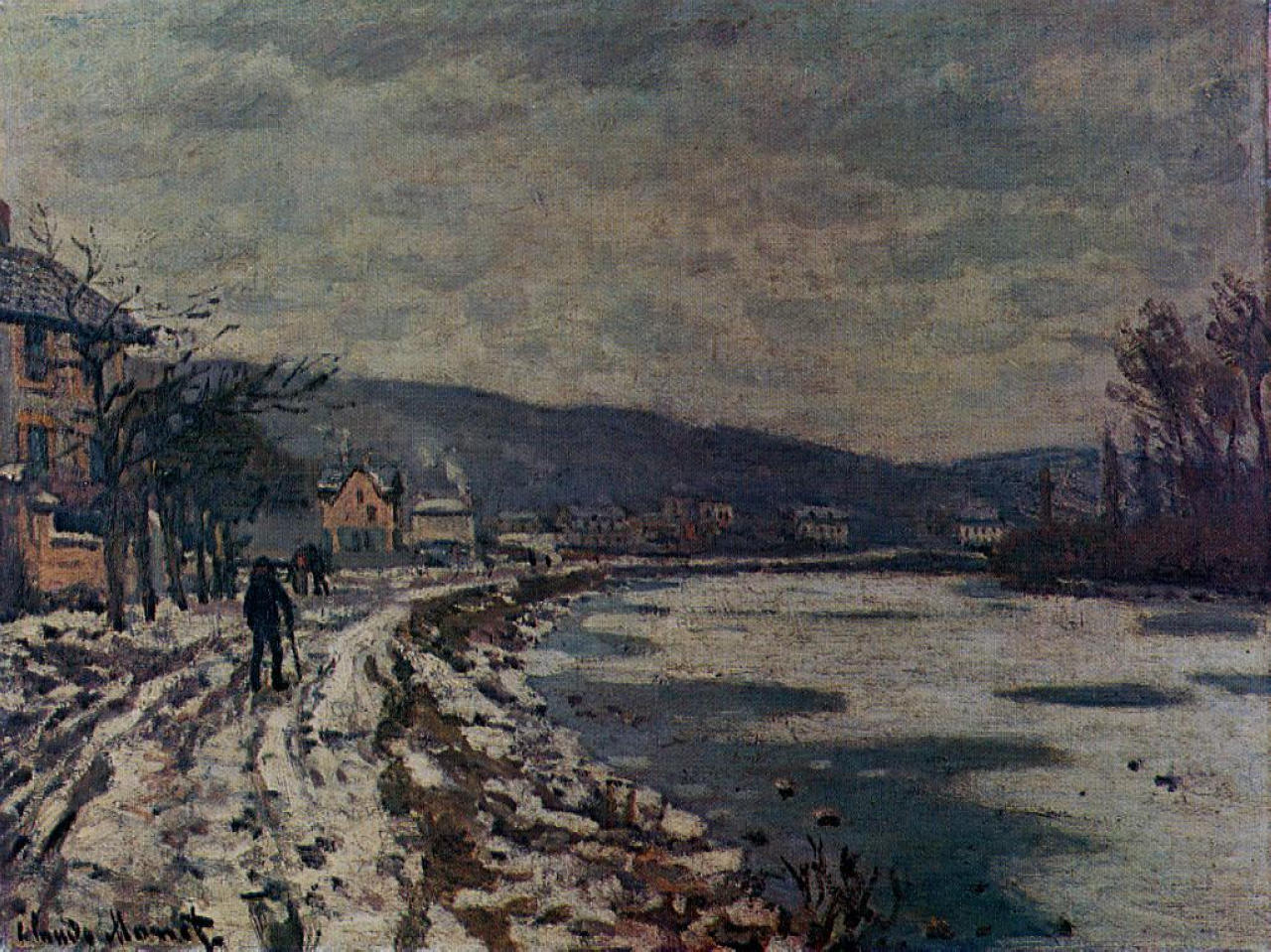
Claude Monet’s The Seine at Bougival, painted in 1869, is a remarkable example of the artist’s developing fascination with atmospheric conditions, natural light, and the subtle relationship between landscape and human experience. Depicting a quiet stretch of the Seine River near Bougival, a picturesque village west of Paris, the painting captures the restrained beauty of a winter landscape. Its subdued colors, snow-covered riverbank, overcast sky, and solitary human figure create a scene that feels both intimate and expansive.
Unlike the vibrant gardens and sunlit landscapes that would later become synonymous with Monet’s Impressionist masterpieces, The Seine at Bougival explores a more contemplative side of nature. The painting relies on muted grays, earthy browns, deep greens, and delicate touches of white to communicate the dampness and stillness of a cold winter day. The atmosphere is heavy with moisture, while the river reflects the subdued tones of the sky above.
Created during an important period in Monet’s artistic development, the painting demonstrates his growing commitment to representing nature as it appeared under specific conditions of light and weather. Rather than idealizing the landscape or transforming it into a dramatic historical setting, Monet concentrates on the visual qualities of an ordinary riverside scene. The result is an evocative image that invites viewers to experience the quiet beauty of a particular moment.
Through its composition, distinctive brushwork, atmospheric effects, and understated emotional character, The Seine at Bougival reveals many of the artistic principles that would eventually define Impressionism. It also offers a fascinating glimpse into the landscapes surrounding Paris during the nineteenth century, when riverside communities such as Bougival were becoming increasingly important subjects for modern French painters.
The Historical Context of The Seine at Bougival
When Claude Monet painted The Seine at Bougival in 1869, he was approaching a decisive turning point in his career. Born in Paris in 1840 and raised in Le Havre, Monet had spent much of the preceding decade developing an artistic language that challenged traditional approaches to landscape painting. His interest in natural light, outdoor observation, and rapidly changing atmospheric effects distinguished him from painters who preferred carefully constructed compositions completed primarily in the studio.
During the late 1860s, Monet frequently worked in and around the villages west of Paris, including Bougival, Louveciennes, and the surrounding Seine valley. These locations provided an extraordinary variety of subjects, from peaceful riverbanks and wooded roads to bridges, boats, houses, and fashionable leisure destinations. The region’s accessibility from Paris also made it attractive to artists interested in the changing relationship between the city and its surrounding countryside.
Bougival occupied a particularly interesting position within this landscape. Situated along a bend of the Seine, the village combined traditional rural features with the emerging culture of suburban recreation. Its waterfront, islands, and nearby establishments attracted visitors seeking relief from the increasingly crowded streets of Paris. For painters such as Monet, the area offered opportunities to explore both the natural environment and the visible transformations brought about by modern life.
The year 1869 was especially significant because Monet was experimenting with increasingly direct methods of depicting light and color. During the summer, he worked alongside Pierre-Auguste Renoir at La Grenouillère, a popular bathing and boating establishment near Bougival. Their paintings of the location explored broken brushstrokes, reflected light, and the constantly shifting appearance of water.
The Seine at Bougival presents a striking contrast to those lively summer scenes. Instead of recreational crowds, brilliant sunlight, and sparkling reflections, Monet depicts a subdued winter environment defined by silence and restraint. Nevertheless, both approaches reveal the same underlying concern with recording a specific visual experience rather than creating a timeless, idealized landscape.
A Detailed Description of the Painting
At first glance, The Seine at Bougival presents a broad view of a riverside landscape under a heavy, cloud-filled sky. The Seine occupies much of the right side of the composition, extending into the distance beneath low hills. Along the left bank, a snow-covered road or pathway curves gently away from the foreground toward a cluster of buildings and trees.
The foreground is dominated by an uneven mixture of snow, exposed earth, vegetation, and muddy tracks. Instead of presenting an immaculate white winter landscape, Monet emphasizes the irregular textures of the ground. Dark patches interrupt the snow, creating a convincing impression of a path that has been used by pedestrians despite the cold weather.
A solitary figure appears near the center-left portion of the painting, walking along the riverside path. Dressed in dark clothing, the individual provides an important human presence within the otherwise quiet environment. Although relatively small compared with the surrounding landscape, the figure immediately attracts attention because of its dark silhouette against the lighter snow.
To the left, a row of leafless trees extends along the road, their delicate branches reaching into the gray sky. Several buildings stand behind these trees, including structures with warm, reddish-brown walls and darker roofs. Farther into the distance, additional houses and architectural forms become increasingly indistinct as they merge with the muted colors of the landscape.
Across the river, a cluster of dark trees occupies the right edge of the composition. Their bare branches and dense silhouettes provide a visual counterweight to the buildings and roadside trees on the opposite bank. Behind them, gently rolling hills stretch across the horizon, creating a sense of depth without overwhelming the scene.
Above everything, the sky occupies a substantial portion of the canvas. Broad layers of gray, blue, and slightly warmer cloud tones suggest unsettled winter weather. The absence of direct sunlight produces a remarkably unified atmosphere, allowing Monet to explore subtle relationships between the colors of the sky, water, snow, and distant landscape.
Composition and the Movement of the Viewer’s Eye
One of the most effective features of The Seine at Bougival is its carefully organized composition. Monet uses the natural curve of the riverbank and the adjoining pathway to guide the viewer’s attention from the immediate foreground into the distant landscape. This creates a visual journey that mirrors the experience of walking beside the Seine.
The path begins near the lower-left corner of the painting and curves toward the center. Its irregular edges, dark wheel tracks, and scattered patches of snow establish a strong sense of perspective. As the road narrows into the distance, it draws the viewer toward the buildings and distant riverbank.
The Seine follows a broadly similar direction, reinforcing the composition’s movement into depth. However, the river’s broad surface contrasts with the narrow, textured pathway. This difference creates a pleasing balance between open space and concentrated detail, allowing the viewer’s eye to move naturally between the two areas.
The solitary pedestrian serves as an important focal point. Positioned along the path rather than at the center of the canvas, the figure introduces an element of human scale without interrupting the landscape’s overall harmony. Its presence helps viewers imagine the physical dimensions of the road, trees, buildings, and river.
Monet also carefully balances the vertical and horizontal elements of the composition. The tall roadside trees on the left and the darker tree group on the right frame the broad horizontal bands formed by the river, hills, and clouds. This arrangement creates stability while preserving the natural irregularity of the landscape.
The distant hills provide another important compositional element. Their gentle rise and fall prevent the horizon from becoming rigid or monotonous, while their dark tones separate the sky from the lighter surfaces below. The hills also create a gradual transition between the relatively detailed foreground and the more atmospheric background.
The overall composition feels spontaneous, yet its visual organization is remarkably sophisticated. Monet transforms an ordinary riverside view into a unified image through the careful placement of roads, trees, buildings, water, and atmospheric space.
The Winter Atmosphere and Its Emotional Impact
The winter atmosphere is perhaps the most memorable characteristic of The Seine at Bougival. Rather than depicting the brilliant white snow associated with picturesque winter scenes, Monet presents a damp, overcast environment in which cold air seems to permeate every element of the landscape.
The snow appears thin and uneven, suggesting either a recent snowfall or a period of partial melting. Brown earth, dark vegetation, and muddy tracks remain visible throughout the foreground. These details contribute to the painting’s realism, capturing the imperfect and transitional character of winter weather.
The sky reinforces this impression of uncertainty. Its broad, gray cloud formations suggest an atmosphere filled with moisture, while the absence of strong shadows indicates heavily diffused daylight. The scene appears to unfold during a quiet interval when the weather is neither dramatically stormy nor completely settled.
This subdued atmosphere gives the painting an introspective emotional quality. The solitary pedestrian, the deserted river, and the bare trees create a sense of isolation, but the scene does not necessarily communicate sadness. Instead, it suggests the peaceful solitude that can accompany a winter walk through familiar surroundings.
Monet’s restrained treatment of color contributes significantly to this emotional effect. The landscape feels hushed because no single area is illuminated by dazzling sunlight or dominated by brilliant color. Every element participates in the same atmospheric conditions, creating a sense of unity and stillness.
The painting also captures a particular quality of winter light that is difficult to express through conventional landscape techniques. The snow is not simply white, the shadows are not completely black, and the sky contains numerous subtle variations. Monet recognizes that winter transforms the relationships between colors, making even ordinary objects appear different under the influence of cold, diffuse illumination.
Color Palette: The Beauty of Muted Tones
Although Claude Monet is frequently celebrated for his vibrant blues, greens, yellows, and pinks, The Seine at Bougival demonstrates his ability to create compelling visual effects through a comparatively limited palette. The painting’s dominant colors include smoky gray, muted blue, olive green, earthy brown, and subdued white.
The sky establishes the general color harmony. Its mixture of cool grays and faintly warmer tones creates an atmospheric foundation that influences the appearance of the river and surrounding landscape. Instead of separating objects through sharply contrasting colors, Monet allows related shades to connect different areas of the composition.
The Seine reflects this muted environment. Its surface contains grayish blues, pale silvery tones, and darker patches that suggest reflections, changes in water movement, or the interruption of the surface by shadows and other natural effects. These variations prevent the river from appearing flat despite the subdued lighting.
The snow provides some of the composition’s lightest passages. However, Monet avoids painting it as a uniform layer of pure white. Its surface includes gray, beige, brown, and faintly bluish tones, acknowledging the influence of surrounding objects, exposed ground, and atmospheric light.
The buildings along the left bank introduce a restrained warmth. Their ochre and reddish-brown surfaces create subtle contrasts with the cooler river and sky. These warmer accents help establish visual interest without disturbing the painting’s overall tonal harmony.
Dark greens, browns, and nearly black tones define the trees and the figure on the path. These deeper colors anchor the composition and create points of contrast against the pale snow. Their distribution across the canvas also helps maintain balance between the left and right sides.
Monet’s achievement lies in revealing how expressive a subdued palette can become when its colors are carefully related. The painting demonstrates that atmospheric beauty does not depend on intense saturation, but can emerge from the delicate interaction of closely connected tones.
Light and the Impressionist Study of Atmosphere
Light plays a central role in The Seine at Bougival, even though the painting contains no obvious source of direct sunshine. The illumination is filtered through thick cloud cover, producing soft transitions between light and shadow throughout the landscape.
This diffused lighting allows Monet to explore the effects of atmosphere on color and visibility. Objects in the foreground possess stronger contrasts and more recognizable forms, while distant houses, trees, and hills appear increasingly softened. The landscape gradually loses definition as it recedes, suggesting the presence of moisture in the winter air.
The treatment of the river is particularly revealing. Rather than representing the water as a transparent substance with clearly defined depths, Monet emphasizes its reflective surface. The river becomes a broad field of shifting tones that responds to the color and brightness of the sky.
The snow-covered ground provides another opportunity to investigate reflected light. Its irregular surface catches the pale illumination in different ways, producing small passages of brightness surrounded by darker earth and shadow. The resulting pattern gives the foreground a sense of physical texture and visual complexity.
Monet also avoids the dramatic contrasts associated with traditional landscape painting. There are no theatrical shafts of sunlight breaking through the clouds, and the darkest areas remain connected to the general tonal structure. This restraint makes the lighting feel convincing and appropriate to the observed weather.
Such attention to the changing appearance of ordinary landscapes became a defining concern of Impressionism. Although the movement would not receive its famous name until 1874, Monet was already developing the observational methods that would later distinguish his mature work.
In The Seine at Bougival, light is not merely a device for illuminating objects. It becomes the unifying force that determines how the entire landscape is perceived.
Brushwork and the Development of Monet’s Painting Technique
The brushwork in The Seine at Bougival reveals an artist increasingly interested in the expressive possibilities of direct observation. Rather than defining every object through precise outlines and carefully blended surfaces, Monet uses varied brushstrokes to suggest texture, form, and atmospheric effects.
The foreground displays some of the painting’s most active handling. Short, irregular strokes create the impression of snow, mud, vegetation, and exposed earth. These marks are particularly effective because they reflect the uneven physical character of the terrain.
Along the riverbank, the brushwork becomes more fragmented, emphasizing the transition between solid ground and water. Dark strokes indicate rocks, plants, and irregular shoreline features, while lighter passages suggest snow or reflected illumination. This combination gives the bank a convincing sense of roughness.
The trees are represented through thin, angular lines and darker masses. Their branches appear almost calligraphic against the pale sky, allowing Monet to describe their winter appearance without rendering every twig individually. The contrast between these linear elements and the broader treatment of the clouds creates visual variety.
The distant landscape is handled with greater restraint. Buildings and trees gradually merge into simplified shapes, while the hills are described through broad tonal areas rather than intricate detail. This approach strengthens the impression of atmospheric distance.
The sky and river contain relatively broad, blended passages, although subtle variations remain visible throughout their surfaces. Their softer handling contrasts with the more energetic foreground, helping distinguish between different textures and distances.
These technical decisions reveal Monet’s movement toward an increasingly independent treatment of paint. The brushstroke begins to function as both a representation of the visible world and an expressive element in its own right.
The Seine River as a Central Subject
The Seine River occupies a fundamental place in Claude Monet’s artistic development. From his early landscapes near Paris to his later representations of bridges, boats, and riverbanks, the Seine provided an ideal environment for studying reflections, movement, and changing light.
In The Seine at Bougival, the river is not presented as a spectacular natural wonder. Its broad, quiet surface contributes to the painting’s atmosphere of stillness, while its gentle movement creates subtle variations in color and reflection.
The absence of prominent boats or recreational activity is especially significant when compared with Monet’s other paintings of the Bougival area. Here, the river becomes an almost meditative presence, emphasizing the ordinary rhythms of the landscape rather than the social activities associated with fashionable riverside destinations.
The river also establishes an important visual relationship between the foreground and distant hills. Its broad expanse opens the composition, preventing the dense trees and buildings from making the landscape feel confined. The viewer experiences the Seine as a corridor of space extending toward the horizon.
Another notable feature is the relationship between the water and the winter sky. Their similar tones suggest that both belong to the same atmospheric environment, while their differing textures preserve their individual identities. The river reflects the sky without becoming a simple mirror.
For Monet, water would eventually become one of the most important subjects of his career. His later paintings of the Thames, the Seine, and the water lily pond at Giverny demonstrate an increasingly radical interest in reflected light and the dissolution of solid forms.
The Seine at Bougival represents an early stage in this exploration, when the river still belongs to a recognizable landscape but already offers opportunities for investigating the instability of visual appearances.
The Solitary Figure and the Human Presence in Nature
The darkly dressed figure walking along the riverbank introduces a subtle narrative dimension into The Seine at Bougival. Although the person’s identity and destination remain unknown, their presence encourages viewers to imagine the experience of moving through the cold landscape.
The figure appears small in relation to the surrounding environment. This difference in scale emphasizes the breadth of the river, the height of the trees, and the considerable distance extending toward the horizon. At the same time, the pedestrian provides a familiar point of reference that makes the scene more accessible.
The person’s dark clothing contrasts sharply with the snow-covered pathway. This tonal difference draws attention to the figure without requiring detailed facial features or elaborate gestures. Monet communicates human presence through silhouette, posture, and placement.
The figure’s apparent movement along the road contributes to the painting’s sense of continuity beyond the represented moment. The viewer can imagine the pedestrian having traveled from somewhere outside the picture and continuing toward the distant buildings. The landscape consequently feels like part of a larger, inhabited world.
The emotional significance of the figure remains open to interpretation. It may suggest solitude, perseverance, quiet reflection, or simply an ordinary journey through a familiar environment. Monet does not impose a specific story, allowing the pedestrian to function as both an individual presence and a compositional element.
This understated approach distinguishes the painting from traditional narrative landscapes, in which figures often enact recognizable religious, historical, or mythological events. In Monet’s work, everyday life becomes worthy of artistic attention without requiring an extraordinary incident.
The solitary walker ultimately strengthens the painting’s contemplative mood. Surrounded by bare trees, winter clouds, and the quiet Seine, the figure evokes the personal experience of encountering nature during a cold, subdued day.
Snow, Mud, and the Realism of the Winter Landscape
One of the most compelling aspects of The Seine at Bougival is Monet’s refusal to idealize the winter landscape. Instead of covering the ground with a flawless blanket of snow, he depicts the complicated mixture of frozen precipitation, mud, vegetation, and exposed earth that characterizes many winter environments.
The pathway contains irregular tracks and dark patches that suggest previous movement through the snow. These details convey the practical reality of a riverside road used by local inhabitants, rather than an untouched wilderness designed solely for picturesque appreciation.
The uneven distribution of snow also contributes to the painting’s sense of changing weather. Some areas appear relatively clear, while others retain pale coverings that reflect the diffused daylight. This variation suggests that the landscape has been influenced by temperature, moisture, and human activity.
Monet’s interest in such transitional conditions reveals his sensitivity to the temporary character of natural appearances. Snow changes rapidly as it melts, becomes compacted, or mixes with the ground beneath it. Capturing these effects requires close attention to the immediate visual environment.
The contrast between dark earth and pale snow creates rhythmic patterns across the foreground. These patterns are not merely descriptive, but also contribute to the composition’s energy and depth. Their irregular arrangement prevents the lower portion of the painting from becoming visually static.
The treatment of winter terrain also demonstrates Monet’s commitment to finding beauty in ordinary surroundings. Muddy pathways and leafless vegetation might seem unremarkable subjects, yet their textures and colors become compelling when examined through the artist’s attentive observation.
This appreciation of everyday natural phenomena would remain central to Monet’s career. Whether painting snow, sunlight, water, or flowers, he repeatedly demonstrated that the familiar world contained an extraordinary range of visual experiences.
Bougival and the Changing Landscape of Nineteenth-Century France
The village of Bougival provides more than a picturesque setting for Monet’s painting. Its location along the Seine places the work within the broader history of nineteenth-century France, when expanding transportation networks and changing patterns of leisure were transforming the countryside surrounding Paris.
During this period, riverside communities became increasingly accessible to urban residents. Rail connections and improved routes encouraged excursions beyond the capital, allowing visitors to enjoy boating, dining, swimming, and walks along the Seine.
These developments attracted numerous artists who recognized the visual possibilities of the region. Bougival and nearby towns offered a mixture of traditional rural architecture, wooded landscapes, cultivated land, and modern recreational activity. Such environments reflected the evolving relationship between city life and the natural world.
In The Seine at Bougival, Monet emphasizes the quieter side of this transformation. The buildings and established pathway indicate a landscape shaped by human settlement, yet the absence of crowds gives the scene a peaceful, almost rural character.
The painting therefore occupies an interesting position between pastoral landscape and modern suburban view. It neither ignores human development nor makes technological progress its principal subject. Instead, Monet presents a place where natural and constructed elements coexist within a shared atmosphere.
The architecture along the riverbank contributes to this impression. Houses and other structures appear integrated into the landscape rather than isolated as dominant landmarks. Their colors and forms participate in the overall composition, reinforcing the connection between human habitation and the surrounding environment.
This sensitivity to modern landscapes was an important characteristic of Impressionist painting. Artists increasingly recognized that contemporary life, including its ordinary surroundings and seasonal changes, could provide subjects as meaningful as the historical scenes celebrated by academic institutions.
The Influence of Earlier Landscape Traditions
Although The Seine at Bougival anticipates many characteristics of Impressionism, it also reveals Monet’s connections to earlier landscape painting traditions. His attention to weather, tonal harmony, and everyday rural subjects reflects artistic developments that had been transforming French landscape painting throughout the nineteenth century.
The Barbizon painters, including Jean-Baptiste-Camille Corot, Théodore Rousseau, and Charles-François Daubigny, helped establish the importance of close observation of nature. Their landscapes frequently emphasized atmospheric unity, subdued colors, and the distinctive character of specific environments.
Monet inherited aspects of this observational approach while gradually developing a more direct and experimental painting technique. Like his predecessors, he recognized that ordinary landscapes could possess emotional and aesthetic significance without requiring idealized compositions.
The influence of Dutch landscape painting also provides a useful context for understanding the work’s expansive sky and restrained tonal structure. Seventeenth-century Dutch painters frequently explored cloudy weather, waterways, and the relationship between small human figures and broad natural environments.
However, Monet’s approach differs from these traditions in its increasingly visible brushwork and emphasis on the immediate sensation of light. Rather than organizing the landscape according to a predetermined ideal, he allows the particular conditions of the scene to influence the painting’s appearance.
The result is a work that connects historical landscape traditions with the experimental ambitions of modern painting. Its compositional stability recalls earlier approaches, while its atmospheric sensitivity points toward the innovations that would define Monet’s mature career.
Comparing The Seine at Bougival with Monet’s La Grenouillère
A particularly illuminating comparison can be made between The Seine at Bougival and Monet’s paintings of La Grenouillère, also created in 1869. Although both subjects belong to the same geographical area, they reveal dramatically different aspects of the Seine and demonstrate the artist’s versatility.
In La Grenouillère, Monet depicts a lively recreational environment filled with boats, visitors, and shimmering water. The paintings are characterized by relatively bright colors, energetic brushwork, and complex patterns of reflected sunlight. Their atmosphere communicates the movement and social activity of a popular summer destination.
By contrast, The Seine at Bougival presents a quiet winter landscape in which human activity is minimal. The subdued palette, overcast sky, and snow-covered ground create a restrained mood that differs considerably from the brightness of Monet’s summer river scenes.
Despite these differences, the paintings share several important artistic concerns. In both cases, Monet studies the relationship between water and light, using variations in brushwork and color to describe fleeting natural appearances.
The contrasting seasons also demonstrate how profoundly weather can transform the identity of a place. The same river that sparkles beneath summer sunshine can appear muted and almost motionless beneath winter clouds. Monet recognizes that the visual character of a landscape depends on conditions that are continually changing.
These paintings collectively reveal the foundations of his lifelong interest in repeated observation. Although he had not yet developed the systematic series paintings associated with his later career, his work around Bougival already demonstrates a fascination with how a familiar environment can produce radically different visual experiences.
The Emotional Meaning of Silence and Solitude
Beyond its technical accomplishments, The Seine at Bougival possesses a quiet emotional resonance. Its atmosphere encourages contemplation, drawing attention to the relationship between solitude, seasonal change, and the passage of time.
The deserted appearance of the riverbank creates a sense of peaceful separation from the activity of everyday life. The solitary pedestrian reinforces this impression, suggesting an individual moving through a landscape that continues independently of human concerns.
The bare trees contribute to the painting’s seasonal symbolism. Their exposed branches reveal the structural forms normally concealed by foliage, while their dark silhouettes emphasize the temporary absence of spring and summer growth. The landscape appears dormant rather than lifeless.
The snow-covered pathway introduces another possible interpretation. Its tracks suggest previous activity, reminding viewers that the scene belongs to a continuing sequence of human movement and natural transformation. The moment represented by Monet is temporary, even though the painting preserves it visually.
The muted colors further encourage introspection. Without brilliant sunlight or striking contrasts, the viewer’s attention shifts toward subtle variations in atmosphere and texture. The painting rewards patient observation, gradually revealing complexity beneath its apparently simple subject.
Such qualities contribute to the enduring appeal of Monet’s landscapes. His paintings often communicate emotion indirectly, through the appearance of light, weather, and space rather than through explicit symbolic narratives.
In The Seine at Bougival, the emotional experience remains understated. The work invites viewers to appreciate a quiet winter moment without prescribing how they should feel about it.
The Painting’s Place in the Development of Impressionism
The Seine at Bougival belongs to the formative period preceding the official emergence of Impressionism. The movement would become publicly identified with its first independent group exhibition in Paris in 1874, but many of its essential ideas were already being explored during the preceding decade.
Monet’s approach to this winter landscape demonstrates several characteristics that would become central to Impressionist painting. He concentrates on a recognizable location, investigates atmospheric effects, employs varied brushwork, and treats an ordinary scene as a subject worthy of sustained artistic attention.
The painting also reveals a transitional quality. Its relatively dark palette and substantial tonal contrasts retain connections to earlier landscape traditions, while its handling of snow, reflections, and distant forms anticipates Monet’s increasingly experimental treatment of color and light.
This combination makes the work especially valuable for understanding his artistic development. Impressionism did not emerge suddenly as a complete rejection of earlier painting methods. It developed through sustained observation, technical experimentation, and a gradual reconsideration of how visual experience could be represented.
Monet’s later works would frequently employ brighter colors, more fragmented brushstrokes, and compositions in which solid objects seem to dissolve into atmospheric effects. Nevertheless, the fundamental concerns visible in The Seine at Bougival remained central to his artistic identity.
The painting demonstrates that Impressionism was not simply a style associated with sunshine and vivid color. At its core, the movement involved an effort to understand how changing conditions of light and atmosphere influence human perception.
By capturing the subdued beauty of a winter day along the Seine, Monet shows that these principles could be applied to even the quietest and most restrained landscapes.
Why The Seine at Bougival Remains Significant
The lasting significance of The Seine at Bougival lies in its combination of careful observation, atmospheric sensitivity, and emotional understatement. It reveals Claude Monet at an important stage of his artistic development, exploring techniques and visual relationships that would become fundamental to his mature work.
The painting is particularly compelling because it offers a different perspective on an artist commonly associated with colorful gardens, flowering landscapes, and brilliant reflections. Its subdued winter palette demonstrates Monet’s ability to discover beauty in conditions that might initially appear gloomy or unremarkable.
The composition also illustrates his sensitivity to the relationship between human presence and natural space. The solitary figure, winding path, riverside buildings, and distant hills create a convincing environment that feels both inhabited and peaceful.
Monet’s handling of snow and atmospheric light deserves special attention. By incorporating subtle variations of gray, brown, blue, and white, he communicates the physical character of winter without relying on dramatic effects. The result is a landscape that feels observed rather than invented.
The work also preserves a glimpse of the Seine valley during a period of significant cultural and environmental transformation. Bougival’s combination of rural scenery and accessible riverside settlement made it an ideal subject for artists interested in contemporary French life.
Perhaps most importantly, The Seine at Bougival demonstrates Monet’s conviction that ordinary moments can become extraordinary through attentive observation. A winter road, an overcast sky, and a quiet river are transformed into a sophisticated investigation of color, space, and atmosphere.
Conclusion: The Quiet Beauty of Monet’s Winter Landscape
Claude Monet’s The Seine at Bougival (1869) stands as a compelling example of his early mastery of landscape painting and his developing interest in the changing effects of natural light. Through its carefully structured composition, muted palette, atmospheric depth, and expressive brushwork, the painting captures the distinctive character of a winter day beside the Seine.
Its beauty emerges from restraint rather than spectacle. The snow-covered pathway, dark trees, distant houses, solitary pedestrian, and broad river are united by the soft illumination of an overcast sky. Every element contributes to an atmosphere of quiet observation and seasonal stillness.
The painting also offers an important perspective on Monet’s artistic evolution. While his later masterpieces would become celebrated for their luminous colors and increasingly abstract treatment of nature, The Seine at Bougival demonstrates that his fascination with light and perception was already firmly established in 1869.
By focusing on an ordinary winter landscape, Monet reveals the extraordinary visual richness concealed within familiar surroundings. His ability to capture subtle changes in color, texture, and atmosphere transforms the riverside scene into a meditation on the relationship between nature, human experience, and the passage of time.
Ultimately, The Seine at Bougival reminds viewers that the beauty of landscape painting does not depend on dramatic scenery or brilliant sunshine. Sometimes, the most memorable artistic experiences emerge from a quiet river, a cloudy sky, and the fleeting stillness of an ordinary winter afternoon.