Image source: wikiart.org
Introduction to The Bridge at Bougival by Claude Monet
Claude Monet’s The Bridge at Bougival, painted in 1869, captures a moment of transition in both the artist’s career and the history of modern painting. At first glance, the work presents a quiet riverside scene: a road curves across a bridge, figures move through the village, trees rise against a restless sky, and water glimmers at the edge of the composition. Yet beneath this everyday subject is a remarkably fresh way of seeing. Monet does not treat Bougival as a fixed architectural view or a carefully polished landscape. He treats it as a living impression, a place shaped by sunlight, movement, atmosphere, and the quick sensations of modern life.
Bougival, located along the Seine west of Paris, became one of the important sites for painters who were searching for new subjects outside the studio. It offered a blend of rural calm and modern leisure, with bridges, riverbanks, houses, gardens, roads, and passing figures. In this painting, Monet is not simply recording the appearance of a village. He is studying how light breaks across road, water, foliage, rooftops, and clothing. The scene feels casual, almost accidental, as though the viewer has paused for a moment on a walk and noticed the shimmer of the day.
The date of 1869 places the painting at a crucial moment. Monet was still developing the visual language that would later become central to Impressionism. The brushwork is loose, the surface is energetic, and the composition avoids the theatrical grandeur of traditional landscape painting. Instead of idealizing the countryside, Monet looks closely at a specific place under specific weather. The result is a painting that feels both ordinary and revolutionary. It makes the everyday world worthy of deep attention.
The Setting of Bougival and the Seine
Bougival held special importance for Monet and other painters of his generation because it offered a perfect meeting point between nature and modernity. It was close enough to Paris to be accessible, yet removed enough to provide open skies, river views, and village roads. The Seine was not only a natural feature, but also a social and economic artery. Boats, bridges, houses, paths, and leisure activities gathered along its banks, creating a landscape that was neither fully urban nor purely rural.
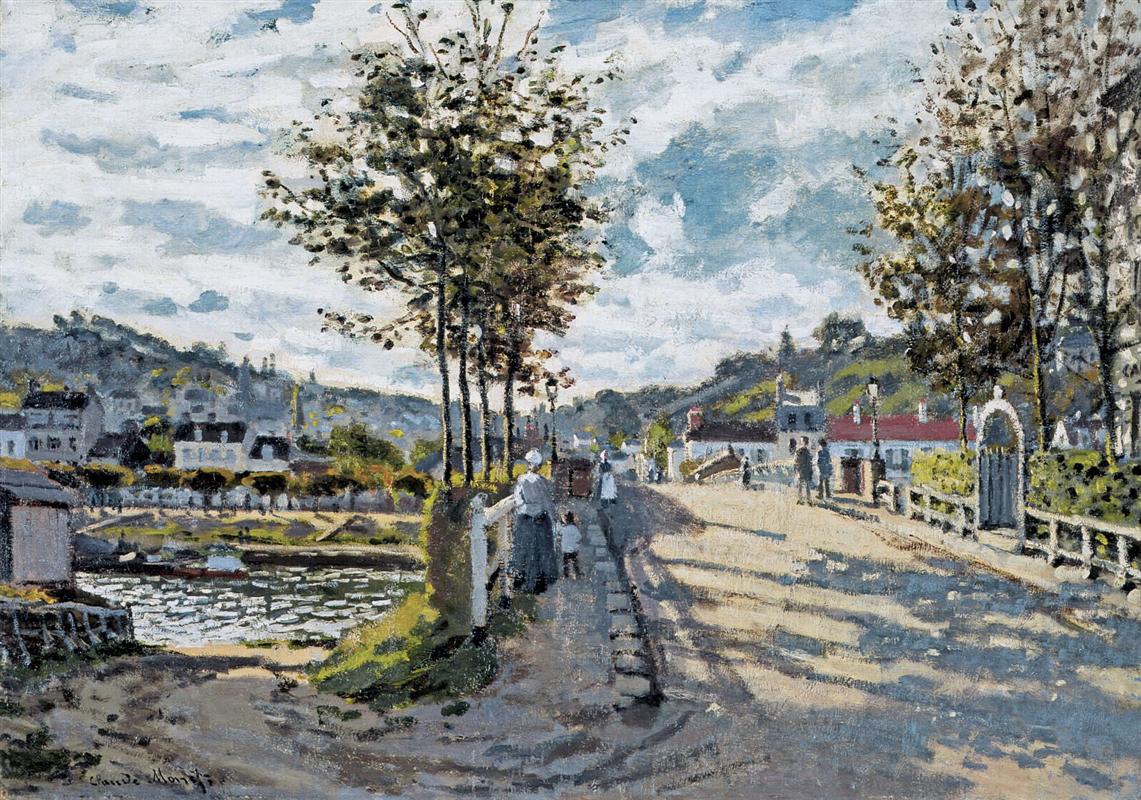
In The Bridge at Bougival, Monet shows this mixed identity with subtle clarity. The water appears on the left, broken by small touches of white and blue that suggest reflected light. The bridge and road occupy the center and right side, carrying the eye deeper into the scene. Houses and village structures sit beyond the river and along the roadside, while trees frame the space and add vertical rhythm. Bougival becomes a place of passage, where people, light, and landscape all seem to be moving.
The bridge itself is essential because it connects different zones of the painting. It links river and road, village and countryside, foreground and distance. Rather than presenting it as a monumental structure, Monet integrates it into the ordinary flow of the scene. It is part of daily life. People walk across it, shadows fall over it, and the road continues beyond it into the village. This ordinary function gives the painting its quiet modern feeling.
The Seine region also allowed Monet to explore reflections and changing atmospheric effects. Even though the water occupies a smaller portion of the image than the road, it plays a vital role in the visual balance. Its broken surface contrasts with the pale, dusty brightness of the bridge. The river gives the painting a sense of openness and coolness, while the road introduces warmth and social movement.
Composition and the Movement of the Eye
The composition of The Bridge at Bougival is carefully organized, even though it appears spontaneous. Monet uses the curve of the road and bridge to pull the viewer into the painting. The eye begins near the lower foreground, where patches of earth, stone, and shadow create a textured entry point. From there, the road rises and bends toward the middle distance, passing between figures, trees, buildings, and railings.
This curving path gives the painting a strong sense of depth. Rather than relying on a rigid central perspective, Monet allows the scene to unfold naturally. The road does not simply lead straight into the horizon. It bends, widens, catches light, and disappears among village forms. This creates a sense of lived space. The viewer feels invited to walk into the image rather than stand outside it.
The tall trees near the center form one of the painting’s strongest vertical accents. Their trunks rise from the edge of the bridge and break into clustered foliage against the sky. These trees help divide the composition without making it feel stiff. They anchor the middle ground, balancing the spreading road on the right and the water on the left. Their dark trunks also contrast with the pale sky and sunlit surfaces, giving the image structure.
On the right side, another group of trees and railings frames the road. This creates a visual corridor that guides the eye toward the distant village. The left side is more open, with water, houses, and a lower horizon. This contrast between enclosure and openness keeps the composition lively. Monet avoids symmetry, but he achieves balance through movement, color, and rhythm.
The small human figures are also placed with care. They are not portraits, but they animate the bridge and road. Their presence helps establish scale and gives the viewer a sense of ordinary life continuing within the landscape.
Light, Weather, and Atmosphere
Light is the true subject of The Bridge at Bougival. Monet paints the scene as a moment shaped by changing weather and shifting brightness. The sky is filled with clouds, but it is not dark or stormy. Instead, it suggests a day of broken sunlight, when clouds pass quickly and illuminate different parts of the landscape in uneven patches. This gives the painting its vibrant instability.
The road and bridge are especially important in the study of light. Pale creams, grays, blues, and warm earth tones spread across the surface, creating the effect of sunlight falling across stone and dust. Shadows from the trees stretch diagonally over the road, but they are not painted as heavy black shapes. They are made of blue, gray, and violet tones, suggesting that shadow itself is full of reflected light.
The sky is handled with loose, active brushwork. White, blue, and gray are placed in broken strokes, creating a sensation of moving air. Monet does not smooth the clouds into a polished backdrop. He allows the paint to remain visible, which makes the sky feel alive. It seems to belong to the same changing world as the river and road.
The foliage also reflects this atmospheric approach. The trees are not carefully outlined leaf by leaf. Instead, Monet builds them through clusters of dark and light touches. Some strokes suggest sunlit leaves, while others suggest branches or shadowed masses. The result is a natural effect that depends on sensation rather than exact description.
This treatment of light reveals Monet’s developing interest in perception. He is less concerned with what each object is in a stable sense and more concerned with how each object appears at a particular moment. The bridge, trees, houses, and figures are all shaped by the same passing conditions of weather and illumination.
Brushwork and the Emerging Impressionist Vision
The brushwork in The Bridge at Bougival shows Monet moving toward the style that would later define Impressionism. The paint is visibly applied in quick, broken strokes. Forms are suggested rather than tightly drawn. The surface of the painting remains active, allowing the viewer to sense the artist’s hand and the immediacy of observation.
This looseness is not carelessness. Monet uses broken brushwork to capture the instability of visual experience. Water flickers because it is made of small, scattered strokes. Leaves tremble because they are built from dabs and touches. The road glows because light and shadow are layered across it in visible marks. The painting does not try to hide its construction. Instead, its construction becomes part of its meaning.
In the foreground, the brushwork is especially varied. Some strokes are thick and rough, suggesting earth, stone, and uneven ground. Others are lighter and more fluid, allowing surfaces to merge into one another. This variation prevents the scene from becoming flat. It also gives the painting a tactile quality, as though the viewer can feel the roughness of the road and the damp brightness near the water.
The figures are treated with similar economy. Monet gives them just enough detail to suggest posture, clothing, and direction. They are absorbed into the atmosphere rather than isolated as individual characters. This is one of the painting’s most modern qualities. Human presence is important, but it is part of the total visual experience. People, trees, architecture, and light all share the same painterly language.
This approach challenged older expectations of finished painting. Traditional academic art often valued smooth surfaces, precise contours, and carefully modeled forms. Monet’s painting, by contrast, values freshness and optical truth. It suggests that a fleeting impression can be more truthful than a polished reconstruction.
The Role of the Bridge
The bridge in The Bridge at Bougival functions as both a physical structure and a visual idea. It is a place of crossing, connection, and movement. In the composition, it links the near foreground to the village beyond. Symbolically, it also reflects the transition between older landscape traditions and the modern vision Monet was helping to create.
The bridge does not dominate the painting in a dramatic way. It is not presented as an engineering marvel or historical monument. Instead, it is part of the everyday environment. Its value comes from how it organizes movement and light. The road surface catches the brightness of the day, while the railings and shadows create linear patterns that guide the eye.
A bridge is naturally suited to Monet’s interests because it combines structure and atmosphere. Its solid form gives the composition stability, but its location over water connects it to reflection, openness, and change. The bridge belongs to human construction, yet it is surrounded by trees, sky, and river. This balance between built form and natural effect is central to the painting.
The figures crossing or standing near the bridge add to this sense of passage. They suggest ordinary routines: walking, traveling, meeting, observing. Nothing dramatic happens, but the scene is full of quiet activity. The bridge becomes a stage for daily life, not in a theatrical sense, but in the sense that modern life unfolds through movement.
By choosing such a subject, Monet gives importance to the ordinary spaces of contemporary France. He does not need ruins, mountains, or mythological figures to create visual interest. A bridge at Bougival, seen under shifting light, is enough.
Color and Tonal Harmony
The color palette of The Bridge at Bougival is subtle but lively. Monet uses blues, grays, greens, whites, ochres, and muted reds to create a scene that feels fresh and atmospheric. The painting does not rely on strong dramatic contrast. Instead, its beauty comes from relationships between tones.
The sky introduces cool blues and whites that echo throughout the painting. These colors reappear in the road, the water, the shadows, and some of the clothing. This repetition unifies the composition. Even the shaded areas are not simply dark. They contain cool color, which helps the painting feel luminous.
The greens of the trees and hillside are varied rather than uniform. Some areas are deep and earthy, while others are touched with yellow or pale light. This variation suggests foliage seen in changing sunlight. The greens also balance the red roofs and warmer accents in the village buildings. These small touches of red are important because they add life to the middle distance without overpowering the scene.
The road and bridge contain some of the most interesting color relationships. At first, they may appear simply pale or beige, but closer attention reveals a mix of cream, gray, blue, lavender, and warm brown. Monet uses these colors to show how sunlight and shadow transform a surface. The road is not a single color because the eye does not experience it as a single color in nature.
The river on the left provides another cool counterpoint. Its broken reflections pick up sky tones, creating a shimmering area that contrasts with the more solid road. The water is not highly detailed, but its color and texture make it feel alive.
Modern Life in a Quiet Village Scene
One of the strengths of The Bridge at Bougival is the way it presents modern life without spectacle. The painting is not crowded, dramatic, or symbolic in an obvious way. Yet it is deeply modern because it focuses on a contemporary place and a passing moment. Monet shows people moving through a real environment shaped by roads, bridges, houses, and leisure.
The figures are small, but they matter. Their clothing and placement suggest everyday social presence. They walk along the road, stand near the bridge, or move toward the village. Their anonymity is part of the painting’s charm. Monet is not telling a story about specific individuals. He is showing the rhythm of public life.
This kind of subject was important to the development of modern painting. Instead of turning to historical events, religious narratives, or idealized pastoral scenes, Monet looked at the world around him. Bougival was not remote or timeless. It was a place connected to the modern experience of travel, leisure, and suburban expansion. The painting captures that world before it becomes fully urban, while it still retains the freshness of trees, water, and open sky.
The balance between rural and modern elements gives the painting emotional complexity. The river and trees suggest calm, while the road and bridge suggest movement. The village houses suggest settlement, while the open sky suggests change. This combination makes the scene feel both peaceful and alive.
Monet’s modernity lies in his refusal to overexplain. He lets the viewer experience the visual moment directly. The painting feels like a fragment of life, observed quickly but remembered vividly.
Monet’s Development in 1869
The year 1869 was important for Monet because he was still shaping his artistic identity. He had already shown a strong interest in outdoor painting, light, and contemporary subjects, but he was not yet the fully established Impressionist master later known for haystacks, cathedrals, water lilies, and serial studies. Works from this period reveal an artist testing how far he could push looseness, immediacy, and natural light.
The Bridge at Bougival belongs to this experimental phase. It has enough structure to remain legible and composed, but it also contains the freshness that would become central to Monet’s mature work. The brushwork is freer than traditional landscape painting. The subject is everyday rather than grand. The atmosphere is more important than narrative. These qualities point forward to Impressionism.
At the same time, the painting still has a strong sense of place. Monet does not dissolve the scene completely into color and light. The bridge, road, trees, houses, and figures remain recognizable. This balance between description and sensation is one of the reasons the painting is so compelling. It shows Monet at a moment when he was moving beyond conventional realism while still deeply connected to observation.
The painting also reflects Monet’s interest in working directly from nature. The image feels immediate because it seems based on direct looking rather than studio invention. The shifting sky, broken reflections, and casual arrangement of figures all suggest a scene captured in real time. This does not mean the painting is random. Rather, it shows how Monet transformed direct perception into a carefully organized visual experience.
The Emotional Mood of the Painting
The mood of The Bridge at Bougival is calm, bright, and slightly restless. It is not a serene image in the classical sense, because everything in it seems to vibrate with changing light. The clouds move, the water flickers, leaves shimmer, and shadows stretch across the road. The scene feels peaceful, but not still.
This emotional quality comes partly from the weather. The broken sky suggests a day that is neither completely sunny nor overcast. Light comes and goes, creating a sense of passing time. The viewer becomes aware that the moment will not last. In a few minutes, the shadows may shift, the figures may disappear, and the sky may change. Monet’s painting preserves this fragile interval.
The road also contributes to the mood. Roads naturally imply travel and continuation. Here, the road curves into the village, making the viewer feel that life extends beyond the frame. The painting does not feel closed. It feels like part of a larger world.
There is also a quiet human warmth in the scene. The figures are small and distant, but they prevent the landscape from feeling empty. The houses and bridge suggest community. The painting is not about isolation. It is about a place where nature and human life coexist.
The emotional power of the painting lies in its modesty. Monet does not force drama onto the scene. He trusts the beauty of ordinary perception. The result is a work that feels intimate, breathable, and gently luminous.
Why The Bridge at Bougival Matters
The Bridge at Bougival matters because it shows Monet discovering a new way to paint the modern landscape. The painting may seem simple in subject, but its artistic importance lies in how it transforms everyday scenery into a study of light, movement, and atmosphere. Monet takes a village bridge and turns it into an exploration of perception.
The work also demonstrates the shift away from traditional landscape painting. Earlier landscapes often sought ideal beauty, balanced composition, and smooth finish. Monet keeps balance, but he allows the surface to remain open and energetic. He values the sensation of the moment over polished permanence. This makes the painting feel alive.
For viewers today, the painting offers a clear view into the origins of Impressionism. It contains many of the movement’s defining concerns: outdoor observation, modern subject matter, broken brushwork, luminous color, and attention to fleeting effects. Yet it also has its own distinct personality. It is not merely an early step toward later masterpieces. It is a beautiful and complete work in itself.
The painting also reminds us that modern art did not begin only with radical abstraction or shocking subjects. Sometimes modernity entered painting through a road, a bridge, a patch of sunlight, and a few figures walking through a village. Monet’s achievement was to recognize that such moments were worthy of serious artistic attention.
In The Bridge at Bougival, the viewer encounters the world as Monet saw it: unstable, radiant, ordinary, and full of subtle beauty. The painting invites slow looking because its richness is not hidden in dramatic symbolism, but in the delicate relationship between light and place.
Conclusion
Claude Monet’s The Bridge at Bougival is a remarkable example of his early transformation of landscape painting. Painted in 1869, it captures a village scene along the Seine with freshness, movement, and atmospheric sensitivity. The bridge, road, trees, river, houses, and figures are all simple elements, but Monet combines them into a living impression of a specific day.
The painting’s power comes from its balance between structure and spontaneity. The curving road leads the eye through the composition, while the trees provide vertical rhythm and the river opens the scene to light. The brushwork is loose and visible, giving the surface vitality. The colors are subtle but beautifully connected, with blues, greens, grays, whites, and warm earth tones working together to create a unified atmosphere.
As an image of Bougival, the painting reveals a place where modern life and natural beauty meet. As a work by Monet, it reveals an artist on the edge of a new visual language. He is already moving toward the Impressionist belief that the fleeting effects of light are not secondary details, but the very heart of painting.
The Bridge at Bougival remains compelling because it turns an ordinary view into something deeply memorable. It asks the viewer to notice the way sunlight changes a road, the way clouds animate a sky, the way small figures give life to space, and the way a bridge can become a poetic link between movement, memory, and modern vision.
