Image source: wikiart.org
Introduction to The Dinner by Claude Monet
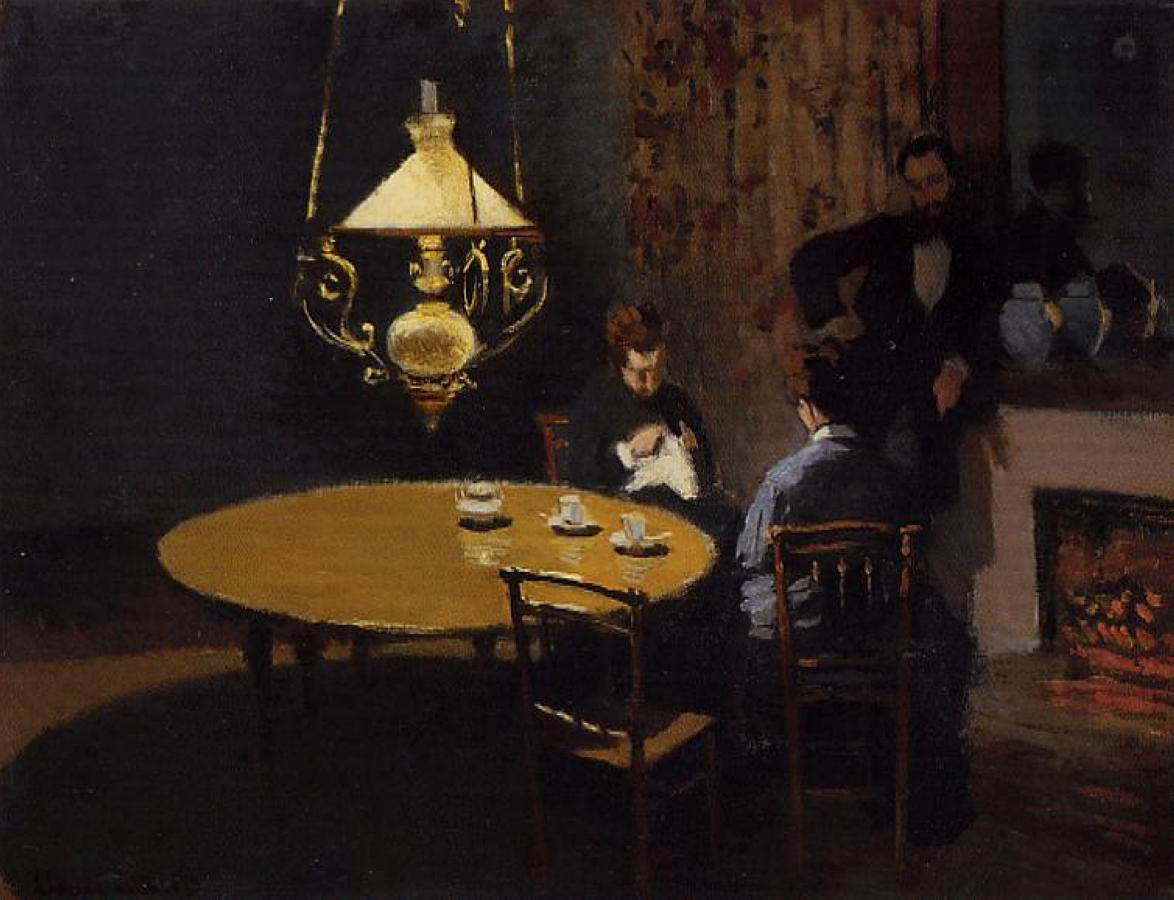
Claude Monet’s The Dinner, painted in 1869, is one of those early works that reveals how much of his later genius was already forming before Impressionism became a recognized movement. At first glance, the painting appears quiet and domestic: a family or small group seated around a dining table in a dark interior, illuminated by the glow of a hanging lamp and the warmth of a fireplace. Yet the more closely one looks, the more the painting becomes a study of atmosphere, intimacy, shadow, and modern life. Monet is not simply recording a meal. He is exploring how light shapes human presence, how private life can become pictorial drama, and how ordinary moments can carry emotional depth.
Unlike the outdoor landscapes that would later define Monet’s reputation, The Dinner takes place inside. The scene is enclosed, dimly lit, and filled with subdued tones. The room feels still, almost hushed. The figures are not theatrically posed. They seem caught in the middle of a real evening, absorbed in the rhythm of domestic life. The table dominates the foreground, its round surface glowing softly under the lamp. Cups, saucers, and small objects rest on it, suggesting that the meal is ending or has already ended. The people are pushed toward the right side of the canvas, partially submerged in shadow, while the lamp and table hold the visual center.
This arrangement gives the painting an unusual power. Monet does not present dinner as a scene of abundance or celebration. Instead, he makes it feel intimate, restrained, and contemplative. The room becomes a world of muted conversation, suspended gestures, and flickering light. In this sense, The Dinner is not only an image of private domesticity. It is also an early experiment in the artistic problems that would occupy Monet for the rest of his life: how to capture the visible world as it appears through light, atmosphere, and momentary perception.
The Historical Context of Monet’s Early Career
In 1869, Claude Monet was still a young artist struggling to establish himself. He had not yet become the celebrated painter of water lilies, haystacks, cathedrals, and shimmering riverbanks. His reputation was uncertain, his finances were unstable, and his artistic identity was still developing. This was the period when Monet was moving away from the polished conventions of academic painting and toward a more immediate, observational approach to modern life.
During the late 1860s, French painting was changing rapidly. The official Salon still dominated artistic success, but a younger generation of painters wanted to depict contemporary subjects in a more direct and natural way. Artists such as Édouard Manet, Pierre-Auguste Renoir, Frédéric Bazille, Alfred Sisley, and Monet were interested in modern people, modern clothing, everyday interiors, outdoor leisure, changing weather, and casual social spaces. They rejected overly idealized historical and mythological subjects in favor of scenes drawn from real life.
The Dinner belongs to this transitional moment. It is not yet fully Impressionist in the bright, broken, outdoor sense of Monet’s later work. The palette is dark, the atmosphere is enclosed, and the paint handling still has connections to Realism. Yet the painting already shows Monet’s fascination with fleeting visual effects. The glow of the lamp, the dimness of the room, the soft reflections on the table, and the indistinct figures all reveal an artist more interested in sensation than in exact description.
The work also reflects the importance of domestic modernity in nineteenth-century art. Instead of heroic public action, Monet turns to the private home. Instead of grand narrative, he studies a quiet evening. This shift matters because it places ordinary experience at the center of painting. A dinner table, a lamp, a few people, and a fireplace become worthy of serious artistic attention.
First Impressions of the Composition
The most striking feature of The Dinner is its composition. Monet places a large round table in the foreground, nearly empty of figures, while the people are gathered toward the right side and rear of the room. This choice creates a sense of distance between the viewer and the human subjects. We are not seated at the table with them. We are observing from across the room, as though standing quietly in the shadows.
The round table acts almost like a stage. Its warm ochre surface catches the light and becomes the brightest horizontal form in the painting. Yet the table is not crowded with food. Instead, it holds cups, saucers, and small dishes. This spareness gives the scene a feeling of aftermath. The central event may already have passed. What remains is the atmosphere after dinner, when conversation slows and the room grows quieter.
Above the table hangs a lamp, one of the most important visual elements in the painting. The lamp is both an object and a source of illumination. Its pale shade glows against the dark background, creating a strong contrast between light and shadow. The lamp also introduces a vertical axis that balances the round table beneath it. Together, the lamp and table form the structural core of the image.
The figures on the right create a counterweight to this central arrangement. One person sits near the table, another appears seated or leaning in the background, and a standing male figure occupies the shadowed area near the mantel. Their placement is informal and asymmetrical. Monet avoids the balanced, theatrical arrangement typical of academic interiors. Instead, he allows the room to feel naturally occupied, as though the figures have arranged themselves without concern for the viewer.
This asymmetry is central to the painting’s modern quality. The scene feels glimpsed rather than staged. Monet’s composition invites the viewer into a private moment without explaining it completely.
The Role of Light and Shadow
Light is the emotional and visual heart of The Dinner. The painting is built around two sources of illumination: the hanging lamp and the fireplace. These lights do not flood the room evenly. Instead, they create pockets of visibility surrounded by deep shadow. The lamp lights the table and part of the nearby space, while the fireplace provides a reddish warmth at the right edge of the composition.
This use of artificial light gives the painting an intimate atmosphere. Unlike daylight, which opens space and clarifies forms, lamplight narrows attention. It makes the room feel enclosed. It reveals certain objects while concealing others. The viewer becomes aware not only of what can be seen, but also of what remains hidden.
Monet’s treatment of darkness is especially important. The left side of the painting is almost entirely swallowed by shadow. The wall behind the lamp is dark, and the far areas of the room dissolve into vague tonal fields. Rather than carefully outlining every piece of furniture or architectural feature, Monet allows darkness to simplify the scene. This makes the illuminated table and lamp appear more intense.
The figures are also partially absorbed into shadow. Their faces and clothing are not described with crisp detail. Instead, Monet suggests their presence through patches of tone and touches of light. This approach gives them a quiet mystery. They are not portraits in the traditional sense. They are part of the room’s atmosphere.
The fireplace adds another kind of light. Its reddish glow contrasts with the golden light of the lamp. The fire suggests warmth, comfort, and domestic shelter, but it also heightens the depth of the shadows nearby. The painting therefore becomes a study in competing lights: pale lamp glow, warm firelight, and surrounding darkness. Monet uses these contrasts not simply to describe a room, but to create a mood.
Color and Tonal Harmony
The color palette of The Dinner is restrained, but it is far from simple. Monet works with dark browns, deep blacks, muted ochres, smoky blues, warm creams, and small accents of reddish orange. The painting does not rely on brilliant color. Instead, it depends on tonal relationships. The quiet harmony of the image comes from the way these muted colors interact under artificial light.
The table is the dominant color field. Its golden brown surface catches the lamp’s illumination and spreads across the lower center of the painting like a warm pool. This color gives the composition stability and warmth. It also contrasts with the darkness surrounding it, making the table feel physically present and emotionally central.
The lamp shade introduces a pale yellow-white note that stands out sharply against the dark background. This bright shape pulls the eye immediately. Yet it is not harsh. Monet softens its edges and allows its glow to merge with the surrounding air. The lamp becomes less a hard object than a luminous presence.
The figures are painted in darker, cooler tones. Black clothing, blue-gray fabric, and muted flesh tones keep them subdued. This allows the room itself, rather than the people alone, to become the subject. The seated figure in blue-gray offers a quiet chromatic contrast to the warm table and fireplace. The reddish fire at the far right provides a final color accent, enriching the painting with a sense of warmth and enclosure.
This subdued palette shows Monet’s sensitivity to indoor atmosphere. He understands that color changes under low light. Bright colors become softened. Edges become less distinct. Objects lose some of their individual identity and become part of a broader tonal environment. In The Dinner, color is not decorative. It is atmospheric.
The Figures and Their Emotional Presence
The people in The Dinner are essential to the painting, but Monet does not make them easy to read. They are present, yet withheld. Their expressions are not clearly visible. Their gestures are quiet. Their relationships are suggested rather than explained.
The seated woman near the center-right appears absorbed in a private action, possibly handling a napkin, cup, or small object. Her posture is contained. She does not look outward to the viewer. This inwardness contributes to the painting’s intimate mood. She seems part of the ordinary flow of household life, not a performer in a staged scene.
Another seated figure, seen from behind or in profile, occupies the chair closer to the viewer on the right. This figure’s back helps guide us into the composition. Because we cannot see the face clearly, we experience the scene from a slight distance. The viewer becomes an observer of social intimacy rather than a participant in it.
The standing man near the mantel is especially shadowed. His dark clothing blends with the background, and his form appears almost ghostlike. He is physically large but visually subdued. This creates an interesting tension: he occupies space, but he does not dominate the scene. The lamp and table remain more visually assertive than any single person.
This treatment of figures marks an important departure from traditional narrative painting. Monet does not use the figures to tell a clear story. Instead, they contribute to the atmosphere. Their presence gives the room life, but their emotional states remain open. Are they tired, relaxed, quiet, distracted, or merely passing time after a meal? Monet leaves the answer unresolved.
That ambiguity is part of the painting’s appeal. It makes the scene feel real. In daily life, people are often seen in half-light, in partial gestures, and in moments that do not declare their meaning. Monet captures that subtle reality.
Domestic Life as a Modern Subject
One of the most compelling aspects of The Dinner is its treatment of domestic life as a serious subject. The painting does not depict a grand historical event, a mythological scene, or an aristocratic ceremony. It shows an ordinary interior after or during a meal. Yet Monet gives this subject quiet dignity.
The nineteenth century saw a growing artistic interest in everyday life. Domestic interiors, family meals, reading rooms, cafés, gardens, and streets became important subjects because they reflected the changing experience of modern society. For Monet and his contemporaries, modernity was not only found in railways, boulevards, and public entertainment. It was also found in the private home, where new patterns of middle-class life unfolded.
In The Dinner, the home is not idealized into perfect comfort. The room is dark, somewhat crowded, and visually uneven. This realism makes it convincing. The table is not arranged like a still life of luxury. The figures are not elegantly posed for admiration. The room feels lived in. The fire burns, the lamp hangs low, and the chairs are positioned casually around the table.
This everyday quality makes the painting feel modern. Monet is interested in how life actually looks, not how it should appear according to academic ideals. The painting’s beauty comes from its honesty. It finds visual richness in dimness, silence, and ordinary objects.
The dinner table also carries symbolic weight. It suggests family, routine, nourishment, and social connection. Yet in this painting, the table is partly empty and the figures are somewhat distant from it. This creates a delicate emotional tension. The table is the center of domestic life, but the people seem dispersed around it. The scene feels connected and isolated at the same time.
Realism and the Beginnings of Impressionism
The Dinner stands at the crossroads between Realism and Impressionism. Its subject, palette, and domestic setting connect it to the Realist tradition, especially the interest in ordinary people and everyday environments. But Monet’s handling of light, atmosphere, and visual uncertainty points toward Impressionism.
Realism sought to represent modern life without idealization. Monet shares that impulse here. He does not beautify the scene in a conventional way. He paints a dark room, a plain table, and figures absorbed in ordinary activity. There is no dramatic moral lesson. There is no polished academic finish. The painting values the truth of a moment.
At the same time, Monet is already moving beyond Realism’s descriptive emphasis. He is less interested in exact detail than in perception. The objects on the table are quickly suggested. The figures are blurred by shadow. The wall covering in the background is loosely indicated. The viewer senses the room through patches of color and light rather than through precise outlines.
This is where Monet’s future becomes visible. Impressionism would later focus on the changing effects of light, the mobility of vision, and the immediacy of painted sensation. Although The Dinner is darker and more interior than Monet’s later works, it shares that concern with how things appear at a particular moment under particular conditions.
The lamp is a key example. Monet does not merely paint the object. He paints its effect on the room. The table glows because of it. The surrounding darkness deepens because of it. The figures become partially visible because of it. The entire scene depends on a temporary condition of light. This sensitivity to visual experience is fundamentally Impressionist in spirit.
The Table as the Center of the Painting
The round table is more than furniture. It is the compositional and symbolic anchor of The Dinner. Its size, placement, and color make it impossible to ignore. It occupies the foreground like a glowing island within the dark room.
Because the table is round, it creates a sense of gathering. Round tables imply conversation, equality, and shared space. Everyone seated around them belongs to the same circle. Yet Monet complicates this idea by leaving much of the table empty. The figures are gathered mostly to one side, and the viewer sees the broad surface without a full social circle around it.
This emptiness is visually powerful. It gives the painting a mood of pause. The meal may be finished. The conversation may have slowed. The table holds traces of use, but not abundance. Cups and saucers suggest social ritual, perhaps coffee or tea after dinner. These small objects become evidence of human presence.
The table also controls the viewer’s movement through the painting. Its curved edge leads the eye across the lower part of the canvas. From there, the eye rises to the lamp, then moves toward the figures and fireplace on the right. Monet uses the table to organize space without making the composition feel rigid.
The warm color of the table contrasts with the darkness around it, giving it a quiet emotional warmth. It is the place where light gathers. It is also the place where domestic life has recently taken place. Even though the figures are not centered on it, the table remains the heart of the room.
The Atmosphere of Silence and Intimacy
The emotional tone of The Dinner is difficult to define, which is one reason the painting is so intriguing. It is warm, but not cheerful. It is intimate, but not sentimental. It is quiet, but not empty. Monet creates a mood of suspended domestic silence.
Much of this atmosphere comes from the low light. Dim interiors naturally slow the eye. They invite contemplation. The viewer must adjust to the darkness and search for forms. This process mirrors the experience of entering a softly lit room in real life. Details emerge gradually. The painting rewards patience.
The gestures of the figures also contribute to the silence. No one appears to be speaking dramatically. No one turns outward. The people seem enclosed within their own thoughts or routines. This creates a sense of privacy. We are allowed to see the scene, but not to fully enter it.
The fire adds comfort, while the shadows add mystery. This combination gives the painting psychological depth. The home can be a place of warmth, but also of inwardness. A shared meal can bring people together, but it can also reveal the quiet distances between them.
Monet does not force an interpretation. He allows the atmosphere to remain open. The painting could be read as a peaceful evening, a tired family gathering, a moment of reflection after dinner, or simply an experiment in interior light. Its strength lies in this restraint. It does not tell the viewer what to feel. It creates conditions in which feeling can arise.
Brushwork and Surface Texture
The brushwork in The Dinner is loose, expressive, and carefully controlled. Monet does not polish the scene into academic smoothness. Instead, he allows the paint to remain visible. Forms are built through strokes, patches, and tonal contrasts.
The table surface is handled broadly, with warm color spread across its oval form. Its edges are not sharply exact, but they are clear enough to hold the composition together. The objects on the table are indicated with small touches of light and shadow. They do not need detailed description because their function is immediately understood.
The lamp is painted with greater brightness and sharper contrast. Monet uses pale tones to suggest the shade and warmer touches to define the decorative metal elements. Yet even here, he avoids excessive precision. The lamp glows because the paint is arranged to create a visual effect, not because every detail is meticulously described.
The figures are especially loose. Their faces and clothing appear through dark masses and small highlights. This looseness makes them feel integrated into the room. They are not cut out from the background. They belong to the same atmosphere as the furniture, walls, and shadows.
The background is also important. The wall hanging or curtain behind the figures is suggested through muted verticals and floral-like touches. It provides texture without distracting from the main light effects. The fireplace is painted with small, warm strokes that suggest burning embers and reflected heat.
This brushwork shows Monet’s developing confidence. He trusts the viewer’s eye to complete the image. Rather than explaining every object, he gives enough visual information for the scene to come alive.
Relationship to Monet’s Later Work
Although The Dinner may seem very different from Monet’s later landscapes, it belongs to the same artistic journey. The painting reveals his early commitment to perception, light, and atmosphere. The setting is interior, but the central problem is the same one that would later animate his paintings of the Seine, poppy fields, haystacks, Rouen Cathedral, and water lilies: how does light transform what we see?
In his mature Impressionist works, Monet often painted outdoors, where sunlight changes rapidly. In The Dinner, he studies artificial light instead. The lamp and fire create a temporary visual environment. Objects appear differently because of them. Shadows are not merely dark areas. They are active parts of the composition.
The painting also anticipates Monet’s later interest in incomplete vision. In many of his later works, forms dissolve into atmosphere, color, and reflection. Here, the figures and room already possess that quality. They are not sharply fixed. They appear through conditions of light.
What differs is the mood. Later Monet often opens the world outward into air, water, sky, and garden. The Dinner closes the world inward. It is a painting of enclosure rather than expansion. Yet this makes it especially valuable. It shows that Monet’s art was never only about bright outdoor color. From the beginning, he was deeply attentive to the relationship between light and lived experience.
Why The Dinner Still Matters
The Dinner remains important because it shows Monet before he became fully identified with the public image of Impressionism. It reminds us that his art developed through experiment, uncertainty, and close observation. The painting is not a simple precursor to greater works. It is a compelling achievement in its own right.
Its power lies in its restraint. Monet takes a modest subject and transforms it into a study of mood, perception, and domestic intimacy. A room after dinner becomes a world of glowing light, deep shadow, and quiet human presence. The painting asks the viewer to slow down and notice the visual poetry of ordinary life.
It also broadens our understanding of Monet. Many people associate him with gardens, rivers, flowers, and sunlight. The Dinner shows another side of his vision: darker, more interior, more psychological. It demonstrates that his sensitivity to atmosphere was not limited to nature. He could find atmosphere in a dining room, around a table, beneath a lamp, beside a fire.
The painting’s modernity also remains striking. Its off-center figures, informal arrangement, and incomplete details feel natural to contemporary viewers, but they were part of a major shift in nineteenth-century art. Monet helped move painting away from staged idealism and toward the reality of lived moments.
In this way, The Dinner is both quiet and radical. It does not announce itself loudly, but it changes the terms of what painting can value. It finds importance in the everyday, beauty in dimness, and emotional resonance in a scene that seems almost accidental.
Conclusion
Claude Monet’s The Dinner is a deeply atmospheric early painting that captures the intimacy of domestic life through light, shadow, and restrained composition. Painted in 1869, it stands at a crucial point in Monet’s development, between the darker tonal language of Realism and the luminous experiments that would later define Impressionism. The painting’s subject is ordinary, but its treatment is sophisticated and emotionally rich.
The glowing lamp, the round table, the shadowed figures, and the warm fireplace all work together to create a scene of quiet presence. Monet does not explain the moment. He lets it unfold through visual sensation. The viewer senses the room’s warmth, its silence, its social closeness, and its subtle distance.
What makes The Dinner so compelling is that it does not rely on drama. Its meaning emerges slowly, through atmosphere. It shows Monet discovering that the modern world could be painted not only in parks, streets, and riverbanks, but also in the private spaces of everyday life. A meal, a lamp, and a few figures in shadow become enough to sustain a powerful work of art.
The painting remains a reminder that Monet’s genius was not only in color and sunlight, but also in his ability to see the extraordinary within the ordinary. In The Dinner, he transforms a dark interior into a meditation on perception, intimacy, and the fragile beauty of a passing moment.