Image source: wikiart.org
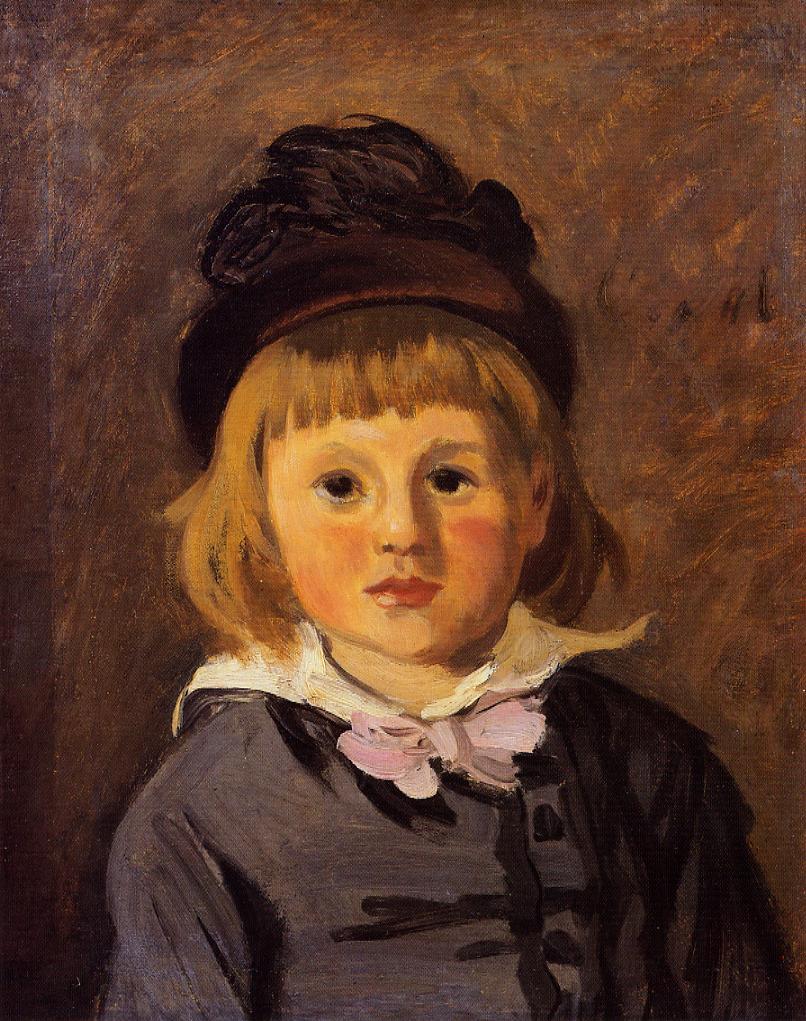
Portrait of Jean Monet Wearing a Hat with a Pompom by Claude Monet
Claude Monet’s Portrait of Jean Monet Wearing a Hat with a Pompom is one of the most intimate images from the early period of the artist’s career. Painted in 1869, it shows Monet’s young son Jean in a direct frontal pose, dressed in a dark outfit, a pale collar, a pink bow, and a soft hat crowned with a pompom. The painting is modest in subject, yet it carries a remarkable emotional and artistic weight. Rather than presenting childhood through sweetness alone, Monet gives the viewer a portrait that feels immediate, tender, slightly solemn, and quietly experimental.
At first glance, the painting appears simple. A child looks outward from a warm brown background. His face is round, softly lit, and framed by blond hair. His clothing is painted with broad, economical strokes, while the face receives greater attention. Yet the more one looks, the more the portrait reveals Monet’s developing artistic language. The painting is not only a family portrait. It is also a study in light, color, texture, and psychological presence.
The date of 1869 places the work at a crucial moment in Monet’s life. He was still struggling for recognition and financial stability, but he was also moving toward the loose, light focused style that would soon become central to Impressionism. Jean, born in 1867, was still very young when this portrait was made. Monet’s depiction of him therefore combines parental closeness with painterly observation. The result is a work that feels personal without becoming sentimental.
The Intimacy of a Family Portrait
One of the most striking qualities of the portrait is its closeness. Jean is not shown in a grand interior, a garden, or a narrative setting. There are no toys, no decorative furnishings, and no symbolic objects to explain his identity. Monet places the child close to the picture plane, filling the composition with his head, shoulders, and upper torso. This tight framing gives the painting an almost conversational quality, as though Jean has just turned toward the viewer for a brief moment of stillness.
The portrait’s intimacy comes partly from its simplicity. Monet does not attempt to idealize Jean into a polished society child. The child’s expression is calm but slightly uncertain. His eyes are dark and open, yet not dramatically expressive. His lips are gently closed, and his cheeks carry a warm blush. He appears both present and reserved, as children often do when asked to sit still.
This sense of natural observation is central to the painting’s charm. Monet does not force a theatrical mood onto the child. Instead, he allows Jean’s young face to remain somewhat unreadable. The viewer senses personality, but not a fixed narrative. Jean is not turned into a symbol of innocence, nor is he made into a decorative accessory. He is treated as an individual presence.
The portrait also has the feeling of a private image made within the family circle. It lacks the social formality of many nineteenth century child portraits. There is no grand pose, no stiff arrangement, no display of status through elaborate clothing or setting. Even though Jean is neatly dressed, the painting’s emotional center is not costume or class. It is the child’s face, his vulnerability, and the father’s act of looking.
Jean Monet as Subject and Son
Jean Monet occupies a special place in Claude Monet’s early art. As the son of Monet and Camille Doncieux, he belonged to the artist’s closest domestic world. Monet painted his family repeatedly, especially Camille and Jean, turning everyday private life into a subject worthy of artistic attention. This portrait belongs to that broader pattern, but it is more concentrated than many of Monet’s outdoor scenes.
In this image, Jean is both a child and a painter’s subject. Monet observes the softness of his features, the fall of light across his cheeks, the weight of the hat, and the contrast between pale skin and dark clothing. The painter’s affection is visible, but it is expressed through attention rather than obvious sentiment. Monet’s love appears in the care given to Jean’s face, in the warmth of the palette, and in the delicate balance between accuracy and painterly freedom.
The hat with a pompom gives the portrait a slightly playful character. It adds a childlike detail without overwhelming the image. The hat sits heavily on Jean’s head, its dark form creating a rounded silhouette above his blond hair. The pompom itself is painted with loose dark strokes, almost merging into the hat and background. This accessory helps define Jean as a young boy of his time, but it also gives the painting a memorable visual identity.
Jean’s clothing contributes to the same mixture of formality and informality. His dark jacket, pale collar, and pink bow suggest that he has been dressed carefully. Yet Monet paints the clothing with brisk handling, allowing the brushwork to remain visible. The outfit does not become a precise fashion record. Instead, it supports the composition through tonal contrasts: dark jacket, pale collar, warm face, dark hat, brown ground.
Composition and Frontal Presence
The composition is direct and stable. Jean faces the viewer nearly straight on, with his head centered in the upper half of the canvas. This frontal arrangement gives the portrait a quiet seriousness. He is not caught in motion, nor is he posed in profile. Monet chooses the most direct form of engagement: a child looking outward.
The head and hat form the visual anchor of the painting. The rounded hat echoes the roundness of Jean’s face, while the curve of the collar and bow softens the transition into the body. The shoulders slope downward, creating a triangular structure that stabilizes the image. The dark mass of the clothing on the right side balances the lighter gray of the garment on the left.
Monet avoids excessive detail in the background, which keeps attention on the child. The brown field behind Jean is active but not descriptive. It has brushy movement, warm tonal variation, and a sense of atmospheric depth. This background prevents the portrait from feeling flat while still refusing to distract from the face.
The cropping also matters. Jean’s body is partially cut by the lower edge of the canvas, and his shoulders extend beyond the central area. This creates a feeling of nearness. The child is not presented as a distant figure to be admired formally. He is brought close to the viewer’s space. The portrait seems to preserve a living encounter rather than a staged performance.
The Warm Brown Background
The background of Portrait of Jean Monet Wearing a Hat with a Pompom is one of the most important elements in the painting. It may appear plain at first, but it plays a crucial role in the mood of the work. The warm brown tones surround Jean with a soft, earthy atmosphere. They create a sense of domestic intimacy and visual warmth.
This background is not a smooth academic surface. Monet leaves traces of the brush visible, with subtle shifts of brown, ocher, gray, and muted orange. These variations bring life to the empty space. Rather than painting a detailed room, Monet creates a tonal environment. The background feels like air, shadow, and paint at once.
The brown setting also makes Jean’s blond hair and pale face stand out. The warm darkness behind him acts almost like a halo of shadow, allowing the light areas of his face, collar, and bow to glow. This contrast is not harsh. It is softened by the warmth of the entire palette. The painting avoids cold black and white contrasts in favor of rich tonal harmony.
There is also a psychological effect in the background. Because it gives no clear location, Jean seems suspended in a private, timeless space. The viewer is encouraged to focus on expression, color, and presence rather than narrative. The lack of setting makes the portrait more universal, even though it is deeply personal.
Light and the Modeling of the Face
The face is the emotional and visual center of the painting. Monet uses light to shape Jean’s features gently. The illumination appears to come from the front and slightly from one side, touching the forehead, cheeks, nose, and chin. The face is not modeled with hard academic precision. Instead, it is built from warm patches of color and soft transitions.
Jean’s cheeks are especially important. Their rosy tones bring vitality to the portrait and contrast with the darker eyes, hat, and clothing. Monet uses pinks, creams, yellows, and warm browns to create a living surface. The child’s skin does not appear porcelain smooth. It has the warmth and variation of real flesh.
The eyes are dark and simplified, yet they hold the viewer’s attention. Monet does not describe every detail of the pupils or lashes. He uses dark shapes, small highlights, and surrounding shadows to suggest depth. This gives Jean’s gaze a quiet seriousness. The eyes are not overly bright or sentimental. They are watchful and slightly inward.
The mouth is also delicately handled. The small red lips add color and focus to the lower face. Their shape is clear but not overdrawn. Combined with the stillness of the eyes, the mouth gives Jean an expression that is calm, thoughtful, and perhaps a little tired. This emotional ambiguity makes the portrait feel truthful.
Color Harmony and Subtle Contrasts
The painting’s color scheme is restrained but expressive. Monet works with warm browns, dark blacks, muted grays, soft yellows, pale whites, and touches of pink. The result is a portrait that feels rich without being flashy. Its beauty comes from harmony, not spectacle.
The strongest contrast occurs between Jean’s pale face and the surrounding dark hat and clothing. The hat creates a dark crown above the face, while the jacket creates a dark base below it. Between these areas, the face glows with warmth. Monet uses this arrangement to guide the eye naturally toward Jean’s expression.
The pink bow is a small but significant color accent. It lightens the mood of the portrait and introduces a gentle note of childhood charm. The pink is not overly bright. It is softened by surrounding whites, grays, and browns. This restraint keeps the bow from becoming decorative in a shallow way. Instead, it becomes part of the painting’s emotional balance.
The gray garment on Jean’s left side is also important. It cools the warm palette and gives the composition a broader tonal range. The gray is not flat. It contains brushstrokes that shift between bluish, brownish, and violet tones. This color complexity shows Monet’s sensitivity to the way dark and neutral colors can still carry life.
Brushwork and the Early Monet Style
The brushwork in this portrait reveals Monet’s transition away from strict academic finish. The face is more carefully worked than the clothing and background, but even there the surface remains painterly. Monet does not hide the making of the image. Strokes remain visible, especially in the hat, hair, clothing, and background.
The hat is painted with thick, dark strokes that suggest texture rather than describe every detail. The pompom is particularly loose, almost abstract in its handling. It is recognizable, but it also functions as a cluster of dark marks. This is typical of Monet’s growing interest in optical impression. He gives enough information for the eye to understand the form, but he does not overfinish it.
The hair is handled with quick strokes of yellow, brown, and gold. The bangs across Jean’s forehead are clearly indicated, yet they have a lively, uneven rhythm. This gives the child’s head a natural softness. The hair does not look like a polished wig or a carefully arranged pattern. It feels touched by light and movement.
The clothing is even freer. The dark jacket and gray garment are built with broad strokes, some of which remain rough and visible. Monet allows the lower part of the portrait to dissolve slightly into painterly suggestion. This directs attention upward while also giving the work a modern freshness. The painting is not unfinished in a careless sense. It is selective. Monet finishes what matters most for the portrait’s emotional effect.
Childhood Without Sentimentality
Nineteenth century portraits of children often emphasized innocence, sweetness, or social status. Monet’s portrait is more restrained. Jean is certainly charming, but the painting does not reduce him to cuteness. His expression is serious, almost solemn. He seems small and vulnerable, but also composed.
This lack of exaggerated sentimentality gives the painting lasting power. Monet does not impose an adult fantasy of childhood onto Jean. Instead, he captures the quiet complexity of a young child’s presence. Children can be playful, but they can also be watchful, still, uncertain, and introspective. This portrait respects that complexity.
The direct gaze is central to this effect. Jean looks outward, but he does not perform for the viewer. He does not smile. He does not gesture. He simply sits. This stillness allows the viewer to sense the gap between the adult painter’s gaze and the child’s inner world. Monet can paint Jean’s appearance with affection, but he cannot fully possess his thoughts. That slight distance gives the portrait emotional depth.
The hat and bow could have made the image overly quaint. Instead, Monet’s sober palette and loose handling keep the painting grounded. Childhood appears here as something tender but real, not as a decorative fantasy.
The Role of Clothing and Costume
Jean’s clothing helps establish the painting’s character. The dark hat with pompom, the pale collar, the pink bow, and the dark jacket all give the portrait visual interest. Yet Monet does not treat costume as the main subject. The clothing frames the face and contributes to the overall design.
The hat is the most distinctive element. Its dark color contrasts strongly with Jean’s blond hair and light skin. It also gives the head a larger, more rounded shape. Because the pompom blends into the top of the hat, the form has a soft irregularity that feels childlike and informal.
The collar creates a bright band below the face. It separates the warm flesh tones from the dark clothing and helps lift the head visually. The white paint is applied with lively strokes, not with smooth precision. This gives the collar a fluttering quality, as if the fabric is soft and slightly rumpled.
The bow adds delicacy. Its pale pink color introduces a note of tenderness, while its loose shape reinforces the informality of the image. The bow sits at the center of the composition, just below Jean’s chin, but it does not compete with the face. It acts as a small visual bridge between the child’s head and body.
A Portrait Between Realism and Impressionism
This painting stands between traditional portraiture and Monet’s later Impressionist practice. It retains the frontal pose, central composition, and psychological focus associated with portrait painting. At the same time, it uses loose brushwork, tonal atmosphere, and selective detail in ways that point toward Monet’s mature style.
The portrait is realistic in the sense that it presents a recognizable child with specific features. Jean’s face, hair, clothing, and expression are individualized. Yet the painting is not realistic in a purely detailed or photographic way. Monet is already more interested in the sensation of seeing than in exact description.
The background, clothing, and hat are especially modern in their handling. They are painted as arrangements of light, dark, and color. Their material identity matters, but their painterly presence matters just as much. The viewer is constantly aware of the image as paint on canvas.
This balance makes the portrait historically interesting. It shows Monet before the full flowering of Impressionism, but already moving toward a freer approach. The work reminds us that Impressionism did not emerge only from landscapes and outdoor scenes. It also developed through portraits, domestic subjects, and experiments with how much visual information a painter needed to convey life.
Emotional Tone and Psychological Presence
The emotional tone of the portrait is quiet and tender. Jean’s expression is not dramatic, but it lingers in the mind. His dark eyes, small mouth, and softly flushed cheeks create an impression of childhood vulnerability. At the same time, there is a dignity in his stillness. Monet does not make him fragile in a theatrical way. He gives him presence.
The painting’s warmth contributes to this mood. The brown background, golden hair, and rosy cheeks create a sense of closeness. The viewer feels near the child, almost within the same domestic space. Yet the dark hat and clothing add gravity. They prevent the image from becoming too light or decorative.
There is also a slight melancholy in the portrait. This does not come from any obvious sadness in Jean’s expression. Rather, it comes from the stillness, the subdued colors, and the child’s solemn gaze. The portrait seems aware of the fleeting nature of childhood. Jean is captured at a specific age, in a moment that cannot last. Monet’s quick, sensitive brushwork reinforces this sense of passing time.
This quality connects the painting to a larger theme in Monet’s art: the attempt to hold onto momentary appearances. Whether painting sunlight on water, flowers in a garden, or the face of his own son, Monet was drawn to the fragile beauty of what is seen briefly.
The Painting as a Record of Monet’s Domestic World
Portrait of Jean Monet Wearing a Hat with a Pompom also matters because it gives us a glimpse of Monet’s domestic life. The public image of Monet often centers on gardens, rivers, haystacks, cathedrals, and water lilies. Yet behind those famous subjects was a life filled with family, financial pressure, relationships, and ordinary domestic moments. This portrait belongs to that more private Monet.
Jean’s presence reminds us that Monet’s art was not separate from his life. His family members were often available subjects, but they were also emotional anchors. Painting them allowed Monet to combine personal attachment with artistic experimentation. In this portrait, the family subject becomes a site of technical exploration.
The painting also reveals the tenderness of looking within the home. Monet did not need a dramatic landscape to study light and color. A child’s face, a dark hat, a pale collar, and a brown background were enough. The ordinary becomes meaningful through the intensity of attention.
This domestic dimension makes the portrait especially appealing for modern viewers. It feels less like an official commission and more like an image made from closeness. It is a painting about seeing someone familiar with fresh eyes.
Why the Portrait Still Feels Modern
The portrait still feels modern because it avoids excessive polish. Monet’s loose brushwork, simplified background, and direct composition give the image a freshness that differs from more formal nineteenth century portraits. The work does not try to impress through detail alone. It trusts the power of suggestion.
Modern viewers may also respond to the painting’s emotional restraint. The portrait does not tell us exactly what to feel. It leaves space for interpretation. Jean may appear calm, shy, serious, or simply patient. The ambiguity makes the painting more lifelike. Real faces rarely express only one emotion.
The painting’s surface also remains active. One can enjoy it as an image of a child, but also as a field of brushstrokes and colors. The background swirls quietly, the hat absorbs light, the hair flickers with gold, and the collar breaks into quick pale marks. This combination of representation and visible paint is one of the qualities that keeps Monet’s work alive.
In this sense, the portrait is not merely an early family image. It is part of Monet’s broader effort to make painting more immediate, more responsive, and more honest to perception.
Conclusion
Claude Monet’s Portrait of Jean Monet Wearing a Hat with a Pompom is a small but deeply revealing work. Painted in 1869, it captures the artist’s young son with warmth, restraint, and painterly sensitivity. The portrait’s power lies in its balance between intimacy and observation. Monet looks at Jean as a father, but also as an artist studying light, color, and form.
The painting’s frontal composition, warm brown background, dark hat, pale collar, and softly modeled face create an image of quiet emotional strength. Jean is not idealized into a symbol of childhood innocence. He is presented as a real child, solemn, tender, and vividly present. The visible brushwork gives the portrait freshness, while the restrained palette gives it depth.
As an early work by Monet, the portrait also shows the artist moving toward the freedom that would define Impressionism. Its loose handling, atmospheric background, and selective detail reveal a painter increasingly interested in the living sensation of sight. Yet the painting remains grounded in affection. It is both a family keepsake and a serious artistic achievement.
Portrait of Jean Monet Wearing a Hat with a Pompom reminds us that Monet’s genius was not limited to landscapes and gardens. He could find beauty in the quiet face of his child, in the softness of hair, in the glow of cheeks, and in the delicate contrast between dark fabric and warm skin. The result is a portrait that feels personal, modern, and enduring.
