Image source: wikiart.org
Claude Monet’s Red Mullets as an Unusual Still Life
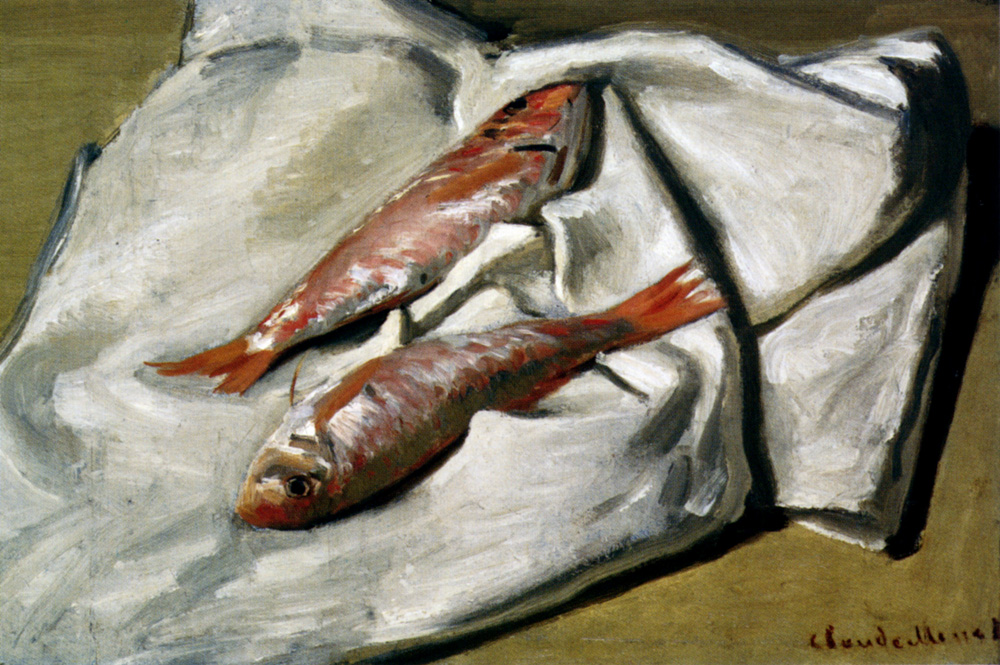
Claude Monet’s Red Mullets, painted in 1869, is a compact but striking still life that reveals a side of the artist often overshadowed by his landscapes, gardens, rivers, and luminous outdoor scenes. Instead of showing a bright harbor, a sunlit field, or figures relaxing beside water, Monet turns his attention to two fish resting on a white cloth. The subject is humble, almost ordinary, yet the painting has a surprising intensity. The red bodies of the fish glow against the pale fabric, while the dark outlines and loose brushwork give the image a sense of immediacy.
At first glance, the painting may seem simple. Two red mullets lie diagonally across a rumpled white cloth, set against a subdued brown-green surface. There are no elaborate table settings, no decorative plates, no luxurious background, and no attempt to turn the subject into a grand feast. Monet reduces the still life to its essentials: color, texture, weight, light, and composition. The result is a painting that feels direct, physical, and modern.
This directness is part of what makes Red Mullets so compelling. Monet does not treat the fish as symbols of abundance in the traditional still life manner. Instead, he studies them as forms in light. Their bodies are built from streaks of red, orange, silver, brown, and white. The cloth is not carefully smoothed or polished but animated by large, energetic strokes. Every surface seems to have been painted quickly, yet nothing feels careless. The painting captures the freshness of perception, as though Monet is less interested in perfect detail than in the sensation of seeing.
The Historical Moment of 1869
The year 1869 was an important period in Monet’s artistic development. He was still years away from the first Impressionist exhibition of 1874, but many of the qualities that would later define Impressionism were already forming in his work. During the late 1860s, Monet was moving away from the more controlled finish expected by academic painting and toward a freer, more responsive way of handling paint.
This was a difficult and experimental time for him. Monet was still seeking recognition, struggling financially, and testing the boundaries of what modern painting could be. His work from this period often shows an artist caught between several worlds. He admired the bold realism of Gustave Courbet, the modernity of Édouard Manet, and the direct observation of outdoor light that would become central to his own identity. Red Mullets belongs to this transitional moment.
The painting is not Impressionist in the full later sense. It does not show flickering sunlight on water or the atmospheric effects of changing weather. Yet it already contains Monet’s growing interest in visual immediacy. He does not build the image through hard outlines and smooth modeling. Instead, he lets color and brushstroke carry the structure. The fish, the cloth, and the background are all shaped by painterly marks that remain visible. This gives the work a modern vitality that separates it from polished academic still life.
The Power of a Simple Subject
One of the most interesting aspects of Red Mullets is the simplicity of its subject. A pair of fish on a cloth could easily seem too modest for serious painting, especially in the context of nineteenth-century French art, where history painting and grand allegorical subjects still held prestige. Monet’s choice of subject reflects a modern shift in artistic values. Everyday things could become worthy of close attention. A painting did not need mythological figures or historical drama to be meaningful.
In this work, the red mullets are not merely food items. They are visual events. Their color, shape, shine, and placement create the drama of the painting. Monet seems fascinated by the contrast between the warm red bodies and the cool white fabric. The fish are small, but they dominate the composition because their color is so concentrated. Against the neutral ground, they become almost radiant.
The subject also allows Monet to explore the relationship between organic form and painted surface. Fish have a natural slipperiness and sheen, qualities that are difficult to describe with paint. Monet responds not by rendering every scale with precision, but by using broken highlights and quick touches of color. The bodies shimmer because the brushwork is active. The viewer does not need exact detail to sense the smooth, reflective quality of the fish.
Composition and Diagonal Movement
The composition of Red Mullets is built around strong diagonal movement. The fish do not sit horizontally or symmetrically. They angle across the white cloth, creating a dynamic arrangement within a small space. The upper fish points from lower left toward upper right, while the lower fish stretches in a similar diagonal direction. This repetition gives the composition rhythm and unity.
The white cloth also participates in this movement. It is folded, creased, and pulled into angular forms that echo the lines of the fish. On the right side, a dark border or fold curves downward, framing the cloth and giving the painting a strong visual edge. The cloth is not a passive background. It is almost as important as the fish themselves, because it creates the stage on which their red bodies appear.
Monet avoids a stiff central arrangement. The fish are placed slightly off balance, and the cloth seems to spread unevenly across the surface. This gives the painting a casual quality, as if the scene has been observed directly rather than arranged with decorative precision. Yet the casualness is carefully controlled. The red fish, white cloth, and muted background are balanced so that the eye moves naturally across the whole painting.
The composition also creates a tension between stillness and motion. The fish are motionless, but their diagonal placement suggests energy. Their tails and fins point outward, and their bodies seem almost to glide across the cloth. Monet transforms a still life into something visually animated.
The Red of the Fish
Color is the emotional center of Red Mullets. The fish are painted with warm reds, oranges, russets, and touches of brown. These colors stand out powerfully against the white cloth and the subdued background. Monet does not use red as a flat local color. Instead, he breaks it into many variations. Some areas are bright and fiery, while others are shadowed and earthy. This gives the bodies depth without making them overly detailed.
The red also creates a sense of freshness and physical presence. These fish feel recently placed on the cloth, not distant or decorative. Their color suggests both life and the market, both nature and domestic reality. Monet’s handling of red is bold, but not artificial. He allows the color to glow while still belonging to the material object.
The fins and tails are especially vivid. They flare outward with sharp accents of orange-red, creating small bursts of movement at the edges of the bodies. These details help the fish read instantly as red mullets, while also giving the painting its strongest color notes. The viewer’s eye returns again and again to these accents because they provide contrast against the pale cloth.
This use of red is one reason the painting feels modern. Monet is not merely describing the fish. He is organizing the entire image around color relationships. The red bodies become the painting’s visual anchor, while the surrounding whites, grays, browns, and greens serve to intensify them.
The White Cloth as a Painterly Field
The white cloth in Red Mullets is not plain white. It is a complex field of grays, creams, blues, and warm shadows. Monet uses broad strokes to suggest folds and wrinkles, allowing the fabric to become a study in reflected light. The cloth takes up most of the composition, so its treatment is crucial to the painting’s effect.
Rather than carefully outlining every fold, Monet builds the fabric through sweeping, visible brushstrokes. Some strokes are thick and opaque, while others appear softer and more blended. This gives the cloth a tactile quality. We feel its weight and roughness, but we also see it as paint. Monet allows the material surface of the painting to remain alive.
The cloth also performs an important compositional role. Its pale color creates the contrast that makes the fish stand out. Without the cloth, the red mullets might blend into the brown-green background. Against white, they become vivid and sculptural. The cloth acts almost like a spotlight, concentrating attention on the fish.
At the same time, the cloth introduces abstraction into the painting. Its folds create shapes that are not immediately readable as fabric if viewed up close. They become patches of light and shadow, brush marks arranged across the canvas. This tension between recognizable object and painted surface is central to Monet’s modernity.
Brushwork and the Feeling of Immediacy
The brushwork in Red Mullets is energetic and visible. Monet does not hide the act of painting. The white cloth is made of large, confident strokes. The fish are described with shorter, more varied marks. The background is handled more thinly and quietly, allowing the central forms to come forward.
This visible brushwork gives the painting a sense of speed. It feels as though Monet wanted to capture the subject before its freshness disappeared. Still life painting often involves long, careful observation, but here the image seems urgent. The fish, especially, appear to have been painted with quick attention to color and light rather than meticulous detail.
The brushwork also helps distinguish textures. The fish have smooth, shiny bodies created through streaks of highlight and color. The cloth has broader, heavier strokes that suggest softness and folds. The background is flatter and more restrained. Monet uses the movement of the brush to describe material differences without needing photographic precision.
This is one of the reasons Red Mullets feels connected to the later Impressionist approach. Monet is already trusting the viewer’s eye to complete the image. He does not provide every detail. Instead, he gives enough visual information through color and gesture for the subject to come alive.
Light, Shadow, and Surface
Light in Red Mullets is subtle but essential. The painting does not show dramatic theatrical illumination. Instead, the light seems to fall across the fish and cloth from above, catching certain surfaces and leaving others in shadow. The highlights on the fish are especially important. Small touches of white and pale gray suggest the slick reflective quality of their bodies.
The cloth receives light in broader planes. Some areas appear bright and chalky, while others sink into gray shadow. These shifts create volume and depth. The folds become sculptural, almost like a landscape of fabric. Monet uses light not simply to describe the objects but to create the painting’s rhythm.
The background remains muted, which helps the light areas stand out. Its brown-green tone gives warmth to the composition without competing with the red fish. This subdued setting also contributes to the sense of intimacy. There is no distracting environment. The viewer is brought close to the objects, as if standing directly above the table.
Monet’s treatment of light is less about exact realism than about optical experience. He paints how the objects strike the eye. The red fish catch attention first, then the white cloth expands around them, then the darker edges and background frame the scene. Light guides the viewer through the painting.
A Dialogue with Realism
Although Monet is best known as an Impressionist, Red Mullets also reveals his connection to Realism. In mid-nineteenth-century France, Realist artists challenged academic ideals by painting ordinary subjects from contemporary life. Gustave Courbet, in particular, helped elevate humble objects, rural scenes, and everyday labor into serious art. Monet’s still life of fish shares this respect for the material world.
There is nothing idealized about the subject. The fish are not placed in a luxurious banquet setting. They are simply presented as objects of daily life. Their bodies are tangible, their colors vivid, their placement informal. This honesty connects the painting to Realist values.
At the same time, Monet goes beyond Realism by making the act of perception more important than the object itself. Courbet’s influence may be felt in the physicality of the paint and the ordinary subject, but Monet’s attention to light, color, and visual sensation points toward his later style. Red Mullets therefore stands between Realism and Impressionism. It honors the solidity of things while also dissolving them into strokes of color.
The Influence of Modern French Painting
The painting also suggests Monet’s awareness of the modern still life experiments of his time. Artists such as Édouard Manet brought a new boldness to still life, using simplified backgrounds, strong contrasts, and visible brushwork. Monet’s Red Mullets shares this modern directness. The subject is placed close to the viewer, the arrangement is spare, and the painting values immediacy over polish.
The dark contours around the cloth and the confident handling of the fish give the work a graphic strength. Monet is not trying to make the objects disappear into illusion. He lets them remain painted. This approach would have felt fresh and even challenging in a period when many viewers still expected smooth surfaces and carefully finished details.
What makes Monet’s version distinctive is the sensitivity of his color relationships. The painting is not only bold but atmospheric. The reds, whites, grays, and muted greens interact with subtle harmony. Even in this small still life, Monet is already thinking like a painter of light.
The Role of the Background
The background of Red Mullets is restrained and understated, but it plays a crucial role. Its muted brown-green tone creates a quiet environment around the white cloth. It does not describe a specific room or setting. Instead, it functions as a tonal field, allowing the central arrangement to command attention.
This simplicity makes the painting feel modern. Traditional still lifes often include elaborate settings, polished tables, glassware, fruit, flowers, or symbolic objects. Monet removes almost everything except the essential visual relationship. The background is not there to tell a story. It is there to support the balance of color and form.
The earthy tone also enriches the red of the fish. Red and green are complementary colors, and even though the background is muted, its greenish quality helps intensify the warmth of the mullets. Monet’s color choices are subtle but purposeful. The red fish appear more vivid because they are surrounded by restrained tones.
Still Life as Experiment
For Monet, a still life like Red Mullets offered an opportunity to experiment. Unlike a landscape, where light changes quickly and weather conditions shift, a still life allows the artist to focus intensely on relationships between objects, surfaces, and colors. Yet Monet treats the subject with the freshness of outdoor painting. He does not labor over it until it becomes static. He keeps it alive through movement and gesture.
The painting can be understood as a laboratory for Monet’s developing ideas. He studies how red behaves against white, how highlights describe shine, how folds create movement, and how a simple diagonal arrangement can energize a small canvas. These concerns would remain important throughout his career, even when his subjects changed dramatically.
In later decades, Monet would paint haystacks, poplars, cathedrals, water lilies, and garden paths again and again, exploring how light transforms perception. Red Mullets may seem far removed from those famous series, but it shares the same fundamental curiosity. What happens when the eye encounters color and light? How can paint capture sensation rather than merely outline objects? These questions are already present here.
The Physicality of the Fish
The fish in Red Mullets have a strong physical presence. They are not idealized or decorative. Their bodies have weight. They press against the cloth, casting small shadows and occupying real space. Monet captures their forms with enough specificity that they feel tangible, yet he avoids excessive detail.
The lower fish is especially engaging because its eye and head are visible. This small detail gives the subject an unexpected immediacy. The viewer is reminded that these were once living creatures, now transformed into still life objects. Monet does not sentimentalize this fact, but neither does he ignore it. The eye becomes a small dark point within the composition, drawing attention and adding psychological intensity.
The upper fish is more elongated and partially turned, with its body catching more light along the side. Together, the two fish create variation. They are similar enough to form a pair, but different enough to avoid repetition. Their placement suggests natural disorder rather than strict arrangement.
The Beauty of the Ordinary
One of the deeper achievements of Red Mullets is its transformation of an ordinary subject into something visually rich. Monet shows that beauty does not require grandeur. It can be found in the red skin of fish, the folds of a cloth, the contrast between warm and cool tones, and the movement of a brush across canvas.
This idea was central to modern painting. Nineteenth-century artists increasingly turned toward contemporary life, ordinary objects, and direct perception. Monet’s still life participates in that broader transformation. It asks the viewer to look closely at something easily overlooked.
The painting also resists the idea that still life must be decorative or symbolic. It is not primarily about moral lessons, luxury, or domestic abundance. It is about seeing. The red mullets become important because Monet paints them with seriousness and attention. Their beauty comes from their color, texture, and placement in light.
Relationship to Monet’s Later Art
Although Red Mullets is not one of Monet’s best-known works, it helps illuminate his later achievements. The painting shows his early commitment to visible brushwork, simplified composition, and color contrast. These qualities would become central to his mature art.
In his later landscapes, Monet often allowed forms to dissolve into light. In Red Mullets, the forms remain solid, but they are already energized by paint. The cloth is not described through precise drawing alone, but through strokes that create a living surface. The fish are not rendered scale by scale, but through flashes of color and reflected light. This is the language that Monet would continue to develop.
The painting also reveals his sensitivity to white. In later works, Monet would explore snow, mist, clouds, water, and pale atmospheric effects. Here, the white cloth becomes a field of subtle variation. It is never simply white. It contains shadow, warmth, coolness, and movement. Monet’s ability to find complexity in a limited range of tones is already clear.
Why Red Mullets Matters
Red Mullets matters because it expands our understanding of Monet. It reminds us that he was not only a painter of landscapes and gardens. He was also an artist deeply interested in the visual life of ordinary things. This still life shows him working with concentration, economy, and boldness.
The painting also matters because it captures a transitional moment in modern art. It belongs to the period before Impressionism became a named movement, when Monet and his contemporaries were still testing new ways of painting. In this small work, one can see the loosening of academic finish, the influence of Realism, the impact of Manet’s modern directness, and the emerging importance of optical sensation.
Its appeal lies in its balance of simplicity and intensity. The subject is modest, but the painting is not modest in effect. The red fish burn against the cloth. The white fabric becomes a landscape of strokes. The background quietly strengthens the whole arrangement. Everything is reduced, but nothing is empty.
Conclusion
Claude Monet’s Red Mullets is a powerful example of how a simple still life can reveal major artistic ideas. Painted in 1869, it shows Monet at a crucial point in his development, combining Realist attention to ordinary objects with a growing fascination for light, color, and painterly immediacy. The painting may not have the expansive atmosphere of his river scenes or the radiant beauty of his garden works, but it possesses its own quiet force.
The two fish, placed diagonally across a white cloth, become more than a kitchen subject. They become a study in contrast, texture, and perception. Their red bodies glow against the fabric, while Monet’s visible brushwork gives every part of the image movement. The cloth, the fish, and the background are all treated as living elements of paint.
In Red Mullets, Monet demonstrates that modern painting could find meaning in the simplest arrangement. A pair of fish on a cloth becomes an exploration of color harmony, physical presence, and visual freshness. The painting invites the viewer to slow down and recognize the richness of ordinary sight. It is a small work with a large artistic significance, revealing the young Monet’s confidence, curiosity, and early movement toward the language that would transform modern art.
