Image source: wikiart.org
The Luncheon by Claude Monet: An Intimate Vision of Modern Life
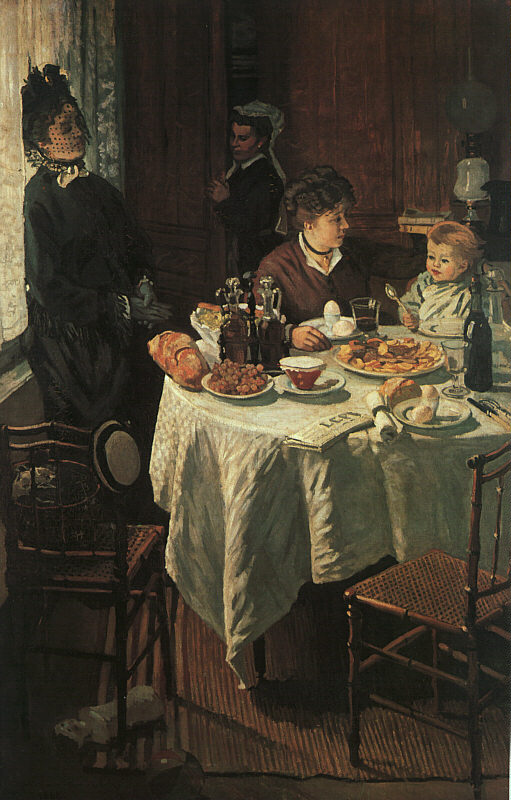
Claude Monet’s The Luncheon, painted in 1868, is one of the most revealing works of his early career. Before Monet became the central figure of Impressionism, before the broken brushwork and luminous outdoor scenes that would define his mature reputation, he was already searching for a new way to paint modern life. This painting captures that search with unusual intimacy. Instead of myth, history, religious drama, or idealized beauty, Monet presents a domestic meal. A woman, a child, a seated visitor, and a servant occupy a dim interior arranged around a table covered with food, glassware, bottles, linen, and everyday objects. The scene feels ordinary, yet the painting transforms ordinariness into something richly atmospheric and psychologically complex.
At first glance, The Luncheon may appear to be a simple family scene. A child sits at the table, watched by a woman who is likely Camille Doncieux, Monet’s companion and later wife. The meal is partly served. There are eggs, bread, fruit, bottles, plates, and utensils. The atmosphere is quiet, almost suspended. Yet Monet does not treat the household as a sentimental stage. He paints the room as a living space shaped by light, shadow, social roles, and the physical weight of objects. The viewer does not enter a polished bourgeois fantasy. Instead, we are placed in a dense interior where figures and furnishings seem caught between intimacy and distance.
The painting is especially important because it shows Monet working through the artistic problems that would later define Impressionism. How can light organize a picture without relying on strict academic clarity? How can a modern scene feel truthful without being anecdotal? How can paint suggest life through texture, tone, and atmosphere rather than polished finish? In The Luncheon, Monet is not yet the painter of shimmering haystacks, water lilies, and sunlit gardens. He is a young artist testing how far contemporary painting can move away from traditional narrative and toward the lived experience of seeing.
The Historical Context of Monet’s Early Career
The Luncheon belongs to a crucial moment in Monet’s development. In the late 1860s, he was still trying to secure recognition within the official art world while also developing a style that challenged its expectations. The Paris Salon remained the dominant institution for artists seeking reputation, patrons, and financial stability. Large paintings of historical, religious, or mythological subjects were still treated as especially serious, while scenes of everyday life were often considered less prestigious. Monet, however, was drawn increasingly toward modern subjects, personal interiors, contemporary dress, and effects of natural light.
In 1868, Monet was not yet financially secure. His relationship with Camille Doncieux was under pressure, and their son Jean had been born the previous year. This personal context gives The Luncheon a special emotional charge. The painting is not merely a neutral observation of dining. It is connected to Monet’s own household, his domestic life, and the tensions between private affection and social instability. The meal scene may seem comfortable, but the darker tonal range and somewhat withdrawn figures prevent it from becoming simply cheerful.
The work also reflects broader changes in French painting. Artists such as Gustave Courbet and Édouard Manet had already challenged the authority of academic art by painting modern people in direct, unsentimental ways. Monet admired and learned from these developments, but he was not simply imitating them. His attention to light, surfaces, and fleeting visual impressions gives The Luncheon a distinctive character. The painting is grounded in realism, but it already moves toward a more optical and atmospheric approach.
Unlike Monet’s later outdoor scenes, The Luncheon is an interior. This matters because interiors require a different handling of light. The brightness does not flood the whole canvas evenly. It enters from the side, strikes the tablecloth, touches faces and objects, then dissolves into darkness. The contrast between illuminated surfaces and shadowed space becomes one of the painting’s central dramas. Monet uses this domestic setting to explore the instability of vision itself, showing how some things emerge sharply while others remain half absorbed by darkness.
Composition and the Structure of the Scene
The composition of The Luncheon is carefully organized, even though it may initially appear casual. The table dominates the center of the painting. Its white cloth forms the brightest and most visually active area, pulling the viewer’s eye immediately toward the meal. Around this table, the figures are arranged in a loose but meaningful pattern. The child at the right, the woman near the center, the dark seated figure at the left, and the servant in the background create a rhythm of social and spatial positions.
The table is not only a piece of furniture. It acts as the painting’s emotional and visual anchor. Its diagonal placement opens the space toward the viewer, making us feel close to the scene. The front edge of the tablecloth hangs forward, almost spilling into our space. This creates a sense of immediacy, as though the viewer has stepped into the room just as the meal is taking place. At the same time, the figures do not directly welcome us. Their attention is absorbed elsewhere, which gives the painting its intriguing mixture of closeness and separation.
The left side of the composition is heavy with darkness. The seated woman in black, seen near the window, is partly silhouetted. Her figure creates a strong vertical mass, contrasting with the bright curtain beside her and the glowing tablecloth in front of her. She is present but withheld, almost mysterious. Her dark clothing and bonnet make her less individually defined than the woman and child at the table. She may represent a visitor, a family member, or a social presence whose role remains ambiguous.
The background figure, likely a servant, deepens the composition. He stands in a darker part of the room, partially turned, not central but still important. His presence reminds us that domestic life is structured by labor. The luncheon does not appear magically. It depends on service, preparation, and social hierarchy. Monet includes this figure without turning him into the subject of a moral lesson. Instead, he integrates him into the atmosphere of the room, letting his shadowed presence complicate the image of family comfort.
The chairs in the foreground also play an important compositional role. They frame the viewer’s access to the table while also creating a sense of everyday disorder. One chair is empty, another is cut off by the edge of the canvas, and a small dog appears near the lower left. These details make the room feel inhabited rather than staged. Monet avoids perfect symmetry. The arrangement feels like life interrupted, which is central to the painting’s modernity.
The Role of Light in The Luncheon
Light is one of the most powerful elements in The Luncheon. It enters from the left, probably through a window partly hidden by the curtain. This light does not simply illuminate the scene. It divides the painting into zones of visibility and obscurity. The tablecloth catches the strongest brightness, becoming almost radiant against the dark interior. The child’s face, the woman’s profile, the eggs, the plates, and the glassware all receive selective touches of light.
This selective illumination gives the painting a deeply atmospheric quality. Monet is not interested in describing every object with equal clarity. He allows much of the room to remain dim, especially the wooden background and the seated figure at the left. The viewer must adjust to the painting the way one adjusts to a room after entering from brighter daylight. Forms gradually reveal themselves. The eye moves from the white tablecloth to the muted reds and browns, then into the surrounding darkness.
The light also has emotional meaning. It gathers around the child and the food, suggesting warmth, nourishment, and domestic routine. Yet because the rest of the room remains shadowed, that warmth feels fragile. The luncheon is not bathed in carefree sunlight. It is enclosed, quiet, and somewhat solemn. The brightness of the table is surrounded by darkness, as if the ordinary act of eating exists within a larger atmosphere of uncertainty.
Monet’s treatment of light anticipates Impressionism, but in a restrained form. Later, he would dissolve entire landscapes into color and reflection. Here, he still uses heavier contrasts and darker tonal masses. Nevertheless, the painting already shows his belief that light is not a decorative addition but the organizing force of vision. Objects matter because of how they catch, absorb, or reflect light. The eggs are not merely eggs. The bottles are not merely bottles. They are surfaces through which Monet studies brightness, opacity, transparency, and color.
The white tablecloth is especially important. It is not painted as a flat white shape. It contains gray, cream, yellow, and greenish tones, with folds that shift depending on the direction of the light. This sensitivity to reflected color is one of Monet’s great strengths. Even in an interior scene, he resists the academic habit of separating objects into fixed local colors. Instead, he shows that color changes according to light, texture, and surrounding tones.
The Table as a Still Life Within the Painting
One of the richest aspects of The Luncheon is the central table arrangement. Monet fills the tabletop with food and dining objects, creating a still life embedded within a domestic scene. Bread, fruit, eggs, dishes, bottles, glassware, and utensils are placed with apparent casualness, but they form a dense and carefully balanced visual field. The viewer’s eye lingers over these objects because they are among the most brightly lit and materially vivid parts of the painting.
The table creates a dialogue between abundance and disorder. There is plenty of food, but the arrangement is not ceremonial. The meal feels midcourse or recently interrupted. Plates are unevenly placed, bottles cluster near the center, and napkins and utensils create small irregular accents. This gives the painting a sense of time. We are not seeing a formal display before anyone has touched it. We are seeing a meal as part of lived experience.
The still life also reveals Monet’s technical ambitions. The bottles provide opportunities for dark reflections and vertical accents. The eggs offer smooth, pale forms that contrast with the rougher bread and folded cloth. The fruit adds small notes of color. The glass and ceramic objects catch highlights, creating flickers of brightness across the tabletop. Monet uses these objects to demonstrate his ability to paint different textures without relying on meticulous finish.
Yet the objects are not just technical exercises. They reinforce the painting’s theme of domestic modernity. The meal is ordinary, but it becomes visually compelling because Monet treats everyday objects with the seriousness once reserved for grand subjects. This is one of the great shifts of nineteenth-century art. A dining table can become as worthy of painting as a historical battle or mythological feast. The meaning lies not in dramatic action but in attention itself.
The table also separates and connects the figures. The woman and child face each other across it. The seated figure at the left sits nearby but seems removed. The viewer is positioned at the near edge, close enough to observe the food but not quite included in the conversation. The table is therefore both a symbol of family gathering and a barrier. It organizes intimacy while also marking distance.
Camille and Jean: Motherhood Without Sentimentality
The woman seated at the table is often associated with Camille Doncieux, Monet’s companion and later wife. The child is usually identified as their son Jean. Their presence gives The Luncheon a deeply personal dimension. However, Monet does not idealize the scene as a sweet maternal image. Camille is not posed as a glowing Madonna-like mother. Jean is not transformed into a perfectly charming child. They are shown within the ordinary structure of a meal, absorbed in a quiet moment.
Camille’s posture is attentive but restrained. She turns toward the child, creating one of the painting’s main emotional connections. Her face is lit from the side, and her expression seems calm, watchful, perhaps slightly tired. Monet captures the dignity of domestic care without exaggerating it. She is present as a mother, but also as a modern woman in a real interior, wearing contemporary clothing and occupying a specific social space.
Jean, seated at the right, provides a lighter emotional note. His small body, pale face, and focused attention bring tenderness into the scene. He appears engaged with the spoon or object in his hand, caught in a moment of childhood concentration. Monet’s handling of the child is delicate but not overly polished. The child emerges from the paint through touches of light and soft color, rather than through hard outlines.
The relationship between Camille and Jean is central to the painting’s emotional structure. Their interaction gives the image warmth, but it is a quiet warmth. Monet avoids theatrical affection. There is no embrace, no exaggerated gesture, no obvious moral message about motherhood. Instead, the tenderness is found in proximity, attention, and shared space. This restraint makes the painting feel more modern and more psychologically believable.
The scene also reflects the realities of Monet’s personal life at the time. Domestic life for the young artist was not secure or comfortably established. Financial hardship and social pressure surrounded his relationship with Camille. In this context, the painting’s muted mood becomes especially meaningful. The luncheon is not simply a celebration of family life. It is an image of family life under the shadow of uncertainty, painted with affection but also with seriousness.
The Seated Figure and the Mystery of Social Presence
The dark seated figure at the left is one of the most visually striking and enigmatic parts of the painting. Dressed in black and wearing a bonnet, she is positioned near the window but remains largely in shadow. Her face is difficult to read, partly obscured by the angle, the darkness of her clothing, and the complex pattern of the bonnet. She does not participate clearly in the exchange between mother and child. Her presence feels both intimate and detached.
This figure adds psychological depth to The Luncheon. Without her, the painting might read more simply as a mother and child at a meal. With her, the scene becomes socially layered. She may be a guest, a relative, or a chaperone-like presence. Her dark silhouette introduces a note of formality, even severity. She seems to belong to the household scene, yet she also stands apart from its emotional center.
The contrast between her black clothing and the bright curtain beside her is dramatic. Monet uses this contrast to anchor the left side of the painting. The figure becomes almost a shadow mass, a counterweight to the bright tablecloth. Her presence prevents the composition from becoming too light or decorative. She brings gravity.
The ambiguity of this figure also reflects Monet’s refusal to overexplain. Academic painting often made relationships and narratives explicit. Viewers could usually identify the story, the moral lesson, or the symbolic meaning. In The Luncheon, Monet gives us enough information to feel the social atmosphere, but not enough to reduce it to a simple story. The result is more lifelike. In real rooms, people often occupy space without declaring their meaning.
This ambiguity is part of the painting’s modernity. Monet is interested not only in what people do, but in how they appear within a field of light, furniture, silence, and social arrangement. The seated woman is not a character in a drama so much as a presence within an observed moment. Her partial concealment asks the viewer to look longer.
The Servant and the Structure of Domestic Labor
The servant in the background is another important figure. He stands behind the table, partly absorbed by the dark wall and wooden interior. His placement suggests movement and function. He is not seated with the family or guests. He belongs to the meal, but from the position of service. Through this figure, Monet acknowledges the social structure behind domestic comfort.
The servant’s shadowed appearance is significant. He is present, but not individualized to the same degree as Camille and Jean. This reflects the social conventions of the period, but it also contributes to the painting’s realism. In a bourgeois or aspiring bourgeois household, service was often visible and invisible at the same time. Meals depended on labor that could be quietly pushed into the background. Monet makes that background visible without turning it into the painting’s central subject.
His dark clothing and upright posture create a vertical accent behind the table. Compositionally, he helps connect the foreground meal to the deeper space of the room. He also introduces a sense of pause, as though he has just entered, is waiting, or is preparing to continue serving. This contributes to the painting’s feeling of a moment caught in time.
The servant also complicates the painting’s emotional mood. The luncheon is not purely private. It is observed and structured by social roles. The mother and child sit in the light, the guest or older woman occupies the side, and the servant remains in the background. The room becomes a small social system. Monet’s interest in modern life includes not only clothing and interiors, but the subtle arrangements of class and labor that shape everyday experience.
Color, Tone, and the Dark Interior
The color palette of The Luncheon is darker and earthier than many people expect from Monet. Later viewers often associate Monet with bright gardens, blue shadows, pink skies, and sparkling water. Here, however, the dominant colors are black, brown, cream, muted red, ocher, and gray. The painting’s atmosphere is built through tonal contrast rather than high-key color.
The dark wooden background gives the scene depth and seriousness. It absorbs light, creating a warm but heavy enclosure. Against this darkness, the tablecloth appears especially luminous. The color contrast is not loud, but it is powerful. Monet uses the opposition between the pale cloth and the surrounding brown-black interior to guide the viewer’s eye.
The clothing also contributes to the tonal structure. The seated figure at the left is nearly swallowed by black. Camille’s reddish-brown garment adds warmth near the center. Jean’s pale clothing catches light and connects visually with the tablecloth. The servant’s dark outfit recedes into the background. Each figure is defined not only by identity but by tonal value.
The muted red of Camille’s clothing is especially effective. It creates a human warmth within the otherwise subdued palette. It also helps separate her from the table and background, giving her central importance without making her overly dominant. Monet does not need a theatrical spotlight. A modest shift in color is enough.
This restrained palette shows Monet’s early debt to realism and to the darker tonal traditions of mid-nineteenth-century painting. Yet within this darkness, his handling of light and color is already innovative. He does not polish surfaces into academic smoothness. He lets brushstrokes remain visible. Color areas feel alive, shifting, and imperfect. The painting’s darkness is not flat. It is full of subtle variations.
Brushwork and Surface
The brushwork in The Luncheon is one of the clearest signs of Monet’s evolving style. The painting is not finished in the highly smooth manner favored by academic art. Instead, Monet uses visible strokes, varied textures, and areas of abbreviated description. Some passages are more carefully defined, especially around the table and faces, while others are loose and suggestive.
This variation gives the painting its sense of immediacy. Monet does not describe every detail with equal precision. The eye is encouraged to move as it would in real perception, focusing on illuminated objects and letting peripheral details remain less distinct. The background wall, the dark clothing, the floor, and some of the chairs are painted with broad, dark handling. The table objects receive sharper accents because they catch the light.
The tablecloth is particularly expressive. Monet paints its folds with energetic strokes that show the weight, texture, and unevenness of fabric. The cloth is not merely a white shape. It has movement. It sags, creases, reflects light, and casts shadows. Its surface becomes almost landscape-like, with ridges and valleys of tone.
The food and tableware are painted with economical confidence. Monet suggests grapes, bread, eggs, and dishes without overdefining them. This is important because it shows his movement away from descriptive exactitude and toward optical truth. He is less concerned with naming every object than with capturing how objects appear together under specific conditions of light.
The brushwork also affects the figures. Faces and hands are not rendered with porcelain smoothness. They have a living roughness. This gives the painting emotional honesty. The people do not look like idealized types. They seem momentary, observed, and human.
The Painting as a Scene of Modern Domesticity
The Luncheon is a modern painting because it treats everyday domestic life as worthy of serious artistic attention. Rather than presenting an elevated story from the past, Monet paints contemporary people in contemporary surroundings. The clothing, furniture, tableware, and social arrangement all belong to the world of the artist’s own time.
This focus on modern life was central to the artistic revolution of the nineteenth century. Painters increasingly turned away from grand historical subjects and toward cafés, parks, streets, train stations, bedrooms, dining rooms, and gardens. Monet would later become famous for painting modern leisure and modern landscapes, but The Luncheon shows that his interest in contemporary experience was already strong in the 1860s.
The domestic subject also connects the painting to broader questions about privacy, family, and social respectability. The meal is a ritual of household order. It suggests nourishment, routine, and civilized behavior. Yet the painting does not present domestic life as perfectly harmonious. The room is crowded, shadowed, and slightly tense. The figures are near one another but not emotionally unified in an obvious way. This complexity makes the painting more compelling.
Monet’s modernity lies partly in his refusal to moralize. He does not tell the viewer what to think about the family, the servant, or the visitor. He offers a visual experience rather than a lesson. The painting’s meaning emerges through arrangement, light, and atmosphere. This approach would become increasingly important in modern art, where ambiguity and perception often replace narrative certainty.
The Influence of Manet and Realism
The Luncheon shows the influence of the realist and modernist currents surrounding Monet in the 1860s. Édouard Manet’s impact is especially relevant. Manet had already shocked viewers with works that used bold contrasts, modern dress, and flattened arrangements. Monet admired Manet and shared his interest in contemporary life. The strong darks, the modern interior, and the unsentimental treatment of figures in The Luncheon all suggest this artistic environment.
At the same time, Monet’s painting is not simply Manet-like. Monet’s attention to atmospheric light is more enveloping. Manet often emphasized the confrontational presence of figures and the formal boldness of painted surfaces. Monet, in The Luncheon, is more interested in the relationship between figures, objects, and surrounding light. The room feels like an environment rather than a stage.
The influence of realism is also clear. The painting refuses idealization. The figures are not classically beautiful. The objects are ordinary. The composition includes awkwardness, clutter, and shadow. This gives the scene credibility. Monet does not clean up the world in order to make it fit academic expectations.
Yet Monet moves beyond realism by making perception itself the subject. The painting is not only about a luncheon. It is about seeing a luncheon in a particular room, at a particular moment, with light falling unevenly across surfaces. That shift from subject to perception would become essential to Impressionism.
Comparison With Monet’s Later Impressionist Works
Looking at The Luncheon from the perspective of Monet’s later career, the painting feels both familiar and surprising. It is familiar because it reveals his lifelong fascination with light. It is surprising because it is much darker, more enclosed, and more socially detailed than his mature Impressionist landscapes.
In later works, Monet often painted outdoors, exploring sunlight, weather, reflection, and seasonal change. His brushwork became lighter and more broken. His colors became brighter and more varied. Human figures often became secondary to atmosphere. In The Luncheon, by contrast, the figures remain central, the room is enclosed, and the tonal range is heavy.
Still, the connection is clear. The tablecloth in The Luncheon anticipates Monet’s later treatment of light-struck surfaces. The glassware and bottles anticipate his interest in reflection. The refusal to overdefine background details anticipates his mature use of visual suggestion. The painting may not look like a classic Impressionist canvas at first glance, but its deeper concerns point toward Impressionism.
The Luncheon also reminds us that Monet’s development was not sudden. He did not simply become an Impressionist overnight. His mature style grew from years of experimentation with realism, figure painting, interiors, and ambitious compositions. This work preserves a transitional moment when Monet was still negotiating between the Salon tradition and his own emerging vision.
The Emotional Atmosphere of the Painting
One of the most memorable qualities of The Luncheon is its emotional atmosphere. The scene is calm, but not relaxed in a simple way. It feels intimate, but not openly affectionate. It is domestic, but not cozy in the conventional sense. This emotional ambiguity gives the painting lasting power.
The figures seem absorbed in their own roles. Camille attends to Jean. The seated woman remains withdrawn. The servant waits or moves in the background. The child is focused on his small action. No one looks directly at the viewer. This creates a sense of privacy. We are close to the scene, but we are not addressed by it.
The darkness of the room contributes to this mood. The luncheon takes place within an interior that feels protective but also heavy. The light on the table offers relief, yet it does not dissolve the surrounding shadows. The result is a painting that holds warmth and melancholy together.
This emotional complexity may reflect Monet’s own uncertain life in 1868. The family scene is tender, but the painter does not turn tenderness into fantasy. He allows the room to remain dim, the figures to remain separate, and the social atmosphere to remain unresolved. This honesty is one of the painting’s greatest strengths.
Why The Luncheon Matters in Monet’s Oeuvre
The Luncheon matters because it reveals a side of Monet that is sometimes overshadowed by his later fame. Many viewers know Monet primarily as the painter of water lilies, haystacks, poplars, and gardens. The Luncheon shows him as a painter of interiors, figures, and domestic psychology. It reminds us that his artistic achievement was broader than a single style or subject.
The painting also demonstrates Monet’s ambition as a young artist. This is not a small decorative scene. It is a complex composition with multiple figures, a carefully structured interior, and a rich still life arrangement. Monet was attempting to prove that modern domestic life could support a serious, large-scale painting.
Its importance also lies in its transitional character. The Luncheon stands between realism and Impressionism. It contains the dark tonal weight of earlier nineteenth-century painting, but it also contains the optical sensitivity that would shape Monet’s future. It is both rooted in tradition and moving beyond it.
For anyone studying Monet, The Luncheon is essential because it complicates the simplified story of his career. Monet was not only a painter of outdoor light. He was also an artist deeply concerned with how modern people inhabit spaces, how objects gather meaning through use, and how light transforms even the most ordinary meal into a subject worthy of sustained attention.
The Lasting Appeal of The Luncheon
The lasting appeal of The Luncheon comes from its combination of ordinariness and mystery. The scene is easy to recognize. A family meal, a child at the table, a room filled with furniture and food. Yet the more one looks, the less simple it becomes. The relationships between the figures are quiet but charged. The table is inviting but also separating. The light is warm but surrounded by darkness. The painting seems to describe a moment while also withholding its full meaning.
This is why The Luncheon remains compelling. It does not depend on dramatic action. Its drama is visual and psychological. It asks the viewer to notice the glow of a tablecloth, the turn of a mother’s head, the small concentration of a child, the dark presence of a seated visitor, the quiet labor of a servant, and the dense atmosphere of a lived-in room.
Monet’s greatness is already visible here, not because the painting looks exactly like his later masterpieces, but because it reveals his seriousness as an observer. He understood that modern life did not need to be exaggerated in order to be profound. A meal could contain relationships, class structures, memories, textures, light, and silence. The ordinary world, if seen deeply enough, could become art.
The Luncheon is therefore more than an early domestic painting by Claude Monet. It is a statement about attention. It shows a young painter discovering that the truth of modern painting might lie not in heroic subjects, but in the unstable beauty of everyday perception. The painting’s subdued light, intimate figures, and richly painted table continue to invite close looking because they preserve something deeply human: the quiet complexity of a shared moment.
