Image source: wikiart.org
Introduction
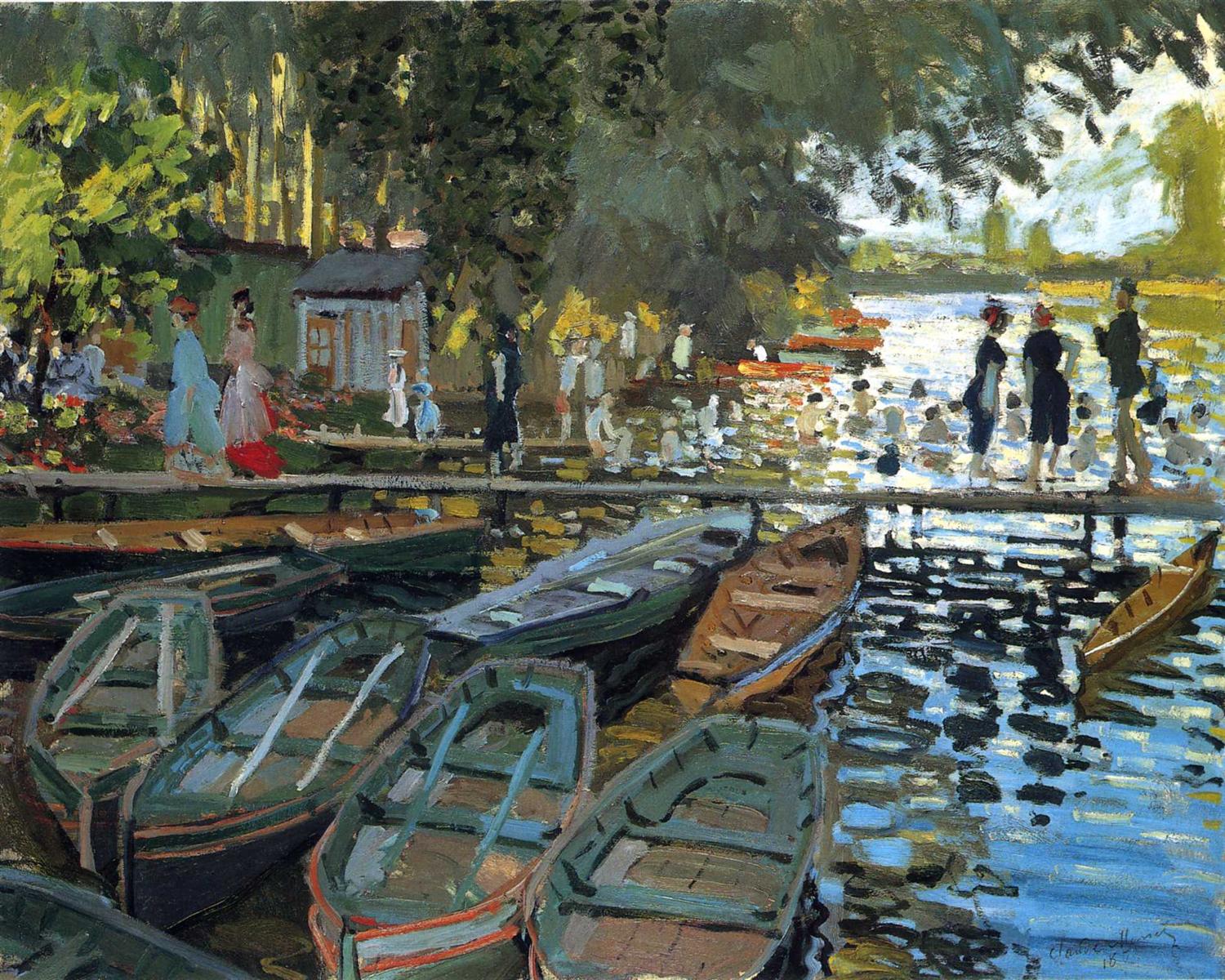
Claude Monet’s Bathers at La Grenouillere from 1869 is a painting that captures a scene of leisure, sunlight, water, and modern life with remarkable freshness. At first glance, it seems almost casual, as though the artist simply paused by the river and recorded what he saw in a rush of excitement. Yet the painting is far more carefully felt than it first appears. It turns an ordinary summer gathering into a shimmering study of light, movement, and atmosphere. Boats rest in the foreground, bathers gather in the sparkling water, elegantly dressed figures cross the narrow walkway, and tall trees cast a veil of shadow over the whole scene. The result is a composition that feels immediate and alive, full of shifting sensations rather than fixed details.
This painting is often admired because it stands so close to the beginnings of Impressionism. Monet does not treat the scene as a polished narrative image, nor does he present every figure with academic precision. Instead, he focuses on the experience of looking. Water glitters, bodies dissolve into patches of tone, and the landscape becomes a field of changing color. The eye is invited to wander across reflections, silhouettes, and bright interruptions of sunlight. Monet makes the riverbank feel crowded yet airy, social yet unstable, rooted in the visible world yet constantly slipping into paint itself.
What makes Bathers at La Grenouillere especially compelling is the way it balances observation with invention. It is recognizably a place filled with people enjoying a warm day, but it is also a meditation on how vision works. Monet shows that seeing is never simple. Surfaces flicker, shadows deepen unexpectedly, forms merge and separate, and light breaks apart solid objects. This painting does not merely represent a riverside resort. It reveals how a modern artist could transform a fleeting moment into a new kind of visual language.
The Setting and the Modern Leisure Scene
La Grenouillere was a popular riverside resort near Paris, a place where city dwellers could escape, socialize, boat, stroll, and bathe. That setting matters deeply to the meaning of the painting. Monet is not painting a mythological bathing scene or an idealized pastoral retreat. He is painting contemporary leisure. The people in the image belong to the modern world. Their clothing, their relaxed public gathering, and the very casual nature of the scene reflect a new social rhythm in which pleasure and recreation become important subjects for art.
This change in subject matter was significant. Traditional academic painting often elevated history, religion, and mythology above ordinary life. Monet moves in another direction. He treats a riverside outing as worthy of serious artistic attention. In doing so, he helps redefine what painting can be about. The modern world, with all its passing pleasures and everyday spectacles, becomes a legitimate source of beauty.
The scene also reflects the energy of suburban expansion and mobility in the nineteenth century. Places like La Grenouillere were accessible to a growing public and became symbols of new patterns of urban recreation. Monet is therefore painting more than people by the water. He is painting the culture of leisure itself. The bathers, strollers, and boaters embody a society increasingly interested in recreation, display, and shared public experience.
Yet Monet does not present this culture in a moralizing way. He does not idealize it, and he does not condemn it. Instead, he observes it. His attention falls on how people occupy space, how they appear against the shining river, and how the scene feels under a summer sky. That observational neutrality gives the painting much of its modern character. It invites viewers to experience the place rather than judge it.
Composition and Spatial Structure
One of the most striking aspects of Bathers at La Grenouillere is its composition. Monet organizes the painting through layers that move the viewer from the boats in the foreground to the walkway in the middle ground and then to the bright, open water beyond. This layered structure creates depth, but not in a rigid academic manner. The space feels compressed and dynamic, as though everything is happening at once within a vibrating field of light.
The boats in the foreground play an especially important role. Their angled shapes pull the eye inward while also anchoring the lower half of the painting. They are large, close, and strongly present, yet they are not rendered with meticulous finish. Their forms are suggested through brisk strokes and broken color. This gives them both physical weight and painterly looseness. They occupy real space, but they also remind us that the image is made of paint.
Across the center of the composition runs the narrow walkway, which acts almost like a stage. It divides the darker foreground water from the brighter river behind it and carries a line of figures across the canvas. This horizontal element stabilizes the scene while also emphasizing movement. People walk, pause, and gather along it, and the eye follows their silhouettes from left to right.
Beyond the walkway, the painting opens into a luminous expanse of water where bathers and reflections merge into a sparkling field. Here Monet loosens form even further. The background is not empty, but it is less solid than the foreground. The effect is one of visual release. After the crowded closeness of the boats, the eye enters a brighter, more fluid zone.
The overhanging trees frame the top of the composition and introduce a canopy of shadow. This dark upper register prevents the painting from becoming too open or scattered. It encloses the scene and heightens the brilliance of the water below. Monet thus builds the composition through contrasts of density and openness, shadow and glare, stillness and movement.
Light as the True Subject
Although the painting contains figures, boats, trees, and water, its true subject is light. Monet is less interested in describing objects than in recording how light transforms them. The river surface becomes the main arena for this transformation. White highlights, pale blue reflections, and warm flashes of yellow create a constantly shifting visual rhythm. The water is never simply blue or silver. It is a mosaic of changing tones, each responding to the angle of sunlight and the movement of the surface.
The figures in the water are partly defined by contrast. Dark heads and pale bodies appear against the brilliant reflections, making them seem to emerge and disappear at the same time. This is one of Monet’s most important achievements in the painting. He shows that visibility is unstable. Light can reveal, but it can also dissolve. The bathers are present, yet they are also fleeting sensations within a luminous environment.
Light also shapes the boats and the walkway. It glances off edges, catches wooden surfaces, and breaks forms into scattered accents. Even the shaded areas are alive with variation. Monet understands that shadow is not absence but complexity. The darker sections of the painting contain greens, blues, browns, and muted violets that enrich the overall harmony.
This approach marks a decisive break from older painting methods that often treated light as a tool for modeling solid form. For Monet, light is not just something that falls on objects. It is an active force that changes everything it touches. The world becomes unstable under its influence, and painting must adapt to that instability. In Bathers at La Grenouillere, light turns a social gathering into a shimmering event of perception.
Color and Tonal Harmony
The palette of this painting is subtle but rich. Monet avoids heavy, rigid color blocks and instead builds the image through relationships among greens, blues, browns, whites, and touches of warm red and yellow. These colors are not isolated from one another. They interact continuously, often blending at the edges or echoing one another across different parts of the canvas.
The green tones are especially important. They appear in the trees, the shadowed water, the boats, and the riverbank structures. This creates a visual cohesion that binds the scene together. But Monet does not use green in a flat or repetitive way. Some greens are cool and gray, others are warm and golden, and still others verge on blue. The result is a living, varied surface.
Blue functions as a counterbalance to the greens and browns. It appears most strongly in the reflective water and in parts of the boats, where it gives freshness and clarity to the composition. These blues are often pale and broken, mingling with white highlights to suggest sunlight dancing on the river. They help create the cool, liquid atmosphere that defines much of the painting’s mood.
Warm accents are used sparingly but effectively. Small touches of red, orange, and ochre appear in clothing, floral areas, and wooden elements. These notes prevent the painting from becoming overly cool or monochromatic. They also guide the eye, creating moments of visual emphasis within the broader harmony.
Monet’s tonal structure is equally important. The painting depends on strong contrasts between dark shadow and bright reflection. The upper and lower portions contain deep, weighty passages, while the center and right side blaze with light. This contrast gives the scene both drama and coherence. Without it, the broken brushwork might feel scattered. With it, the entire image holds together.
Brushwork and the Language of Impressionism
The brushwork in Bathers at La Grenouillere reveals Monet at a crucial moment in the development of his style. His strokes are visible, varied, and responsive to the motif before him. He does not smooth the surface into a seamless illusion. Instead, he lets the marks remain legible, allowing viewers to sense the speed and freedom of his hand.
This brushwork is essential to the painting’s vitality. Short, loaded strokes describe leaves, reflections, clothing, and water without fully outlining them. Forms are built through touches of color rather than through precise drawing. In many places, Monet suggests more than he defines. A figure may be reduced to a few dark strokes and a pale highlight, yet still feel convincing within the scene.
The boats show how effective this method can be. Their edges are not rigidly drawn, but the accumulation of strokes gives them structure and volume. Likewise, the bathers are not anatomically detailed, yet their presence is unmistakable. Monet trusts the viewer’s eye to complete what the brush only indicates.
This painterly openness is one of the qualities that would become central to Impressionism. Rather than hiding the process of painting, Monet makes it part of the picture’s meaning. The visible stroke conveys immediacy. It suggests that the scene was observed directly, under real conditions, in real time. Even when the image is carefully composed, it still feels spontaneous.
At the same time, the brushwork is not random. Monet adjusts it according to the demands of each area. Dense foliage receives clustered, textured marks, while the water is treated with more fluid, broken passages. The figures are simplified but strategically placed. This control within freedom is what makes the painting so persuasive. It feels fresh because Monet knows exactly how much to say and how much to leave unresolved.
Figures, Social Presence, and Human Scale
The human figures in this painting are small, but they are central to its atmosphere. They give the scene its social life and establish its scale. Without them, the painting would still be beautiful, but it would not communicate the same sense of modern public leisure. The dressed women on the left, the standing figures along the walkway, and the bathers in the water all contribute to a lively and varied human presence.
Monet does not individualize these people as portraits. They are types, silhouettes, fleeting presences. Yet they are not generic in a dull sense. Each figure is placed with purpose. The women near the left bank introduce elegance and color. The darker standing figures on the right create vertical accents against the glittering water. The bathers form a scattered pattern of heads and shoulders that enlivens the bright center of the composition.
This treatment of figures reflects Monet’s priorities. He is less concerned with personality than with appearance in light. People are part of the visual fabric of the scene. They interact with water, shadow, and space rather than existing apart from them. In this sense, the painting is democratic. No single person dominates. Everyone participates in the shared atmosphere of the place.
The figures also bring a subtle tension between stillness and activity. Some appear to stroll or pause, while others immerse themselves in the water. This variety prevents the composition from becoming static. The scene feels inhabited and unfolding, as though it might continue to change from one moment to the next.
Because the figures are not fully fixed, the viewer experiences them almost as passing glimpses. That quality matches the overall logic of the painting. Just as reflections flicker and dissolve, so too do the people who populate the riverside. They are visible for a moment, then absorbed into the broader shimmer of modern life.
Water, Reflection, and Visual Instability
Water is the element that allows Monet to explore some of his most radical ideas in this painting. A river surface is never stable. It reflects, distorts, brightens, darkens, and fragments whatever appears around it. For an artist interested in fleeting visual effects, water becomes an ideal subject. In Bathers at La Grenouillere, it is both a setting and a kind of visual engine that drives the entire composition.
The reflections beneath the boats are especially remarkable. Dark hulls, pale edges, and patches of sky are broken into wavering shapes that seem to tremble across the surface. These reflections are not mirror images. Monet paints them as shifting impressions, dependent on movement and angle. This gives the lower half of the painting a restless, fluid energy.
In the brighter water beyond the walkway, reflection becomes even more abstract. Sunlight breaks the surface into flashes of white and pale color, while bodies and shadows interrupt the glittering field. The viewer senses the difficulty of seeing clearly in such conditions. Water does not simply reveal the world. It complicates it.
This visual instability is one of the painting’s deepest themes. Monet suggests that reality is not made of fixed outlines and stable forms. It is a flow of sensations shaped by time, weather, and light. Reflection becomes a metaphor for perception itself. We never see the world in a perfectly settled way. We see it through shifting conditions, partial views, and momentary impressions.
That is why the painting feels so modern. It accepts uncertainty as part of vision. Rather than correcting or suppressing it, Monet makes it beautiful. The unstable surface of the river becomes a new model for painting, one in which truth lies not in hard definition but in responsive observation.
Nature and Modernity in Balance
A fascinating tension runs through Bathers at La Grenouillere. On one hand, it is full of nature: trees, water, sunlight, and open air. On the other hand, it is unmistakably modern and social. Boats are moored in rows, people gather in a leisure resort, and the landscape is shaped by human use. Monet does not present nature as untouched wilderness. He presents it as a living environment inhabited and enjoyed by modern society.
This balance is important because it reflects a central concern of nineteenth century art. How should painting respond to a world that is becoming more urban, mobile, and socially fluid, yet still deeply attached to the pleasures of nature? Monet’s answer is neither nostalgic nor mechanical. He shows that modern life can be encountered through nature and that nature itself can be seen through the lens of modern experience.
The trees in the painting are not symbolic in a grand literary sense. They provide shade, atmosphere, and compositional framing. Yet they also serve as a reminder that leisure depends on environment. The river resort is appealing because of its natural setting. Light filtering through leaves, reflections on water, and cool shadows along the bank create the very mood that draws people there.
At the same time, the orderly boats and dressed visitors show that this is no remote landscape. It is curated, frequented, and shared. Monet’s genius lies in refusing to force a conflict between these elements. Instead, he paints their coexistence. Modernity does not destroy the beauty of the scene. It becomes part of that beauty.
Emotional Tone and Lasting Appeal
The emotional tone of Bathers at La Grenouillere is one of freshness, pleasure, and transience. It is not sentimental, yet it carries a quiet joy. The painting invites viewers into a moment of communal ease, where light, water, and human presence come together in harmony. There is no dramatic event, no central story, and no moral lesson. Its appeal lies in its ability to make ordinary experience feel luminous.
Part of this emotional power comes from the painting’s incompleteness in the best sense. Because Monet does not overdefine everything, the scene remains open and breathing. The viewer feels the warmth of the day, the motion of the water, and the hum of activity without being trapped in rigid detail. The painting leaves room for imagination and sensory memory.
It also carries a sense of passing time. The light will change, the bathers will leave the water, the boats may drift or be taken out again, and the afternoon will end. Monet captures a moment that is already on the verge of disappearing. That awareness of ephemerality gives the work its tenderness. It celebrates pleasure while quietly acknowledging its brevity.
This is one reason the painting continues to resonate. It reminds us that beauty often resides in unstable moments rather than permanent monuments. A riverside outing, a flicker of reflected light, a row of boats under shadowed trees can become unforgettable when seen with enough sensitivity. Monet teaches viewers how to value the transient.
Conclusion
Bathers at La Grenouillere stands as a powerful example of Claude Monet’s early brilliance and his growing commitment to a new way of painting. Through a riverside leisure scene, he explores light, reflection, color, and social modernity with extraordinary freshness. The composition is layered yet fluid, the brushwork free yet controlled, and the atmosphere vivid without losing its delicacy.
What makes the painting so important is not just its charm, though it has plenty of that. Its real significance lies in the way it transforms everyday life into a field of visual discovery. Monet shows that a contemporary scene can possess as much poetic richness as any historical or mythological subject. He also shows that painting can move beyond fixed outlines and polished finish toward something more immediate, more perceptual, and more alive.
The boats, bathers, walkway, and trees are all essential parts of the image, but none of them dominates the whole. Everything exists within a larger experience of light and air. That unity gives the painting its enduring strength. It feels less like a constructed statement and more like a living encounter with the world.
In Bathers at La Grenouillere, Monet does not simply depict a place. He captures a way of seeing. He reveals how sunlight dissolves solidity, how water unsettles vision, and how modern life can be rendered through fleeting impressions rather than fixed certainties. The painting remains compelling because it makes perception itself into a source of wonder. It is a celebration of presence, movement, and the fragile brilliance of a passing afternoon by the water.
