Image source: wikiart.org
The Sea as Subject and Experience
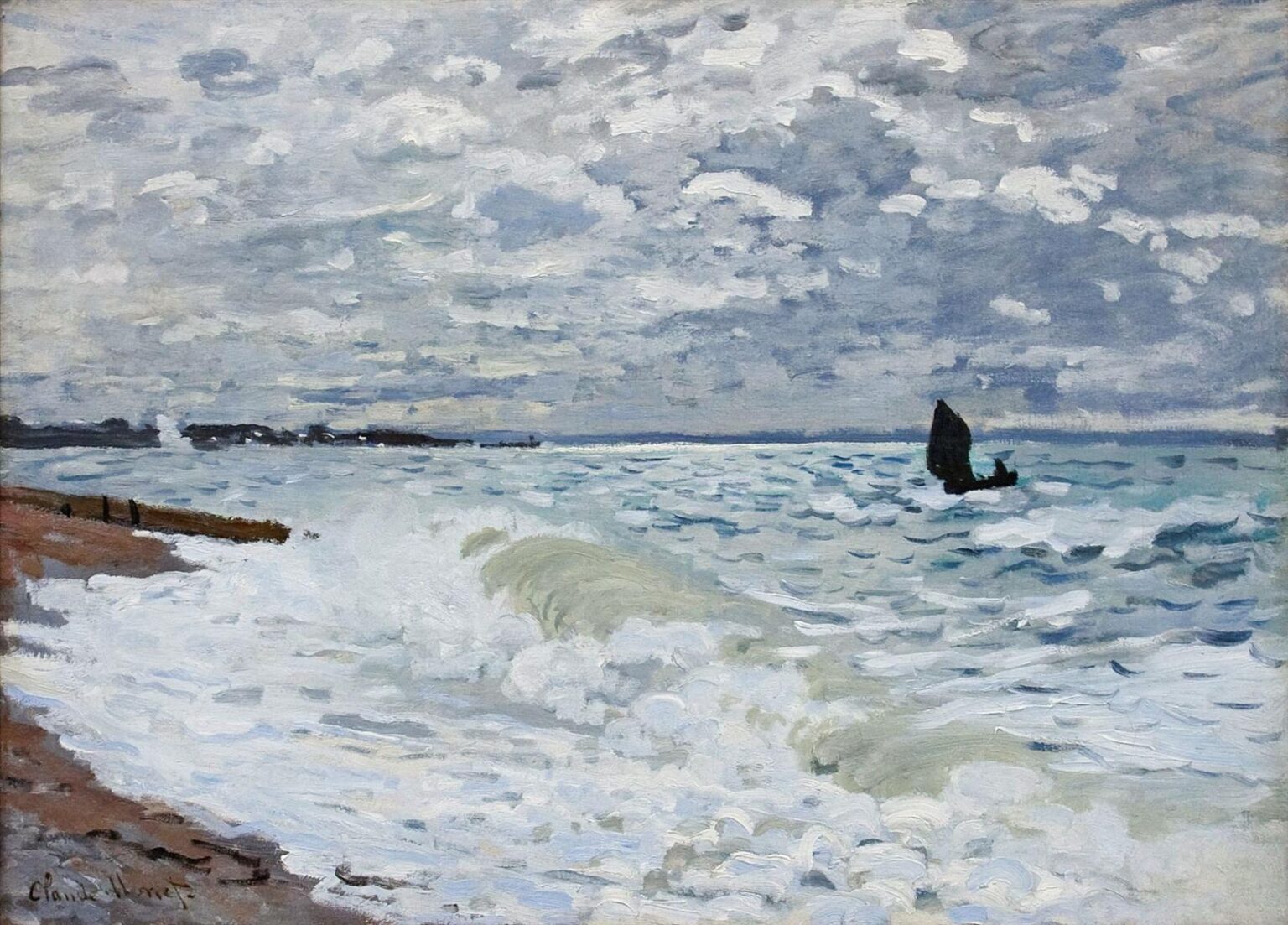
Claude Monet’s The Sea at Saint-Adresse from 1868 is a painting that turns a simple coastal view into something vivid, unstable, and deeply atmospheric. At first glance, the scene seems modest. There is no crowded harbor, no dramatic narrative, no group of elegant figures arranged for social display. Instead, Monet gives us surf, sky, shoreline, and a dark sail moving across a bright, restless sea. Yet this apparent simplicity is exactly what gives the painting its force. It is not trying to impress through subject matter alone. It is trying to make the viewer feel the shifting life of weather, water, and light.
The picture captures a moment along the Normandy coast, a region that mattered enormously to Monet’s development. Saint-Adresse, near Le Havre, offered him access to changing skies, sea winds, bright reflections, and the kind of unstable natural conditions that would become central to his art. In this painting, the sea is not treated as a flat backdrop or a decorative horizon. It is the main event. The waves rush toward the viewer, the foam gathers in thick bursts, and the sky occupies a huge part of the composition, pressing down over the water with an immense, broken cloud cover.
What makes the work especially compelling is the way Monet balances openness with immediacy. The horizon stretches outward and suggests endless space, but the foreground surf crashes so close to us that the scene feels almost physical. We are not simply observing the shore from a comfortable distance. We are placed near the edge of the water, as if the next wave could surge up and wet our shoes. That combination of vastness and nearness is one of the painting’s great strengths. It allows the sea to feel both expansive and intimate.
The picture also reveals Monet’s remarkable ability to transform fleeting observation into structure. The painting may seem spontaneous, but it is carefully organized. Every element, from the diagonal line of the beach to the dark punctuation of the boat, helps stabilize a scene that is otherwise full of motion. The result is a work that feels immediate without feeling chaotic. It is alive with sensation, but it is also held together by strong visual intelligence.
Composition and the Pull of the Shoreline
One of the first things that stands out in The Sea at Saint-Adresse is the way the composition draws the eye through the scene. The shoreline enters from the lower left and leads inward, giving the painting a directional movement that feels natural rather than forced. This diagonal edge is crucial. It prevents the wide horizontal view from becoming static and helps connect the foreground surf to the distant horizon.
The foreground is dominated by white, foaming water. This is where Monet places the strongest sensation of motion. The wave breaks across the lower center of the canvas with a loose but convincing energy. Its pale green interior and frothy white crest make it feel thick, cold, and fast moving. Because the wave occupies so much space at the front of the picture, it creates a sense of immediacy. The viewer is not held back from the scene. Instead, we are placed right beside the impact of the surf.
Farther back, the sea opens into a broad field of light blues, silvery whites, and scattered brushstrokes that suggest choppy surface movement. The water is not smooth. It flickers and breaks into fragments, each mark catching a different relation to the light. Then, near the right side of the composition, Monet introduces the dark silhouette of a small sailboat. This element is visually essential. Against the luminous sea and sky, the nearly black sail acts as a sharp accent, anchoring the right half of the picture and balancing the heavier visual activity of the surf on the left and center.
The horizon line is relatively low, which gives enormous importance to the sky. This choice is not accidental. By allowing the sky to occupy much of the upper canvas, Monet emphasizes atmosphere as much as geography. The sea is inseparable from the weather above it. The painting is not simply about water meeting land. It is about a coastal world formed by wind, light, and cloud movement.
The distant land on the left side is rendered as a low, dark strip with hints of structures and perhaps smoke or industrial presence. These details are understated, but they matter. They prevent the scene from becoming completely timeless or abstract. This is a real place, lived in and worked in, yet human activity remains secondary to the larger rhythms of nature. Monet keeps the focus where he wants it, on the changing life of the coast itself.
The Drama of the Sky
The sky in this painting is one of its most extraordinary features. It is not a calm blue backdrop, nor is it a purely stormy spectacle. Instead, it is full of broken clouds that shift across the canvas in uneven patches, creating a sense of unstable weather. The clouds are painted with broad, active strokes in soft grays, whites, and cool blues, giving the sky both weight and movement.
Monet understood that the sky over the sea is never merely overhead. It shapes the entire appearance of the landscape. In The Sea at Saint-Adresse, the cloud cover affects the brightness of the water, the mood of the scene, and the emotional temperature of the painting. The sky is luminous, but not cheerful in any simple sense. It feels breezy, unsettled, and full of passing changes. There is light everywhere, yet it is filtered through cloud and mist rather than delivered in strong, direct sunshine.
This complexity is one reason the painting feels so alive. The clouds are not arranged in a rigid pattern. They seem to gather, disperse, and reform. Some passages are thicker and more opaque, while others are thinner and allow more light to come through. Monet uses these variations to create an impression of atmosphere in flux. The viewer senses that the weather could shift within minutes.
The sky also contributes to the emotional tone of the work. It gives the scene a seriousness that lifts it beyond a pleasant seaside view. There is no melodrama here, but there is gravity. The broken cloud cover makes the world feel large and somewhat indifferent. The sea below glitters and surges, but above it hangs an expansive, moving ceiling of air that reminds us of nature’s scale. The human presence in the painting, represented only by the tiny boat and distant shoreline signs of life, appears small beneath this immense sky.
At the same time, the sky is beautiful in a distinctly Monet-like way. Its beauty comes not from polish or theatrical grandeur, but from perception. The painter notices how gray can turn blue, how white can flash brightly against denser cloud masses, and how the whole upper field can vibrate through subtle shifts of tone. The sky is not inert paint. It breathes.
Water, Motion, and the Energy of the Sea
If the sky gives the painting its emotional breadth, the water gives it physical energy. Monet’s handling of the sea is one of the clearest demonstrations of his ability to paint motion without freezing it into rigid detail. The surf in the foreground is loose and painterly, yet entirely convincing. It does not rely on carefully outlined waves or painstakingly described foam. Instead, Monet builds the sensation of moving water through the placement of strokes, tonal contrasts, and color temperature.
The breaking wave at center left is especially important. Its curved body contains a pale greenish note, subtle but effective, that suggests depth within the water before it turns to foam. Around it, thick white passages describe the explosion of surf as it hits the shore. These whites are not all the same. Some are warmer, some cooler, some denser, and some more transparent. That variation is what gives the foam its lived reality. It does not look like a decorative border. It looks like water in transformation.
Across the middle distance, the sea surface is treated with smaller, repeated strokes that imply chop and reflection. Monet avoids monotony by changing the direction and spacing of these marks. Some strokes lie flatter, some tilt, and some seem to catch more light than others. The result is a water surface that flickers continuously. The sea does not sit still for the painter, and the painter does not pretend otherwise.
This sense of instability is central to the painting’s success. Monet is not interested in presenting the sea as a fixed object. He is interested in its changing appearance from moment to moment. That interest would later become one of the defining features of his mature art, but it is already very powerful here. The water is not just represented. It is observed under specific conditions, in a particular light, with a particular wind, at a particular instant.
The dark boat to the right gains much of its impact because of this restless sea around it. The vessel looks small and slightly vulnerable against the shifting water. Its silhouette is sharp, but the world surrounding it is fluid. This contrast heightens the sense of motion and makes the boat feel like a temporary participant in a much larger natural system.
Color, Light, and the Cool Coastal Palette
The color scheme of The Sea at Saint-Adresse is restrained, but it is far from dull. Monet works with a range of cool tones, silvery blues, soft grays, muted whites, and touches of green, using them to build a coastal atmosphere that feels fresh, damp, and wind touched. The painting’s palette is one of the main reasons it feels so convincing as a seascape. Rather than relying on bright theatrical color, Monet pays attention to the subtler chromatic relationships that define sea and sky under shifting cloud cover.
The dominant blue-gray tones create a mood of cool luminosity. This is not the intense Mediterranean blue of southern light. It is the more delicate, variable color world of the northern French coast. The sea and sky are closely related in hue, which helps unify the image, but Monet also makes sure they remain distinct. The sky is softer and more vaporous, while the water has a brighter, more reflective sharpness. This distinction keeps the painting from dissolving into a single tonal field.
White plays a special role throughout the canvas. In the clouds, it provides bursts of brightness. In the sea, it becomes reflection and foam. In the surf, it becomes substance and force. Because Monet modulates these whites so carefully, the painting feels full of light even though it is not sunny in a conventional way. Light exists here as a shifting condition rather than a beam. It spreads, flashes, glints, and diffuses.
The touches of pale green in the breaking water are especially effective because they are so restrained. They suggest translucency in the wave and add subtle temperature variation to the otherwise cool palette. Meanwhile, the shoreline browns at the lower left provide just enough earthy contrast to keep the scene grounded. Without that bit of warmer color, the painting might feel too ethereal. Monet understands the importance of contrast not only in value, but also in temperature.
The dark sailboat is the strongest single contrast in the picture. Its near-black shape against the luminous water and sky gives the eye a focal point and intensifies the surrounding brightness. Because the overall palette is so cool and atmospheric, this dark accent becomes especially dramatic. It is a simple device, but a very powerful one.
Brushwork and the Material Life of Paint
Monet’s brushwork in this painting is confident, varied, and highly responsive to the subject. One of the pleasures of looking at The Sea at Saint-Adresse is seeing how paint itself becomes a vehicle for sensation. The picture is not smoothed over into illusion. It remains visibly made, and that visible making is part of its beauty.
In the sky, the brushwork is broad and layered. Monet lets strokes overlap and shift direction, which creates the impression of clouds forming and dissolving. The paint seems to move with the atmosphere it describes. In the sea, the marks become shorter and more rhythmic, suggesting the repeated but never identical motion of waves. In the foreground surf, the handling grows thicker and more energetic, as if the paint itself were crashing forward.
This variety matters because it allows different parts of the scene to have different tactile identities. The sky feels airy, the sea feels flickering, and the foam feels dense and forceful. Monet does not need meticulous finish to create these distinctions. He achieves them through the character of the brushstroke.
The painting also shows how Monet was moving away from academic conventions of finish and toward a more direct language of observation. Instead of concealing his process, he lets it remain visible. The viewer can sense the quick decisions, the adjustments, the effort to capture light and movement before they changed. That gives the painting freshness. It feels discovered rather than manufactured.
At the same time, the work is not careless. The looseness is controlled. Monet knows where to simplify and where to insist. He knows when a broad patch of tone will do more than a fully described form. This balance between freedom and control is one of the marks of his greatness. He paints quickly enough to preserve immediacy, but intelligently enough to preserve coherence.
Monet in 1868 and the Meaning of Place
By 1868, Monet was still a relatively young artist, but he had already developed many of the instincts that would shape modern painting. The Normandy coast was crucial to him not only because it was visually rich, but because it offered exactly the kind of subject matter that encouraged direct engagement with changing natural conditions. In The Sea at Saint-Adresse, we can see him refining his ability to paint not merely a location, but an experience of place.
Saint-Adresse was near Le Havre, where Monet spent part of his youth. That familiarity may help explain the painting’s combination of intimacy and openness. He is not treating the coast as an exotic spectacle. He knows this environment. He knows its weather, its light, its sea moods. The painting feels grounded in repeated looking.
This connection to place also gives the work an important tension between permanence and change. The coastline itself exists as a stable location, but everything visible within the scene is in motion. Clouds move, waves break, light shifts, and the boat glides across the water. Monet seems drawn to precisely this paradox. Nature is always there, but never appears the same way twice. That insight became one of the central truths of Impressionism, and it is already alive in this painting.
The work also stands as an example of Monet’s ability to elevate ordinary motifs. He does not need a grand historical subject to make a memorable image. Sea, shore, and sky are enough, provided they are seen with sufficient intensity. This was a radical artistic conviction in the nineteenth century. It placed perception itself at the center of painting.
Mood, Meaning, and Lasting Power
The emotional power of The Sea at Saint-Adresse lies in its refusal to become sentimental or theatrical. It is not a romantic seascape in the older sense, where nature is exaggerated into a dramatic symbol of human feeling. Yet it is deeply expressive. Its mood comes from the truthful relation between atmosphere, motion, and scale.
The painting suggests freedom, but not comfort. It suggests beauty, but not calm. The sea is radiant, yet forceful. The sky is luminous, yet heavy with movement. The boat is present, yet small. These relationships create a mood that feels contemplative and slightly bracing. The viewer is invited not to escape into fantasy, but to stand within the energy of the natural world.
Part of the painting’s lasting appeal comes from this honesty. Monet does not idealize the coast into a postcard image. He gives us a lived coast, windy and bright and unstable. Because of that, the work still feels fresh. It speaks to anyone who has stood by the sea and felt how quickly weather can transform a landscape.
The painting also remains powerful because it captures a key truth about Monet’s art. He was not only a painter of light in the narrow sense. He was a painter of conditions. He wanted to show how the world appears under specific pressures of air, moisture, reflection, and time. In The Sea at Saint-Adresse, that ambition is beautifully clear. The painting is not simply about what the coast looks like. It is about how the coast happens.
That is why the work continues to hold attention. It offers both immediate pleasure and deeper insight. It is beautiful from across the room, with its cool palette and strong composition, but it becomes even richer the longer one looks. The broken clouds, the varied whites, the pulse of the surf, and the small dark boat all contribute to a scene that feels intensely present. Monet turns a moment at the shore into a lasting image of movement, atmosphere, and perception.
